Hamama’s 2016 seed deck is an exercise in extreme brevity, containing only 11 slides and fewer than 200 words of total text. The company, founded by MIT indoor agriculture researchers, successfully pitched a 'razor-and-blade' model for home-grown microgreens. By showcasing a $35 starter kit and a $17/month recurring revenue stream with 50% margins, the deck emphasizes unit economics over complex market theory. While it lacks traditional sections like a detailed competitor analysis or a specific use-of-funds slide, the traction data—showing 25% month-over-month growth and a dense map of US cus…
Key takeaways
- The founders leverage elite technical pedigree, citing their backgrounds as indoor agriculture researchers at MIT on slide 3.
- The business utilizes a classic 'razor-and-blade' subscription model, selling a $35 starter kit to enable a $17/month recurring seed quilt purchase (slide 7).
- Hamama claims strong unit economics for a physical goods business, stating a 50% margin on their subscription products (slide 7).
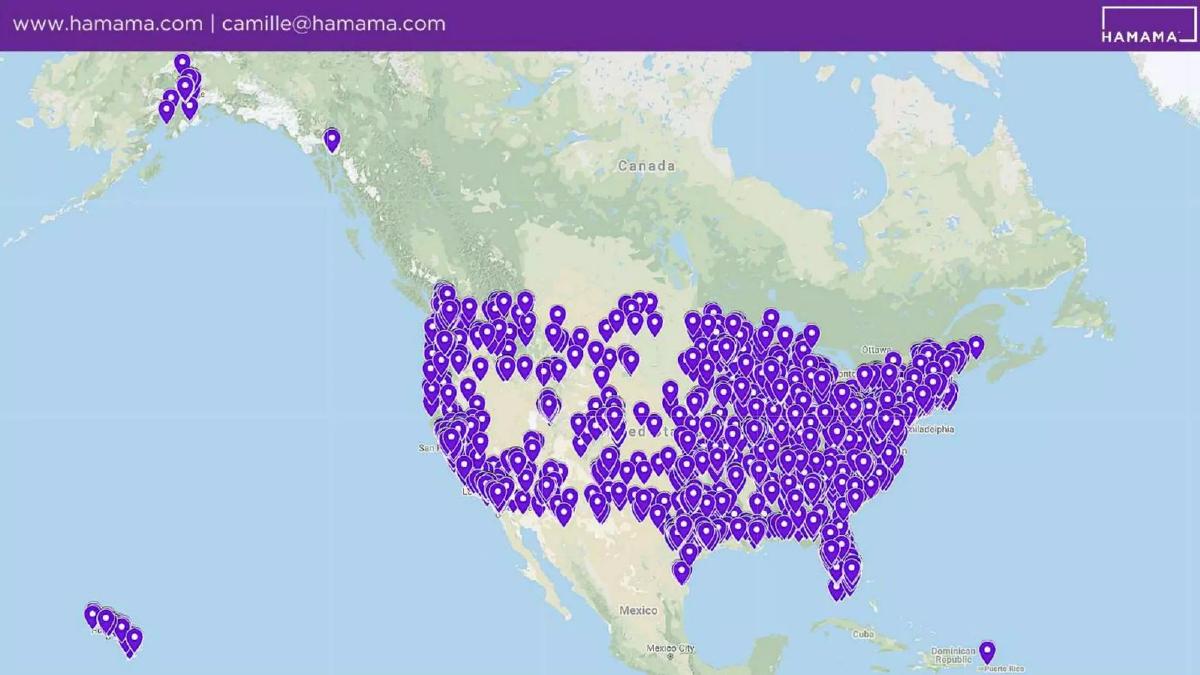
- Traction is demonstrated through geographic density, with a map showing hundreds of customer locations across the United States, including Alaska and Hawaii (slide 6).
- The deck highlights rapid growth metrics, specifically citing 25% month-over-month growth and $180,000 in year-to-date revenue (slide 8).
- Market size is framed through consumer behavior, noting that 1 in 3 US households grows food and $3.6 billion is spent on food gardening annually (slide 10).
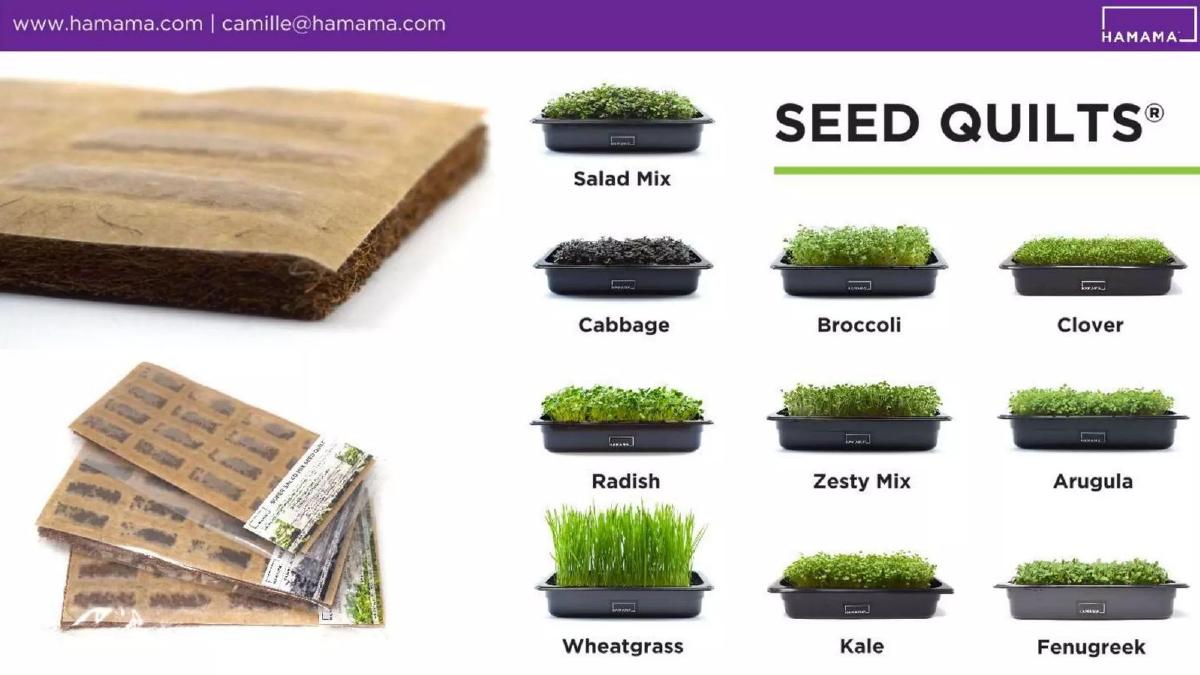
- The product variety is extensive, with slide 4 showcasing ten different 'Seed Quilt' varieties including Kale, Clover, and Fenugreek.
- The deck is almost entirely devoid of traditional 'problem' and 'solution' text, relying instead on high-quality photography to imply the value proposition (slides 1, 2, and 5).
The Power of Visual Storytelling in Hardware
The Hamama pitch deck is a striking example of 'less is more.' In an era where founders often clutter slides with dense paragraphs and complex market diagrams, Hamama opted for a visual-first approach. With only 11 slides, the deck relies on the physical beauty of the product and the undeniable logic of a high-margin subscription model. According to catalogue facts, this deck helped secure $5,200,000 in Seed funding in 2016, proving that investors can be moved by a clear product vision and strong founder pedigree even without a 30-page presentation.
Slides 1-2: The Visual Hook
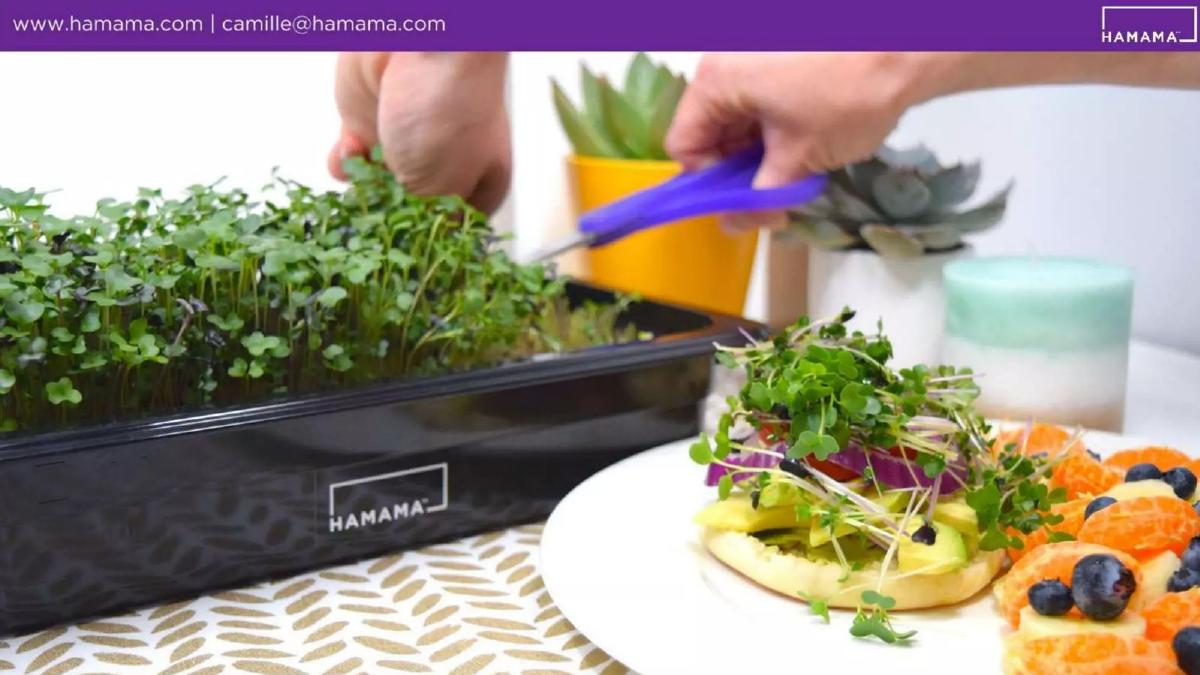
Slide 1 is a minimalist title slide. It features the Hamama logo, the tagline "Grow nutritious greens year round," and a high-resolution image of a hand holding a fresh bunch of microgreens. This immediately establishes the category: health, wellness, and indoor gardening. Slide 2 follows up with a lifestyle shot showing the product in use. It depicts a user harvesting greens from a black Hamama tray directly onto a meal. There is no text on this slide, letting the ease of use and the 'farm-to-table' appeal speak for itself.
Slide 3: The Pedigree Slide
Hamama handles the 'Team' slide early and with significant authority. Slide 3 introduces founders Camille Richman and Daniel Goodman. The headline is the primary value driver: "Previously indoor agriculture researchers at MIT." Below their photos, the deck displays four high-trust logos: MIT, Apple, TEDx, and 500 Global. This slide is critical because it justifies the simplicity of the rest of the deck. When founders have this level of technical background in their specific niche, they don't need to spend ten slides explaining why they are qualified to build the product.
Slides 4-5: Product and Variety
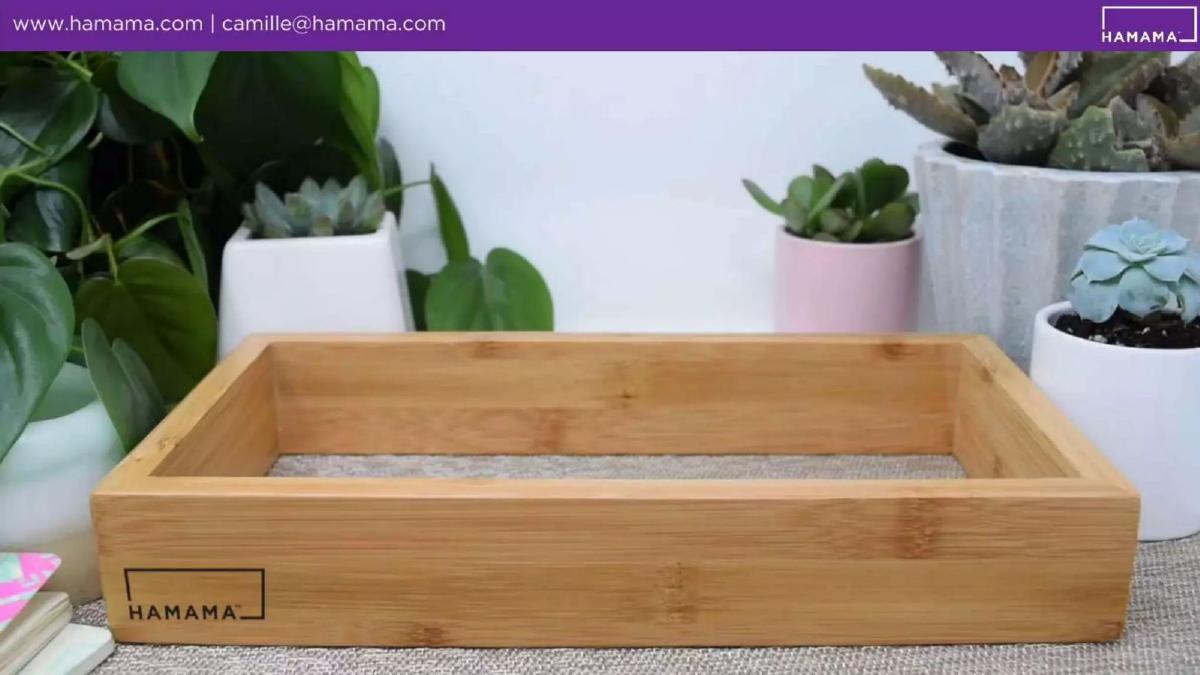
Slide 4 introduces the core innovation: the "Seed Quilts." It shows the product in its raw form—a brown, fibrous mat—and then displays ten different varieties of greens that can be grown, including Salad Mix, Cabbage, Broccoli, Clover, Radish, Zesty Mix, Arugula, Wheatgrass, Kale, and Fenugreek. This demonstrates that the platform is versatile and has a broad culinary appeal. Slide 5 is another purely visual slide, showing a high-end bamboo frame for the growing tray. This positions the product as a piece of home decor rather than just a plastic gardening tool, appealing to the aesthetic sensibilities of urban dwellers.
Slides 6-8: The Business Case and Traction
Slide 6 is a geographic traction map. The United States is saturated with purple pins, including clusters in Alaska, Hawaii, and Puerto Rico. This is a powerful way to show that the product has moved past the 'friends and family' stage and has found a national market. Slide 7 breaks down the unit economics under the heading "Subscription Model." It lists a $35 Starter Kit and $17/month for recurring Seed Quilts. Most importantly, it highlights "50% Margins" in a bold purple box. This is the 'aha' moment for investors: a physical product with software-like recurring revenue and healthy margins. Slide 8 provides the hard numbers: $240,000 in revenue for 2018, $180,000 year-to-date (YTD), and a 25% month-over-month (MoM) growth rate. These figures provide the quantitative proof that the visual promise of the earlier slides is translating into commercial success.
Slides 9-11: Market Context and Conclusion
Slide 9 is a simple transition slide with the text "DIET HEALTH," connecting the product to the broader wellness trend. Slide 10 provides the market sizing. Instead of a traditional TAM/SAM/SOM chart, it uses two large green circles: "1 in 3 US households grows food" and "$3.6B spent on food gardening annually." This frames the opportunity as a proven consumer behavior that Hamama is simply making more convenient. Finally, Slide 11 is a contact slide overlaid on a collage of food photos featuring Hamama greens, reinforcing the end-benefit of the product.
What Works in This Deck
The most successful element of this deck is its clarity of business model . By slide 7, any investor understands exactly how Hamama makes money and what the margins look like. The 'razor-and-blade' model is a favorite among VCs for hardware companies because it mitigates the risk of one-off purchases. Additionally, the founder-market fit is established instantly. The MIT indoor agriculture background is the ultimate 'unfair advantage' in this sector. Finally, the visual quality is exceptional. For a consumer product, the branding must look 'retail-ready,' and Hamama achieves this through professional photography and a clean, consistent color palette.
What Is Missing
Despite its success, the deck leaves several questions unanswered. There is no competitive analysis . While the Seed Quilt is unique, there are many other indoor gardening systems (like Click and Grow or AeroGarden) that investors would likely ask about. There is also no technical deep dive . We see the 'Seed Quilt,' but we don't know what it's made of, how it's manufactured, or if it's patented. Most notably, the deck lacks a specific 'Ask' slide . It does not state how much capital is being raised or how that capital will be deployed (e.g., marketing, R&D, or inventory). While this information was likely handled in the verbal pitch or a separate data room, its absence in the deck is a deviation from standard practice.
What a Founder Should Copy
Founders should emulate Hamama's use of 'Proof of Life' maps . If you have customers across a wide geography, a map is far more visceral than a spreadsheet. You should also copy their boldness in stating margins . If your unit economics are a strength, put them in a large font on their own slide. Finally, copy the minimalist text approach . If your product is physical, show it; don't describe it. Use high-quality imagery to do the heavy lifting so that when you do use text, it carries more weight. Hamama proves that you don't need to explain the 'Problem' of wanting fresh greens for five slides if you can show the 'Solution' looking delicious on a piece of avocado toast in one.
Frequently asked questions
- What is the primary business model of Hamama?
- Hamama operates on a Direct-to-Consumer (DTC) subscription model. As shown on slide 7, they sell a one-time Starter Kit for $35, which serves as the entry point. This is followed by a recurring subscription for 'Seed Quilts' priced at $17 per month. The company highlights that this model operates at a 50% margin, which is healthy for a physical consumer product startup.
- How does the deck establish founder-market fit?
- The deck establishes founder-market fit on slide 3 by highlighting that Camille Richman and Daniel Goodman were previously indoor agriculture researchers at MIT. By including logos for MIT, Apple, TEDx, and 500 Global, they signal both technical expertise in the specific field of indoor growing and general professional excellence.
- What traction does Hamama show in this deck?
- Hamama provides three key traction data points on slide 8: $240,000 in revenue for 2018, $180,000 in year-to-date revenue (presumably for 2019), and a 25% month-over-month growth rate. Additionally, slide 6 uses a map of the United States covered in purple pins to visually demonstrate that they have achieved national distribution and customer adoption.
- Is there a competitive analysis in the Hamama pitch deck?
- No. The 11-slide deck completely omits a competitive landscape or 'X/Y' axis chart. It focuses entirely on Hamama's own product, margins, and growth. This suggests the founders felt their product (the 'Seed Quilt') was sufficiently unique or that the market was large enough that direct competition was not the primary concern for seed-stage investors.
- What is missing from this deck that is usually found in a Seed round pitch?
- The deck is missing several standard slides: a specific 'Ask' (how much they are raising), a 'Use of Funds' breakdown, a detailed 'Problem' slide, and a 'Roadmap' for future product development. It also lacks a deep dive into the technology behind the 'Seed Quilts,' though the MIT background of the founders serves as a proxy for technical validity.