How hardware startups show the device price, the refill or subscription that follows, and how much each customer uses it.
Hardware Business Model Slide: The Device, the Refill and the Usage Rate
Many hardware startups make most of their money after the first sale: cartridges, test strips, seed packs, a yearly subscription to use the device. This guide compares eight real hardware business model slides on one question: does the slide price both the device and what follows it, and say how much a customer uses, so an investor can work out revenue per device?
TL;DR
Price the device and the recurring part, give the cost of each, and state the usage rate you assume. U-Pump comes closest: a $2,800 pump costing $600 and $10 consumables costing $2, with ten consumables a month, so monthly consumable revenue is $100 at 80% margin. Its first-month box shows $2,800 in revenue although ten consumables are included, which leaves open whether they are free in the first month. Astek prices its device ($10,000) and cartridge ($50) but not tests per device. Hamama and Goodrive price the recurring part; Goodrive's forecast arithmetic checks out. Feminora names the model with two unit prices and no usage rate. Blink, Intech Harness and Mitte describe the streams without prices.
Hardware business model slides from real pitch decks
Each example shows the slide above its analysis and links to the full teardown. Slides that price both parts and state a usage rate come first. Claims are as shown on the slides; checks and comments are ours.
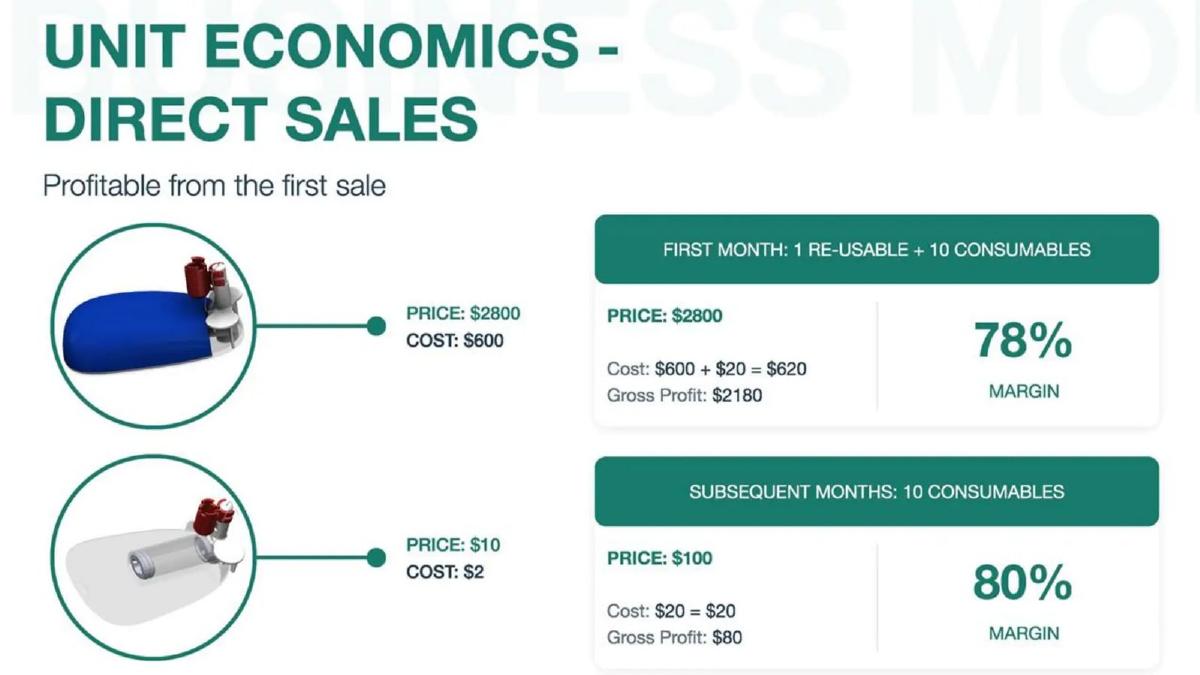
U-Pump business model slide — slide 17
Insulin patch pump. Headed "Unit economics – direct sales".
U-Pump deck, slide 17. Exact stored slide matched to this analysis.
Our analysis: The only slide in the set that states a usage rate, so an investor can work out recurring revenue per pump: $100 a month, or $1,200 a year, if the assumption holds.
Evidence and limitation: The arithmetic holds: $2,180 ÷ $2,800 = 77.9% and $80 ÷ $100 = 80%. In the first month the box counts the cost of ten consumables but not their $100 of revenue; if they are charged, month-one revenue is $2,900 and margin 78.6%. The slide doesn't say which. Ten consumables a month is an assumption with no source. Costs are per unit and exclude everything but the product, and who pays (patient, insurer) isn't stated.
What a founder can adapt: Keep the layout. Add the usage source and the payer: "[N] consumables a month, based on [clinical protocol or pilot]; paid by [insurer or patient]". Show month-one revenue including or excluding the consumables, and say which.
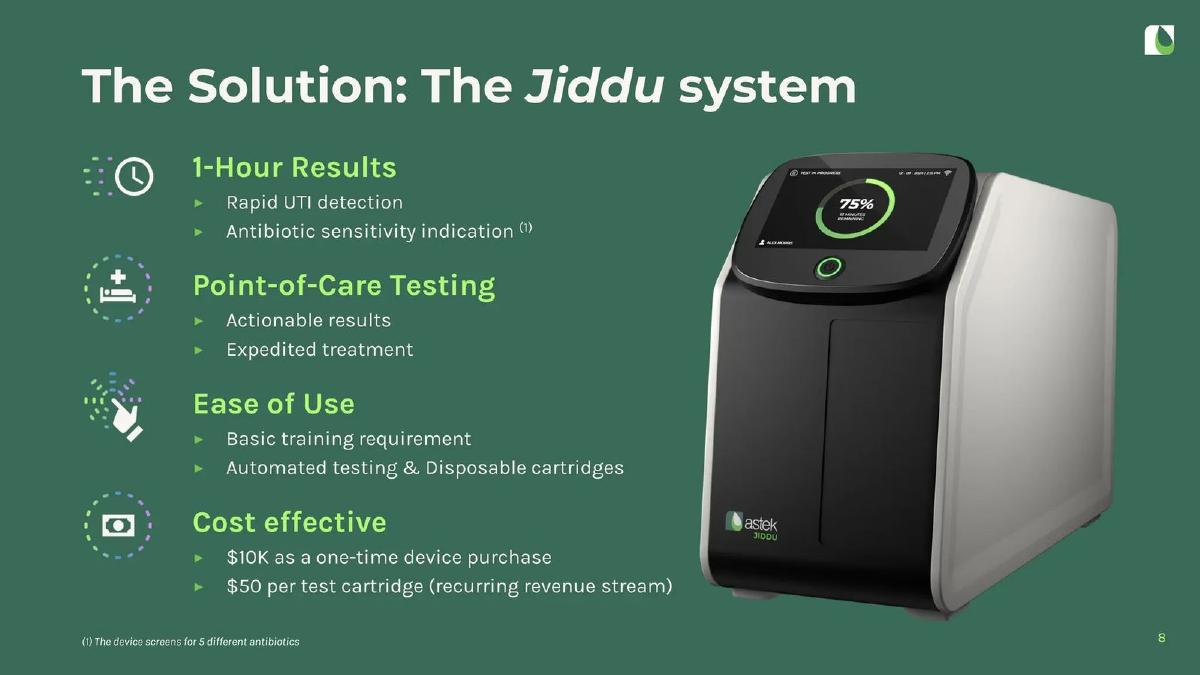
Point-of-care urinary tract infection test (the Jiddu system). Headed "The Solution"; the business model sits in the last block.
Astek Diagnostics deck, slide 8. Exact stored slide matched to this analysis.
Our analysis: A classic instrument-and-cartridge model: a one-off capital sale, then revenue from every test.
Evidence and limitation: Both parts are priced. The slide gives no cartridge cost, no tests per device per month and no buyer type, so revenue per installed device can't be worked out. At [N] tests a month a device would bring in $50 × [N]; the slide doesn't supply N.
What a founder can adapt: "Device $10,000 one-off; cartridge $50 (cost $[X]); a typical [clinic type] runs [N] tests a month, so $[Y] a year per device ([source])".
Supporting analysis
What the deck claims: "1-Hour Results: Rapid UTI detection; Antibiotic sensitivity indication." "Ease of use: Basic training requirement; Automated testing & disposable cartridges." "Cost effective: $10K as a one-time device purchase; $50 per test cartridge (recurring revenue stream)." Footnote: "The device screens for 5 different antibiotics."
Presentation choice: It states plainly which part is one-off and which recurs.
When it does not fit: Calling it cost effective without saying for whom or compared with what.
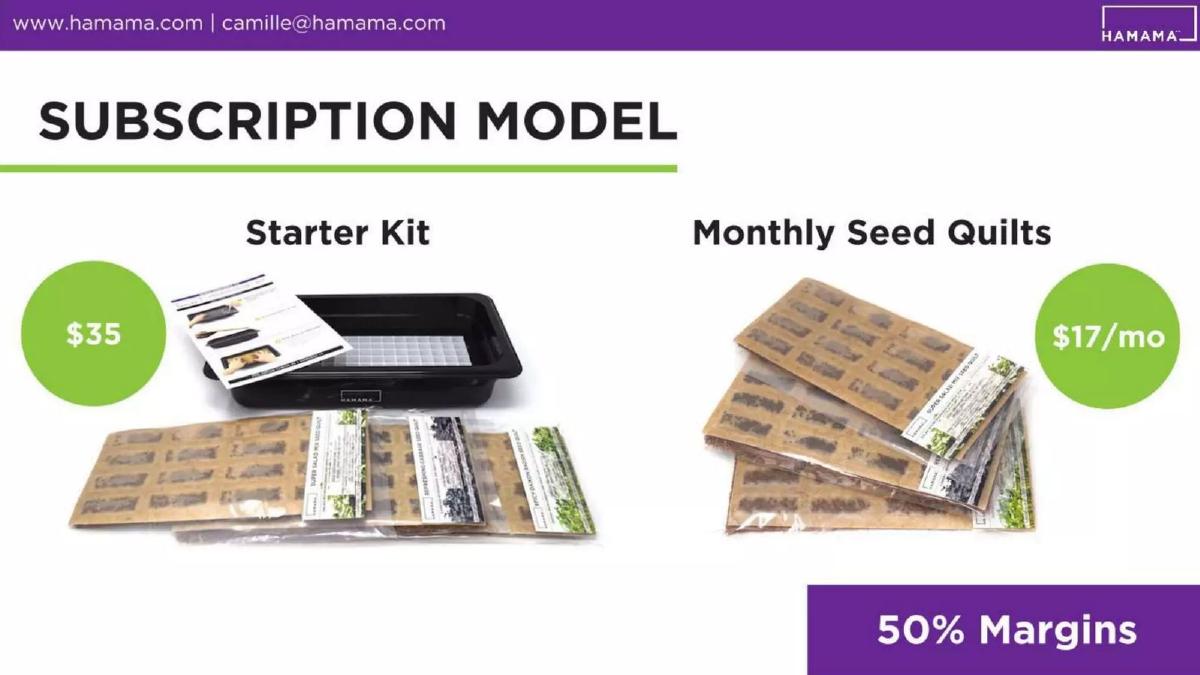
Hamama deck, slide 7. Exact stored slide matched to this analysis.
Our analysis: A low-priced starter device and a refill that recurs monthly. The recurring part soon outweighs the kit: two months of seed quilts ($34) nearly equal the kit price.
Evidence and limitation: Both parts are priced with a period. "50% margins" doesn't say which product, which margin type or whether it is measured. The slide doesn't say how long subscribers stay or what share of kit buyers subscribe.
What a founder can adapt: "[X]% of kit buyers subscribe; average subscription [N] months; gross margin [X]% on kits and [Y]% on quilts ([period])".
Supporting analysis
What the deck claims: "Subscription model." "Starter Kit $35." "Monthly Seed Quilts $17/mo." "50% Margins."
Presentation choice: The simplest clear version of the model: two photos, two prices.
When it does not fit: A single margin figure across two products with different costs.
Car diagnostics device (OBD2 plug) with an app. Spanish-language slides; pages 8 and 10 shown.
Goodrive deck, slide 8. Exact stored slide matched to this analysis.Goodrive deck, slide 10. Exact stored slide matched to this analysis.
Our analysis: The device is bundled into a subscription instead of being sold, so the customer pays yearly and the company carries the device cost.
Evidence and limitation: The arithmetic holds: 2,500 × €19.99 = €49,975 and 0.60 × €49,975 = €29,985. The €19.99 appears only in the calculation on page 10; combined with page 8 it reads as a yearly price, but the slide doesn't label it. The 60% is stated as a minimum and applied as the forecast. 2,500 users is a first-year forecast with no basis given.
What a founder can adapt: "€19.99 per year including the device (device cost €[X]); 2,500 subscribers in year one, based on [pilot or channel]; gross margin [X]% after device cost".
Supporting analysis
What the deck claims: Page 8: "Suscripción para usar el hardware (OBD2) al año. App gratis. Margen bruta: 60% al mínimo" (a yearly subscription to use the OBD2 hardware; free app; gross margin at least 60%). Page 10: "Ingresos (primer año): 2.500 us. x 19,99 € = 49.975 €. Margen bruto (primer año): 0.60 x 49.975 € = 29.985 €" (first-year revenue: 2,500 users × €19.99; gross margin 0.60 × €49,975).
Presentation choice: It shows the subscription working through to revenue and margin in one line.
When it does not fit: Applying a "minimum" margin as the forecast without showing the device cost it has to cover.
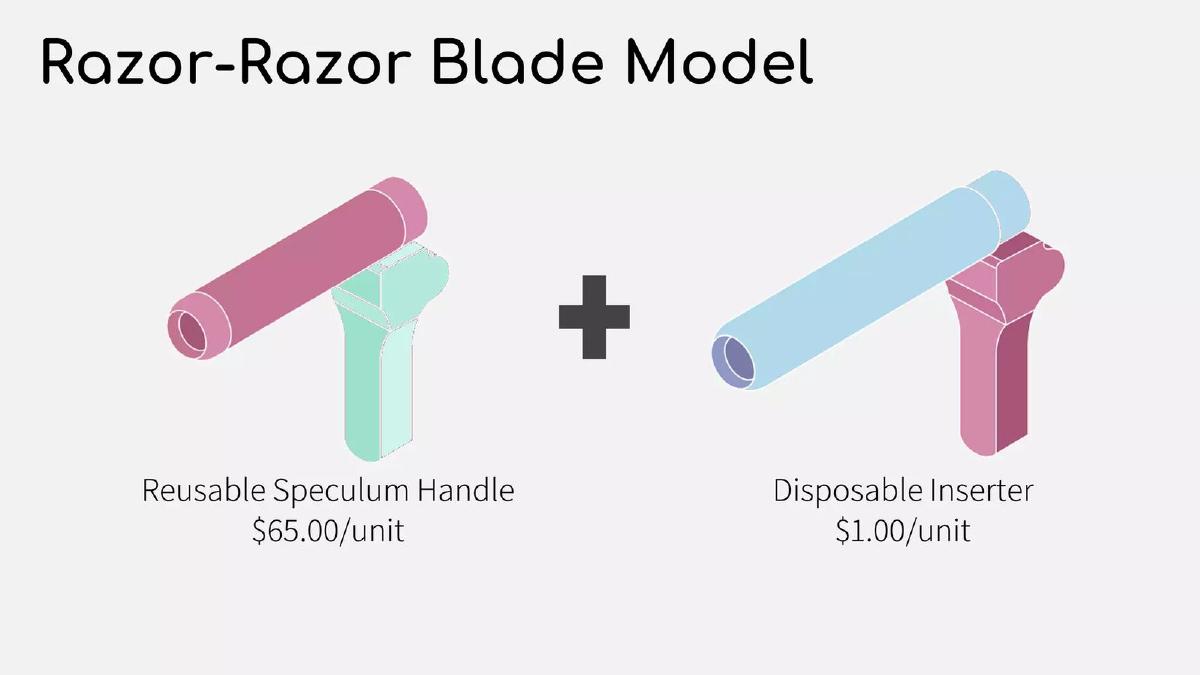
Speculum for gynaecological exams. A different page of this deck appears in the healthcare problem guide.
Feminora deck, slide 7. Exact stored slide matched to this analysis.
Our analysis: One inserter per exam is the natural reading, which would make recurring revenue per handle $1 × exams; the slide doesn't state it.
Evidence and limitation: The slide names the model and gives two unit figures but doesn't label them as prices or costs, and gives no exams per handle, buyer or margin.
What a founder can adapt: "Handle $65 (price), inserter $1 per exam (price; cost $[X]); a clinic runs [N] exams a month".
Supporting analysis
What the deck claims: "Razor-Razor Blade Model." "Reusable Speculum Handle $65.00/unit" + "Disposable Inserter $1.00/unit".
Presentation choice: Naming the model helps a reader, and the reusable and disposable parts are shown side by side.
When it does not fit: Unit figures without saying whether they are prices or costs.
Blink Charging deck, slide 7. Exact stored slide matched to this analysis.
Our analysis: A hybrid: Blink sells hardware to some sites and owns stations at others, earning from drivers at the ones it owns and from network fees at the ones it sold.
Evidence and limitation: Three revenue lines, with no split between them and no split between stations sold and stations Blink owns. "Deployed since inception" is cumulative and may include stations no longer active. No prices.
What a founder can adapt: "Revenue [year]: charging [X]%, hardware [Y]%, network fees [Z]%. Stations: [N] owned, [M] sold".
Supporting analysis
What the deck claims: "Design, manufacture, sell & deploy Blink EV charging stations." "Own, operate & maintain a nationwide network of EV charging stations under long-term agreements with property partners. Blink has deployed 23,000 units since inception." "Generate revenue through charging EV drivers to power their cars, selling EV charging hardware, and providing network connectivity and payment processing for our property partners." "180,000+ registered Blink members." "23,000+ EV charging stations deployed."
Presentation choice: It separates owning from selling, which changes who carries the device cost.
When it does not fit: Cumulative counts presented next to current members without a date.
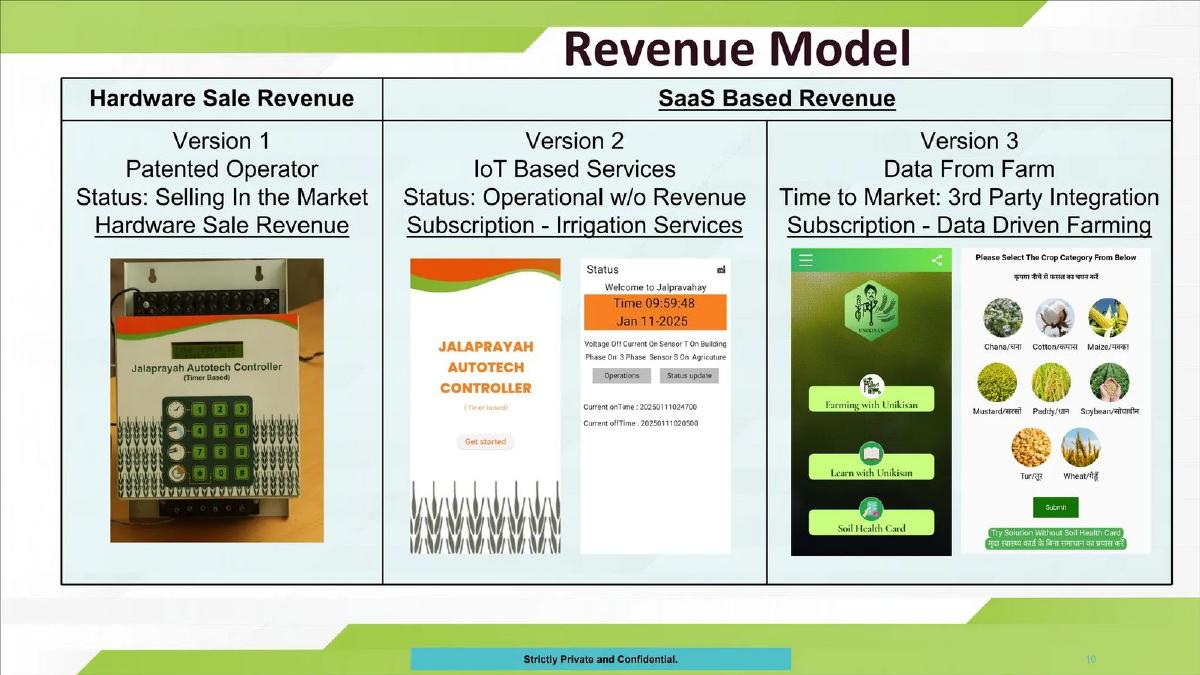
Irrigation controller for farms in India. Other pages of this deck appear in the agtech problem and solution guides. Included as a weaker example.
Intech Harness deck, slide 10. Exact stored slide matched to this analysis.
Our analysis: A path from one-off hardware sales to subscriptions, with only the first stage earning revenue today.
Evidence and limitation: Each stream carries a status, which is honest and useful. No prices, costs or usage figures for any version.
What a founder can adapt: "Controller ₹[X] (selling; [N] units to date). Irrigation service ₹[Y]/month (operational, not yet charged; [M] farms using it)".
Supporting analysis
What the deck claims: "Hardware sale revenue: Version 1, patented operator. Status: selling in the market." "SaaS based revenue: Version 2, IoT based services. Status: operational w/o revenue. Subscription – irrigation services." "Version 3, data from farm. Time to market: 3rd party integration. Subscription – data driven farming."
Presentation choice: Included for its status labels, which many slides lack; the missing numbers are why it sits lower.
When it does not fit: Calling planned subscriptions a revenue model before any are charged.
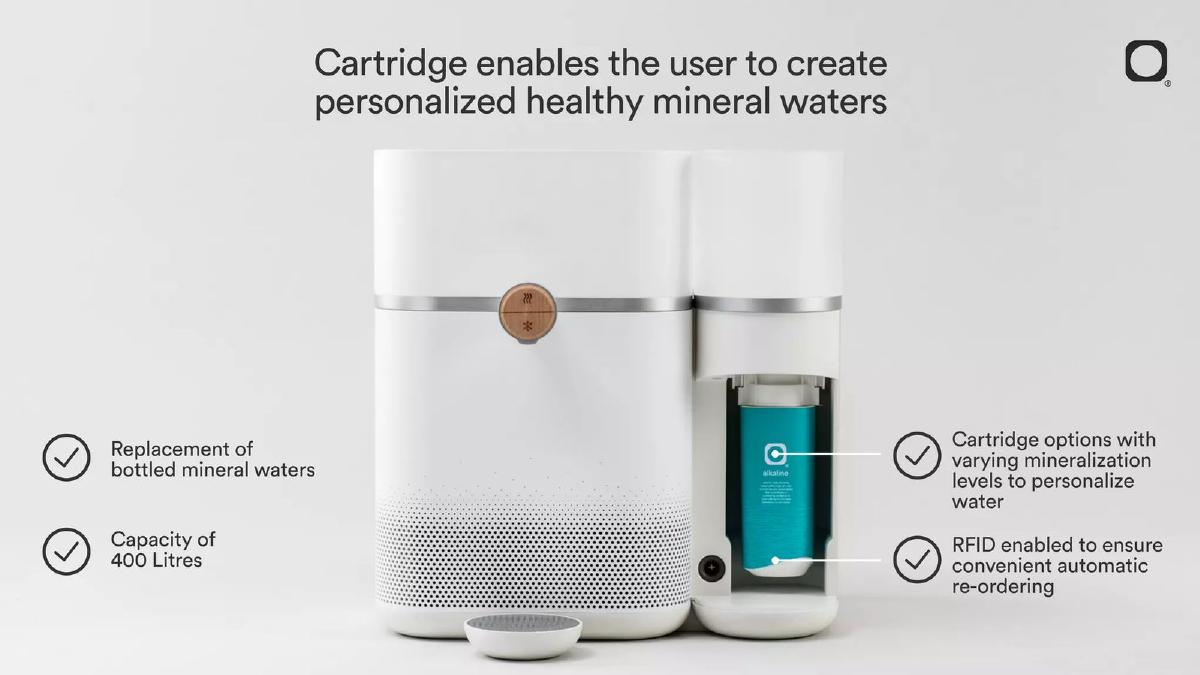
Home water purifier that remineralises water. Included as a weaker example.
Mitte deck, slide 9. Exact stored slide matched to this analysis.
Our analysis: Automatic re-ordering is the recurring mechanism; the slide shows how refills happen, not what they earn.
Evidence and limitation: The cartridge holds 400 litres, which could give a replacement rate once household use is known, but the slide gives no price, no usage and no cartridge cost.
What a founder can adapt: "Cartridge €[X] per 400 litres; a household of [N] uses one every [M] weeks, so €[Y] a year per device".
Supporting analysis
What the deck claims: "Cartridge enables the user to create personalized healthy mineral waters." "Replacement of bottled mineral waters." "Capacity of 400 litres." "Cartridge options with varying mineralization levels to personalize water." "RFID enabled to ensure convenient automatic re-ordering."
Presentation choice: Included to show how a product slide can describe the refill without the numbers a business model needs.
When it does not fit: Leaving the refill cadence for the reader to guess.
Whether each slide prices the device and the recurring part, states a usage rate and gives a margin with its basis.
Example
Device price
Recurring price
Usage rate
Margin
U-Pump
$2,800 (cost $600)
$10 each (cost $2)
10 a month (assumed)
78% and 80%, product only
Astek
$10,000
$50 per cartridge
Not stated
Not stated
Hamama
$35 kit
$17 a month
Not stated
"50%", type not stated
Goodrive
Bundled
€19.99 (yearly, by our reading)
Not applicable
60% minimum, applied as forecast
Feminora
$65 (price or cost?)
$1 (price or cost?)
Not stated
Not stated
Blink
Not stated
Not stated
Not stated
Not stated
Intech Harness
Not stated
Planned
Not stated
Not stated
Mitte
Not stated
Not stated
400 litres per cartridge
Not stated
Key Takeaways
Price both parts: the device and what the customer keeps buying.
State the usage rate (tests, refills or months per device), because recurring revenue per device depends on it.
Give the cost of each part if you quote a margin, and say which margin it is.
Say who pays for the device: the user, a clinic, an insurer or a property partner.
If you run several revenue streams, as Blink does, show the split or at least which is largest.
Label each stream as selling, piloting or planned, as Intech Harness does.
Build your hardware business model slide
Start from one device over its first year.
Device. Price, cost and buyer. Is it sold, leased, bundled or subsidised?
Recurring part. What does the customer keep buying: refills, tests, a subscription? Price, cost, period.
Usage. How many refills, tests or months per device? Measured or assumed, and from what?
Revenue per device. Device price plus recurring price × usage over a stated period.
Status. Which streams are earning today and which are planned?
Copyable framework: Device: $[price] (cost $[X]), bought by [buyer]. [Refill] $[price] (cost $[Y]); [N] per [period] per device ([source]). First-year revenue per device: $[Z]. Status: [selling / pilot / planned].
Illustrative example 1 — written by us
Before: Razor and blade model: device plus consumables.
After: Device $[price] (cost $[X]), bought by [clinics]. Cartridge $[price] (cost $[Y]); [N] per month per device in our [pilot]. First-year revenue per device: $[Z].
What improved: Our illustrative rewrite; all bracketed figures are placeholders, not company facts. It turns the model name into the three numbers an investor needs.
What this guide adds
The general business model guide covers naming who pays and how. The SaaS guide covers subscriptions where there is nothing physical to sell, and the unit economics guide covers customer acquisition cost and lifetime value. This guide covers companies with a physical product, where revenue arrives in two parts: the device, then refills or a subscription.
The healthcare reimbursement guide covers who pays for medical devices; two examples here (U-Pump and Astek) are medical, but this guide looks at the device-and-refill structure rather than the reimbursement code.
Three numbers a device-plus-refill slide needs
Device: price and cost, and who buys it. A subsidised device is fine if the slide says so.
Refill or subscription: price, cost and period.
Usage: how many refills, tests or months per device, measured or assumed. Without it, revenue per device can't be worked out. Only U-Pump states one.
How we read each slide
We quote the text on the slide images and describe images from what is shown. We have not checked company claims. None of these pages was in our stored image set, so we rendered each from the original deck file in our library; the pages shown are the ones quoted. Where a slide shows a calculation, we redid it. Spanish text on Goodrive's slides is translated by us.
Common mistakes
Model name without numbers. "Razor and blade" needs a device price, a refill price and a usage rate.
No usage rate. Recurring revenue per device depends on it; state it and its source.
Unlabelled figures. Say whether each number is a price or a cost.
Margin without a basis. Say which product, which margin and whether it is measured or planned.
Unclear first-sale box. If refills come with the device, say whether they are charged.
Streams without a split. Show which revenue stream is largest.
Diagnostic checklist
Prices the device and the recurring part, each with its period.
States the usage rate per device and where it comes from.
Gives costs if a margin is quoted, and names the margin.
Says who buys the device.
Labels each stream as earning, piloting or planned.
Frequently asked questions
How do I show a razor-and-blade model on a pitch deck slide?
Price the device and the refill, give the cost of each, and state how many refills a customer uses per month or year. U-Pump's slide shows all three, with ten consumables a month as its assumption.
Should a hardware startup sell the device or rent it by subscription?
Either can work; the slide should say which and who carries the device cost. Goodrive bundles its device into a yearly subscription; Astek sells its device once and earns per test.
How we chose these examples
Corpus: published pitch deck teardowns on StartupFundraising.com. Founder-uploaded private decks are excluded.
Selection (2026-09-26): we searched teardown text for hardware, device or sensor decks with a business model, revenue model or pricing slide, and separately for razor-and-blade, cartridge, consumable and refill language. We rendered 50 candidate pages from 38 decks (five deck files were missing) and read each.
Kept eight. Excluded: Jonga p10 (a business model canvas with no prices), Bauz Razors p5 (sells razors; no recurring part), Aeris Health p7 and several other matched pages (the page read was not the business model), Cipher Skin, TimeFlip and SprayPrinter (no pricing page found in the pages read), BioSculpture p8 (liposuction imaging, not a pricing page).
None of the chosen pages was in our stored image set; we rendered them from the original deck PDFs in our library and stored them with the existing slide-image workflow.
Review: slide images were checked on 2026-09-26 and matched to company, deck and page (editorial model review). No person has yet completed an editorial review of this page. We make no claim that any slide caused a fundraising outcome.