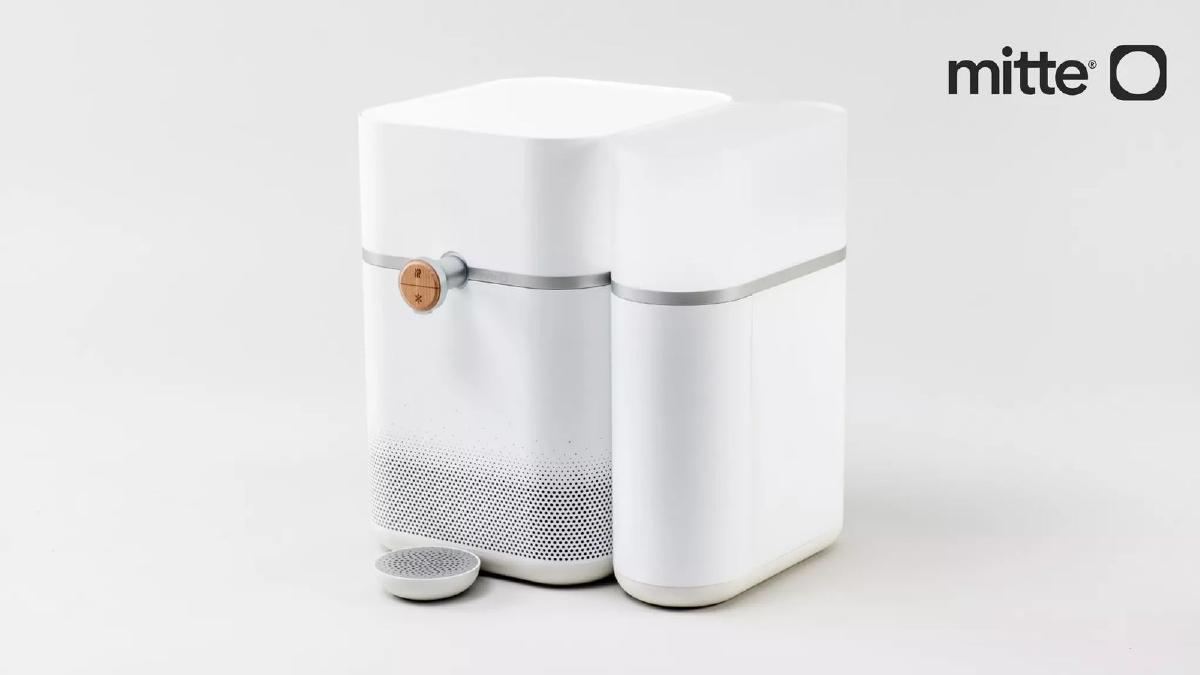
Mitte's pitch deck outlines a sophisticated hardware-as-a-service strategy targeting the global water market. By positioning their device as the 'Nespresso for water,' the company aims to solve the dual problems of tap water impurity and the environmental cost of bottled water. The deck highlights a patent-pending distillation process that is reportedly 60x cleaner than leading pitchers, paired with a high-margin consumable cartridge system. With a projected lifetime value of 540 EUR per user and a clear roadmap from Kickstarter to global retail, Mitte presents a scalable model that integrate…
Key takeaways
- The business model is explicitly compared to Nespresso, targeting a 540 EUR Lifetime Value per machine (Slide 17).
- Mitte claims its distillation technology produces water 60x cleaner than a Brita pitcher (Slide 8).
- The unit economics feature a 15% margin on hardware (399 EUR) and an 80% margin on consumable cartridges (Slide 17).
- Personalization is a core value prop, offering cartridges that mimic mineral profiles of Evian and S.Pellegrino (Slide 10).
- The roadmap targets a Series A in January 2018 and a Series B by September 2018 (Slide 21).
- Social impact is integrated via a one-for-one partnership with water.org (Slide 12).
- Market sizing focuses on a 'core potential' of 19m units in developed countries and 17m in emerging markets (Slide 19).
- The team is structured around three pillars: Technology (CTO), Product (CEO), and Marketing (CMO) (Slide 20).
Mitte Pitch Deck Analysis
Mitte enters the market with a high-design, IoT-enabled water system that attempts to bridge the gap between the convenience of tap water and the perceived health benefits of premium bottled mineral water. The deck is structured to move from a global health problem to a specific technical solution, concluding with a robust financial model based on recurring consumable sales.
Slide 1-5: The Vision and Problem Statement
The deck opens with a clean product shot of the Mitte machine, establishing a premium aesthetic. Slide 2 uses World Health Organization (WHO) data to validate the necessity of minerals in drinking water, setting the stage for Mitte's unique selling proposition: purification plus enhancement. Slide 3 clearly delineates the three-pronged problem: tap water is impure, bottles are unsustainable/expensive, and existing purifiers do not enhance water. Slide 4 presents a multi-year vision, moving from 'Reach' in 2018 to 'Personalisation' in 2019 and finally a 'Platform & Services' model by 2020. This roadmap suggests an ambition to move beyond hardware into data and licensing. Slide 5 summarizes the core mission: creating the world's first connected home water system.
Slide 6-10: Technical Solution and Personalization
Slides 6 and 7 explain the product logic, comparing the machine's process to the natural water cycle (evaporation, condensation, and mineralization). This is a smart marketing move, framing industrial distillation as a 'natural' process. Slide 8 gets specific about the technology, claiming 'patent pending purification by distillation' that is 60x cleaner than a Brita pitcher. Crucially, it claims the distillation unit never needs replacement. Slide 9 introduces the consumable element: an RFID-enabled cartridge with a 400-liter capacity that allows for automatic re-ordering. Slide 10 is perhaps the most important for consumer appeal, showing how Mitte can replicate the mineral profiles of famous brands like Evian, S.Pellegrino, and Essentia using specific mineral ingredients like Maifan stone and Calcite.
Slide 11-14: Connectivity and Social Impact
Slide 11 showcases the mobile app, which handles subscription management, water quality tracking, and custom dispense cards (e.g., 70°C for Green Tea). Slide 12 introduces a 'one-for-one' social impact model in partnership with water.org, where every liter used by a customer triggers a donation of a day's worth of clean water to someone in need. This is a classic 'Buy One, Give One' strategy intended to build brand loyalty. Slide 13 illustrates the 'connected ecosystem,' showing how the hardware, cartridges, and app integrate with third-party services like Stripe for payments and Zendesk for CRM. This slide demonstrates that the founders have considered the backend infrastructure required for a global scale-up.
Slide 15-17: Market Opportunity and Business Model
Slide 15 presents market data showing the decline of soft drinks and the rise of bottled water, projecting a water market exceeding $200bn. Slide 16 provides a price comparison, positioning Mitte at 0.10 EUR per liter, which is significantly cheaper than premium bottled waters like Fiji or Badoit, especially in markets like China and the USA. Slide 17 is the 'money slide,' explicitly labeling the business as a 'Nespresso for water.' It breaks down the unit economics: a 399 EUR machine (15% margin) and 50 EUR cartridges (80% margin). With four replacements per year, they project a 540 EUR Lifetime Value (LTV) over 36 months. This high-margin recurring revenue is the primary hook for venture capital investors.
Slide 18-22: Execution Strategy, Team, and Projections
Slide 18 outlines a four-stage distribution plan starting with Kickstarter and moving toward global retail. Slide 19 quantifies the Total Addressable Market (TAM) at 190m households in developed countries and 340m in emerging countries, though it conservatively targets a 'core potential' of 5% to 10% of those markets. Slide 20 introduces the team, led by CEO Moritz Waldstein-Wartenberg and CTO Dr. Faebian Bastiman, supported by investor Christophe Maire and industry partner Döhler. Slide 21 provides a fundraising and product roadmap, indicating a need for Series A and B funding within a year of each other. Finally, Slide 22 offers aggressive 2025 projections: 3m units sold, 990m EUR in hardware revenue, and 243m EUR in consumable revenue.
What Mitte Does Well
Clear Business Model: The 'Nespresso for water' analogy is immediately understandable and highly attractive to investors looking for recurring revenue in hardware. · Technical Credibility: By citing patent-pending distillation and providing a 60x cleaner metric against a household name (Brita), they establish a clear performance lead. · Personalization: The ability to choose mineral profiles (Alkaline vs. Balance) turns a utility product into a lifestyle choice. · Infrastructure Readiness: Slide 13 shows they aren't just building a machine; they are building a software-enabled business with integrated payments and CRM.
What is Missing from the Mitte Deck
Unit Economics Detail: While they provide margins, they do not list the Customer Acquisition Cost (CAC), which is the other half of the LTV/CAC ratio critical for subscription businesses. · Competitive Landscape: The deck mentions Brita and bottled water, but it ignores other high-end filtration systems or countertop distillers already on the market. · Manufacturing Risk: There is no mention of where the machines are produced or how they will manage the supply chain for complex hardware. · Historical Traction: The deck is entirely forward-looking. There are no results from beta testing, early pre-orders (outside the Kickstarter plan), or user feedback on the water's taste.
Founder's Guide: What to Copy
The Comparison Slide: Slide 16 is a masterclass in price positioning. By showing they are cheaper than the 'premium' alternative but more functional than the 'private label' alternative, they carve out a unique niche. · The Ecosystem Map: Slide 13 is excellent for showing how a startup intends to use existing tools (Stripe, Zendesk, Mixpanel) to act like a much larger company from day one. · The 'Natural' Analogy: If your technology is complex, use Slide 7's approach. Comparing a mechanical process to a natural cycle makes the product feel safer and more intuitive to the consumer.
Frequently asked questions
- What is Mitte's primary technological advantage?
- According to slide 8, Mitte utilizes a patent-pending distillation process. They claim this method provides 'ultimate purification consistency' and results in water that is 60x cleaner than a standard Brita pitcher. Unlike carbon filters, they assert their distillation system never needs replacement, though the mineral cartridges do.
- How does the company plan to generate recurring revenue?
- Mitte employs a 'razor-and-blade' model. Slide 17 details the sale of a 399 EUR machine at a 15% margin, followed by the sale of mineral cartridges at 50 EUR each. These cartridges have an 80% margin and are expected to be replaced four times per year, generating 480 EUR in lifetime profit per user.
- What are the different types of water Mitte offers?
- Slide 10 shows three initial cartridge options: 'Balance' (neutral taste like Evian), 'Vitality' (crisp minerals like S.Pellegrino), and 'Alkaline' (high pH like Essentia). These cartridges use ingredients like Maifan stone, Magnesia, and Calcite to re-mineralize distilled water.
- What is Mitte's go-to-market strategy?
- The strategy is divided into four stages on slide 18. It begins with a Kickstarter campaign for pre-orders, followed by an 'Introduction' phase on Amazon Launchpad in the US and EU. Stage 3 focuses on growth via SEA and India e-commerce partners, ending with Stage 4 retail distribution and flagship stores.
- Who are the key investors and advisors mentioned?
- Slide 20 lists Christophe Maire (CEO of Atlantic Labs) as an advisor and investor. It also highlights a partnership with Döhler, a leading producer of natural beverage ingredients, for product research and development support.