Mistral AI's 2023 seed deck is an anomaly in the fundraising world: a 7-page, text-only 'strategic memo' with zero charts, photos, or diagrams. The company successfully raised €105M by leaning heavily on the extreme technical pedigree of its founders—former lead researchers from DeepMind and Meta—and a clear geopolitical narrative. They positioned themselves as the European 'white box' alternative to the US-based 'black box' oligopoly of OpenAI and Google. The memo outlines a rigorous technical roadmap focusing on open-source models, data sovereignty, and efficiency (models small enough to ru…
Key takeaways
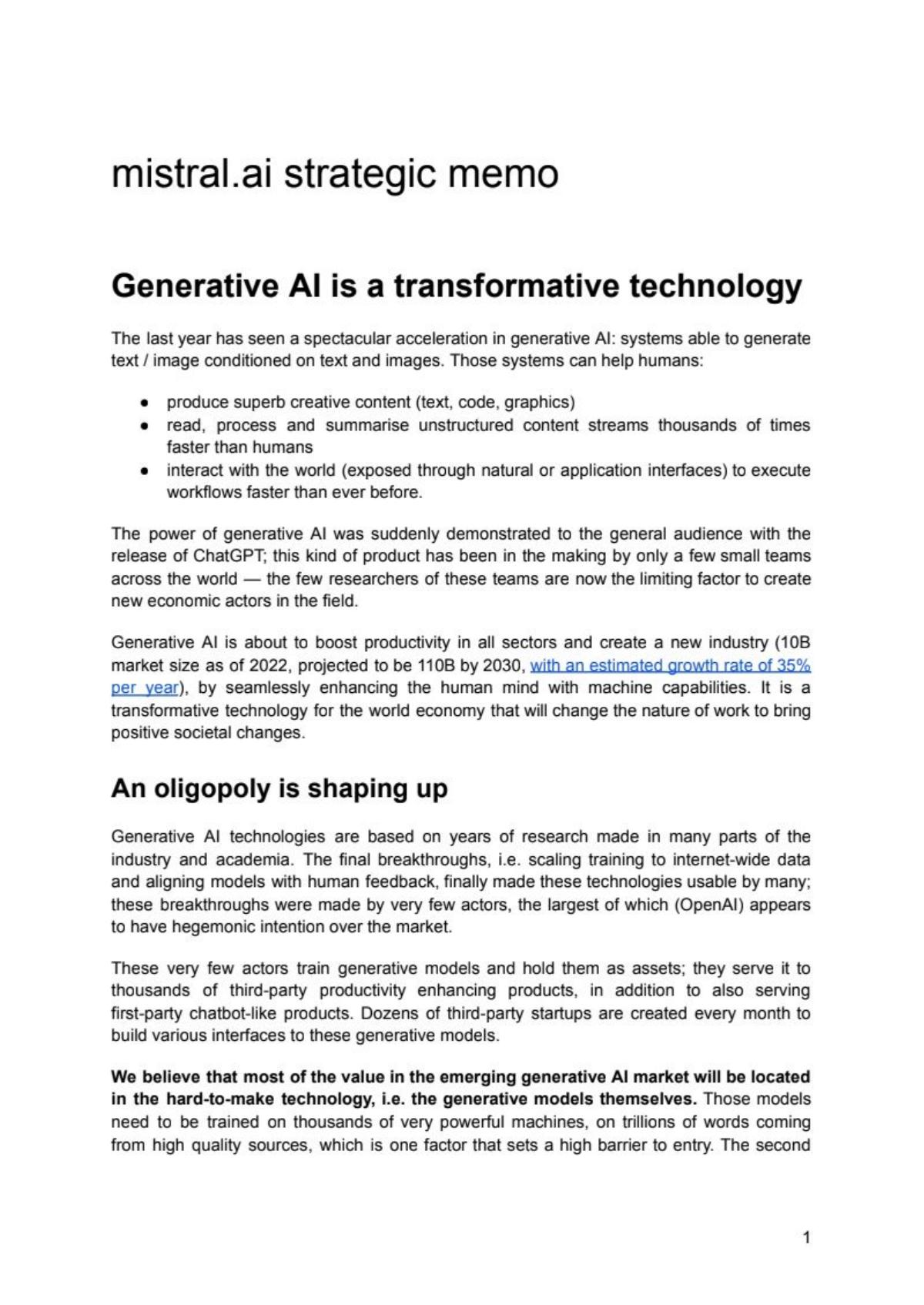
- The deck is a text-only memo, signaling a focus on technical depth and intellectual rigor over marketing polish (Slide 1).
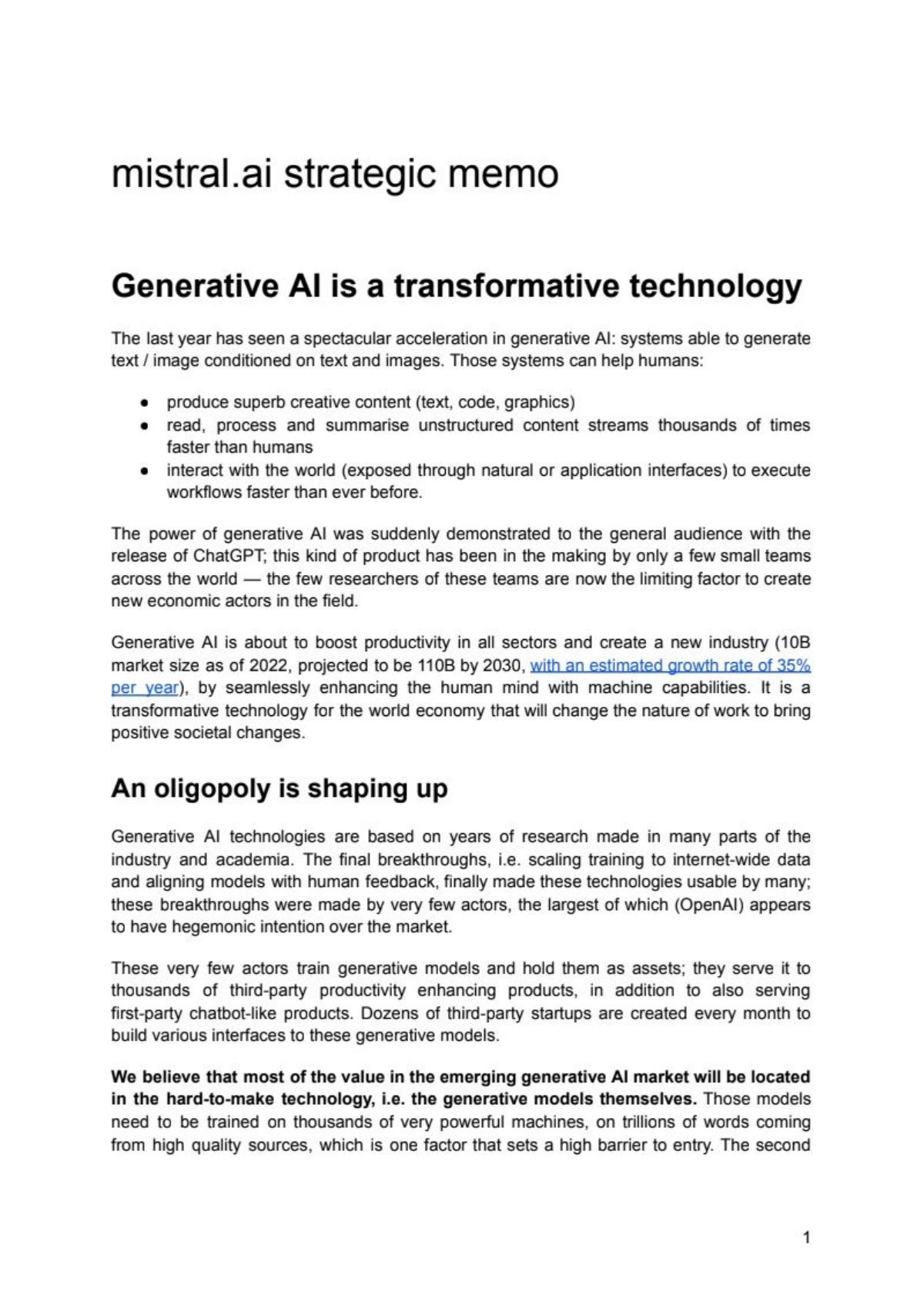
- Mistral identifies a market gap in 'white box' models, criticizing competitors for keeping training data and model weights secret (Slide 2).
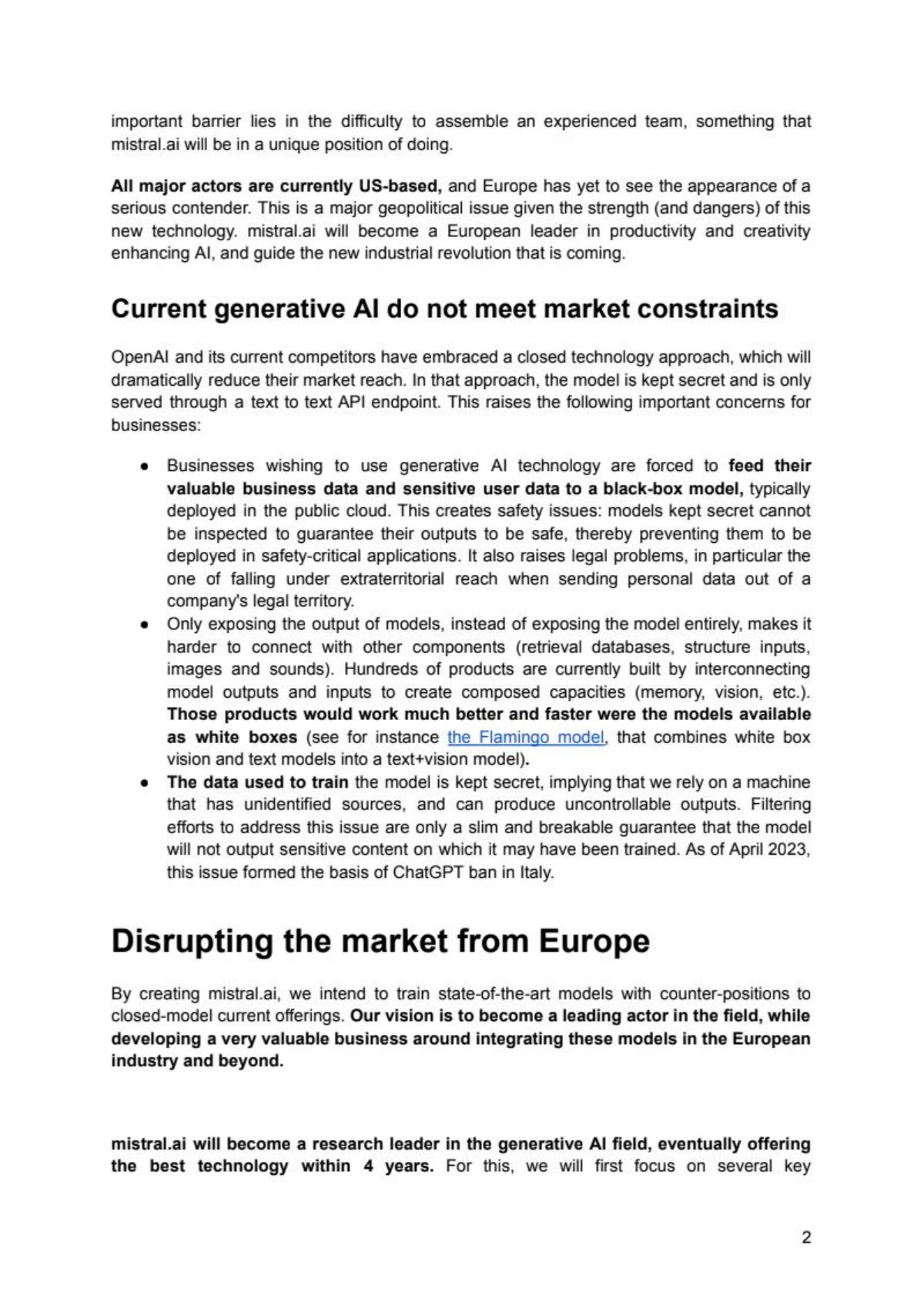
- The team plans to dedicate 1% of funding to a non-profit foundation for open-source community development (Slide 3).
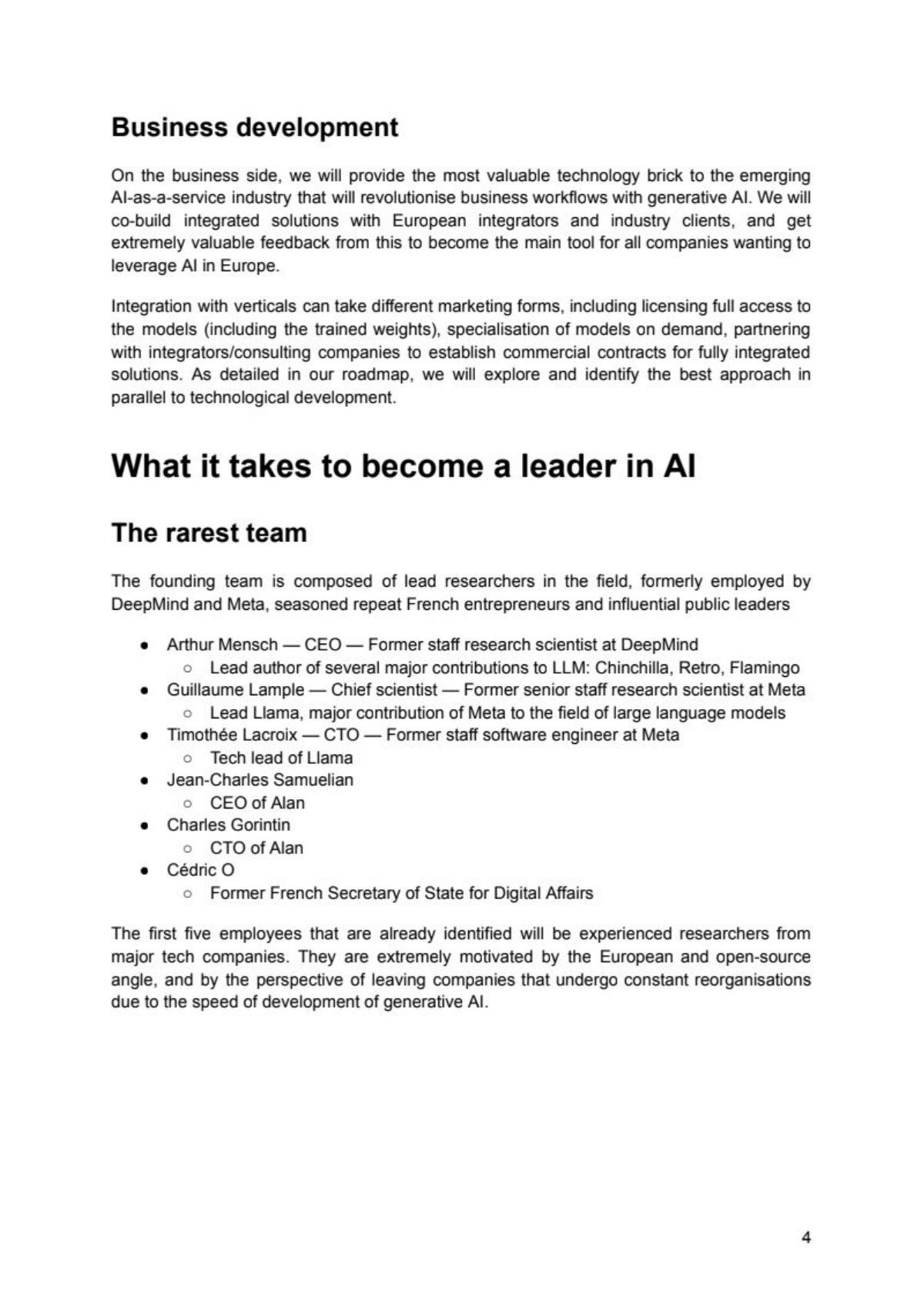
- The founders include the lead author of Chinchilla and the tech lead of Llama, providing immediate credibility in the LLM space (Slide 4).
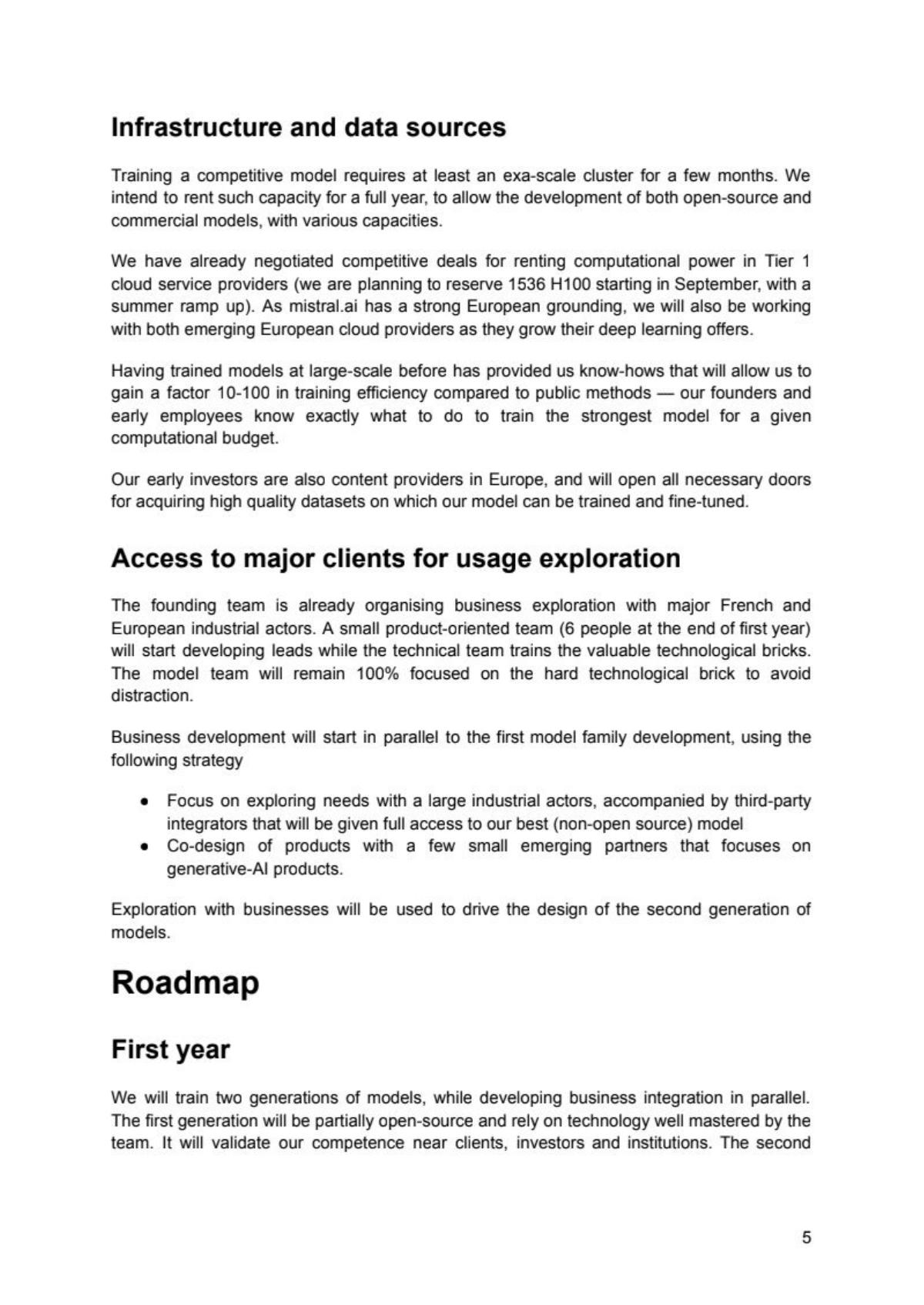
- Mistral aims to be 10-100x more efficient in training than public methods due to the team's prior experience (Slide 5).
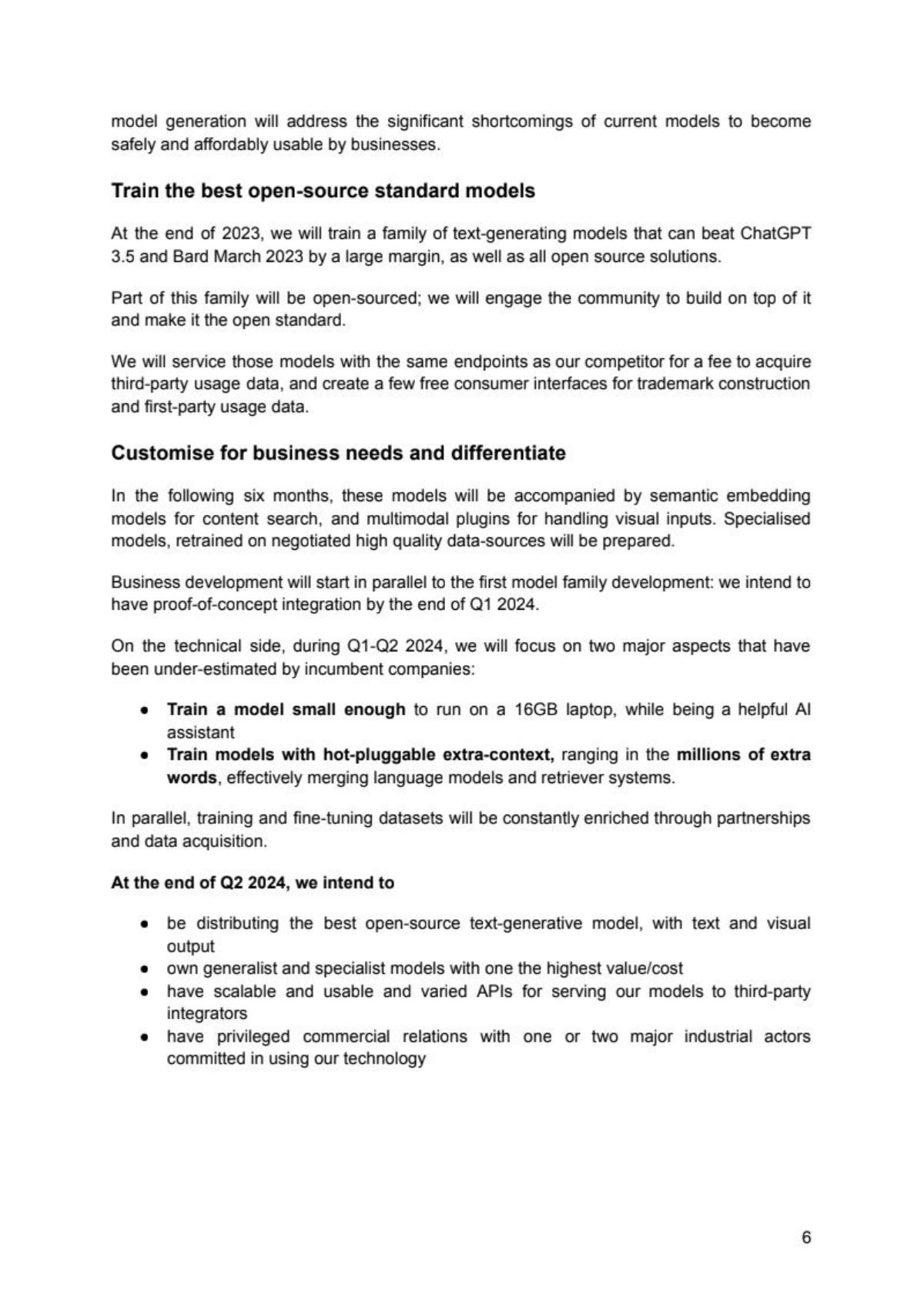
- A specific technical goal is to train a model small enough to run on a 16GB laptop while remaining a helpful assistant (Slide 6).
- The memo explicitly forecasts a Series A requirement of €200M by Q3 2024 to exceed GPT-4 capacities (Slide 7).
- Geopolitics is used as a primary motivator, stating that the lack of a European contender in AI is a 'major geopolitical issue' (Slide 2).
The Strategic Memo: A New Standard for High-Stakes Fundraising
Mistral AI’s seed deck is not a deck in the traditional sense. It is a seven-page document titled 'mistral.ai strategic memo.' In an era where founders are often told to reduce text and use high-resolution imagery, Mistral did the exact opposite. This teardown examines how a team of elite researchers used a plain-text document to secure one of the largest seed rounds in European history—€105M.
Slide 1: The Macro Thesis and the Oligopoly
The memo opens with a high-level overview of Generative AI as a 'transformative technology.' It cites a market size of $10B in 2022, projected to grow to $110B by 2030 at a 35% annual growth rate. However, the core of the argument on Slide 1 is the 'Oligopoly is shaping up' section. Mistral argues that the value in the market lies in the 'hard-to-make technology'—the models themselves. They identify two barriers to entry: the requirement for thousands of powerful machines and the difficulty of assembling an experienced team. By stating that 'the few researchers of these teams are now the limiting factor,' they are subtly setting the stage for their own team introduction later in the document.
Slide 2: The Geopolitical Counter-Position
Slide 2 introduces the primary narrative: the need for a European alternative. Mistral explicitly calls out OpenAI for its 'closed technology approach.' They list three concerns for businesses using closed models: the risk of feeding sensitive data into a 'black-box,' the difficulty of connecting closed models with other components like retrieval databases, and the secrecy surrounding training data. This slide is a masterclass in 'counter-positioning.' By framing the current leaders as secretive and US-centric, Mistral positions itself as the transparent, European-friendly solution. They set a bold goal: 'offering the best technology within 4 years.'
Slide 3: Technological Counter-Positioning
On Slide 3, Mistral details their 'dead angles' in competitor strategies. The most significant is their commitment to an open-source software license for their models. They argue this is an ideological differentiator that will attract top researchers and 'motivated hackers.' Interestingly, they mention a plan to dedicate 1% of funding to a non-profit foundation for open-source development. They also promise 'unmatched guarantees on security and privacy' by allowing models to be deployed on private clouds or directly on devices, removing the need for data to leave a company's infrastructure.
Slide 4: The Rarest Team
This is arguably the most important section of the memo. Slide 4 lists the founding team, and the credentials are world-class. Arthur Mensch (CEO) is noted as a former staff research scientist at DeepMind and lead author of Chinchilla and Flamingo. Guillaume Lample (Chief Scientist) and Timothée Lacroix (CTO) are credited as the lead and tech lead of Llama at Meta. The team also includes seasoned entrepreneurs like Jean-Charles Samuelian and Charles Gorintin (founders of Alan), and Cédric O, the former French Secretary of State for Digital Affairs. In the world of VC, this level of 'founder-market fit' effectively de-risks the investment, justifying the lack of a traditional pitch deck.
Slide 5: Infrastructure and Data Strategy
Slide 5 addresses the 'how.' Mistral acknowledges the need for an 'exa-scale cluster' and notes they have already negotiated deals to reserve 1536 H100 GPUs starting in September 2023. They claim their experience will allow them to be 10-100x more efficient in training than public methods. This is a critical claim for a seed-stage company asking for over €100M; they aren't just building a model, they are claiming a proprietary efficiency in the training process itself. They also mention that their early investors are 'content providers in Europe' who will help them acquire high-quality datasets.
Slide 6: The Roadmap and Technical Milestones
The roadmap on Slide 6 is specific and time-bound. By the end of 2023, they aim to train models that 'beat ChatGPT 3.5 and Bard March 2023 by a large margin.' They also introduce a unique technical goal: training a model small enough to run on a 16GB laptop. This addresses the 'portability' gap in current LLMs. They also mention 'hot-pluggable extra-context,' which suggests a focus on RAG (Retrieval-Augmented Generation) and long-context windows, which have since become major trends in the industry. The slide concludes with an intent to have 'privileged commercial relations' with major industrial actors by Q2 2024.
Slide 7: The Ask and Future Stages
The final slide, Slide 7, looks toward the Series A. Mistral is transparent about the capital intensity of the business, stating that competing with OpenAI will require 'major investments in later stages' (hundreds of millions of dollars). They explicitly state they expect to raise €200M in Q3 2024 for their Series A. The memo ends on a note of safety and institutional trust, promising to work with 'major public and private institutions' to build safe and controllable technology. There is no 'thank you' slide or contact information; the document ends as a rigorous business plan.
What Works in This Deck
Pedigree as a Proxy for Progress: Mistral knew their strongest asset was their team. By listing the specific models they led at Meta and DeepMind (Llama, Chinchilla), they bypassed the need for a 'traction' slide. In deep tech, past performance in elite labs is the ultimate traction.
Clear Enemy, Clear Alternative: The deck identifies a clear 'villain' (the US-based black-box oligopoly) and offers a clear 'hero' (the European white-box champion). This narrative is compelling for both private investors and sovereign wealth funds.
Technical Specificity: Instead of vague promises of 'better AI,' Mistral lists specific hardware (1536 H100s), specific benchmarks (beating GPT-3.5), and specific product features (running on a 16GB laptop). This specificity builds confidence in their execution capability.
What Is Missing
Visuals and Data Visualization: There are no charts, no diagrams of model architecture, and no photos of the team. While this worked for Mistral due to their pedigree, most startups would struggle to maintain investor attention with a 100% text-based approach.
Unit Economics: While the business model is mentioned (API fees, licensing), there is no breakdown of projected margins or the cost per query. The deck focuses entirely on the cost of training rather than the long-term economics of serving.
Competitive Landscape Map: While they mention OpenAI and Google, they do not provide a traditional competitor matrix. They ignore other emerging players in the open-source space, focusing only on the 'closed' giants.
What a Founder Should Copy
The 'Strategic Memo' Format for Deep Tech: If you are building a highly technical product where the 'why' and 'how' are complex, consider a memo. It forces you to articulate your logic without the crutch of icons and stock photos.
The 1% Commitment: Mistral’s pledge to dedicate 1% of funding to an open-source foundation is a brilliant way to build community goodwill and attract talent while still being a for-profit entity.
Explicit Future Capital Needs: Mistral didn't hide the fact that they would need hundreds of millions more. By stating the Series A target (€200M) in the Seed deck, they qualified their investors immediately—only those with deep pockets and a long-term horizon would participate.
Focus on 'Dead Angles': Identifying the 'dead angles' of your competitors is a more sophisticated way of talking about 'competitive advantage.' It shows you understand not just what your competitors are doing, but what their business models prevent them from doing.
Company: Mistral AI · Sector: Artificial Intelligence · Stage: Seed · Year: 2023 · Slides: 7 · Deck Type: Strategic Memo · Outcome: €105M Raised · HQ: Paris, France
Frequently asked questions
- Why did Mistral use a text-only memo instead of a traditional slide deck?
- Mistral used a memo to signal high-level intellectual authority and technical seriousness. In a field as complex as generative AI, a text-heavy document allows for nuanced arguments about model architecture and data sovereignty that bullet points on a slide cannot convey. It also catered to a specific tier of sophisticated investors who value 'founder-market fit' and deep technical roadmaps over aesthetic presentation.
- How does Mistral plan to compete with OpenAI's massive funding?
- Mistral's strategy relies on efficiency and an open-source 'counter-positioning.' They claim their experience allows them to be 10-100x more capital-efficient in training. By releasing open-source models, they aim to build a developer community that acts as a force multiplier, while reserving their most specialized models for paid, negotiated access to sustain the business.
- What is the significance of the 'European' angle in the deck?
- The deck frames the current AI landscape as a US-based oligopoly, calling it a 'major geopolitical issue.' By positioning Mistral as a European champion, they appeal to regional sovereignty concerns regarding data privacy and extraterritorial legal reach. This strategy is designed to win over European institutions, industrial actors, and investors who want an alternative to US 'black-box' models.
- What are the specific technical differentiators mentioned?
- Mistral highlights three main technical pillars: an open-source approach to model weights, a focus on high-quality licensed data sources rather than just scraped content, and the development of 'small but super-efficient' models. They specifically aim to merge language models with retriever systems to allow for 'hot-pluggable extra-context' in the millions of words.
- Does the deck include financial projections or a business model?
- The deck is light on traditional financial projections but clear on the business model. It describes an 'AI-as-a-service' approach, including licensing full access to models, specializing models on demand for B2B clients, and charging fees for API endpoints. It lacks a specific revenue table but details the capital requirements, such as the need for €200M in the Series A round.