MiO Marketplace addresses the inefficiencies of the $1 trillion media industry by providing a centralized B2B marketplace for online and offline media transactions. The deck highlights that 60% of media spend occurs outside of major DSPs and social platforms, creating a massive opportunity for a 'one-stop-shop.' With a B2B SaaS model charging sellers $995 to $15,000+ monthly, MiO aims to capture a fragmented market of 600,000+ account executives. The company raised $550K in 2022 and sought an additional $150K in early 2023 at a $3.8M valuation. While the deck excels at defining the market gap…
Key takeaways
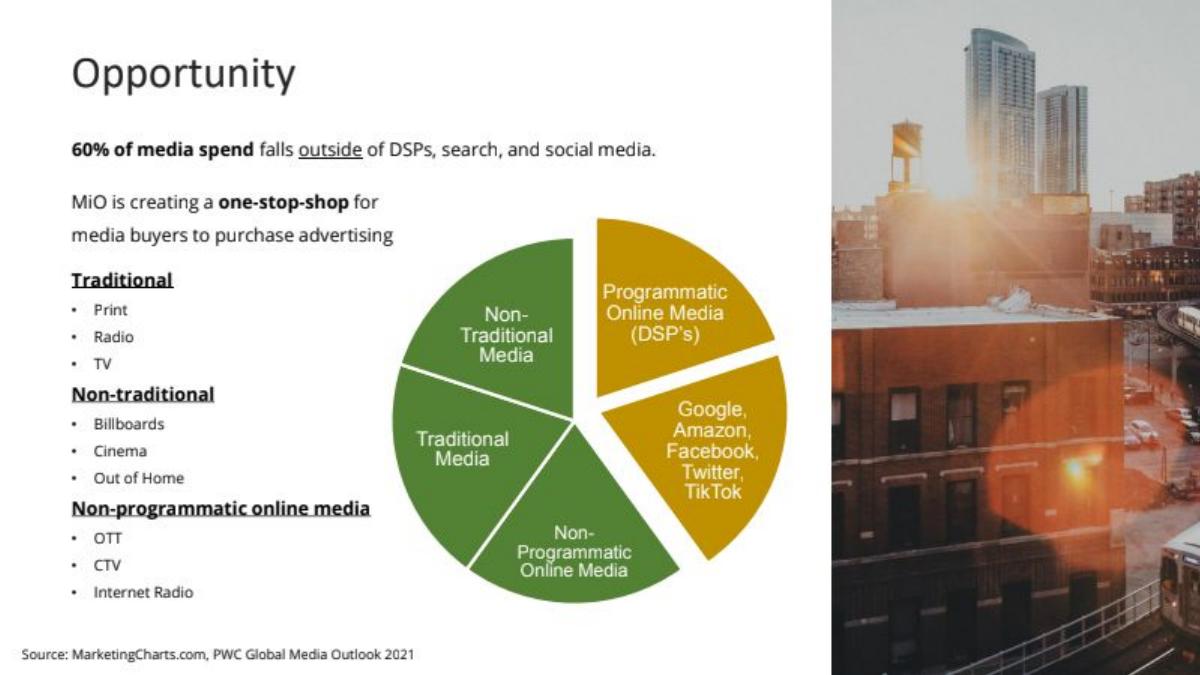
- The media industry is valued at nearly $1 trillion annually, with 60% of spend falling outside of DSPs, search, and social media (Slide 3, 6).
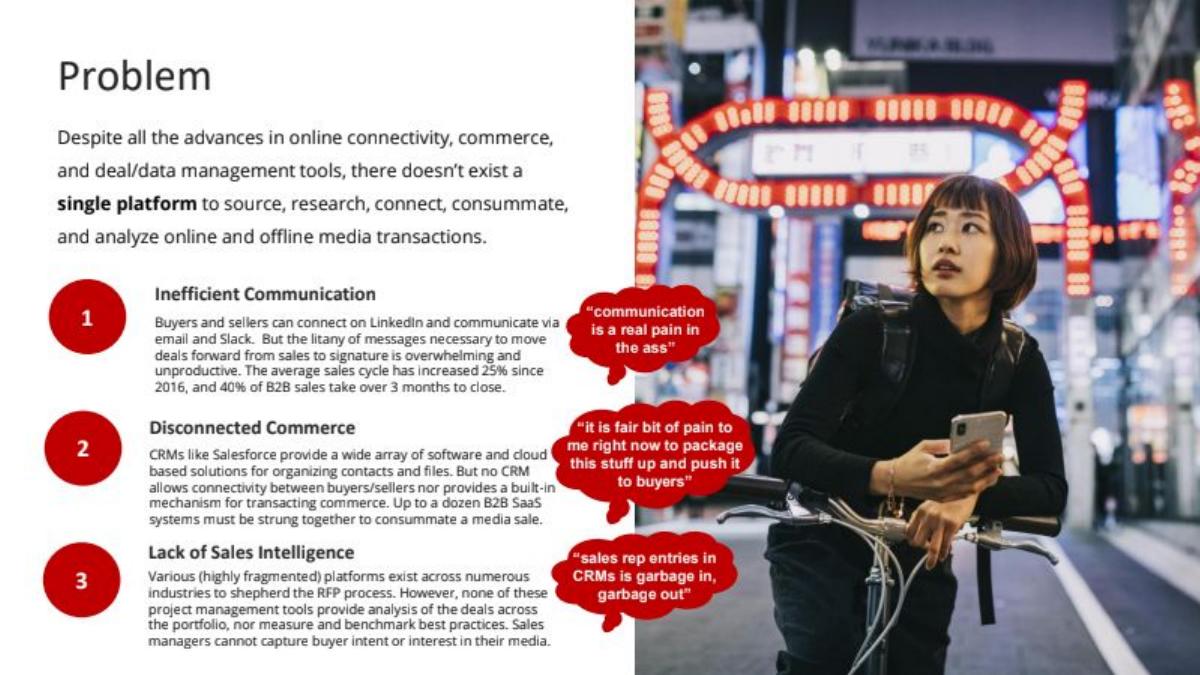
- MiO identifies a 'B2B sales dilemma' where 40% of sales take over 3 months to close due to inefficient communication and disconnected commerce (Slide 4).
- The platform operates on a B2B SaaS model where buyers join for free, while sellers pay monthly subscriptions starting at $995 for local markets (Slide 11).
- Market size is defined by $600B+ in target media categories and 25 million annual ad transactions (Slide 7).
- The company projects a rapid revenue climb from near-zero in 2022 to over $13 million in ARR by 2025 (Slide 13).
- Financing history includes $550K raised in 2022 with a seek for $150K in Spring 2023 at a $3.8M valuation (Slide 13).
- The 'Buyer First Strategy' leverages demand generation to attract buyers, which in turn forces sellers to adopt the platform (Slide 11).
- Traction is demonstrated through a list of media partners including iHeartMedia, Pandora, and SiriusXM, though specific contract values are not disclosed (Slide 12).
Executive Summary and Brand Identity
Slide 1: Title Slide
The deck opens with a bold red, black, and white color scheme. It defines MiO as 'A media marketplace and sales intelligence tool.' The acronym M-I-O is broken down as Marketplace, Intelligence, and Optimization. It explicitly states this is an 'Investment Overview' for 'Pre-Seed Financing.'
Slide 2: Evolution of Online Marketplaces
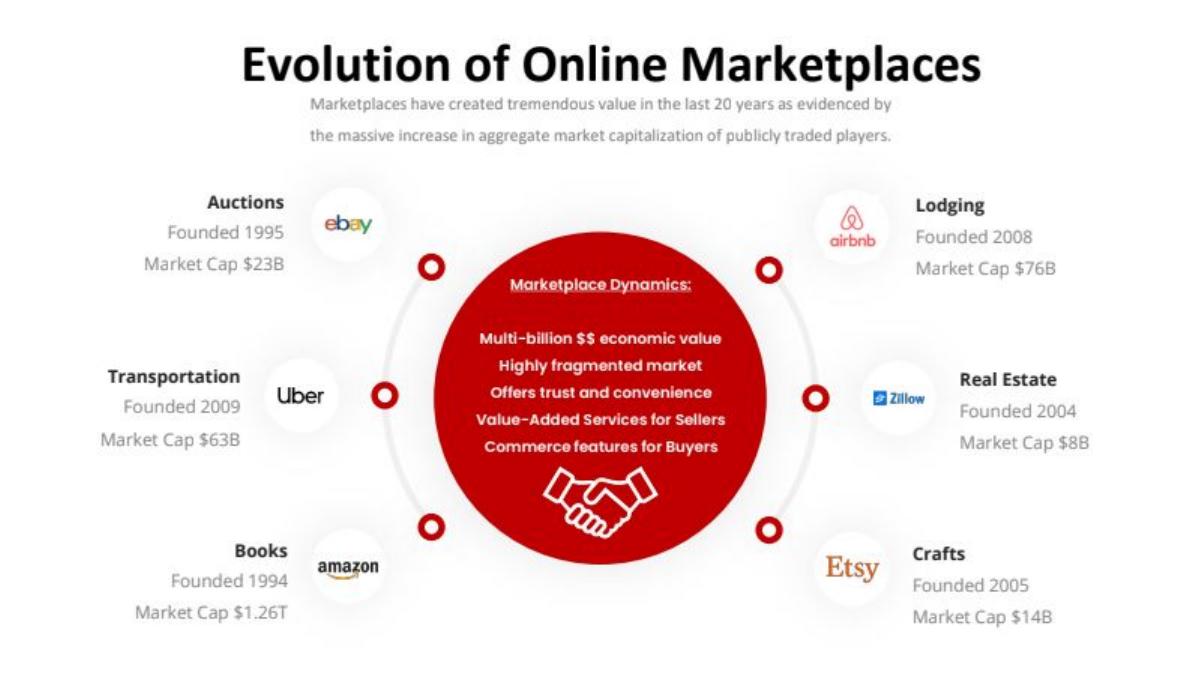
This slide contextualizes MiO by showing the historical success of marketplaces in other sectors. It lists eBay (Auctions, $23B), Airbnb (Lodging, $76B), Uber (Transportation, $63B), Zillow (Real Estate, $8B), Amazon (Books, $1.26T), and Etsy (Crafts, $14B). The central message is that marketplaces create 'multi-billion $$ economic value' in fragmented markets by offering trust, convenience, and value-added services.
The Problem and Market Opportunity
Slide 3: Vision & Mission
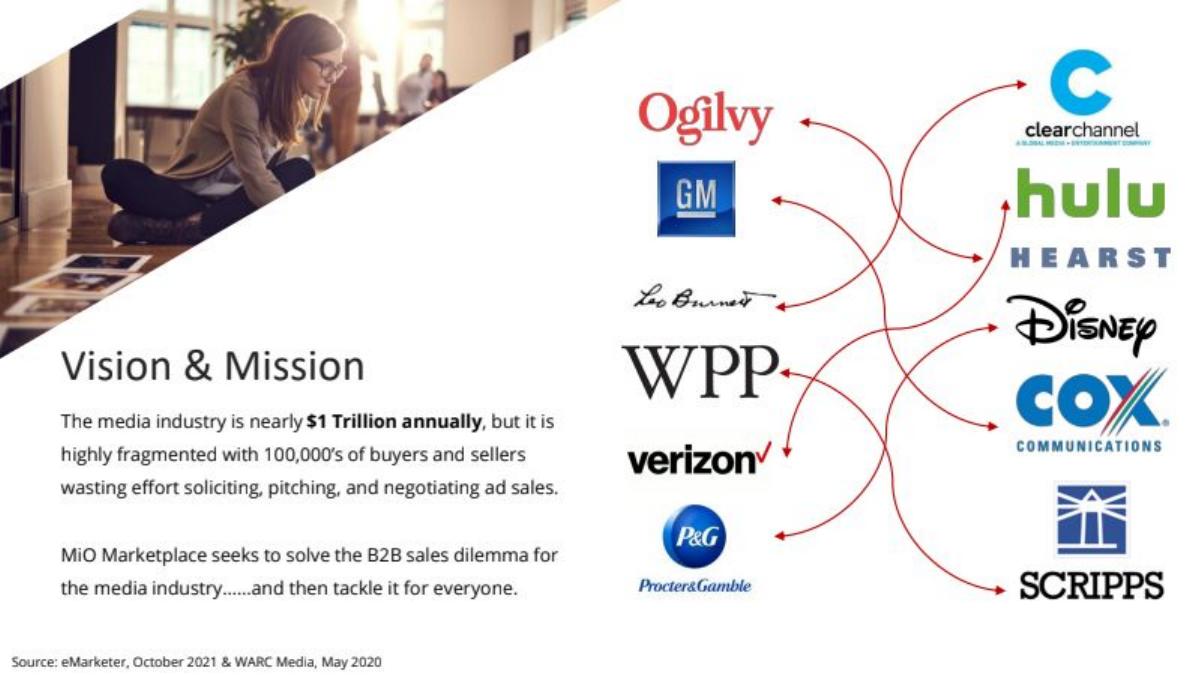
MiO identifies the media industry as a nearly $1 Trillion annual market . The core issue is fragmentation, with '100,000’s of buyers and sellers wasting effort soliciting, pitching, and negotiating ad sales.' The mission is to solve the 'B2B sales dilemma' for media first, then expand to other industries.
Slide 4: The Problem
The deck identifies three specific pain points: Inefficient Communication (sales cycles increased 25% since 2016), Disconnected Commerce (CRMs lack built-in transaction mechanisms), and Lack of Sales Intelligence (inability to capture buyer intent). It includes quotes like 'communication is a real pain in the ass' to emphasize user frustration.
Slide 5: The Solution
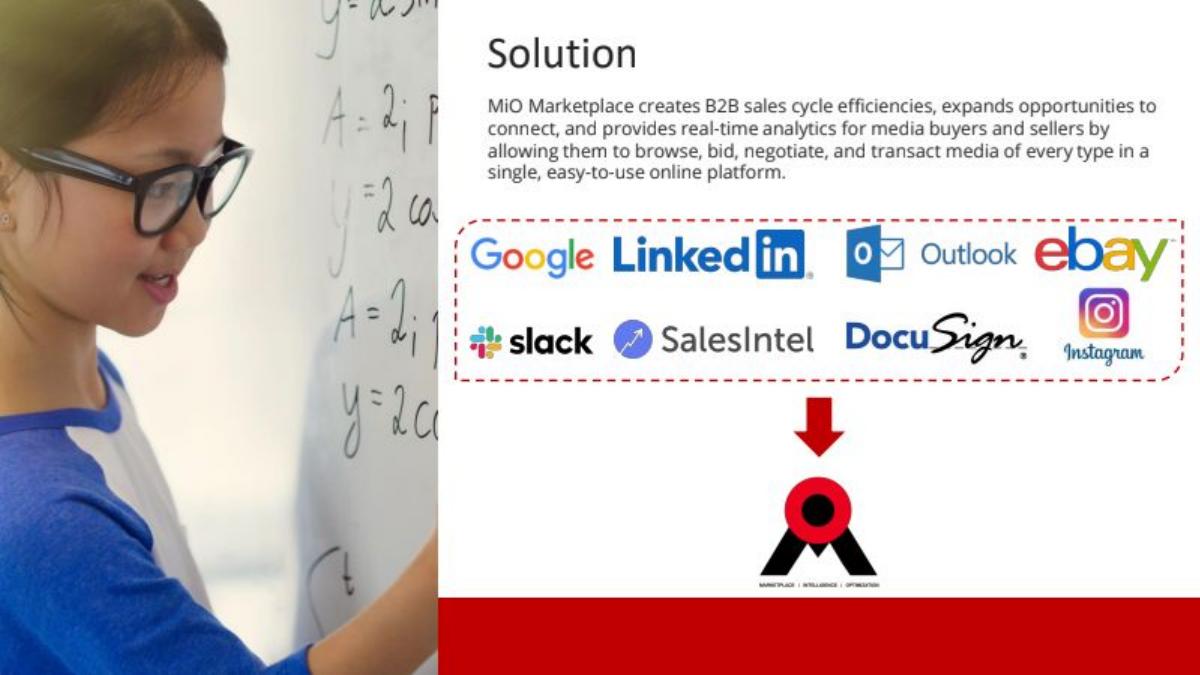
The solution is presented as a single platform where users can 'browse, bid, negotiate, and transact media of every type.' A graphic shows logos of various tools (Google, Slack, LinkedIn, DocuSign) being funneled into the MiO logo, suggesting it consolidates the functionality of these disparate tools into one workflow.
Slide 6: Opportunity
This slide highlights a massive gap in the current ad-tech landscape: 60% of media spend falls outside of DSPs, search, and social media. This includes traditional media (Print, Radio, TV), non-traditional (Billboards, Cinema), and non-programmatic online media (OTT, CTV, Internet Radio). MiO aims to be the 'one-stop-shop' for these categories.
Market Size and Competitive Positioning
Slide 7: Total Addressable Market (TAM)
The TAM is quantified with several large figures: $600+ Billion in total US ad spend in target categories, 600,000+ account executives, 25+ million annual transactions, and $10 Billion in annual wages for ad sellers. A table shows that 10% market penetration would yield $262mm in potential ARR and a $2.1B enterprise value at an 8x multiple.
Slide 8: Competitive Landscape
MiO uses a standard 2x2 matrix. The X-axis ranges from '1-Sided / No Commerce' to '2-Way Interaction / Marketplace.' The Y-axis ranges from 'Narrow Range of Media' to 'Broad Range of Media.' MiO places itself alone in the top-right quadrant, contrasting with Salesforce (top-left) and The Trade Desk (bottom-right).
Product Features and User Experience
Slide 9: Features for Buyers
This slide showcases the buyer interface on an iMac mockup. Key features include 'MiO Mailbox' (integrated chat), 'Like & Dislike' buttons for buyer insights, 'Fetch' (onsite search/concierge), and built-in DocuSign tracking. The goal is to make researching and transacting advertising as simple as a consumer e-commerce experience.
Slide 10: Intelligence for Sellers
The seller dashboard is shown, emphasizing data-driven sales. It lists tools for tracking 'Total Likes/Dislikes,' 'Saved Vendors,' and 'Total Revenue' (shown as $32,400 in the mockup). It also mentions heatmaps for tracking mouse movement and machine learning to optimize campaign visibility. A note indicates CRM integration was planned for Q4 2022.
Go-To-Market and Traction
Slide 11: Go-To-Market Strategy
The strategy is 'Buyer First.' By making the platform free for buyers and using demand generation to attract them, MiO creates a network effect that forces sellers to join. Pricing is transparent: sellers pay $995/month entry-level for local markets and $15k+/month for national. Transactions are currently free for both parties.
Slide 12: Traction
This slide displays logos of 'Media Partners to date' and 'Agency Partners to date.' Notable names include iHeartMedia, Pandora, SiriusXM, Tribune, and Lamar . Agency partners listed are Noble People and Mindstream Media Group. No specific transaction volumes or revenue figures are provided on this slide.
Financials and Team
Slide 13: Projections and Financing
A bar chart shows ARR projections: near-zero in 2022, roughly $2M in 2023, $5M in 2024, and $13M+ in 2025 . The financing section notes the founder bootstrapped in 2021-2022, raised $550K in 2022, and was seeking $150K in Spring 2023 at a $3.8M valuation. Use of funds includes software engineers, UX/UI designers, and a COO.
Slide 14: Founder
Sean Halter is the Founder & CEO. His bio emphasizes 20 years in the industry, building and exiting multiple multi-million dollar companies, and hosting 'The CMO Suite' podcast. This establishes significant domain expertise and a strong network.
Slide 15: Board of Directors
The board includes Sri Rajagopalan (Chief Customer Officer, General Mills), Todd Schnitt (Media Personality/Investor), Paul Willett (Connectivity Holdings CFO), and Matt Brown (SaaS Advisor). This adds corporate and financial credibility to the startup.
Slide 16: Contact
A simple contact slide with Sean Halter’s email and the company website.
What Works and What is Missing
What Works
Clear Market Gap: The deck does an excellent job of proving that 60% of the market is underserved by current digital-only tools. · Transparent Pricing: Unlike many SaaS decks that hide pricing, MiO clearly states their $995/month entry point and $15k/month national tier. · Domain Authority: The founder's 20-year background and podcast reach suggest he has the 'unfair advantage' of industry connections. · Logical GTM: The 'Buyer First' strategy is a classic and effective way to solve the cold-start problem in a marketplace.
What is Missing
Historical Financials: While projections are provided, there is no slide showing actual revenue or growth rates from the $550K already raised in 2022. · Unit Economics: There is no mention of Customer Acquisition Cost (CAC) or Lifetime Value (LTV), which are critical for a B2B SaaS model. · Product Depth: The mockups are high-level. More detail on how the 'negotiation' and 'bidding' actually works within the platform would be beneficial. · Case Studies: While logos are shown, a specific case study showing how a buyer saved time or a seller increased yield would strengthen the 'Intelligence' claim.
What a Founder Should Copy
The 'Evolution' Slide: Using Slide 2 to show that your business model is a proven winner in other categories is a great way to de-risk the 'concept' for investors. · The TAM Breakdown: Slide 7 doesn't just give one big number; it breaks the market down by transactions, wages, and account executives, making the $600B figure feel more grounded. · Direct Ask: Slide 13 clearly states the valuation and the specific amount being sought, which facilitates faster investor decision-making.
Frequently asked questions
- What is the core problem MiO Marketplace is solving?
- MiO addresses the lack of a single platform to source, research, and transact both online and offline media. They cite that the average sales cycle has increased 25% since 2016, and current CRM tools like Salesforce do not provide the built-in commerce mechanisms or sales intelligence needed for complex media deals.
- How does MiO Marketplace make money?
- The business uses a B2B SaaS model. Buyers (agencies and brands) can join and transact for free. Revenue is generated from sellers (media companies) who pay monthly subscriptions. Entry-level local market access is $995/month, while national access is priced at $15k+/month.
- What is the competitive landscape for MiO?
- MiO positions itself in the upper-right quadrant of a competitive matrix, defined by a 'Broad Range of Media' and '2-Way Interaction / Marketplace.' It competes against general CRMs like Salesforce, narrow media marketplaces like OpenX or The Trade Desk, and 1-sided tools like Briefbid.
- What are the company's financial projections?
- The deck projects significant growth, targeting over $13 million in Annual Recurring Revenue (ARR) by 2025. This is based on a market penetration model where even 0.5% penetration of their target seller market results in $13M ARR.
- Who is leading the company and what is their background?
- The company is led by Founder & CEO Sean Halter, who has 20 years of experience in the media and marketing industry. He has previously built and exited multiple multi-million dollar companies and hosts 'The CMO Suite' podcast. The board includes executives from General Mills and Connectivity Holdings.