Misha's Kind Foods successfully raised $3M in 2021 by positioning their plant-based cheese as a 'clean label' solution to the poor taste and unhealthy fillers found in existing dairy alternatives. The deck leans heavily on the founders' culinary and entrepreneurial backgrounds, supported by a high-profile advisory board including the Executive Chef of Beyond Meats. While the deck lacks specific unit economics or a detailed breakdown of the $3M use of funds, it provides strong evidence of product-market fit through its presence in 43 local retailers and 5 major Southern California farmers mark…
Key takeaways
- The company identifies a specific market gap: alternative cheeses that taste like 'fake cheese' and contain unhealthy fillers (Slide 2).
- Product validation is provided through high-resolution imagery of four flavors—Sari, Seven Point Five, Lox, and Joi—alongside their actual nutrition facts and ingredient lists (Slide 3).
- The brand leans into ten specific dietary certifications, including Vegan, Keto, Paleo, and Kosher, to maximize market reach (Slide 4).
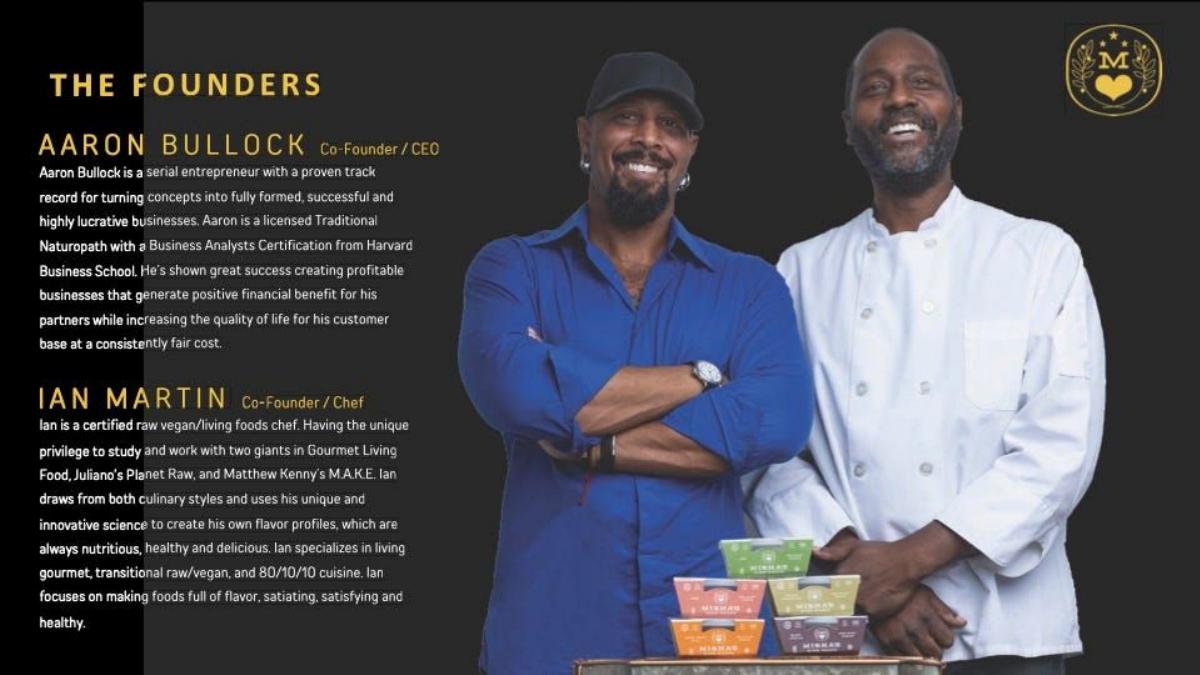
- The founding team combines business experience (Aaron Bullock, Harvard Business School certification) with specialized culinary expertise in raw vegan cuisine (Ian Martin) (Slide 5).
- The advisory board includes significant industry weight, specifically Dave Anderson, the Executive Chef of Beyond Meats (Slide 6).
- Market data highlights that 88% of the 43 million regular plant-based protein consumers in the US do not consider themselves vegan or vegetarian (Slide 7).
- At the time of the pitch, the company was producing 1,000+ spreads per week and wholesaling to 43 local retailers (Slide 9).
- The deck explicitly lists target major retailers for their January rollout, including Whole Foods, Ralphs, Vons, Safeway, and Sprouts (Slide 9).
The Clean Label Strategy for Plant-Based Dairy
Misha's Kind Foods entered the market during a period of intense interest in plant-based alternatives. However, unlike many tech-heavy 'lab-grown' food startups, this deck presents a culinary-first approach. By focusing on the 'Clean Label' movement, the founders addressed a growing consumer backlash against highly processed vegan foods. The deck is structured to move from the sensory problem (taste and texture) to the health problem (fillers and gums) before presenting their artisanal solution.
Slide 1: Title and Brand Identity
The opening slide establishes a premium, 'artisan-crafted' brand identity. The logo prominently features 'Los Angeles' and 'California,' leveraging the region's reputation as a hub for health-conscious food trends. The sub-header lists eight dietary claims: Dairy Free, Gluten Free, Lactose Free, Non-GMO, Vegan, Paleo, Keto, and Kosher. This immediately signals to investors that the product has a broad Total Addressable Market (TAM) across multiple dietary niches.
Slide 2: The Challenge
The problem statement is blunt. It characterizes existing alternative cheeses as tasting like 'fake cheese' with poor 'mouth feel.' More importantly, it attacks the ingredient deck of competitors, citing 'unhealthy fillers, yeasts, soy, gums and more.' This sets the stage for Misha's to present itself as the healthy, natural alternative in a crowded category.
Slide 3: Misha's Flavors and Transparency
This is a critical slide for a CPG (Consumer Packaged Goods) deck. It shows four specific products: Sari (Sun-dried tomatoes, roasted garlic, cilantro), Seven Point Five (Jalapeno, habanero, strawberries), Lox (Dill, capers, roasted carrots), and Joi (Jalapeno, oregano, thyme). By including the actual Nutrition Facts panels and ingredient lists, the company proves its 'Clean Label' claim. Investors can see that the base consists of cashews and almonds rather than processed starches or oils.
Slide 4: Clean Label Certifications
Slide 4 reinforces the dietary versatility mentioned in the intro. By listing ten distinct categories—including Soy Free, which was not on the cover—the company positions itself to capture consumers with multiple allergies or specific lifestyle diets (like Keto or Paleo) who are often underserved by standard vegan products.
Slide 5: The Team
The deck highlights a balance between business and craft. Aaron Bullock is positioned as the 'serial entrepreneur' with the 'proven track record' and a Harvard Business School certification. Ian Martin is presented as the culinary engine, with experience at 'Juliano's Planet Raw' and 'Matthew Kenney's M.A.K.E.' This combination suggests the company can both create a superior product and manage the complexities of a scaling business.
Slide 6: The Advisors
For a Seed round, a strong advisory board acts as a proxy for de-risking. Misha's includes Dave Anderson, the Executive Chef of Beyond Meats, and Reed Glidden, the founder of Beanfield Chips. Having industry veterans from successful plant-based exits or high-growth companies provides significant credibility to the founders' operational plans.
Slide 7: Market Demand
This slide uses third-party data to justify the timing of the investment. It notes that 43 million people in the US regularly eat plant-based proteins, and crucially, 88% of them do not identify as vegan or vegetarian. This 'flexitarian' market is where the largest growth potential lies, and the deck uses this stat to show that Misha's isn't just for a small niche of vegans.
Slide 8: Plant-Based Sales Growth
Using data from The Good Food Institute, this slide shows that 'Other plant-based dairy' (the category including cheese) is the second-largest segment in the plant-based market, with $1,234m in annual sales as of April 2019. This provides the 'Why Now?' context, showing that while plant-based milk is mature, the dairy alternative space still has massive room for growth.
Slide 9: Traction and Future Roadmap
The final visible slide provides the 'Proof of Life.' The company was producing 1,000+ units per week and had already secured 43 local retail accounts and 5 farmers markets. The most compelling part of this slide is the list of major retailers for the upcoming January rollout: Whole Foods, Ralphs, Vons, Safeway, and Sprouts. This indicates that the $3M Seed round was likely intended to fund the inventory and marketing required to support these large-scale retail launches.
What Works in This Deck
Transparency: Showing the actual nutrition labels (Slide 3) is a bold move that builds immediate trust. In an industry where 'natural' is often a marketing term, Misha's provides the data to back it up.
Strategic Advisor Placement: Including the Executive Chef of Beyond Meats (Slide 6) is a powerful signal. It suggests that the product quality has been vetted by one of the most successful individuals in the plant-based sector.
Regional Validation: The deck shows a clear 'beachhead' strategy. By dominating Southern California farmers markets and local retailers first (Slide 9), they created a repeatable model that investors could see scaling to other regions.
What Is Missing
Unit Economics: There is no mention of the cost to produce a single tub of cheese versus the wholesale and retail price points. Investors in CPG need to see that the margins can sustain the high costs of retail slotting fees and refrigerated logistics.
Competitive Matrix: While the deck mentions that 'most alternative cheeses' are bad, it doesn't name specific competitors (like Miyoko's or Kite Hill) or explain how Misha's specifically wins on price or shelf-life against them.
Detailed Use of Funds: The deck ends with a high-level 'Future' section but lacks a slide detailing exactly how the $3M will be spent. A breakdown of spend across 'Production Scaling,' 'Marketing/Demos,' and 'Team Expansion' would have strengthened the pitch.
Founder's Playbook: Lessons from Misha's
Leverage the 'Flexitarian' Angle: If you are building a vegan product, don't just pitch to vegans. Follow Misha's lead on Slide 7 and show that your product appeals to the 88% of consumers who are simply looking for healthier or tastier options, regardless of their dietary label.
Show, Don't Just Tell: Instead of saying your food is healthy, show the ingredient list. Misha's use of high-quality food photography paired with the actual packaging labels is a best practice for any food startup.
Build a 'Moat' via Advisors: If your team is young or lacks deep industry exits, recruit advisors who have them. The presence of a Beyond Meat executive on the advisory slide likely did more to close the round than any single market growth chart could have done.
Frequently asked questions
- How much did Misha's Kind Foods raise with this deck?
- As reported by Business Insider, Misha's Kind Foods raised a $3M Seed round in 2021 using this presentation. The deck itself focuses on the growth trajectory and retail expansion plans rather than stating the specific dollar amount requested on the visible slides.
- What is the primary competitive advantage claimed by the founders?
- The primary advantage is 'Clean Label' formulation. Slide 2 argues that competitors use unhealthy fillers, yeasts, soy, and gums. Misha's counters this by showing labels (Slide 3) that use recognizable ingredients like cashews, almonds, and various herbs and vegetables.
- Who are the key people behind the company?
- The company was co-founded by CEO Aaron Bullock, a serial entrepreneur with a Harvard Business School certification, and Chef Ian Martin, who specialized in raw vegan/living foods. They are supported by advisors from Beyond Meats and Beanfield Chips.
- What does the traction look like in the deck?
- Traction is demonstrated by a production volume of over 1,000 units per week, presence in five Southern California farmers markets, and wholesale contracts with 43 local retailers and six food service accounts (Slide 9).
- What is missing from this pitch deck?
- The deck omits specific unit economics (COGS, margins), a detailed competitor matrix, and a clear 'Ask' slide detailing how the $3M would be allocated across marketing, R&D, and operations.