Minut’s Series B deck is a study in restraint, utilizing only eight slides to secure $14M in funding. Operating at the intersection of hardware and SaaS for the hospitality industry, the deck bypasses traditional problem/solution narratives to focus almost entirely on proof of scale and customer satisfaction. The core of the presentation lies in Slide 5, which showcases elite-tier SaaS metrics including Net Revenue Retention (NRR) over 200% and monthly churn below 0.5%. By positioning their hardware as a 'co-host' rather than just a sensor, Minut successfully framed their product as an essent…
Key takeaways
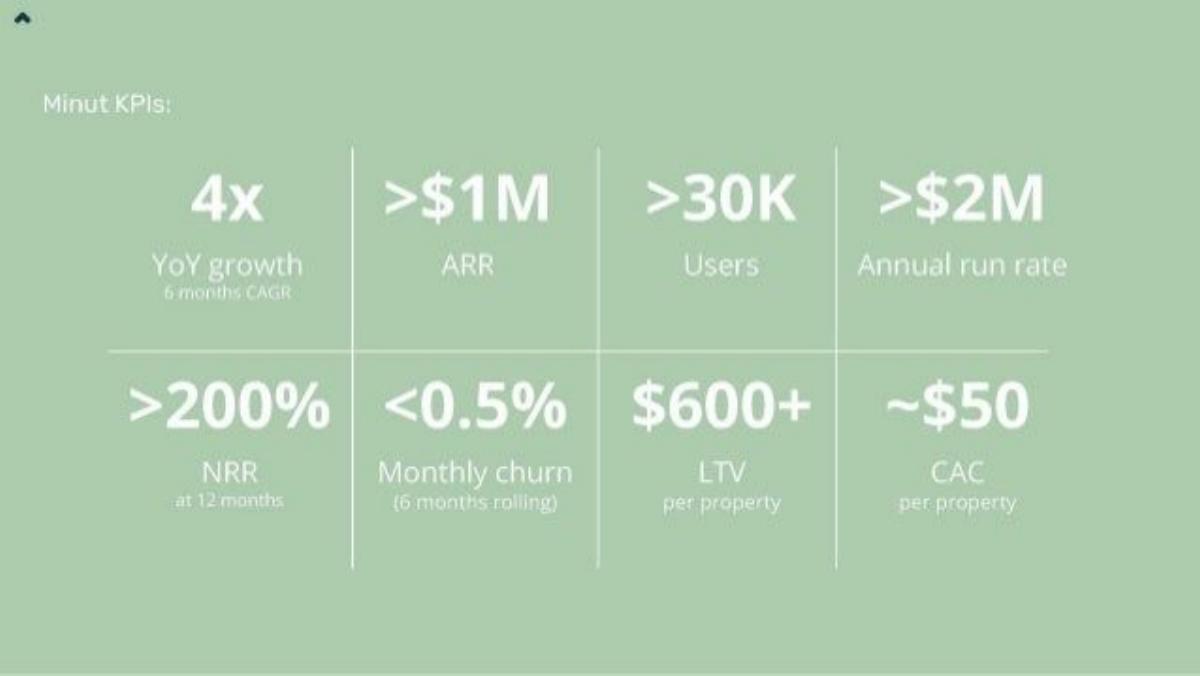
- The company reports a Net Revenue Retention (NRR) of over 200% at the 12-month mark on Slide 5.
- Monthly churn is maintained at an exceptionally low rate of less than 0.5% based on a 6-month rolling average (Slide 5).
- Minut claims a 4x Year-over-Year growth rate based on a 6-month CAGR (Slide 5).
- The business model demonstrates strong unit economics with a Lifetime Value (LTV) per property of $600+ against a Customer Acquisition Cost (CAC) of ~$50 (Slide 5).
- The product is positioned as a 'co-host' that monitors noise, occupancy, and security without invading guest privacy (Slide 3).
- The company has reached a scale of over 30,000 users and an annual run rate exceeding $2M (Slide 5).
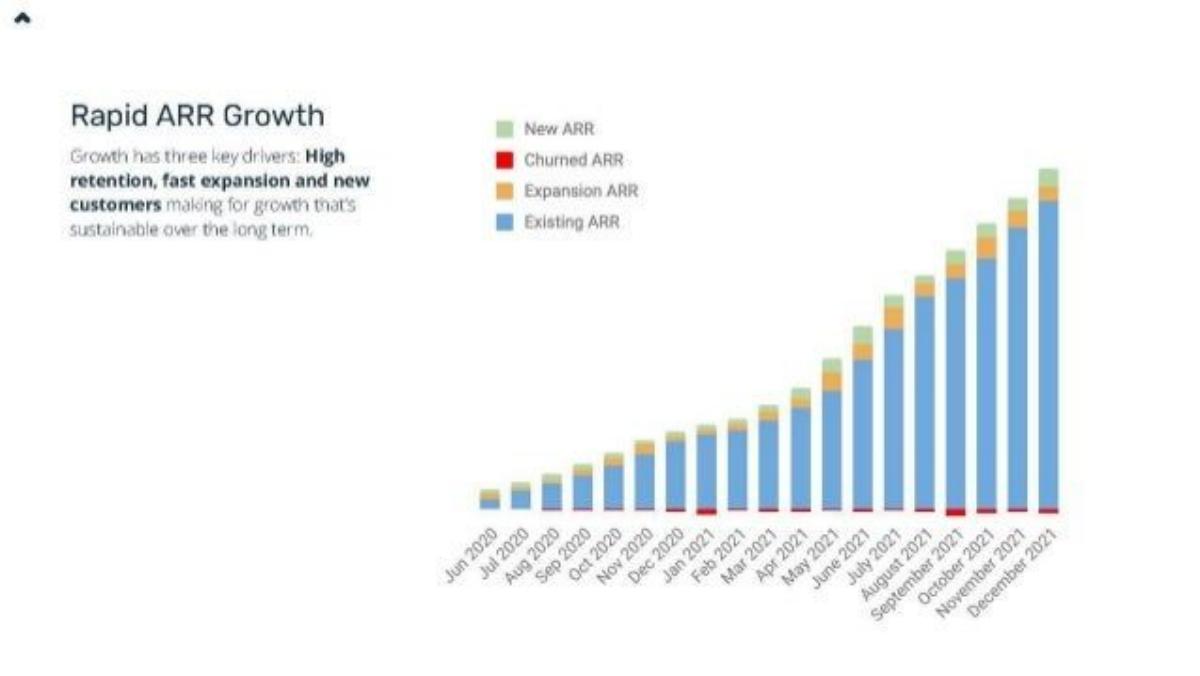
- Revenue growth is driven by a combination of new customers and significant expansion from existing accounts, as visualized in the ARR growth chart (Slide 6).
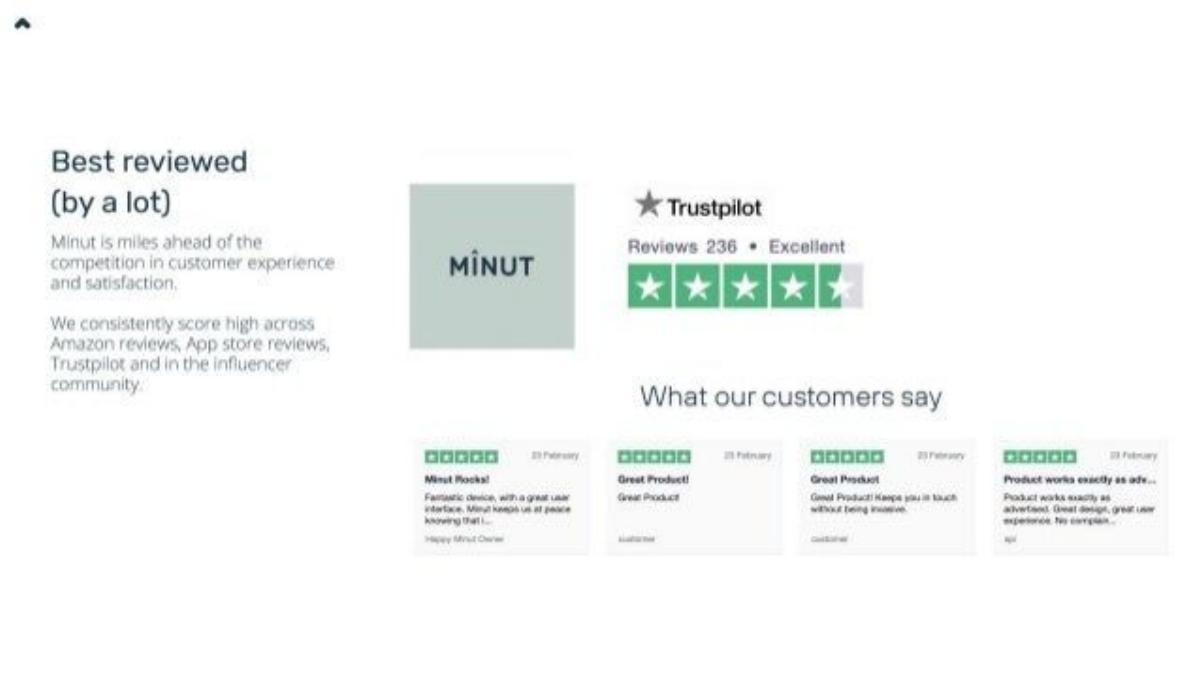
- The deck relies heavily on social proof, citing 236 'Excellent' reviews on Trustpilot and high scores on Amazon and the App Store (Slide 4).
The Power of Brevity in Series B Fundraising
Minut’s 2022 Series B deck is an anomaly in the world of venture capital. While most companies at this stage produce 20-30 slides detailing every facet of their operations, Minut used just eight. This brevity suggests a high level of confidence in the underlying data. When your Net Revenue Retention is over 200%, you don't need forty slides to convince an investor that your product has market fit. This teardown examines how Minut used a minimalist aesthetic and dense unit economics to secure $14M.
Slides 1-2: Brand Identity and Product Visuals
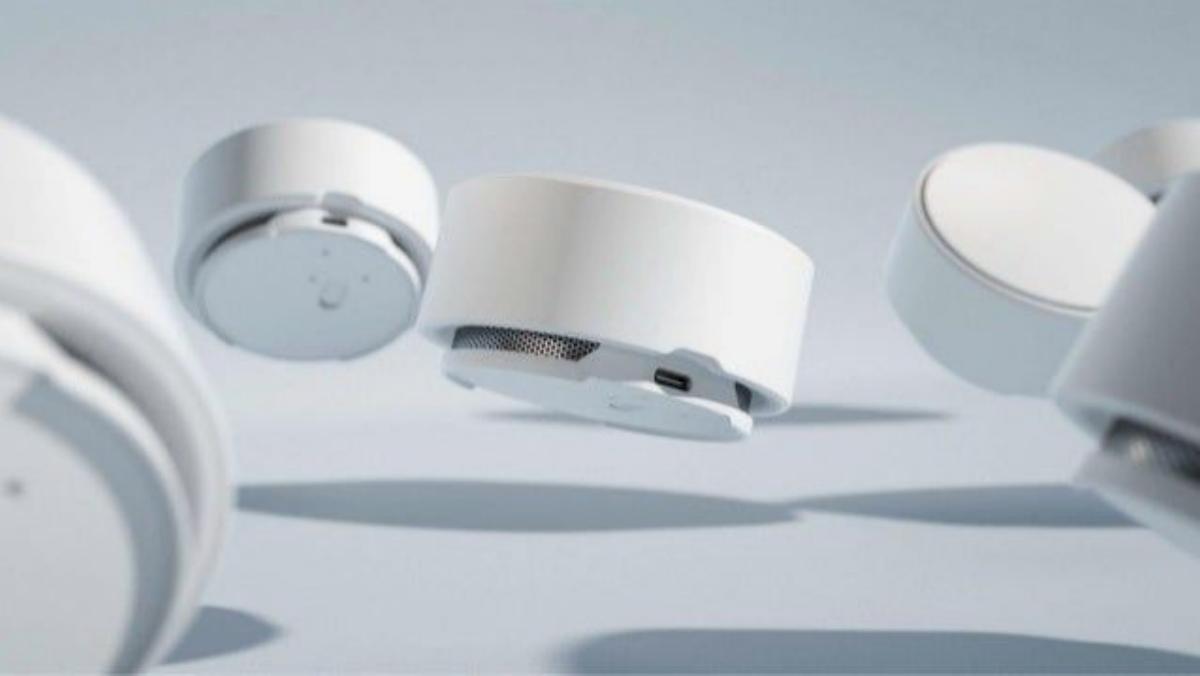
The deck opens with a clean, minimalist title slide featuring the Minut logo and the simple subtitle 'Investor Deck.' There are no taglines or mission statements here. Slide 2 follows immediately with a high-quality product shot. It shows several white, puck-shaped devices floating in a stylized space. This slide establishes the hardware component of the business immediately. The design is sleek and unobtrusive, which aligns with the company's later claims about 'caring for privacy and comfort.' By leading with the physical product, Minut grounds the digital service in a tangible asset.
Slide 3: Positioning as the 'Co-Host'
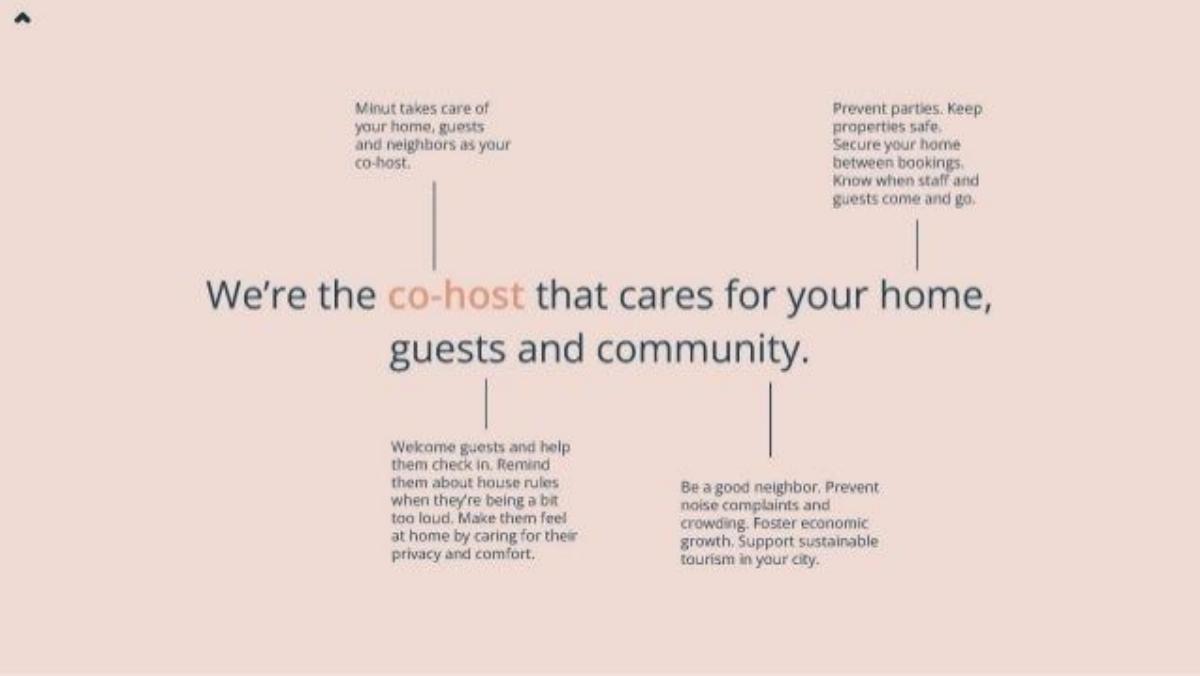
On Slide 3, Minut defines its role in the ecosystem. The central statement is: 'We’re the co-host that cares for your home, guests and community.' This is a strategic piece of positioning. They are not a 'security camera' or a 'noise sensor'; they are a 'co-host.' This language appeals to the emotions and operational needs of vacation rental owners. The slide uses four callouts to detail the service:
Property Care: Taking care of home, guests, and neighbors. · Safety: Preventing parties, securing homes between bookings, and tracking staff/guest arrivals. · Guest Experience: Helping with check-ins and reminding guests about house rules regarding noise. · Community Impact: Preventing noise complaints and fostering sustainable tourism.
This slide successfully bridges the gap between a piece of hardware and a comprehensive property management solution.
Slide 4: Social Proof and Customer Sentiment
Slide 4 focuses on validation. Titled 'Best reviewed (by a lot),' it claims that Minut is 'miles ahead of the competition in customer experience and satisfaction.' The evidence provided includes:
A Trustpilot rating of 'Excellent' with 236 reviews. · Mentions of high scores on Amazon, the App Store, and within the influencer community. · Four specific customer testimonials.
One testimonial, from a 'Happy Minut Owner,' describes it as a 'Fantastic device, with a great user interface.' Another notes that the product 'keeps you in touch without being invasive.' This reinforces the privacy-first angle mentioned earlier in the deck.
Slide 5: The 'Money Slide' - Key Performance Indicators
Slide 5 is the most critical part of the deck. It presents eight high-impact KPIs that justify a Series B valuation. The figures quoted are:
4x YoY growth: Based on a 6-month CAGR. · >$1M ARR: A baseline for the subscription revenue. · >30K Users: Demonstrating significant market penetration. · >$2M Annual run rate: Indicating the current pace of the business. · >200% NRR: Net Revenue Retention at 12 months. This is an elite metric, suggesting that existing customers are rapidly expanding their use of Minut. · Based on a 6-month rolling average. This indicates extremely high product stickiness. · $600+ LTV per property: The lifetime value of a single installation. · ~$50 CAC per property: The cost to acquire that property.
The LTV/CAC ratio here is roughly 12:1, which is exceptional. Most VCs look for a 3:1 ratio as a benchmark for a healthy SaaS business. At 12:1, Minut is demonstrating that they can grow very efficiently.
Slide 6: Visualizing ARR Growth
Slide 6 provides a bar chart showing 'Rapid ARR Growth' from June 2020 to December 2021. The chart is color-coded to show four components: New ARR, Churned ARR, Expansion ARR, and Existing ARR. The visual confirms the 'Expansion' story told by the 200% NRR figure on the previous slide. The 'Expansion ARR' (yellow) and 'New ARR' (green) segments grow consistently over time, while the 'Churned ARR' (red) remains a negligible sliver at the bottom of the bars. This chart proves that the growth is not just coming from new sales, but from a deepening relationship with the current customer base.
Slides 7-8: Closing and External Links
Slide 7 is a purely visual transition, showing a yellow door with a heart-shaped outline superimposed over it. This likely references the 'community' and 'home' aspects of the brand. Slide 8 is a standard promotional slide for the platform where this deck was hosted (bestpitchdeck.com), which is not part of the original Minut presentation. Notably, the deck ends without a team slide, a roadmap, or a specific funding request.
What Minut Does Well
The primary strength of this deck is its data density . By Slide 5, an investor has all the mathematical proof they need to understand that the business is working. The combination of high NRR and low churn is the 'holy grail' of SaaS metrics, and Minut puts them front and center. Furthermore, the positioning is excellent. By using the term 'co-host,' they move away from the 'security' category—which can feel negative or invasive—and into the 'hospitality' category, which feels supportive and value-additive.
What is Missing
This deck is clearly a 'teaser' or a 'supplemental' deck rather than a full pitch. The most glaring omissions are:
The Team: There is no mention of the founders or their backgrounds. At Series B, investors usually want to see a seasoned leadership team capable of scaling to Series C and beyond. · The Competition: There is no mention of other players in the noise-monitoring or home-security space. · The Ask: The deck does not state how much money is being raised or how it will be spent. (We know from catalogue facts it was $14M, but it isn't on the slides). · The Technology: There is no explanation of how the device works or what proprietary IP protects it from being copied by larger consumer electronics firms.
What a Founder Should Copy
Founders should emulate Minut’s clarity of metrics . If you have strong NRR and LTV/CAC figures, do not bury them on Slide 15. Make them the centerpiece of your presentation. Additionally, the visual consistency of this deck is professional and calming. It uses a muted color palette that feels more like a lifestyle brand than a tech company, which fits the hospitality sector perfectly. Finally, the focus on expansion revenue is a powerful narrative for Series B. Showing that your current customers want more of your product is the best way to de-risk a large investment for a VC.
Frequently asked questions
- What is Minut's primary value proposition?
- Minut positions itself as an automated 'co-host' for short-term rental owners. According to Slide 3, the device monitors properties to prevent parties, secure homes between bookings, and manage noise complaints. Crucially, it emphasizes guest privacy and comfort, distinguishing itself from invasive camera-based security systems by focusing on environmental data like noise levels and occupancy.
- How strong are Minut's financial metrics?
- The metrics presented on Slide 5 are top-tier for a Series B company. With an NRR of >200%, the company is effectively doubling its revenue from existing customers every year. This is paired with a very low monthly churn of <0.5% and a highly efficient LTV/CAC ratio of 12:1 ($600 LTV vs. $50 CAC), indicating a very healthy and scalable customer acquisition engine.
- Who is the target customer for Minut?
- Based on the catalogue facts and Slide 3, Minut targets the hospitality and vacation rental sectors. This includes individual B2C hosts and likely property management companies who need to maintain 'sustainable tourism' and 'good neighbor' relations by preventing loud parties and overcrowding in residential areas.
- What is missing from this pitch deck?
- This is a very lean deck that omits several standard elements. There is no team slide, no competitive landscape analysis, no detailed technology roadmap, and no specific 'ask' regarding the $14M round. It functions more as a 'traction teaser' or a high-level summary for investors who are already familiar with the space or the founding team.
- How does Minut handle the hardware vs. software balance?
- While the product is a physical sensor (shown on Slide 2), the deck focuses heavily on SaaS metrics. Slide 6 tracks 'Rapid ARR Growth,' and the business model is listed as SaaS. This suggests that the hardware is a gateway to a recurring subscription service, which is a preferred model for VCs compared to one-off hardware sales.