Mirakl’s Series E deck is a textbook example of late-stage fundraising where the primary goal is to demonstrate market dominance and scalability rather than basic product-market fit. By 2021, Mirakl had already established itself as the leader in enterprise marketplace software, and the deck reflects this by leading with macro-economic trends—specifically how marketplaces grew at 2x the rate of core e-commerce during the pandemic. The deck leans heavily on social proof, featuring logos like Kroger, Airbus, and Carrefour, and highlights a 'shared success model' that saw their valuation double…
Key takeaways
- Slide 2 uses a comparative growth chart to show Enterprise Marketplaces growing at 81% YoY vs. 40% for Core eCommerce in Q4 2020.
- The deck highlights a massive $400M previously raised from top-tier firms like Bain Capital and Permira on Slide 7.
- Social proof is the core engine of this deck, featuring logos from Kroger, Urban Outfitters, and Airbus across Slides 7, 11, and 13.
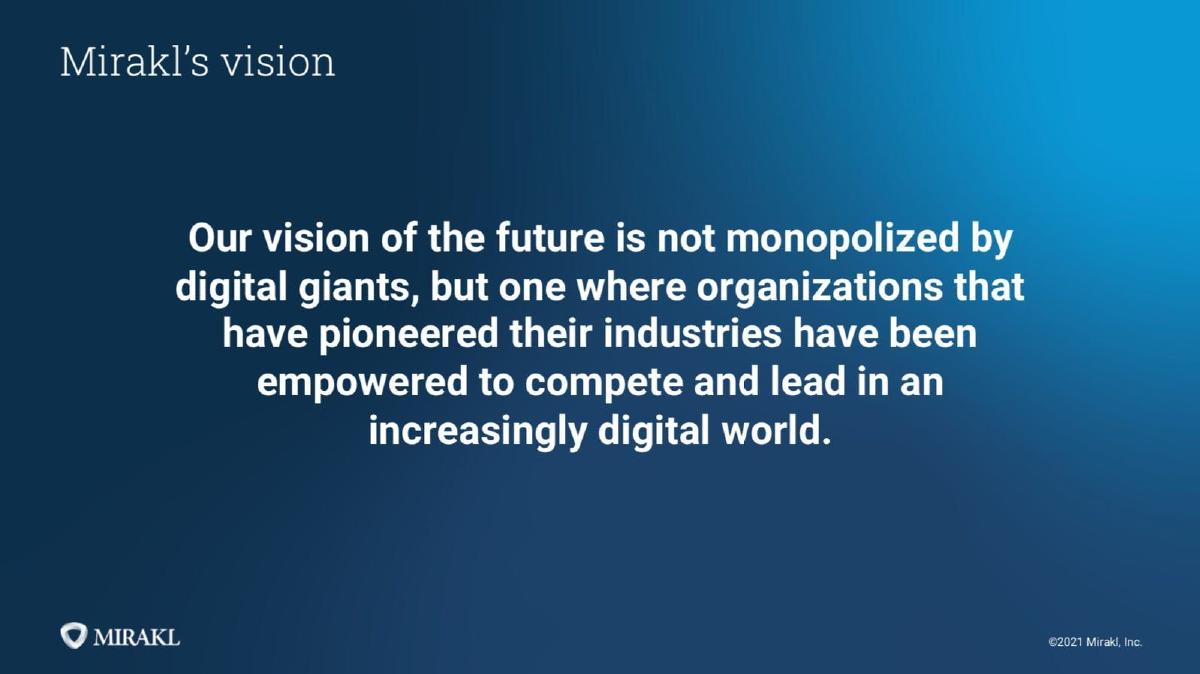
- Slide 5 articulates a 'David vs. Goliath' vision, positioning Mirakl as the tool for legacy organizations to compete against digital monopolies.
- The solution is framed as a three-pillar offering: Technology, Expertise, and Ecosystem, as detailed on Slide 9.
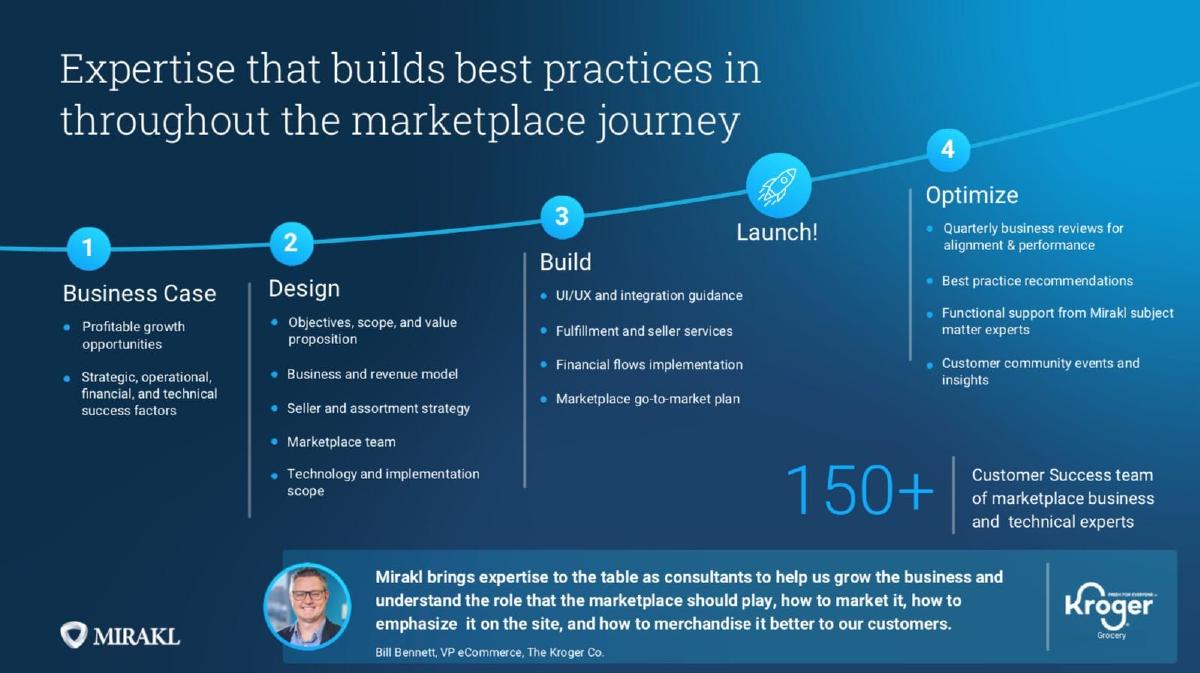
- Slide 11 outlines a four-stage client journey (Business Case, Design, Build, Optimize) to demonstrate a repeatable enterprise sales motion.
- The deck cites a 'Customer Success team of 150+ marketplace business and technical experts' on Slide 11 to emphasize service depth.
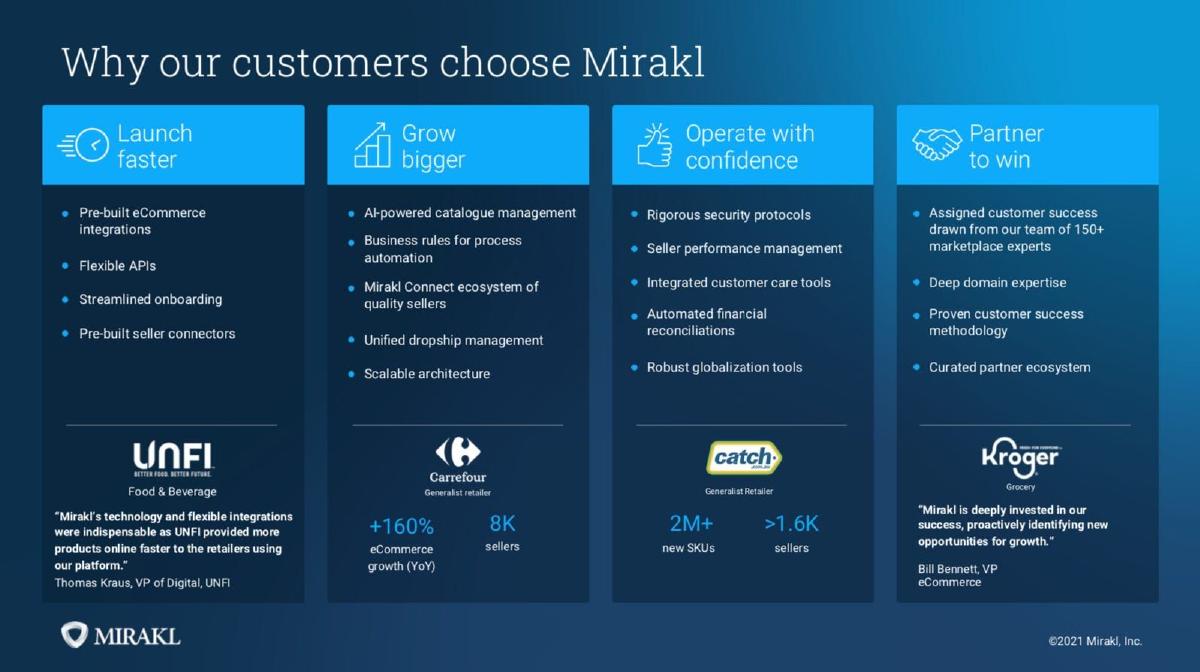
- Specific client outcomes are quantified on Slide 13, such as Carrefour achieving +160% eCommerce growth and 8K sellers.
The Series E Narrative: Scaling a Category Leader
Mirakl’s 2021 pitch deck is a masterclass in enterprise positioning. Raising $555M is no small feat, and the deck reflects a company that is no longer introducing itself, but rather asserting its dominance. The publisher-reported facts indicate this was a Series E round in the E-commerce and Enterprise software sector, based in Europe. The deck’s primary objective is to show that Mirakl is the infrastructure layer for the global shift toward third-party marketplace models.
Slide 1: The Opening Statement
Slide 1 sets a corporate, authoritative tone. The tagline, "The Marketplace Choice of the World's Most Trusted Brands," immediately signals that Mirakl is an enterprise-grade solution. The background imagery of the earth from space is a common trope for companies signaling global scale and ambition.
Slides 2-3: The Macro Opportunity
Slide 2 is perhaps the most important slide for justifying a high valuation. It presents a line chart comparing "Enterprise Marketplaces" to "Core eCommerce." The data, sourced from Mirakl's own Enterprise Marketplace Index, shows that while core e-commerce grew by 40% in Q4 2020, marketplaces grew by 81% . In Q2 2020, the gap was even wider (138% vs. 56%). This slide tells investors: "We are in the fastest-growing sub-sector of a fast-growing industry." Slide 3 continues this trend, reinforcing the marketplace growth narrative.
Slide 4: Third-Party Validation
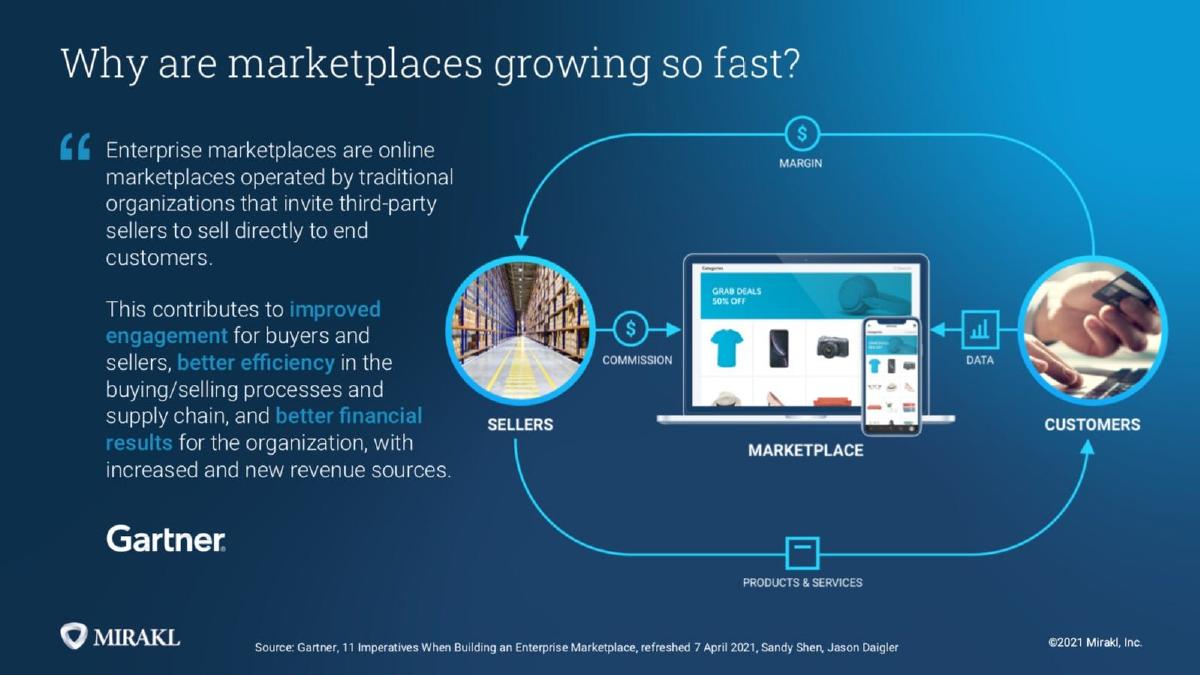
Slide 4 utilizes a Gartner quote. In enterprise software, Gartner is the ultimate gatekeeper. While the specific text isn't detailed in the summary, the inclusion of a Gartner slide is a standard 'check-the-box' requirement for Series D+ rounds to prove that industry analysts recognize the company as a leader in its quadrant.
Slide 5: The Vision and Mission
Slide 5 provides the philosophical 'Why.' It states: "Our vision of the future is not monopolized by digital giants, but one where organizations that have pioneered their industries have been empowered to compete and lead in an increasingly digital world." This is a direct shot at Amazon. Mirakl positions itself as the 'anti-Amazon' for traditional retailers like Kroger or Carrefour, giving them the tools to fight back against the monopoly of digital natives.
Slides 6-8: The Power of Social Proof
Slides 6, 7, and 8 focus entirely on traction and the caliber of the customer base. Slide 7 is a 'logo wall' that would make most founders envious. It categorizes clients into Grocery (Kroger, GPA, Giant Eagle), Generalist (MediaMarkt, Carrefour, Liverpool), Specialist (Maisons du Monde, Bed Bath & Beyond, Leroy Merlin), Apparel (Urban Outfitters, Madewell, Express), and B2B (Astore, Conrad, Airbus Helicopters).
This slide also highlights the financial pedigree of the company: "Valuation increase 2X YoY" and "$400M raised in funding" from investors including Elaia, Felix, Bain Capital, and Permira. By showing these names, Mirakl is telling new investors that the 'smart money' has already de-risked the investment.
Slides 9-10: The Solution and SaaS Platform
Slide 9 breaks down the "Elements of the Mirakl marketplace solution" into three pillars: Technology (APIs and capabilities), Expertise (methodology), and Ecosystem (network of sellers). This is a crucial distinction. Mirakl isn't just selling code; they are selling a turnkey business model. Slide 10 dives into the SaaS platform itself, likely detailing the technical architecture that allows these massive retailers to plug in third-party sellers without breaking their existing tech stacks.
Slide 11: The Enterprise Sales Motion
Slide 11 is titled "Expertise that builds best practices in throughout the marketplace journey." It outlines a four-step process: 1. Business Case, 2. Design, 3. Build, and 4. Optimize. This slide is designed to ease investor fears about 'churn' or 'failed implementations.' By showing a structured journey and mentioning a "Customer Success team of 150+ marketplace business and technical experts," Mirakl demonstrates that they have the human capital to ensure their high-ACV (Annual Contract Value) clients actually get to the 'Launch!' phase.
Slide 12: The Network Effect
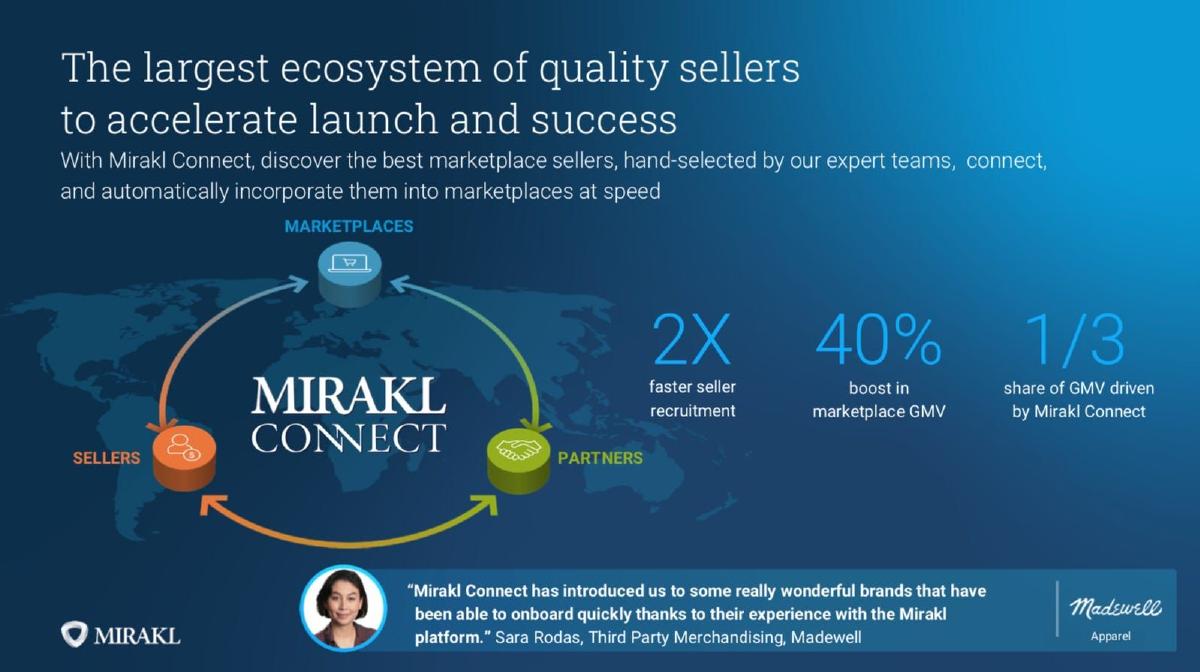
Slide 12 introduces Mirakl Connect . This is the 'moat' slide. By creating a platform where sellers and partners are already vetted and integrated, Mirakl creates a network effect. The more retailers use Mirakl, the more sellers want to be on Mirakl Connect. The more sellers on the platform, the more valuable the software becomes to new retailers. This moves the company from a linear SaaS model to a platform model with exponential potential.
Slide 13: Quantifiable Outcomes
Slide 13, "Why our customers choose Mirakl," provides the hard ROI. It features four case studies:
UNFI: Focuses on speed to market and flexible integrations. · Carrefour: Boasts +160% eCommerce growth (YoY) and 8K sellers. · Catch: Highlights scale with 2M+ new SKUs and >1.6K sellers. · Kroger: A testimonial from the VP of eCommerce regarding Mirakl's proactive partnership.
These aren't just vanity metrics; they are the core KPIs of a marketplace. Increasing SKU count and seller count without increasing inventory risk is the primary value proposition of the marketplace model.
Slide 14: The Closing
The deck concludes on Slide 14, likely with contact information or a final branding message. In a Series E, the 'closing' is often a formality, as the data in the preceding 13 slides has already made the case for a massive capital injection.
What Works in the Mirakl Deck
1. The Growth Gap Narrative: By starting with the fact that marketplaces grow 2x faster than standard e-commerce, Mirakl creates an immediate sense of urgency. Investors hate missing out on the 'winning' segment of a market.
2. Categorized Social Proof: Instead of a random jumble of logos, Slide 7 categorizes them by industry. This proves that Mirakl’s solution is horizontal—it works for grocery just as well as it works for aerospace (Airbus). This significantly increases the Total Addressable Market (TAM) in the eyes of an investor.
3. The 'Anti-Monopoly' Vision: Positioning the company as the savior of traditional brands against 'digital giants' gives the company a clear enemy and a noble mission. It makes the investment feel like a bet on the future of the entire retail industry, not just a software tool.
What is Missing from the Mirakl Deck
1. Unit Economics: There is no mention of LTV (Lifetime Value), CAC (Customer Acquisition Cost), or specific churn rates. While these were undoubtedly in the data room, their absence from the pitch deck suggests the round was led by 'big picture' growth metrics and social proof.
2. The Team Slide: The public version of this deck omits the founders' backgrounds. While Mirakl is a well-known entity, a teardown of a Series E deck usually looks for how the leadership team has evolved to handle a 500+ person organization.
3. The Financial Ask: There is no slide detailing how the $555M will be spent. Usually, a deck will specify 'R&D,' 'Global Expansion,' or 'M&A.' The omission suggests the round was highly competitive and the founders didn't need to 'sell' the use of proceeds as aggressively as a Seed or Series A founder would.
Lessons for Founders
1. Sell the Category, Not the Product: If you are in a high-growth niche, lead with the macro data. Prove that your category is the future, and then prove that you are the leader of that category.
2. Leverage Your Investors: Mirakl prominently displayed the logos of Bain Capital and Permira. If you have blue-chip investors, use their brand equity to build your own. It signals to new investors that the due diligence has already been done by the best in the business.
3. Quantify Client Success: Don't just say your customers like you. Say that Carrefour grew 160%. Hard numbers from recognizable brands are the most persuasive form of evidence you can present.
Final Thoughts
Mirakl’s deck is a high-polish, high-conviction document. It successfully transitions the company from a 'software vendor' to an 'industry essential.' For a Series E, the goal is to show that the engine is built and the $555M is simply the fuel to make it go faster. By focusing on the massive growth of the marketplace model and their undisputed leadership within it, Mirakl made the investment seem like an inevitable success.
Frequently asked questions
- Why does the deck focus so much on market growth rather than product features?
- At the Series E stage, investors are betting on the size of the winner-takes-all opportunity. By showing that marketplaces are growing at double the rate of standard e-commerce (Slide 2), Mirakl justifies a multi-billion dollar valuation. They aren't selling a feature; they are selling a category leadership position in a high-growth sector.
- What is the 'Mirakl Connect' platform mentioned on Slide 12?
- Mirakl Connect is their ecosystem play. It allows marketplace operators to find and onboard vetted third-party sellers quickly. This transforms Mirakl from a simple SaaS tool into a network-effect business, making the platform more 'sticky' because it provides the actual supply (sellers), not just the software to manage them.
- How does Mirakl handle the 'Consulting' vs. 'SaaS' perception?
- Slide 11 and 13 address this by framing their 150+ experts as a competitive advantage ('Expertise') rather than a scaling bottleneck. They position this human element as 'proven methodology' that ensures enterprise clients—who are traditionally slow to move—actually launch and succeed, protecting the recurring SaaS revenue.
- Is there a team slide in the Mirakl deck?
- The provided 14-slide sequence does not include a dedicated team slide featuring the founders or executive leadership. In a Series E for a company of this scale, the 'team' is often represented by the collective strength of the 150+ experts and the quality of the existing investor base (Bain Capital, Permira) shown on Slide 7.
- What specific metrics does Mirakl use to prove success?
- They use three types of metrics: Macro (Marketplace growth rates on Slide 2), Corporate (2X YoY valuation increase and $400M raised on Slide 7), and Client-specific (160% growth for Carrefour and 2M+ new SKUs for Catch on Slide 13). This multi-layered approach proves the company works at every level.