Mine raised $12.5 million in 2019 for its Series A, presenting a compelling case for a 'smart data assistant' that helps users reclaim their digital footprint. The deck is a masterclass in using momentum as a proxy for market need, citing over 1 million deletion requests sent by users within the first eight months of launch. While the product began as a B2C tool, the deck strategically introduces a B2B 'Enriched Requests' SaaS model to solve the friction created by those very same consumer requests. By positioning themselves as the bridge between regulated companies and privacy-conscious cons…
Key takeaways
- The company reported reaching over 100,000 sign-ups within eight months of their official launch on Slide 17.
- Mine successfully sent more than 1,000,000 data deletion requests on behalf of users, creating a massive top-of-funnel for their B2B product (Slide 17).
- The management team highlights previous experience at high-profile firms including Microsoft, Verizon Ventures, and Nielsen (Slide 2).
- The deck identifies a conversion rate of approximately 28% from site visitor to sign-up, which they claim is 6x higher than the industry benchmark (Slide 17).
- A clear B2B pivot is introduced on Slide 19, moving from a free consumer app to a 'Manage with Mine' API for companies.
- The product uses proprietary machine learning and NLP algorithms to calculate individual risk scores and analyze privacy policies (Slide 14).
- The deck omits a specific 'Ask' slide detailing the exact use of funds or the valuation sought for the $12.5M round.
- Growth was entirely organic during the 'Corona period,' with sign-ups doubling every cohort as shown on the confidential growth chart (Slide 18).
The Narrative: From Privacy Tool to Infrastructure Standard
Mine’s Series A deck is a study in timing and traction. In 2019, the world was still grappling with the early implementation of GDPR and CCPA. Mine entered the market not just as another privacy tool, but as a high-velocity engine for consumer rights. The deck’s primary strength lies in its ability to show that consumers actually care about data privacy—a point often debated by investors—by presenting overwhelming usage numbers. By the time the investor reaches the business model slide, the 'problem' (millions of manual deletion requests) has been proven by the company’s own B2C success, making the B2B solution feel inevitable.
The Team and Market Context (Slides 1-5)
Slide 1: Title. The deck opens with a clean, minimalist aesthetic and the tagline 'The Future of Data Ownership.' The use of an ostrich as a recurring visual motif suggests a playful take on the 'head in the sand' approach most people take toward their data.
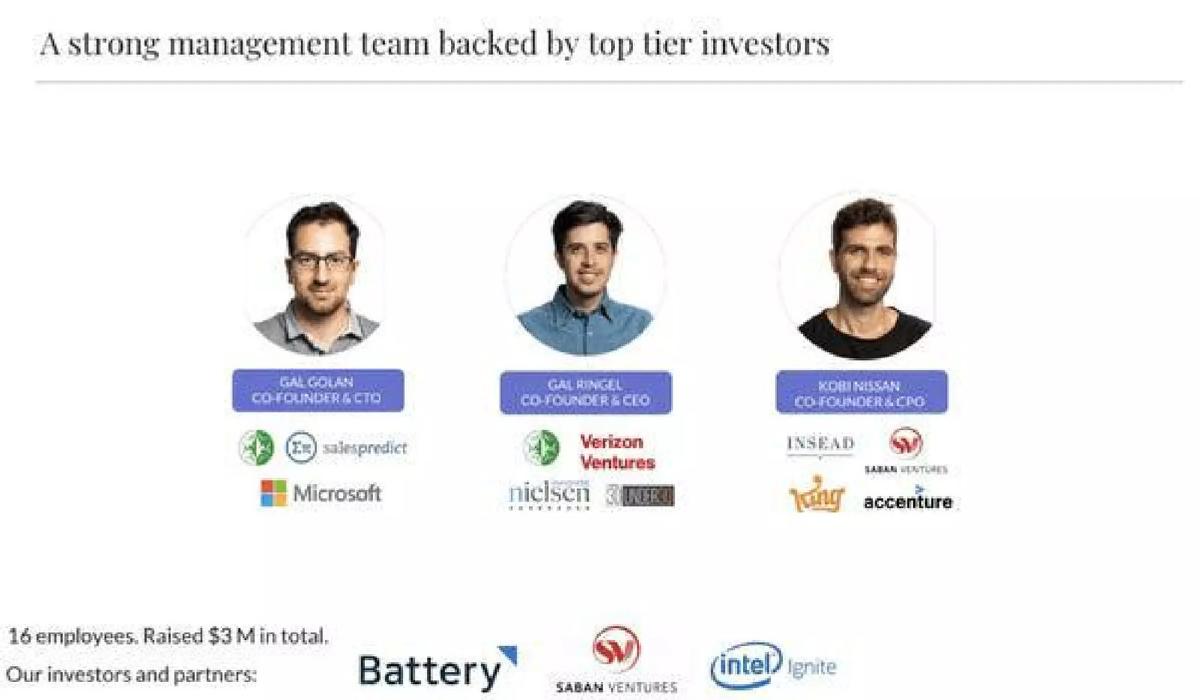
Slide 2: Management Team. Mine leads with its team, which is a common tactic for Series A rounds. They highlight 16 employees and a previous seed raise of $3M. The founders (Gal Golan, Gal Ringel, and Kobi Nissan) boast logos from Microsoft, Verizon Ventures, and Nielsen, establishing immediate technical and corporate credibility. Existing investors like Battery Ventures and Saban Ventures are also prominently displayed.
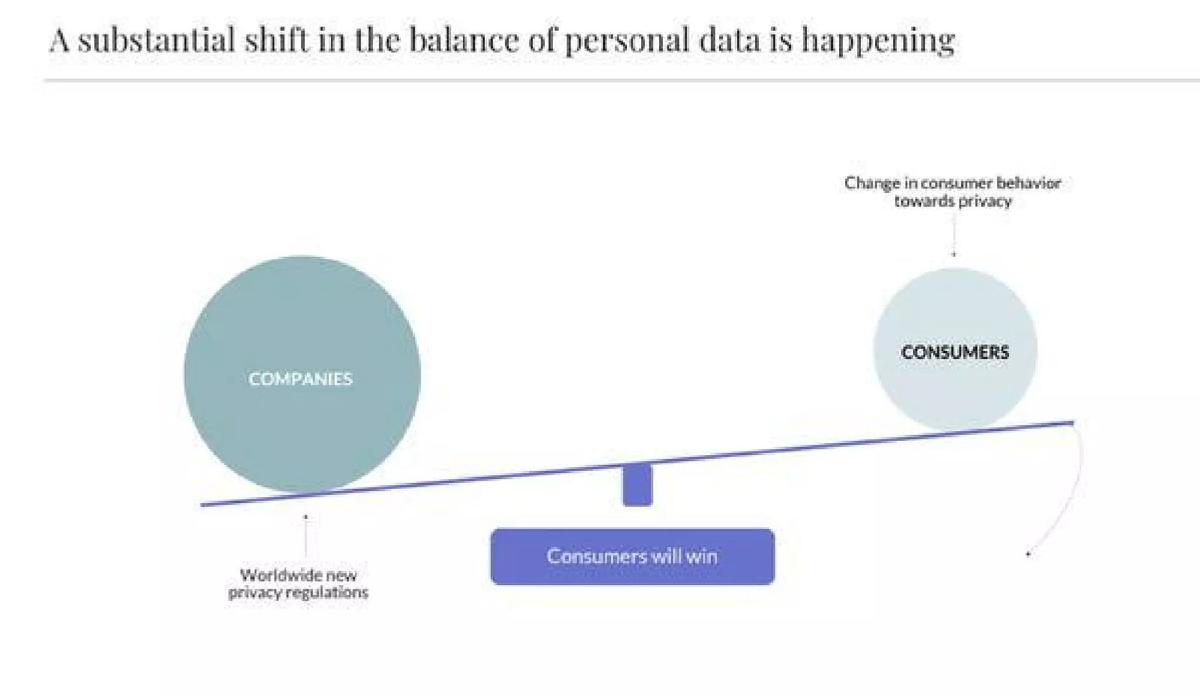
Slide 3: The Shift. This slide uses a simple seesaw graphic to illustrate a 'substantial shift in the balance of personal data.' It posits that worldwide privacy regulations and changing consumer behavior are finally tipping the scales in favor of the consumer.
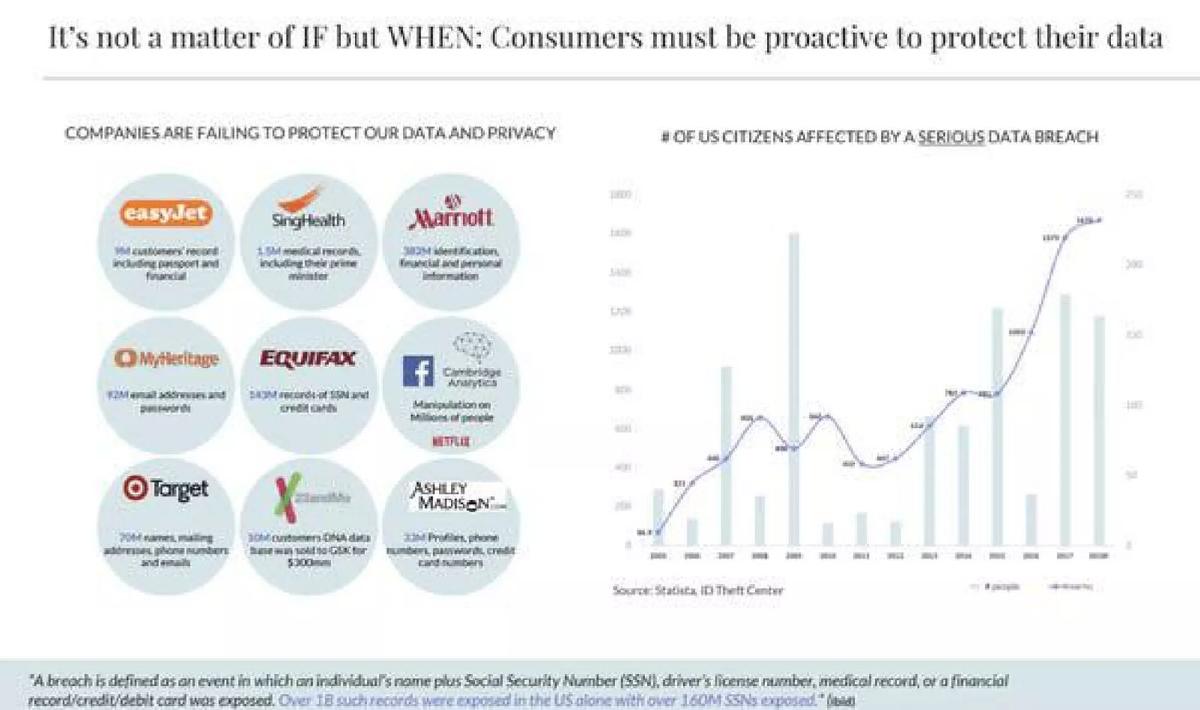
Slide 4: The Problem. To create urgency, Mine lists major data breaches (EasyJet, Marriott, Equifax, Target) and provides a chart showing the rising number of US citizens affected by serious breaches. The footnote emphasizes that over 1B records were exposed in the US alone, with 160M Social Security Numbers compromised.
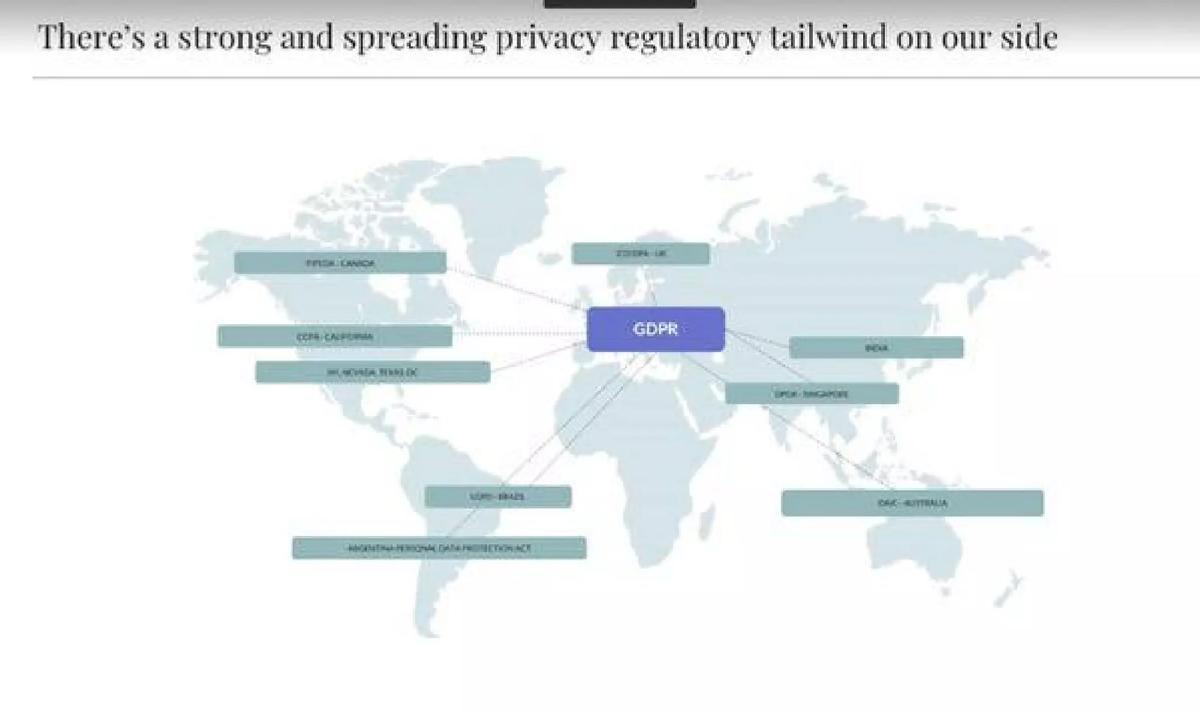
Slide 5: Regulatory Tailwind. This slide maps out the global spread of privacy laws, with GDPR at the center. It lists regulations in Canada (PIPEDA), California (CCPA), Brazil (LGPD), and Australia (OAIC), framing Mine's solution as a globally relevant necessity rather than a niche regional tool.
The Solution and Product Experience (Slides 6-13)
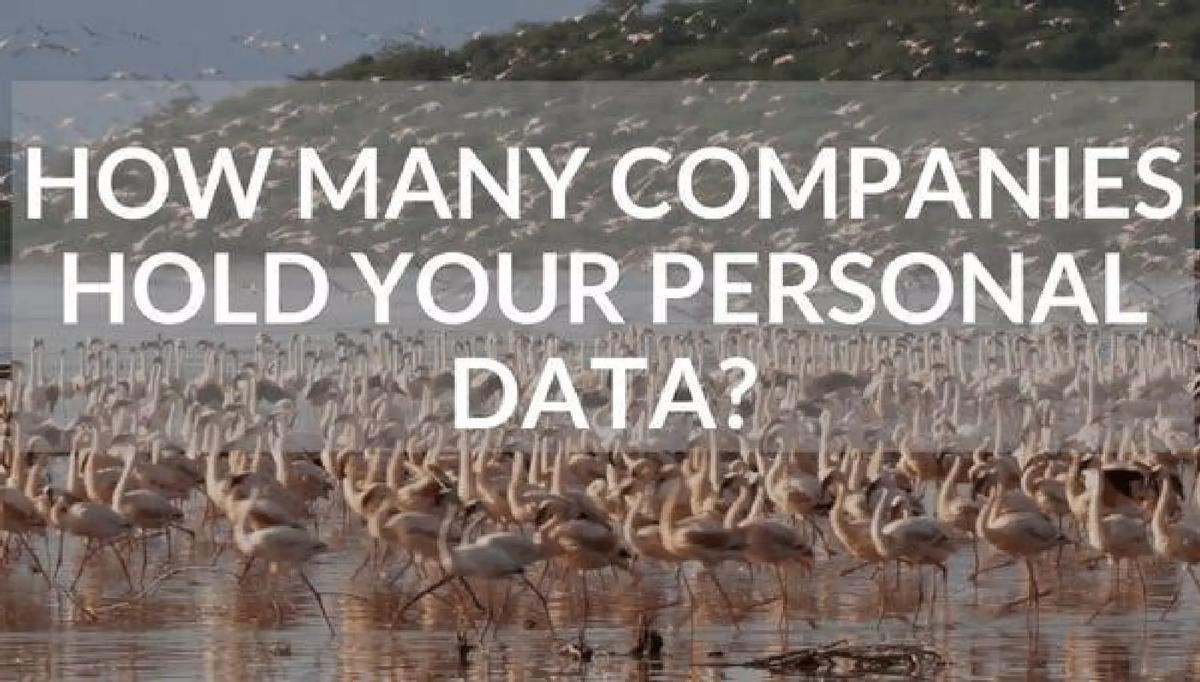
Slide 6-8: The Mission. After asking 'How many companies hold your personal data?' against a backdrop of a flock of birds, Slide 8 defines Mine as a 'smart data assistant.' The mission is stated clearly: 'Keep your data, only where you need it.'
Slide 9-10: Product Overview (Discovery). These slides showcase the UI. Slide 9 shows a dashboard indicating a user has 298 companies in their footprint. Slide 10 explains that Mine identifies these companies by analyzing email subject lines (explicitly stating they do not process email content or sensitive data) to find services that have likely collected user data.
Slide 11-13: User Journey and Communication. Slide 11 shows a 'tailored journey' with weekly tasks to improve a 'digital exposure score.' Slide 12 is critical: it shows the in-app communication tool that allows a user to send a formal data erasure request to a company (in this case, Spotify) with a single click. Slide 13 provides 'risk-context,' showing the type of data shared (Financial, Identity, etc.) and the industry's breach potential.
The Technical Moat and Traction (Slides 14-18)
Slide 14: Tech and Product Moat. Mine attributes its advantage to proprietary machine learning and NLP. They highlight three components: Continuous Discovery, Value Level Score (VLS), and Privacy Policy Analysis. Crucially, they note that 'no behavior change is needed on the user side,' which is a major selling point for consumer apps.
Slide 15-16: Call to Action and PR. Slide 15 is a simple 'Give our product a try' slide. Slide 16 displays an impressive wall of press logos from the US, Europe, and Israel, including Fast Company, VentureBeat, and Fortune. It also notes their success on Product Hunt (#1 Product of the Day/Week).
Slide 17: Accumulative Metrics. This is the 'money slide.' Mine reports over 100,000 sign-ups and over 1,000,000 deletion requests sent within 8 months. They claim a 28% conversion rate from visitor to sign-up and state they have reduced users' online data exposure by 40%-60%.
Slide 18: Growth Chart. A 'Confidential' line graph shows accumulative sign-ups growing by 2x every cohort during the 'Corona period.' While the Y-axis is unlabeled, the upward trajectory is steep and consistent from December 2019 to September 2020.
The Business Model and Vision (Slides 19-20)
Slide 19: The Bridge. This slide explains the transition from B2C to B2B. Mine positions itself as the 'One Standard' for privacy requests. By streamlining requests through APIs, they help companies 'operate faster' and 'reduce time spent on each request.' This effectively turns the 'problem' Mine created for companies (a flood of deletion requests) into a 'solution' they can sell to those same companies.
Slide 20: Monetization. The final content slide confirms the dual model: a Freemium B2C app and a B2B SaaS model for 'Enriched Requests.' The B2B side is noted as being in the 'beta phase,' while the B2C side was slated to remain free until the end of 2020.
What Works in This Deck
Traction as Proof of Concept: The 1 million deletion requests sent (Slide 17) is a powerful metric. It proves that the 'Right to be Forgotten' is not just a legal theory but a consumer demand that Mine has successfully tapped into. · Visual Consistency: The use of the ostrich and the clean, purple-accented UI makes the brand feel approachable and 'friendly' (as mentioned in the catalogue description), which is vital for a product dealing with the scary topic of data breaches. · The B2B Pivot Logic: The deck brilliantly sets up the B2B product. By showing how easy it is for consumers to send requests, they implicitly show how difficult it will be for companies to manage them without a standardized API like Mine.
What Is Missing
The Ask: There is no slide detailing how much capital is being raised in this specific round or how it will be allocated (e.g., hiring, marketing, R&D). While we know from catalogue facts it was $12.5M, the deck itself omits this. · Unit Economics: While sign-up growth is shown, there is no mention of Customer Acquisition Cost (CAC) or the projected Lifetime Value (LTV) of the B2B customers. · Competitive Landscape: The deck assumes Mine is the only player in this space. It does not address other privacy management platforms or how they compare to manual 'Subject Access Requests' (SARs).
What a Founder Should Copy
The 'Tailwind' Slide: Slide 5 is an excellent way to show that your startup is riding a global wave of regulation. It makes the business feel like a 'when,' not an 'if.' · The 'Moat' Breakdown: Slide 14 does a great job of explaining complex technical processes (NLP/ML) in terms of user benefits (no behavior change needed). · Metric Callouts: The use of 'sticky note' style callouts on Slide 17 (e.g., 'Mostly organic,' '6x higher than industry benchmark') helps investors quickly digest why the numbers are impressive, not just what the numbers are.
Frequently asked questions
- What is Mine's primary value proposition for consumers?
- According to Slide 8, Mine acts as a 'smart data assistant' that allows users to discover where their personal data is stored and manage their digital footprint. It aims to reduce unnecessary online exposure and minimize risks by identifying companies that hold sensitive data like financial, identity, and health records, then facilitating the deletion of that data.
- How does Mine plan to monetize its platform?
- Slide 20 outlines a dual-track monetization strategy. The B2C side is described as 'Freemium' (though noted as free until the end of 2020), while the B2B side focuses on a SaaS model for 'Enriched Requests.' This B2B product was in beta at the time of the deck and aims to help companies process privacy requests faster.
- What evidence of market fit does the deck provide?
- The deck provides significant traction metrics on Slide 17, including over 100,000 sign-ups and 1 million deletion requests sent. It also highlights a 28% visitor-to-signup conversion rate and claims to have reduced users' online data exposure by 40% to 60%.
- What is the 'tech moat' mentioned in the deck?
- Slide 14 defines the moat through three pillars: Footprint Continuous Discovery, Value Level Score (VLS), and Privacy Policy Analysis. These are powered by proprietary machine learning and NLP algorithms that allow the system to function without requiring a change in user behavior.
- Who are the founders and what is their background?
- The founding team consists of Gal Golan (CTO), Gal Ringel (CEO), and Kobi Nissan (CPO). Their backgrounds include experience at Microsoft, SalesPredict, Verizon Ventures, Nielsen, and Accenture, with education from institutions like INSEAD (Slide 2).