CornFinger, Inc. presented a pitch deck in late 2010 focused on capturing the loyalty of Nebraska Cornhuskers fans through a combination of a proprietary hand gesture and sustainable apparel. The company sought a modest $50,000 equity investment to fund inventory, marketing, and working capital. Their strategy relied heavily on the 'CornFinger' gesture as a new tradition and leveraged a supply chain involving NatureWorks for sustainable materials. While the deck highlights traction through 37 retail stores and 2,200 followers, it reveals a business model deeply tied to the performance and cul…
Key takeaways
- The company sought a $50,000 equity investment, with the largest portion ($18,400) allocated to organizational expenses (Slide 5).
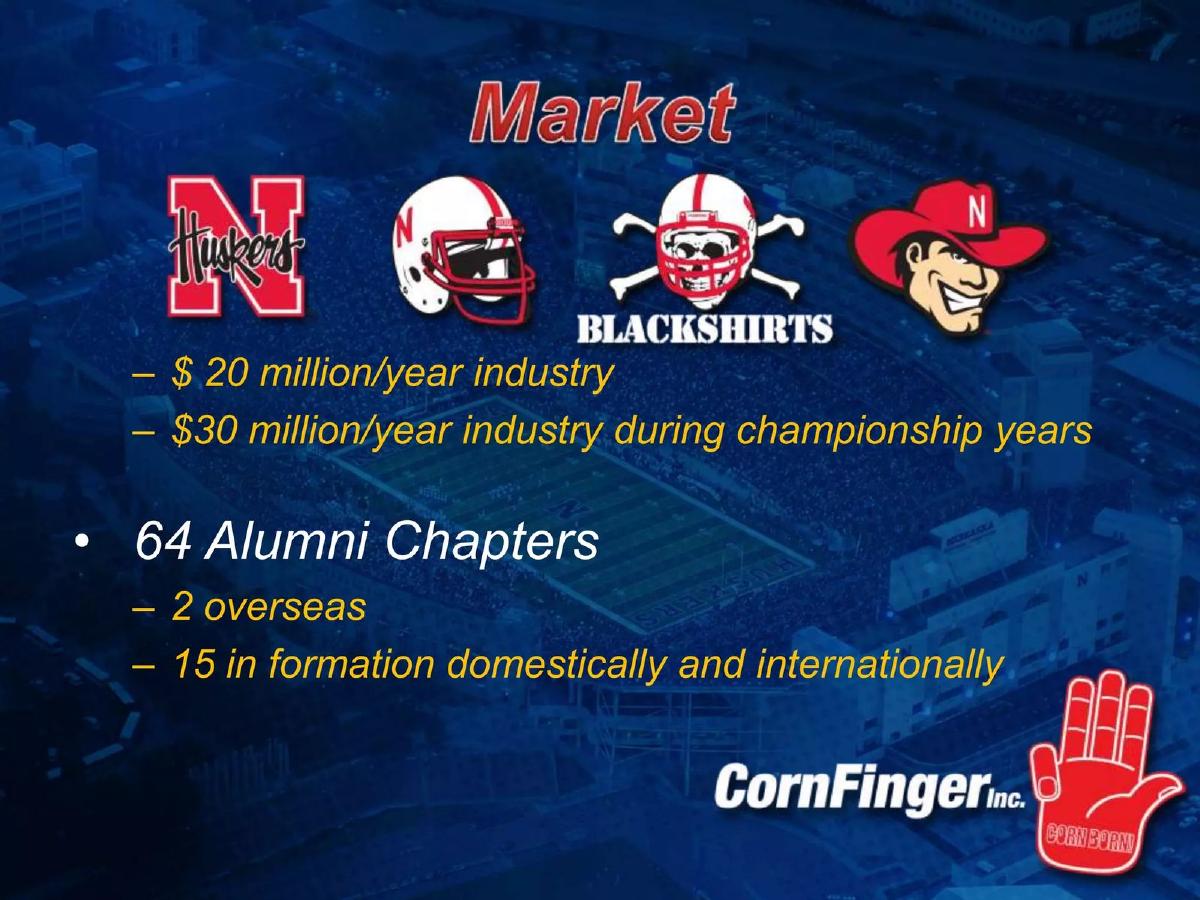
- CornFinger identified a $20 million to $30 million annual industry centered around Nebraska Huskers and Blackshirts branding (Slide 3).
- The product value proposition combined a cultural 'hand gesture' with 100% sustainable, high-performance apparel (Slide 2).
- Traction was defined by presence in 37 retail stores and a social following of 2,200 'passionate followers' (Slide 7).
- The supply chain involves six distinct stages, starting with NatureWorks and moving through converters, spinners, and manufacturers (Slide 4).
- The exit strategy specifically names Iconix Brand Group, Inc. as a potential acquirer (Slide 6).
- The market reach includes 64 alumni chapters, with two located overseas and 15 more in formation (Slide 3).
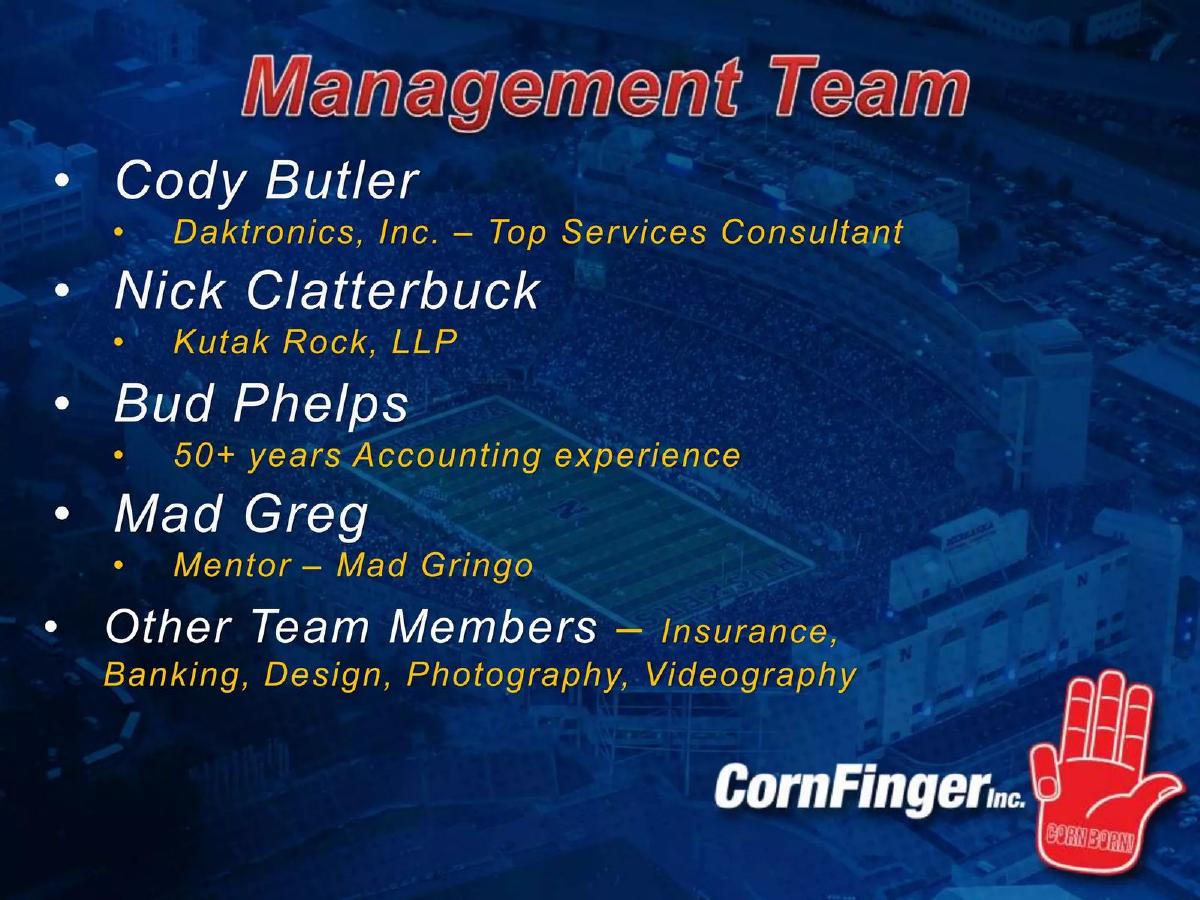
- The deck lacks a dedicated team slide, providing only a single contact name, Cody Butler, on the final slide (Slide 8).
Executive Summary: The Hyper-Local Fan Play
CornFinger, Inc. represents a very specific era of niche apparel startups that sought to combine regional sports passion with the burgeoning 'green' movement of the late 2000s. The deck, dated Fall 2010, outlines a plan to monetize Nebraska football culture through a proprietary hand gesture and sustainable clothing. With a small ask of $50,000, the company was less a 'tech startup' and more a traditional retail play seeking seed capital to stabilize operations and inventory.
Slide 1: Title and Branding
The cover slide introduces the brand name 'CornFinger Inc.' and the tagline 'We Are CORN BORN!' The visual identity is dominated by a red hand gesture logo set against an aerial shot of a packed football stadium, presumably Memorial Stadium in Lincoln, Nebraska. The branding is aggressive and clearly targeted at a specific demographic: University of Nebraska fans. The use of the term 'Corn Born' reinforces a native, tribal identity that the company hopes to capitalize on.
Slide 2: The Opportunity (Problem and Solution)
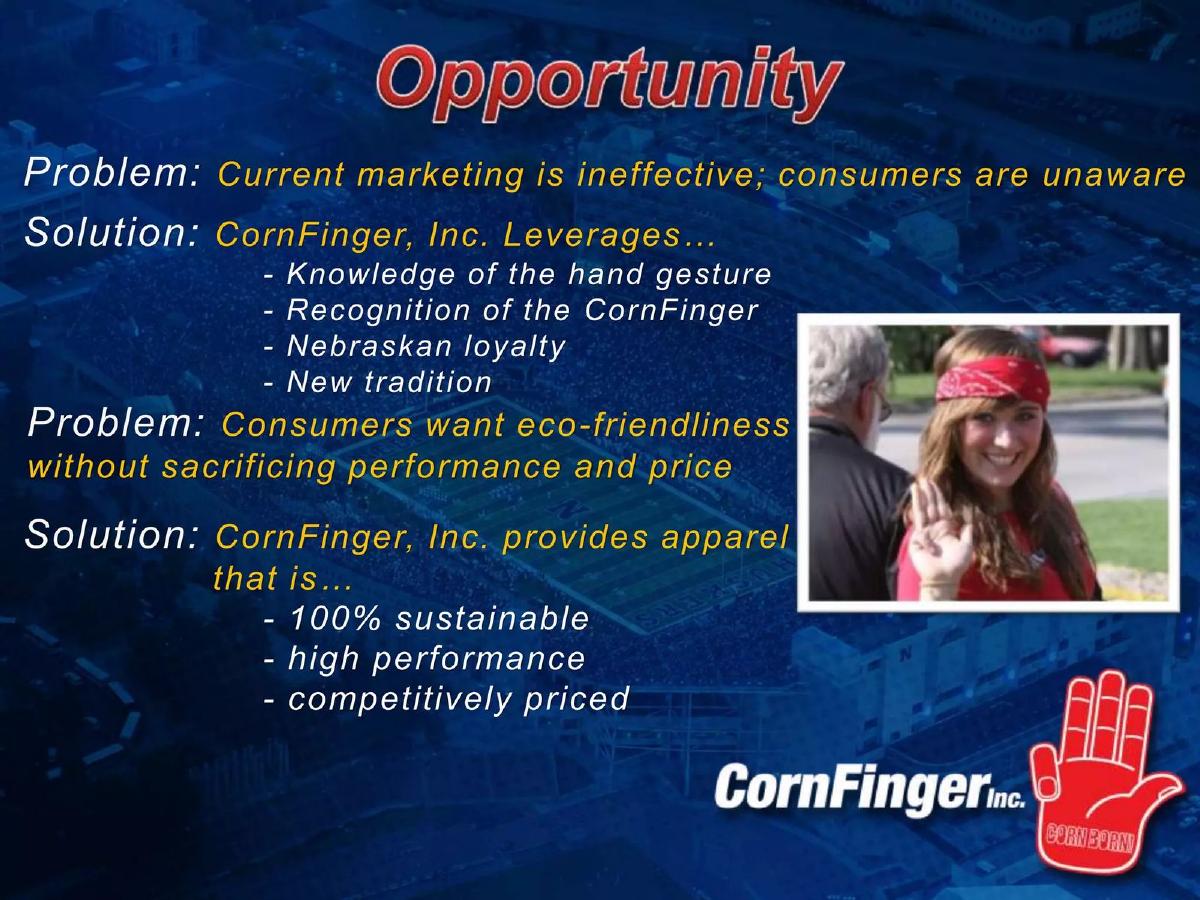
Slide 2 attempts to define the market gap. It lists two distinct 'Problem' and 'Solution' sets. First, it claims current marketing is 'ineffective' and consumers are 'unaware.' The solution is to leverage the 'CornFinger' hand gesture and Nebraskan loyalty to create a 'New tradition.' Second, it addresses a consumer desire for 'eco-friendliness without sacrificing performance and price.' The solution offered is apparel that is '100% sustainable' and 'high performance.' This slide is critical because it reveals the dual-track strategy: cultural branding combined with sustainable manufacturing. However, it does not explain why current marketing is ineffective, which is a significant assumption.
Slide 3: Market Size and Alumni Reach
This slide quantifies the opportunity. It cites a '$20 million/year industry,' which increases to '$30 million/year industry during championship years.' These figures likely refer to the total licensed merchandise market for the Nebraska Cornhuskers. To demonstrate reach, the slide notes '64 Alumni Chapters,' including two overseas and 15 in formation. This provides a clear roadmap for customer acquisition—targeting organized groups of fans who are already geographically dispersed but culturally connected.
Slide 4: The Complex Supply Chain
Slide 4 is perhaps the most technical, outlining a six-step supply chain. It begins with 'NatureWorks' (a real-world supplier of biopolymers like Ingeo), then moves to a 'Converter,' 'Spinner,' 'Manufacturer,' 'Wholesaler,' and finally 'Retailer.' The CornFinger logo is placed over every step from Converter to Retailer, implying the company manages or owns the relationships throughout the production cycle. For a company seeking only $50,000, this is an incredibly complex logistical chain, suggesting that the founders were attempting to build a vertically integrated brand from the fiber up.
Slide 5: Funding and Use of Proceeds
The 'Funding' slide explicitly states the ask: 'Seeking $50,000 Equity Investment.' It includes a table showing the 'Sources of funds' (Invest Nebraska) and 'Uses of Funds.' The breakdown is as follows: Inventory ($10,000) , Organizational Expenses ($18,400) , Marketing Expenses ($6,000) , and Working Capital ($15,600) . The high allocation to 'Organizational Expenses' (36.8% of the total raise) is a red flag for most investors, as it typically implies paying off back-debts, legal fees, or administrative overhead rather than driving growth.
Slide 6: The Exit Strategy
Slide 6 lists four potential exit paths: Acquisition, Licensing, Buyback, and Exchange of Stock. It prominently features the logo for Iconix Brand Group, Inc. , a brand management company that owns labels like Starter and Danskin. By naming a specific acquirer, the founders are signaling that they view CornFinger as a brand asset that could eventually be folded into a larger portfolio of sports and lifestyle labels.
Slide 7: Traction and Social Proof
The 'Traction' slide uses logos from NBC, Silicon Prairie News, the Lincoln Journal Star, Budweiser, and Groupon to imply media coverage or partnerships. The concrete metrics provided are '37 Retail Stores' and '2,200 Passionate Followers.' The retail store count is a strong indicator of product-market fit, showing that physical storefronts were willing to stock the inventory. The follower count, while small by modern standards, represented a decent community size in 2010.
Slide 8: Contact Information
The final slide provides a contact name, Cody Butler , along with an email and phone number. Notably, this is the only mention of a person in the entire 8-slide sequence. The lack of a team slide is a major omission, as investors at the seed stage are primarily investing in the founders' ability to execute.
What Works in This Deck
The deck is highly focused. It knows exactly who the customer is: a Nebraska fan who cares about sustainability. By quantifying the 'championship year' bump in market size (Slide 3), the founders show they understand the cyclical and emotional nature of sports-based retail. The traction slide (Slide 7) also provides tangible evidence that the product exists in the real world (37 stores), which moves the conversation beyond mere theory.
What Is Missing
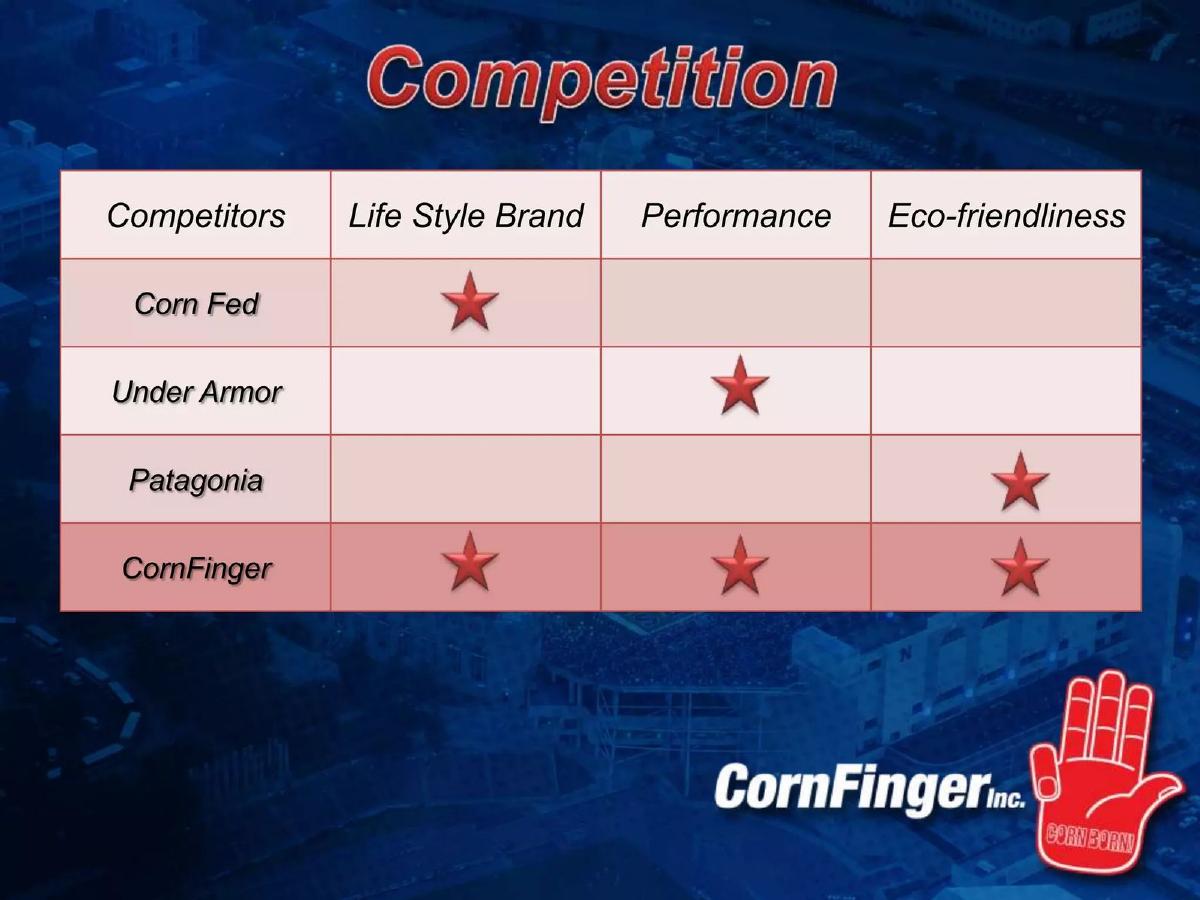
The Team: There is no information regarding the founders' backgrounds. Do they have experience in apparel manufacturing? Do they have connections in the Nebraska athletic department? · Unit Economics: While the deck mentions 'competitively priced' (Slide 2), it never lists the COGS (Cost of Goods Sold) or the MSRP (Manufacturer's Suggested Retail Price). With a six-stage supply chain (Slide 4), margins are a major concern. · Product Visuals: The deck shows a logo and a hand gesture, but it does not show the actual apparel. Investors need to see the quality and design of the shirts or hats they are funding. · Competition: The deck ignores existing licensed apparel giants like Nike or Fanatics, who would be the primary competitors for shelf space in those 37 retail stores.
Founder's Playbook: What to Copy
Specific Market Sizing: The distinction between a normal year and a 'championship year' (Slide 3) is a great way to show deep industry knowledge. If your business is tied to an external event (sports, elections, weather), model those fluctuations.
Supply Chain Transparency: Even though it looks complex, Slide 4 shows the founders have thought through how a raw material (NatureWorks) becomes a finished product. This level of detail is helpful for physical product startups.
Clear Use of Funds: The table on Slide 5 is simple and direct. Even if the 'Organizational Expenses' are high, the transparency of where every dollar goes is a trait every founder should emulate.
Final Analysis
The CornFinger deck is a relic of 'hyper-local' entrepreneurship. It attempts to solve a marketing problem (lack of a unique gesture) and a manufacturing problem (sustainability) simultaneously. While the $50,000 ask is modest, the complexity of the supply chain and the narrowness of the target market suggest a business that might struggle to scale beyond the borders of Nebraska. For a local angel investor or a group like 'Invest Nebraska,' this was a clear, low-risk bet on a local brand, but as a venture-scale pitch, it lacks the 'billion-dollar market' narrative required for larger firms.
Frequently asked questions
- What is the core product of CornFinger?
- Based on Slide 2, the product is sustainable apparel that is '100% sustainable, high performance, and competitively priced.' The brand is built around the 'CornFinger' hand gesture, which the company describes as a 'new tradition' for Nebraskan loyalty. It essentially functions as a lifestyle and fan-gear brand for the Nebraska Cornhuskers community.
- How does the company plan to use the $50,000 investment?
- According to Slide 5, the $50,000 is split into four categories: $10,000 for Inventory, $18,400 for Organizational Expenses, $6,000 for Marketing Expenses, and $15,600 for Working Capital. The inclusion of 'Organizational Expenses' as the largest line item suggests significant early-stage administrative or legal costs.
- What is the 'CornFinger' gesture mentioned in the deck?
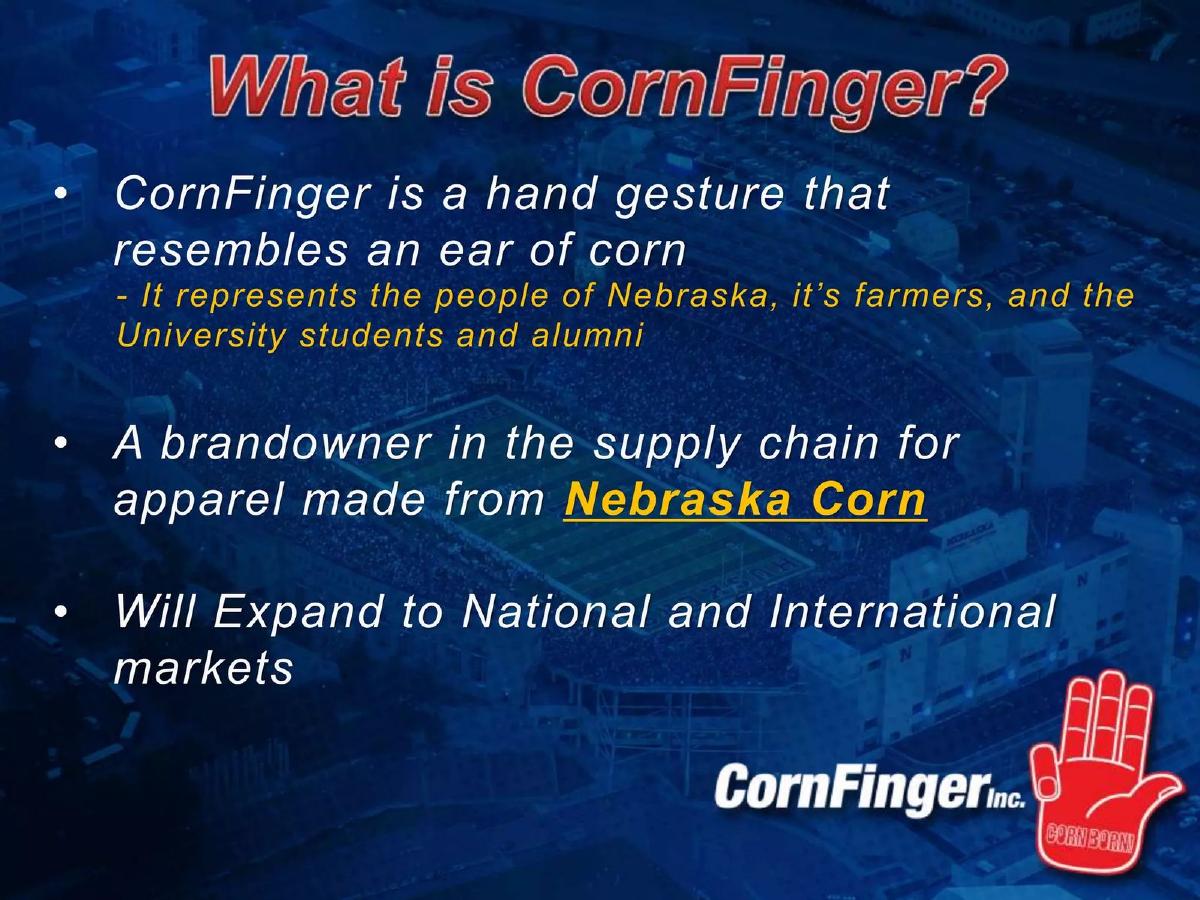
- The gesture, shown in the company logo on Slide 1 and Slide 2, consists of a hand with the index, middle, and ring fingers extended upward, while the thumb and pinky are extended outward. The company positions this as a way to leverage 'Nebraskan loyalty' and create a recognizable brand symbol similar to other collegiate hand signs.
- Who are the target customers for this brand?
- The primary target is the Nebraska Cornhuskers fan base. Slide 3 highlights the 'Huskers' and 'Blackshirts' logos, noting 64 alumni chapters globally. The market size is estimated at $20 million annually, growing to $30 million during championship years, indicating a business model sensitive to the sports team's success.
- What are the primary risks identified in the deck's strategy?
- The most significant risk is geographic and cultural concentration. By tying the brand so closely to a specific university and gesture (Slide 2 and 3), the 'Total Addressable Market' is capped by the size of the Nebraska fan base. Additionally, the complex supply chain (Slide 4) for a small $50,000 raise suggests potential margin pressure.