Copper Cow Coffee’s 11-slide deck is a lean, visually-driven presentation that prioritizes brand identity and retail validation over dense financial modeling. The deck successfully bridges the gap between a personal founder story—rooted in Vietnamese heritage—and hard business metrics, specifically citing $80,000 in revenue for June 2018 with 45% margins. While it lacks a formal 'Ask' slide or detailed competitive landscape, it compensates with a powerful traction slide featuring major retailers like Williams Sonoma and Macy’s. The deck serves as a strong example of how a consumer packaged go…
Key takeaways
- The deck establishes immediate brand identity with high-quality product photography on Slide 1.
- Founder Debbie Mullin uses Slide 2 to build authenticity by connecting the brand to her grandmother in 1970s Saigon.
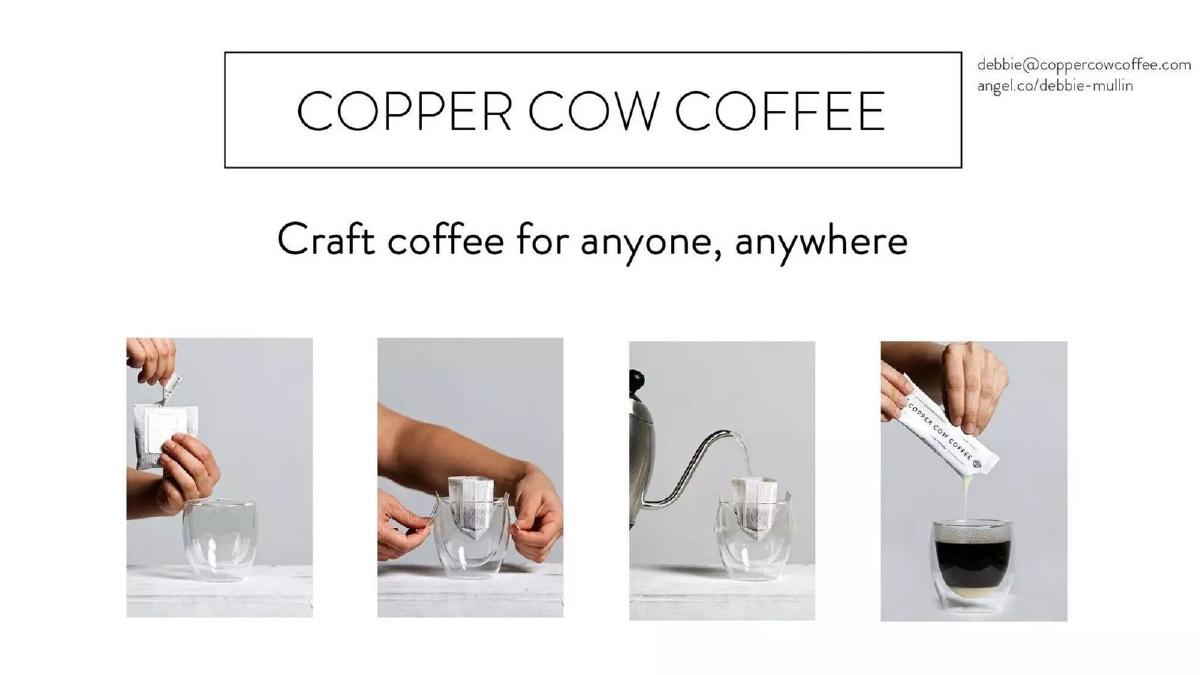
- A four-step visual guide on Slide 4 explains the unique 'portable pour-over' product mechanism without using any text.
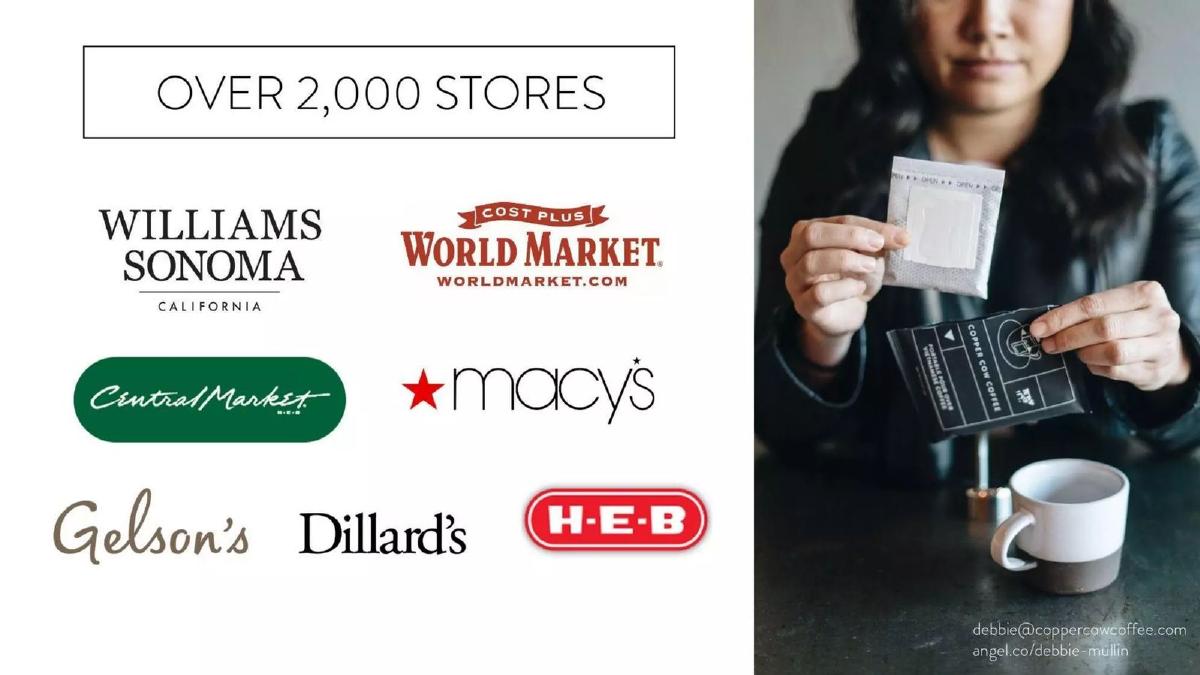
- Slide 6 provides massive social proof by listing logos for over 2,000 retail stores, including H-E-B and World Market.
- The total addressable market is simplified to a single figure: the $32 billion American coffee industry on Slide 7.
- Revenue is clearly stated as $80,000 for the month of June 2018 on Slide 9.
- Unit economics are highlighted via a 45% margin figure prominently displayed on Slides 9 and 11.
- The team slide (Slide 10) emphasizes founder pedigree with logos from MIT, Berkeley, and The World Bank.
The Visual Power of CPG Fundraising
Copper Cow Coffee’s pitch deck is a masterclass in brevity. At only 11 slides, it manages to convey a premium brand aesthetic while hitting the essential notes required for a Series A round. The deck is less about complex data visualizations and more about establishing a 'vibe' that aligns with specialty coffee culture, backed by the hard reality of retail distribution. According to catalogue facts, the company raised $11.5 million following this period, proving that a lean deck can be highly effective when the traction is undeniable.
Slides 1-3: Brand Identity and Heritage
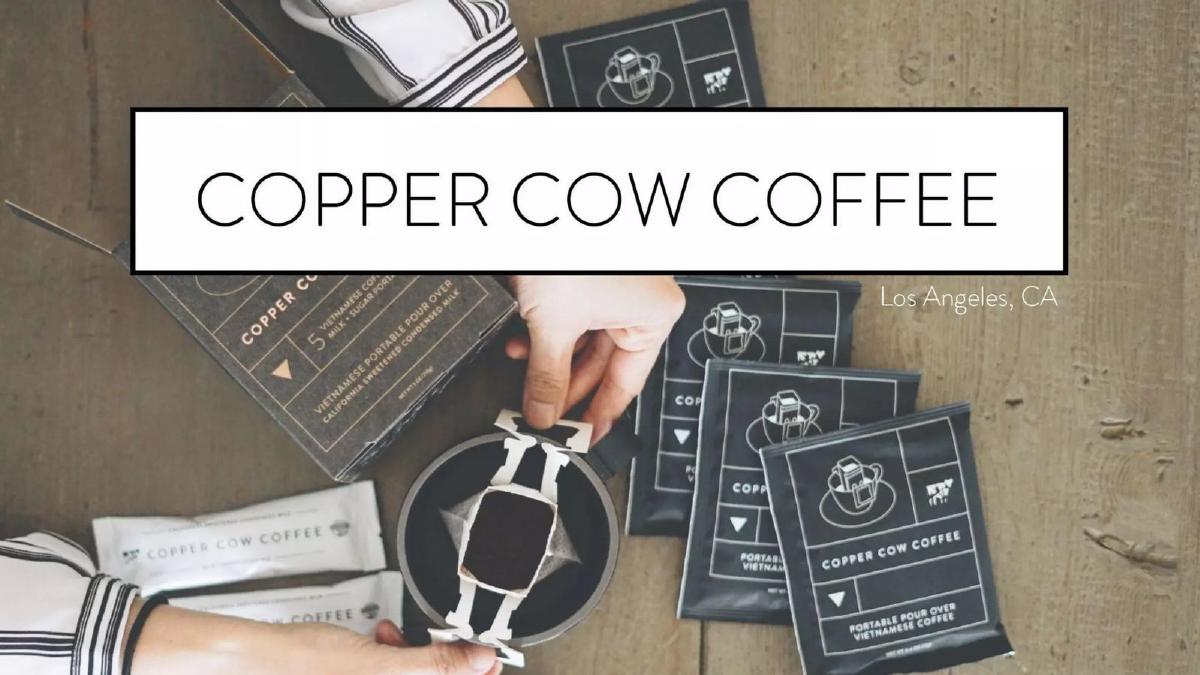
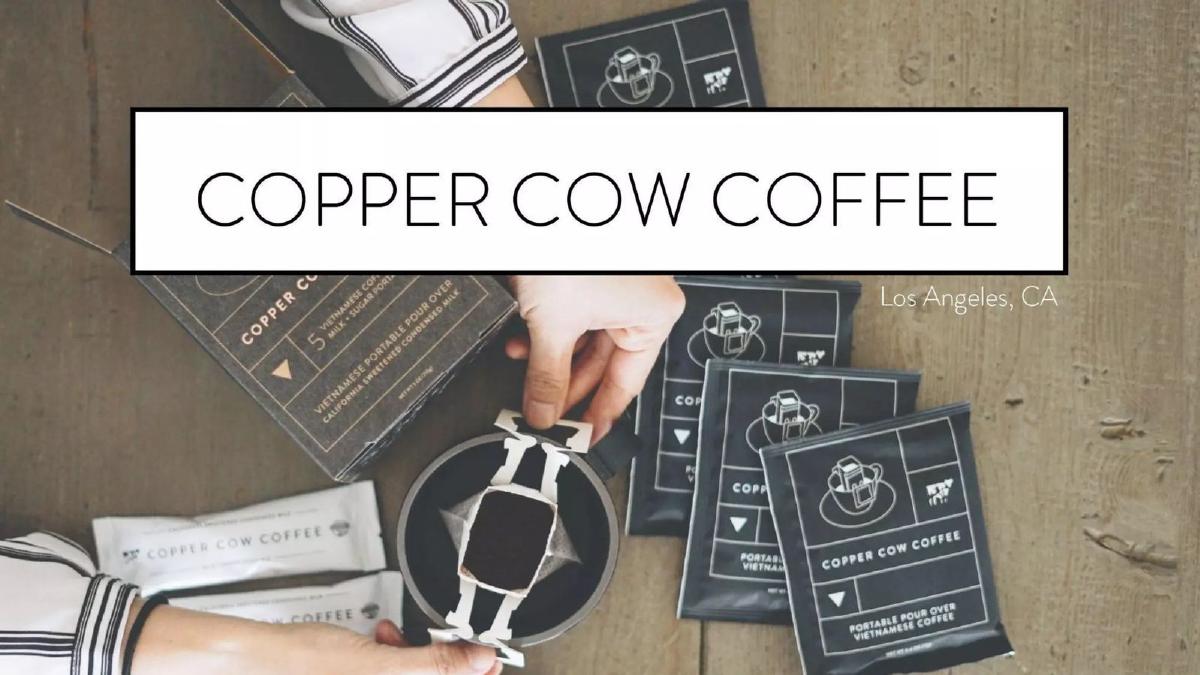
Slide 1: Title The opening slide is a full-bleed photograph of the product in use. It establishes the Los Angeles, CA headquarters and the brand name in a clean, minimalist font. The visual focus is on the unique packaging—black and gold foil—which immediately signals a 'premium' market position.
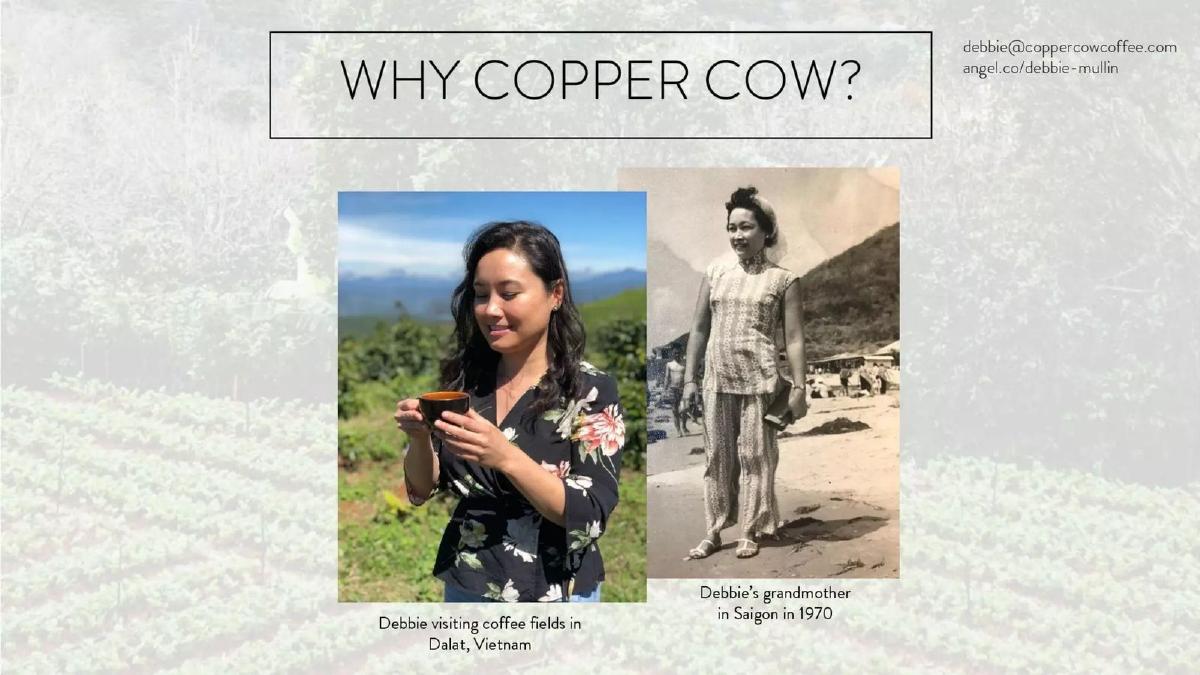
Slide 2: Why Copper Cow? This is the 'Origin Story' slide. It features two photos: one of founder Debbie Mullin in a coffee field in Dalat, Vietnam, and a vintage photo of her grandmother in Saigon in 1970. This slide does the heavy lifting of establishing authenticity. In the specialty coffee world, sourcing and heritage are competitive advantages, and Mullin ties her personal history directly to the product.
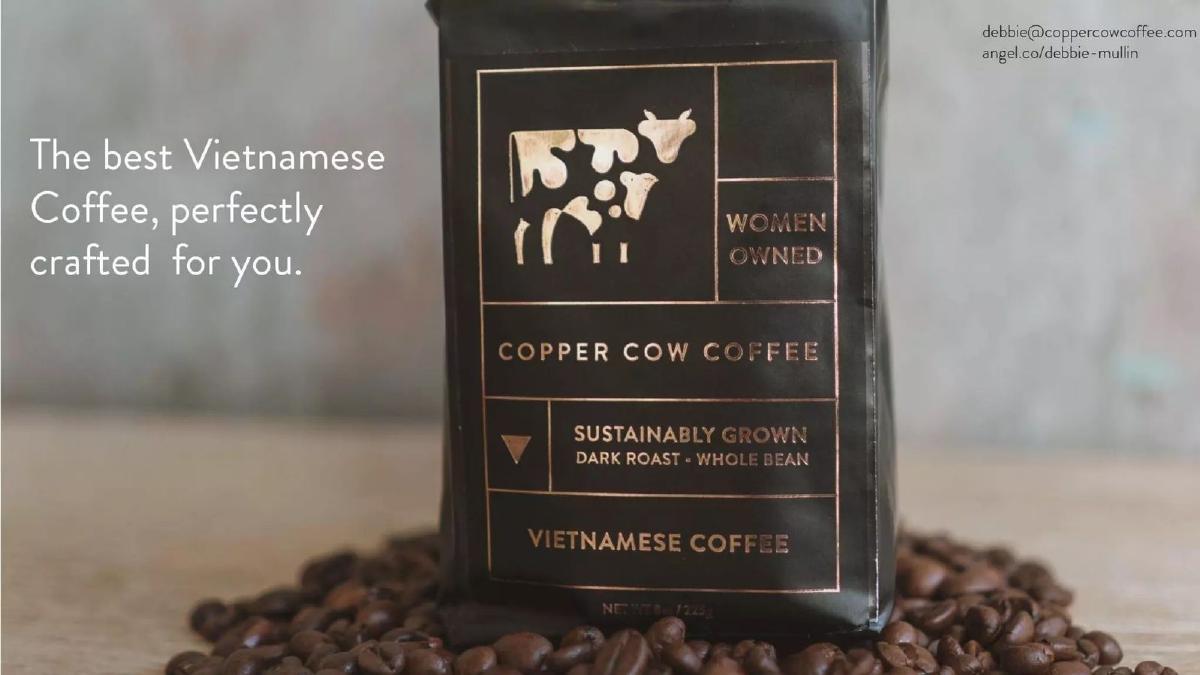
Slide 3: The Product A close-up of a coffee bag with the text "The best Vietnamese Coffee, perfectly crafted for you." It highlights that the company is "Women Owned" and the coffee is "Sustainably Grown." These are key selling points for modern, socially-conscious consumers.
Slides 4-5: The Mechanism and the Moat
Slide 4: Craft coffee for anyone, anywhere This slide explains the product's unique value proposition (UVP) without a single bullet point. Through four clear photos, it shows the process: opening the filter, hanging it on a cup, pouring water, and adding condensed milk. This addresses the 'Problem' of specialty coffee being difficult to make on the go, providing a 'Solution' that is both portable and high-quality.
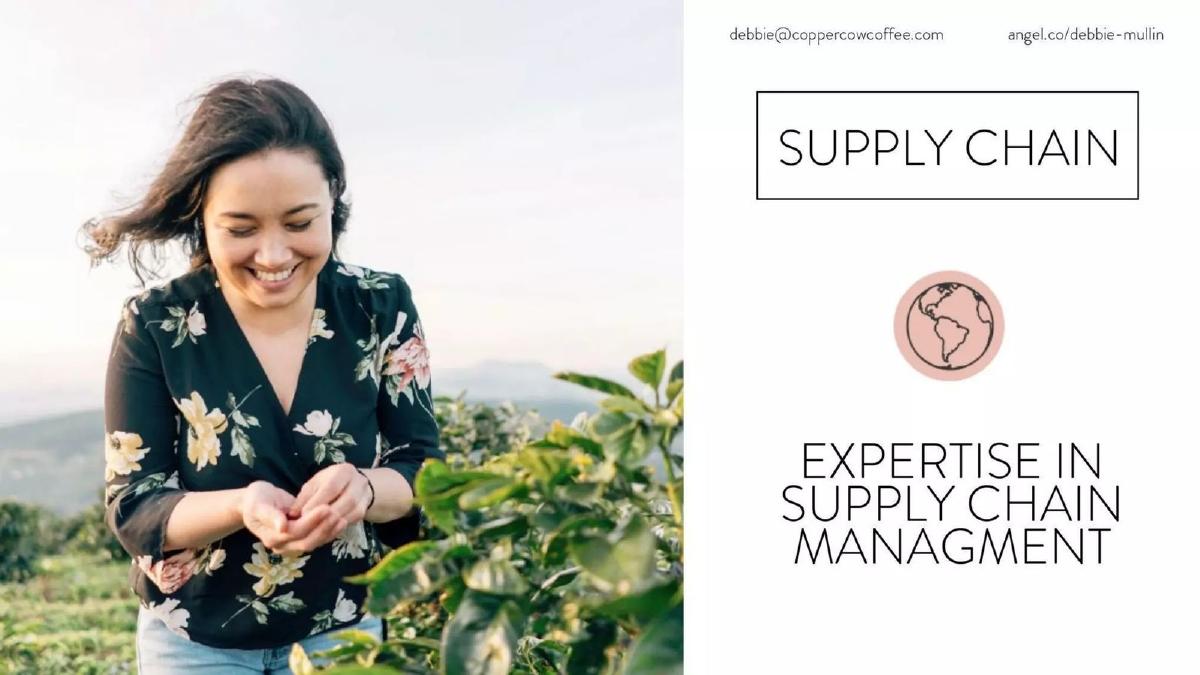
Slide 5: Supply Chain Featuring another photo of Mullin in the field, this slide claims "Expertise in Supply Chain Management." While it doesn't provide specific data on their supply chain, it suggests that the founder has a hands-on relationship with the producers in Vietnam, which is a significant barrier to entry for competitors trying to replicate the flavor profile.
Slides 6-7: Market Validation and Size
Slide 6: Over 2,000 Stores This is the most important slide in the deck for a Series A investor. It lists high-tier retail partners including Williams Sonoma, World Market, Central Market, Macy’s, Gelson’s, Dillard’s, and H-E-B. Having 2,000+ doors open is proof of product-market fit and indicates that the brand can handle large-scale wholesale operations.
Slide 7: $32 Billion American Coffee Industry The deck uses a massive Top-Down market sizing approach. By citing the $32 billion figure, they are telling investors that even a tiny fraction of the market represents a massive revenue opportunity. It’s a simple way to show the 'ceiling' for the business is very high.
Slides 8-9: Growth and Financials
Slide 8: New Revenue Opportunities This slide looks forward, identifying "Office & Hotel" and "E-Commerce" as the next frontiers. It shows the product in a hotel setting and a screenshot of their mobile-optimized website. This demonstrates that the company isn't just a retail play; it has a multi-channel growth strategy.
Slide 9: Traction The numbers are presented with zero distraction. "$80K Revenue June 2018" and "45% Margins." For a Series A, these numbers are the heartbeat of the deck. The 45% margin is particularly impressive for a physical product, suggesting that the company has achieved significant efficiencies in production and sourcing.
Slides 10-11: The Team and The Close
Slide 10: Team The team slide is lean, focusing on two people. CEO Debbie Mullin’s credentials are highlighted with logos for MIT, Berkeley, and The World Bank. This signals to investors that the founder has the intellectual and operational rigor to scale a complex international business. Lillian Mayer is listed as Sales & Customer Success, which makes sense given the retail-heavy traction shown earlier.
Slide 11: Conclusion The final slide repeats the core metrics: $80K revenue and 45% margins. It ends with the phrase "YOU GET A COFFEE!" and the founder’s email address. It’s a confident, high-energy close that brings the focus back to the product itself.
What Works in This Deck
1. Visual Consistency: The deck looks like the product. The use of high-quality photography and a consistent color palette (black, white, and gold) reinforces the premium branding. Investors aren't just buying a coffee company; they are buying a brand that consumers will want to display on their kitchen counters.
2. Retail Social Proof: Listing 2,000 stores is a massive de-risking event. It tells investors that professional buyers at major chains have already vetted the product, the packaging, and the price point.
3. Margin Clarity: Many CPG decks hide their margins or present 'gross margins' that don't account for shipping or spoilage. By putting "45% Margins" front and center, Copper Cow shows they have a healthy, investable business model.
What is Missing
1. The Ask: There is no slide stating how much money the company is raising or what the terms are. While this is often discussed in person, including a 'Use of Funds' slide (e.g., 40% marketing, 30% inventory, 30% team) helps investors understand the roadmap.
2. Competitive Landscape: The deck doesn't mention other specialty coffee players or traditional Vietnamese coffee brands. A 'Competitor Matrix' would have helped define exactly where Copper Cow sits in the market relative to Starbucks or Blue Bottle.
3. Detailed Financial Projections: While the June 2018 snapshot is great, there are no year-over-year growth charts or future revenue targets. Investors usually want to see the path from $80K a month to $1M a month.
What a Founder Should Copy
1. The 'How it Works' Slide: If your product has a unique physical interaction, use photos, not text. Slide 4 is a perfect example of how to explain a process instantly.
2. Pedigree Logos: If you have a degree from a top university or experience at a major institution, use the logo. It provides an immediate mental shortcut for investors regarding your capability.
3. The Personal Connection: Don't be afraid to show your 'Why.' The photo of the founder's grandmother on Slide 2 creates an emotional hook that a spreadsheet never could. It makes the brand memorable and gives it a 'soul.'
Final Thoughts Copper Cow Coffee’s deck succeeds because it doesn't try to do too much. It identifies a large market, proves the product works through retail traction, and shows that the unit economics are sound. For a Series A founder, this is the ultimate goal: prove that you have a machine that works, and you just need the capital to pour more fuel into it.
Frequently asked questions
- What is the primary product innovation shown in the deck?
- Copper Cow Coffee focuses on a 'portable pour-over' system. Slide 4 illustrates this through a sequence of photos showing a pre-filled filter being placed over a cup, hot water being poured through, and sweetened condensed milk being added from a separate packet. This positions the product as a premium, convenient alternative to traditional brewing methods.
- How does the company demonstrate market traction?
- Traction is demonstrated through two primary metrics. First, Slide 6 claims presence in 'Over 2,000 Stores,' showcasing logos of major national retailers like Macy’s, Williams Sonoma, and H-E-B. Second, Slide 9 provides a specific financial snapshot, reporting $80,000 in revenue for June 2018, which validates consumer demand at scale.
- What are the reported profit margins for Copper Cow Coffee?
- The deck explicitly states a 45% margin on Slide 9 and repeats this figure on the final slide. For a CPG brand in the specialty coffee space, a 45% margin is a critical indicator of a sustainable business model that can withstand the costs of retail distribution and marketing.
- What information is missing from this pitch deck?
- The deck is missing several standard elements: a formal 'Ask' (how much money they are raising), a 'Use of Funds' slide, a competitive analysis, and a detailed financial projection. It relies heavily on current traction and brand strength rather than future forecasting or defensive positioning against competitors.
- Who are the key team members mentioned?
- The deck highlights two key individuals on Slide 10: CEO and Founder Debbie Mullin, and Lillian Mayer, who handles Sales & Customer Success. Mullin’s background is emphasized through her education at MIT and Berkeley, as well as her professional experience at The World Bank, suggesting a high level of operational expertise.