CorgiAI's 2023 seed deck is a 22-page Google Slides file raising $2 million for B2B payment fraud prevention, split into a 13-slide main narrative and a 9-page appendix. Its strengths are ruthless one-idea-per-slide pacing, a Stripe Radar founder slide in position two, and pricing disclosed next to $14m of monthly GMV. Its defining flaw is ordering: the two most persuasive pages — observed ~10% precision and ~15% recall in incumbent client models, and two customers whose pain is quantified in dollars — sit behind the appendix divider, while a logo wall and two anonymous quotes occupy prime na…
Key takeaways
- CorgiAI's seed deck is 22 pages: a 13-slide main narrative plus a 9-page appendix, with in-deck "Details" links connecting the two.
- The founder slide comes second, not the problem — Saif Farooqui, former APAC lead data scientist for Stripe Radar, claiming a solution that improved fraud model performance by 78%.
- The problem is split across three single-sentence slides so each claim builds an argument instead of crowding one page.
- Traction is $14m of GMV processed monthly with pricing of 0.2% of GMV plus 20% of revenue unblocked, and $252k of projected 2023 revenue.
- The $21B market slide shows its arithmetic (33,000 businesses x $700k/year) but sources neither input, and $700k per merchant does not reconcile with the stated pricing.
- The deck's strongest evidence — client fraud models observed at roughly 10% precision and 15% recall, worse than a coin flip — is buried on page 19 of the appendix.
- There is no competition slide and no team slide anywhere in the 22 pages, despite Stripe Radar being both the founder's former employer and the obvious competitive question.
- The $2m ask names four gateway integration targets (Checkout.com, PayPal, Shopify, Airwallex) but omits runway, round structure, and how the money splits across four buckets.
What this deck actually is
This is a real seed fundraising deck, and the file name says so: CorgiAI Fundraising Deck — Seed v3 . It is 22 pages built in Google Slides in mid-2023 by Saif Farooqui, a former APAC lead data scientist on Stripe Radar, to raise $2 million for a B2B SaaS company that detects and prevents payment fraud.
The structural decision that defines this deck is the split: 13 slides of main narrative, then an appendix that runs from page 14 to page 22 . The main deck is almost aggressively minimal. Most slides carry one sentence and one number. Several of them contain a small "Details" link that jumps into the appendix, and one links out to a separate technical deck. It is a deck engineered for a live 10-minute meeting, with the evidence parked behind it for the analyst who reads it afterwards.
That makes it far more useful to study than the average recreation floating around on deck-collection sites. This is not a polished post-hoc reconstruction of a famous Series A. It is a working seed deck from a technical solo founder at the stage where the company has $14m of monthly GMV flowing through it and $252k of projected revenue — real, small, early numbers. The teardown below covers all 22 pages in order.
Slide-by-slide walkthrough
Slide 1 — Title: CorgiAI, B2B SaaS for payment fraud prevention
Company name, then a nine-word category sentence: "B2B SaaS for Payment Fraud Prevention." No tagline, no mission statement, no "reimagining trust in commerce." An investor who reads only this slide already knows the business model (SaaS), the buyer (B2B), and the problem space (payment fraud). That is the entire job of a title slide and most founders fail it by reaching for poetry instead.
Slide 2 — Founder
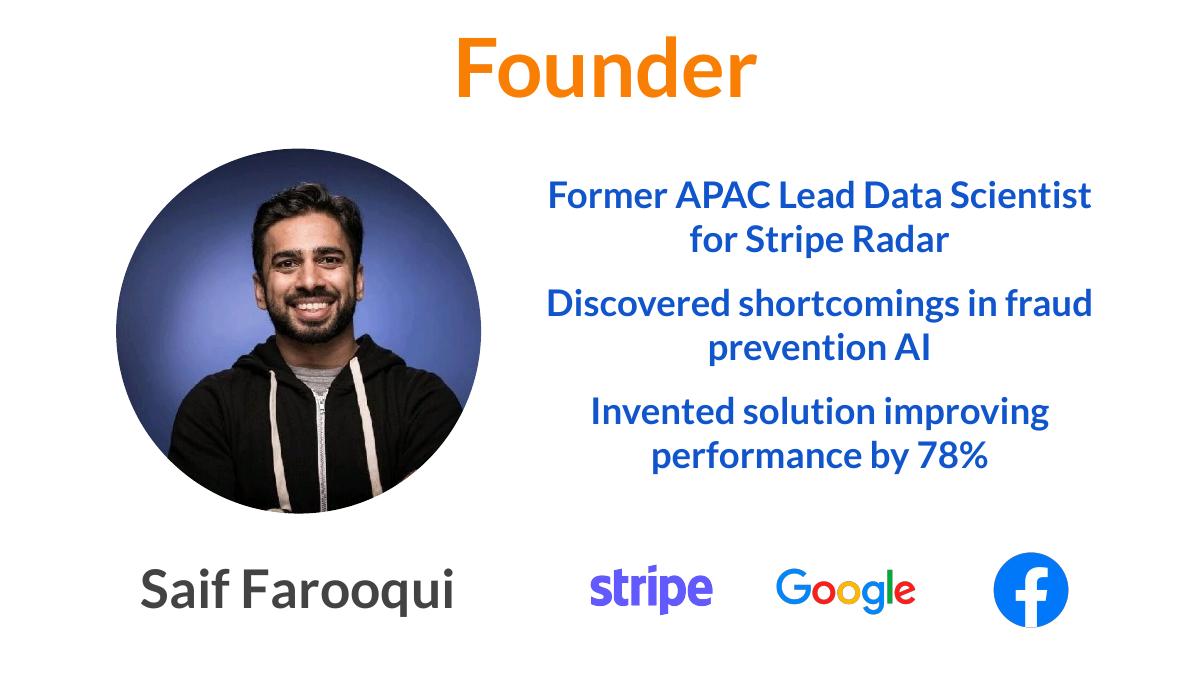
The second slide is the founder, not the problem. Saif Farooqui, former APAC lead data scientist for Stripe Radar, with three bullets: discovered shortcomings in fraud prevention AI, invented a solution improving performance by 78%.
Putting founder-market fit in position two is a deliberate bet, and for this company it is the right one. Fraud prevention is a domain where credibility is the product. "I ran fraud modelling for Stripe's own fraud product across APAC" is close to the strongest possible credential for a seed-stage fraud startup, and it recontextualises everything that follows: when the deck later criticises incumbent models for low precision and recall, the reader already knows the criticism comes from someone who built one.
The weakness is that it is one person on a slide labelled "Founder," singular. There is no team slide anywhere in 22 pages. At seed that is survivable for a technical solo founder with this pedigree, but it is the first question in the meeting.
Slides 3, 4 and 5 — The problem, split across three slides
Rather than one crowded problem slide, CorgiAI uses three single-sentence slides in sequence:
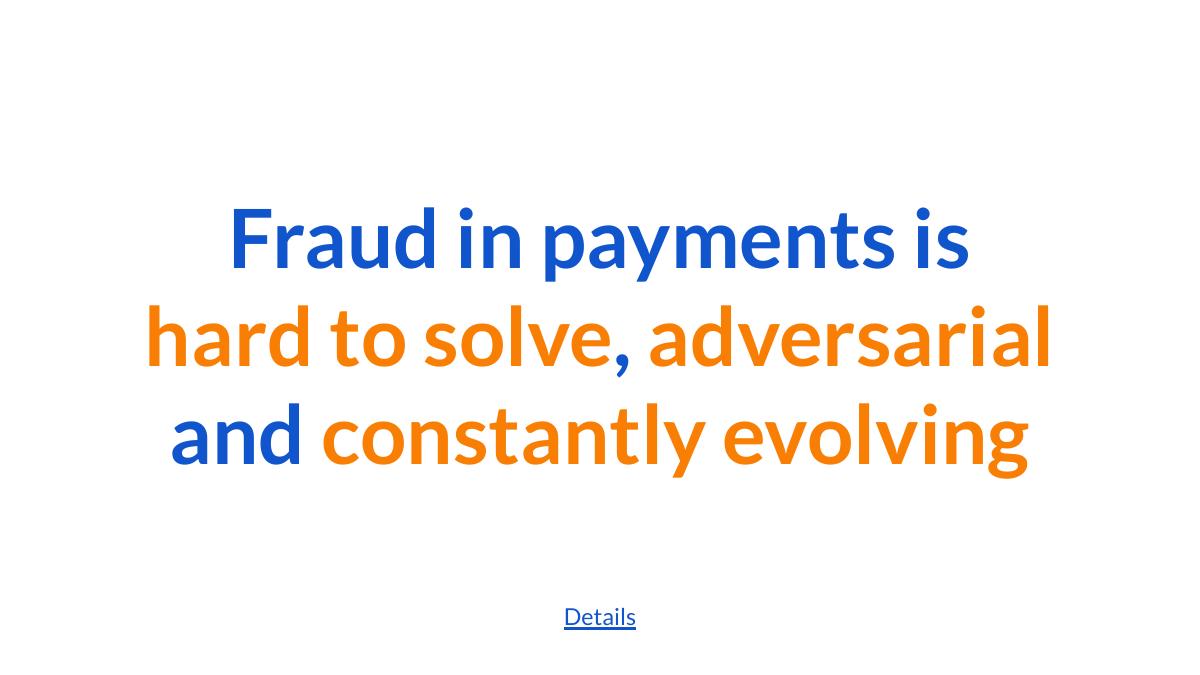
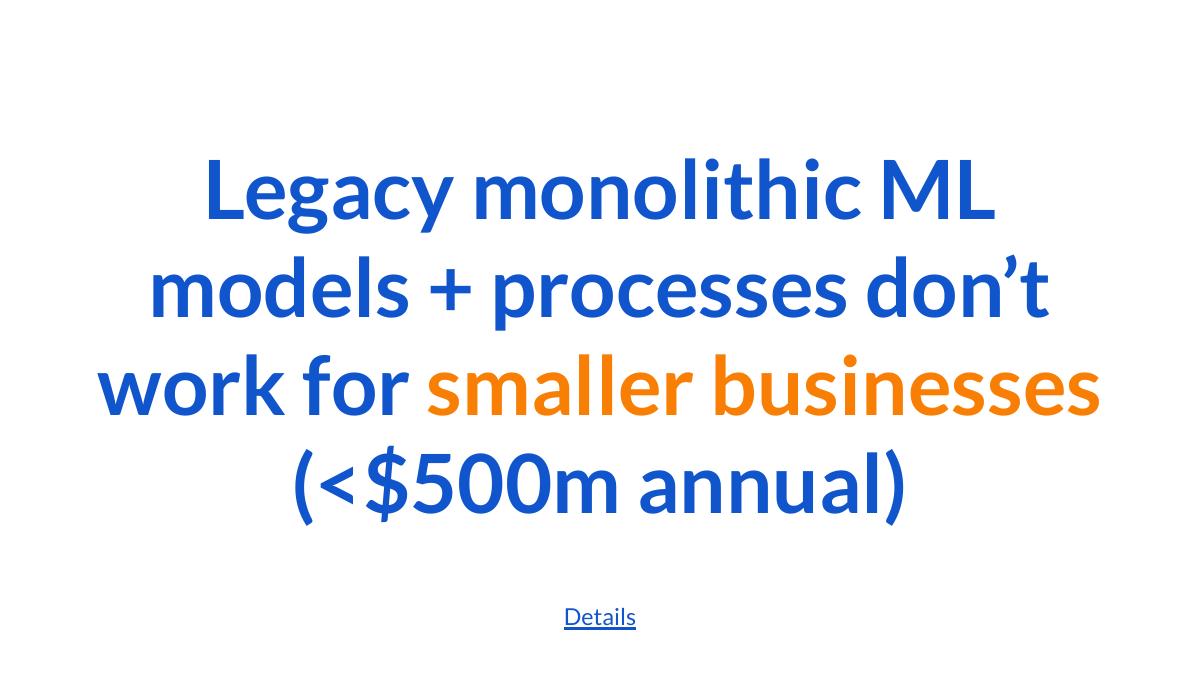
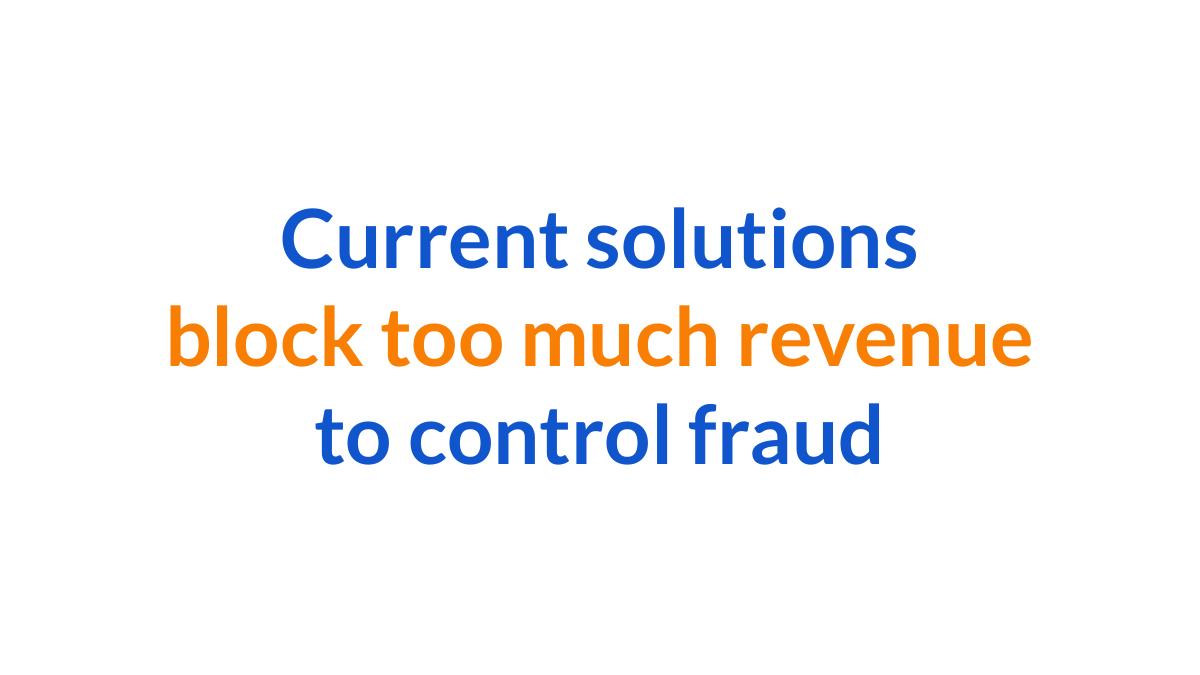
Slide 3: "Fraud in payments is hard to solve, adversarial and constantly evolving." · Slide 4: "Legacy monolithic ML models + processes don't work for smaller businesses (<$500m annual)." · Slide 5: "Current solutions block too much revenue to control fraud."
Slides 3 and 4 carry a "Details" link into the appendix. This is the best sequencing decision in the deck. Each slide isolates one claim, and the three claims build an argument rather than a list: the problem is intrinsically hard, the existing tooling is built for enterprises, and the workaround businesses adopt costs them revenue. By slide 5 the reader has been handed the exact wedge — sub-$500m merchants who are choosing between fraud losses and blocked revenue — without a single chart.
The cost of the approach is pace. Three slides to deliver three sentences works in a room where the founder is talking; it can feel thin when the deck is forwarded cold and read in ninety seconds.
Slide 6 — Market opportunity: $21B
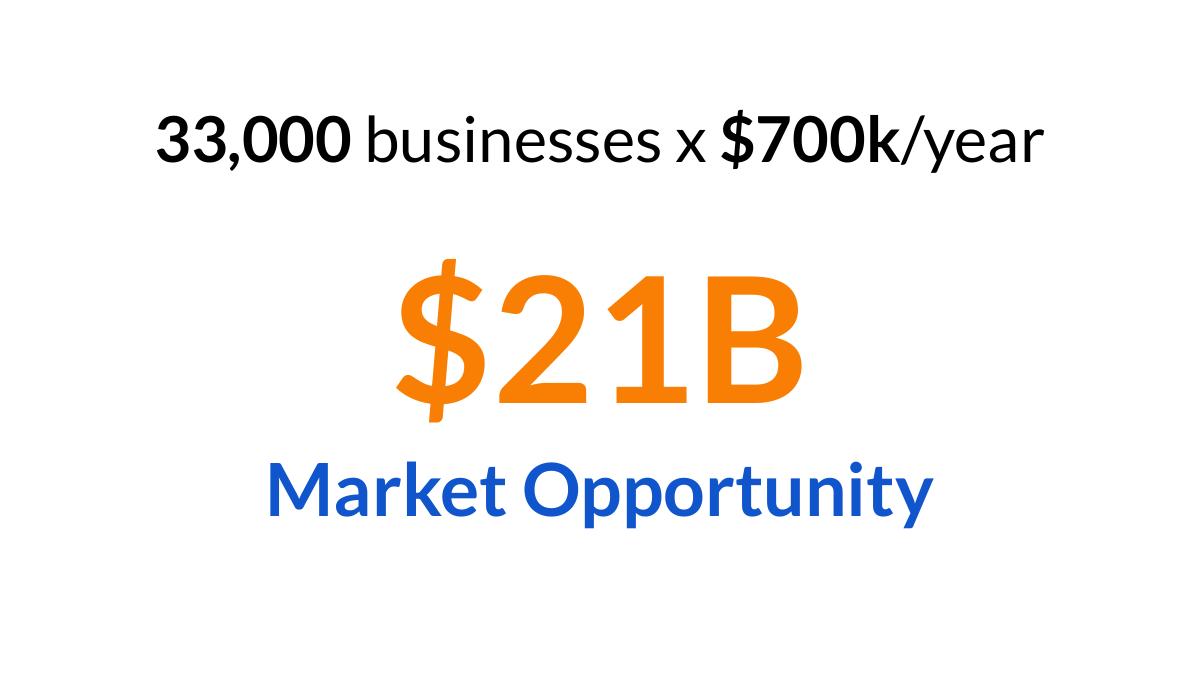
One calculation, shown in full: 33,000 businesses × $700k/year = $21B.
Showing the arithmetic is the correct instinct and rarer than it should be. The reader can immediately interrogate both inputs instead of arguing with an unsourced trillion-dollar TAM. But the two inputs are exactly where this slide is fragile. There is no source for the 33,000 business count and no derivation of the $700k annual figure — and $700k per year per merchant is a very large number to assume against a pricing model that, two slides later, is 0.2% of GMV plus 20% of unblocked revenue. At $14m of monthly GMV across the current book, the implied per-customer revenue is nowhere near $700k. Any partner who does that division in their head will ask about it, and the deck does not pre-empt the question.
Slide 7 — Solution
"We bring balance to revenue and fraud via proprietary AI," with a "Details" link and a link to a separate technical deck.
The framing — balance , not eliminate — is the sharpest positioning line in the deck, because it directly answers the problem set up on slide 5. Every competitor promises less fraud. CorgiAI promises less fraud without the collateral revenue loss, which is the thing the merchant actually feels. Offloading the architecture to a separate technical deck is also the right call: it keeps the main narrative at one idea per slide while giving a technically inclined investor somewhere to go.
Slide 8 — Product proof
Two numbers: "5 minute integration" and ">10% revenue recovered."
These are the two objections a payments buyer raises — how painful is the integration, and what do I get — answered in seven words. What is missing is the denominator. Revenue recovered relative to what baseline, measured over what period, across how many merchants? A single customer's result and a book-wide average are very different claims, and the deck presents them identically.
Slide 9 — GTM strategy
"We grow by integrating directly with payment providers," with a supporting line: evidence of reduced fraud and increased revenue for individual businesses builds the pathway for these partnerships.
This is a channel strategy, not a sales strategy, and the deck is honest about the ordering: win individual merchants first, use those results as the proof needed to sign the provider that distributes you to thousands. It is a credible motion for a fraud product because payment providers are the natural aggregator of the buyer. What the slide never states is the sales reality underneath it — no CAC, no sales cycle length, no count of provider conversations in flight. The strategy is asserted; the pipeline is not evidenced.
Slide 10 — Traction and pricing
$14m GMV processed monthly · Pricing (starting June 2023): 0.2% of GMV + 20% of revenue unblocked · $252k projected revenue for 2023
Three things are worth copying here. First, GMV processed is the right traction metric for an infrastructure product pre-revenue-scale: it proves live production integration, not pilots. Second, the pricing model is disclosed on the same slide as the traction, which lets the reader verify the revenue projection rather than take it. Third, the performance-linked component — 20% of revenue unblocked — is a genuinely strong commercial construction, because the merchant only pays the larger share of the bill out of money they were previously losing.
The exposure is the word "projected," and the date. Pricing starts in June 2023, the deck is dated June 2023, so $252k of 2023 revenue is essentially forward-looking from a standing start. There is no MRR figure, no customer count, and no retention. An investor reading carefully will conclude the company has live volume but almost no revenue history, which is a defensible seed position — but it would be stronger stated plainly than left to be inferred.
Slide 11 — Partners
Undefined logo walls are the most over-used and least persuasive slide in early-stage fundraising. "Partner" can mean a signed revenue-share agreement or a conversation that happened once on Zoom, and because it can mean either, experienced investors read it as the weaker one. One line of definition per logo — integrated, in pilot, contracted, in discussion — would convert this from decoration into evidence.
Slide 12 — Quotes
Two testimonials: "CorgiAI can help us solve fraud problems for the underloved SMEs segment" from a product lead at a global payment provider, and "CorgiAI is poised to become the de facto payments firewall for the industry" from an investor.
Both are anonymous, and anonymity roughly halves the value of a quote. The first one is still useful because it is a demand-side statement from the exact channel partner the GTM slide depends on — it corroborates the strategy. The second is a compliment from an unnamed investor about the company's future, which proves nothing and occupies the same visual weight as the first. Two quotes of unequal value presented as a pair drags the good one down toward the weak one.
Slide 13 — The ask
Build team: engineers, data scientists, sales · GTM: 50 customers and $500k MRR by 2025 · Gateway integrations: Checkout.com, PayPal, Shopify, Airwallex · Global expansion: US, EU, Japan, Korea, Australia
Naming the four gateway targets is what makes this ask credible: it turns "we will do integrations" into a checkable roadmap. The milestone is also concrete and time-bound, which most seed asks are not. The gaps are the standard ones — no runway in months, no round structure (SAFE or priced), no allocation across the four buckets, and no committed amount. And listing five geographies for a $2m seed reads as ambition rather than plan; a $2m round funds one new market properly, not five.
Slide 14 — Appendix divider
A single word. Worth noting only because of what it signals: everything before it is the pitch, everything after it is the defence. That boundary is why the main deck can afford to be so sparse.
Slide 15 — Digital payments and fraud, the ecosystem map
A full-page flow diagram of a card transaction: customer, commerce portal, payment processor, acquirer, card network, issuer, customer account, merchant account, merchant, payout, disputes and chargebacks — annotated with where each fraud type enters (friendly fraud, card testing, account takeover, refund fraud at the top of funnel; interception and triangulation fraud at delivery). The takeaway text notes that payment fraud usually occurs after the merchant has received the payment and stems from disputes.
This is the slide that separates a domain expert from a founder who read a market report. It is far too dense for the main deck and exactly right for the appendix, where its job is to survive scrutiny from an investor who already knows payments.
Slide 16 — The fraud funnel
A timeline showing the fraud lifecycle: payment, dispute, chargeback, consumer, refund, with 90 days for the consumer window and "90 + X days (X could be ∞)" for the provider's detection and mitigation loop.
The "X could be infinity" annotation is the most persuasive single mark in the deck. It reframes fraud from a cost line into an uncapped, open-ended liability — which is precisely the emotional argument for buying prevention rather than absorbing losses. Founders in any category with a delayed, unbounded cost should steal this device.
Slide 17 — Fraud is a problem
The macro case, with two cited statistics: every $1 of fraud transactions costs a store more than $3, and an estimated 80%+ of chargebacks are fraud-related. Both carry a "Source" link.
Sourcing the market statistics puts this deck ahead of the majority of seed decks, where headline numbers appear with no provenance at all. The $3-per-$1 multiplier is also doing real argumentative work: it converts a fraud rate into a much larger P&L number, which is what makes the customer case on slide 21 land.
Slide 18 — Why now?
Four arguments: inflationary pressure squeezing merchant margins, shrinking profit making fraud prevention more urgent, payment providers struggling in newer APAC markets, and the emergence of new APAC payment providers (especially eWallets) without the resources to fight fraud.
Half of this is strong and half is generic. "Inflation squeezes margins so cost control matters" is a timing argument any B2B cost-saving company could make in 2023. The APAC argument is the real one and it is specific to this founder: a wave of new payment providers in a region where the incumbent models were trained on US and EU data, pitched by the person who ran fraud data science for APAC at Stripe. That should have been the whole slide, and arguably should have been in the main deck rather than the appendix.
Slide 19 — Limitations of current solutions
The technical indictment, with the deck's most quotable numbers: client models observed running at roughly 10% precision (only 10% of predicted fraud is actually fraud) and roughly 15% recall (only 15% of real fraud is caught) — explicitly compared to a 50% coin flip. Two footnotes explain the mechanism: models trained on US and EU payments data are assumed to transfer to newer markets, and the resulting data bias produces poorer results; one footnote names Vietnam as a case where fraud prevention consistently struggles.
The line "They tailor the problem to the solution. It should be the other way around" is the thesis of the company in ten words. And observed precision and recall from live client models is first-party evidence — the kind of proprietary insight that justifies a seed cheque more than any market chart. The reason this belongs in the main deck rather than page 19 is that it is the single most defensible reason to believe the incumbents are beatable.
Slide 20 — Limitations, the 2×2
Four failure modes of existing fraud tooling: manual (over 75% of the process depends on human labelling, evaluation and validation in some cases), limited scope (add-ons cover endpoints of the fraud intelligence spectrum, not the complete user journey), capital-intensive (human labelling, implementation, forward-deployed engineering and server costs), and legacy dependence (heavy reliance on 3D Secure, which adds a costly extra check rather than being a comprehensive solution), with a footnote defining 3DS for non-specialists.
Defining 3D Secure in a footnote is a small, generous touch. It lets a generalist partner follow the argument without asking, which is a real conversion mechanism in a room where not everyone is a payments person.
Slide 21 — Customers are lost and confused
The best slide in the appendix, and possibly in the deck. Two anonymised real customers, presented as the two failure directions:
Fraud losses: an e-commerce CEO — "We know our fraud rate is very high, but all the solutions we've tried were blocking way too much revenue." Chargeback rate 0.8%, roughly $960k lost per year, and at the $3-per-$1 multiplier an actual fraud loss around $2.88m. · Lost revenue: a marketplace CFO — "We're scared of chargebacks. We paid for ML models, set strict rules, and ran extra verifications. Keeps our fraud rate low." The strict rules blocked an additional 5% of potential revenue, roughly $1.3m a year.
This is how customer evidence should be presented: the quote, then the quantified consequence of the quote. It proves the problem is expensive in both directions, which is the entire premise of the "balance" positioning on slide 7. Burying it on page 21 is a distribution error — most readers of a forwarded deck never reach it.
Slide 22 — Introducing CorgiAI
The product slide, closing the appendix: a user-centric, API-based, end-to-end fraud detection and prevention suite built on customisable and explainable AI, with five attributes — lightweight (upstream data processing and filtering optimises ML runtimes), simple (integrates directly with your payment provider through an API), customized (intelligent clustering adapts the algorithm to the problem space), end-to-end (automated detection and insights all the way to blocking), and transparent (explainable AI plus observable performance metrics). A footnote reveals the name is an acronym — Clustering Optimized Rule Generation Intelligence, patent pending.
Each attribute maps to a specific incumbent failure from slides 19 and 20: transparency answers the black box, customization answers the transferred US/EU model, simplicity answers the forward-deployed engineering cost. That mapping is what makes the product feel inevitable rather than merely described. And "patent pending" is one of the few defensibility signals in the entire deck — which is another argument for moving this page forward.
What this deck does better than most startup pitch decks
One idea per slide, ruthlessly. Slides 3, 4, 5, 7, 8 and 9 each carry a single sentence. In a live pitch this keeps the investor listening to the founder instead of reading ahead. · Founder-market fit in position two. Leading with Stripe Radar credentials makes every subsequent technical criticism of incumbents land as expertise rather than opinion. · A main deck / appendix architecture with working links. "Details" links let a skim-reader stay in the 13-slide narrative and a diligent reader jump straight to the evidence. Very few seed decks are built for both audiences at once. · Pricing disclosed alongside traction. Showing 0.2% of GMV + 20% of revenue unblocked next to $14m monthly GMV lets an investor check the revenue projection instead of trusting it. · First-party technical evidence. The observed ~10% precision and ~15% recall of client models is proprietary insight nobody else can quote, and it justifies the whole company. · Sourced market statistics. The $3-per-$1 and 80%+ chargeback figures carry source links, which is rare enough to be a differentiator on its own. · Customer pain quantified in both directions. Slide 21 pairs a real quote with the dollar consequence for both over-blocking and under-blocking. · A named, checkable roadmap in the ask. Checkout.com, PayPal, Shopify and Airwallex is a commitment; "gateway partnerships" would have been a wish.
Where this deck would fail in an investor meeting
No competition slide anywhere in 22 pages. Payment fraud is a crowded category — Sift, Signifyd, Forter, Ravelin, Riskified, plus Stripe Radar itself, the founder's former employer. The absence reads as either unawareness or avoidance, and the obvious question ("why can't Stripe do this?") goes unanswered. · No team slide. One founder, no engineers, no advisors, no hiring plan beyond the words "engineers, data scientists, sales" in the ask. For a company whose moat is modelling talent, this is the largest gap. · The $21B TAM is unsourced and inconsistent with the pricing. $700k per merchant per year does not reconcile with 0.2% of GMV plus 20% of unblocked revenue at the current customer scale. · Traction is volume, not revenue. $14m monthly GMV and $252k of projected 2023 revenue, with pricing that only starts the month the deck is dated. No MRR, no customer count, no retention, no growth rate. · Anonymous quotes and an undefined partner wall. "Product lead at global payment provider" and unlabelled logos both invite the discount. · No financials or runway. There is no burn rate, no runway in months, no round structure and no allocation of the $2m across the four buckets. · The strongest material is buried. Slides 19 and 21 — the precision/recall evidence and the quantified customer pain — are the two most persuasive pages in the file, and both sit after the appendix divider where a forwarded reader never reaches them. · Five geographies on a $2m round. US, EU, Japan, Korea and Australia is not a plan a seed round funds; it dilutes an otherwise focused APAC wedge.
Main deck versus appendix: what each half actually proves
Density One sentence or one number per page Full-page diagrams, footnotes, sourced statistics
Audience The partner in the room, listening The analyst reading the forwarded PDF
Strongest asset Slide 10 — GMV plus disclosed pricing Slide 21 — customer pain quantified both ways
Evidence type Assertions and headline metrics First-party data, mechanism, citations
Domain credibility Implied by the founder slide Proven by the payments flow map
Biggest gap No competition, no team, no financials Product slide arrives on page 22
Works if forwarded cold? Partially — reads thin without narration Yes, but only if the reader gets there
How you would rebuild this deck for a 2026 seed round
Promote slide 19 into the main deck. The ~10% precision and ~15% recall observation is the reason to believe. It should sit immediately after the three problem slides, as the proof that the problem is not merely hard but currently unsolved. · Promote slide 21 to just before the ask. Two named customer situations with dollar consequences in both directions is the emotional close. Nothing on pages 11 or 12 outperforms it. · Move the product slide (22) to follow the solution statement (7). The five attributes each answer a stated incumbent failure; that mapping is wasted at the end of an appendix. Keep the patent-pending footnote visible. · Add a competition slide with Stripe Radar on it. The founder built inside Radar; that is a positioning advantage, not a threat, but only if the deck says so. Position on the precision/recall trade-off for sub-$500m merchants, not on feature checklists. · Add a team and hiring slide. Founder plus first two hires plus any advisor with payments credibility. If the company is genuinely one person, state that and show which roles the $2m funds first. · Rebuild the market slide bottom-up from the actual pricing. Take the merchant count, apply the real 0.2% of GMV plus 20% of unblocked revenue against a defensible average GMV, and show the working. A smaller, verifiable number beats an unsourced $21B. · Replace projections with the operating picture. Customers live, MRR today, GMV growth over the last three months, and gross retention. If revenue only started in June, say the month it started — investors forgive early, they do not forgive vague. · Label every logo and attribute every quote. Integrated, in pilot, in discussion. Name the payment provider or drop the quote. One credited testimonial beats two anonymous ones. · Cut the geography list to one market. Fund the APAC wedge the founder can uniquely win, and mention the rest as a downstream consequence, not a use of proceeds. · Complete the ask. $2m on a named structure, allocated across four buckets in percentages, buying a stated number of months to a stated milestone (50 customers, $500k MRR).
The transferable lesson
CorgiAI's deck is a case study in a mistake that has nothing to do with design and everything to do with ordering. The founder had the two strongest pages in the file — observed precision and recall from real client models, and two customers whose pain is quantified in dollars in both directions — and put both of them behind the appendix divider, where they only get read by an investor who is already convinced. Meanwhile the pages that occupy prime narrative real estate are an unlabelled logo wall and two anonymous quotes.
That inversion is extraordinarily common, and founders almost never see it in their own deck, because the evidence they worked hardest on feels technical and the assertions feel presentable. It is only visible from the outside — which is exactly what an investor's first pass is.
Before you send your next deck, find out what a first read actually surfaces: which slide carries your strongest claim, whether your traction is legible in seconds, and what a partner would flag before agreeing to a meeting.
Frequently asked questions
- Is the CorgiAI deck a real pitch deck used to raise money?
- Yes. The file is titled "CorgiAI Fundraising Deck — Seed v3" and was built in Google Slides in June 2023 to raise a $2 million seed round for a B2B payment fraud prevention company. It is a working founder deck rather than a post-hoc recreation, which is why it still contains rough edges like projected revenue and an unsourced market calculation.
- What is CorgiAI?
- CorgiAI is a B2B SaaS company building API-based, end-to-end payment fraud detection and prevention for merchants processing under roughly $500m a year. The name is an acronym for Clustering Optimized Rule Generation Intelligence (patent pending). It was founded by Saif Farooqui, previously APAC lead data scientist for Stripe Radar, and it prices at 0.2% of GMV plus 20% of revenue unblocked.
- How many slides is the CorgiAI pitch deck?
- Twenty-two pages in total, structured in two halves. Slides 1 to 13 are the main pitch narrative — title, founder, three problem slides, market, solution, product, GTM, traction and pricing, partners, quotes and the ask. Slides 14 to 22 are an appendix containing the payments ecosystem map, fraud funnel, market statistics, why-now, incumbent limitations, customer evidence and the product detail.
- Which CorgiAI slides should founders copy?
- Three of them. Slide 10 pairs traction ($14m monthly GMV) with the actual pricing model so an investor can verify the revenue projection. Slide 19 uses first-party evidence — client fraud models observed at ~10% precision and ~15% recall against a 50% coin flip. Slide 21 pairs two real customer quotes with the dollar consequence of each, in both the over-blocking and under-blocking directions.
- What is the biggest weakness in the CorgiAI pitch deck?
- Ordering. The two most persuasive pages in the file — the precision and recall evidence on slide 19 and the quantified customer pain on slide 21 — sit behind the appendix divider, where a cold reader of a forwarded PDF never reaches them. Meanwhile slides 11 and 12, an undefined logo wall and two anonymous quotes, hold prime narrative position. The missing competition and team slides come a close second.
- Should a seed deck use an appendix like CorgiAI does?
- Yes, if the main narrative is genuinely readable without it. CorgiAI's split lets a live pitch run on one idea per slide while a diligent analyst can jump to full diagrams and sourced statistics, and the in-deck "Details" links make that navigable. The rule is that anything required to believe the company belongs in the main deck; the appendix is for defending claims, not for making them.