Counterpart’s Series B deck is a study in brevity and market positioning. With only nine slides, the company successfully communicated a complex insurance proposition by focusing on the massive gap in SME Directors & Officers (D&O) insurance. The deck identifies a $20B current market with a $50B future potential, specifically targeting US private companies with fewer than 250 employees. By emphasizing 'Bionic Underwriting'—a blend of 85 years of industry experience and autonomous digital risk profiles—Counterpart positioned itself as a bridge between legacy carriers and modern data science. T…
Key takeaways
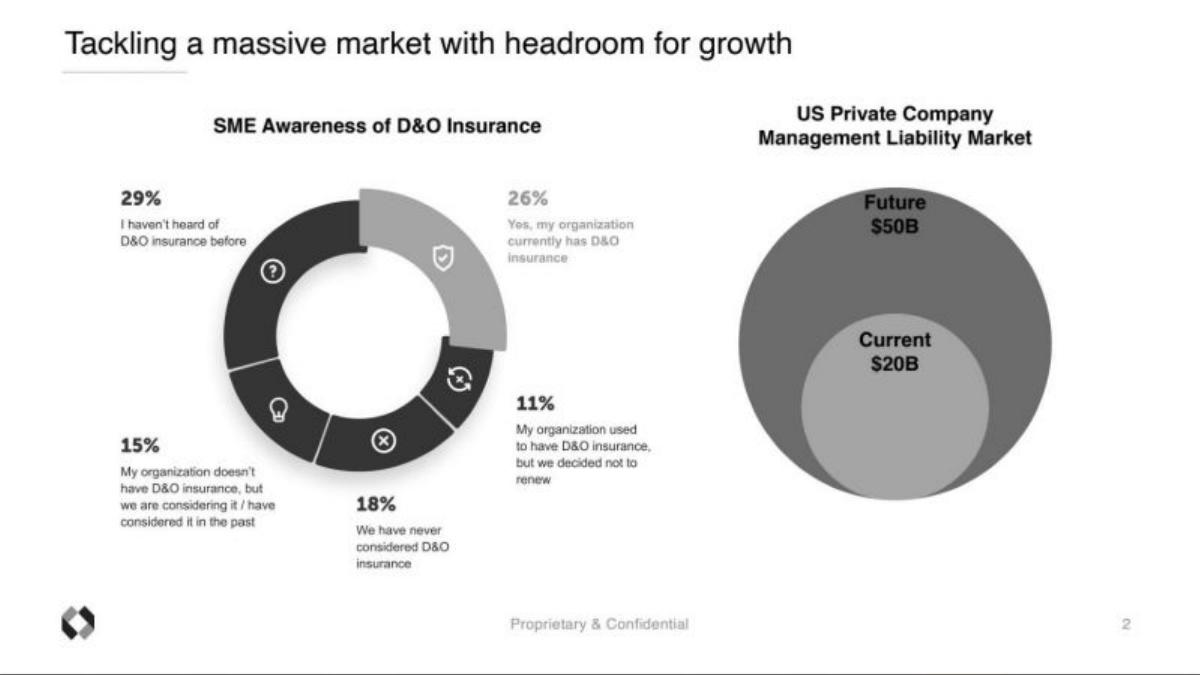
- The deck identifies a significant market education gap, noting that 29% of SMEs have never heard of D&O insurance (Slide 2).
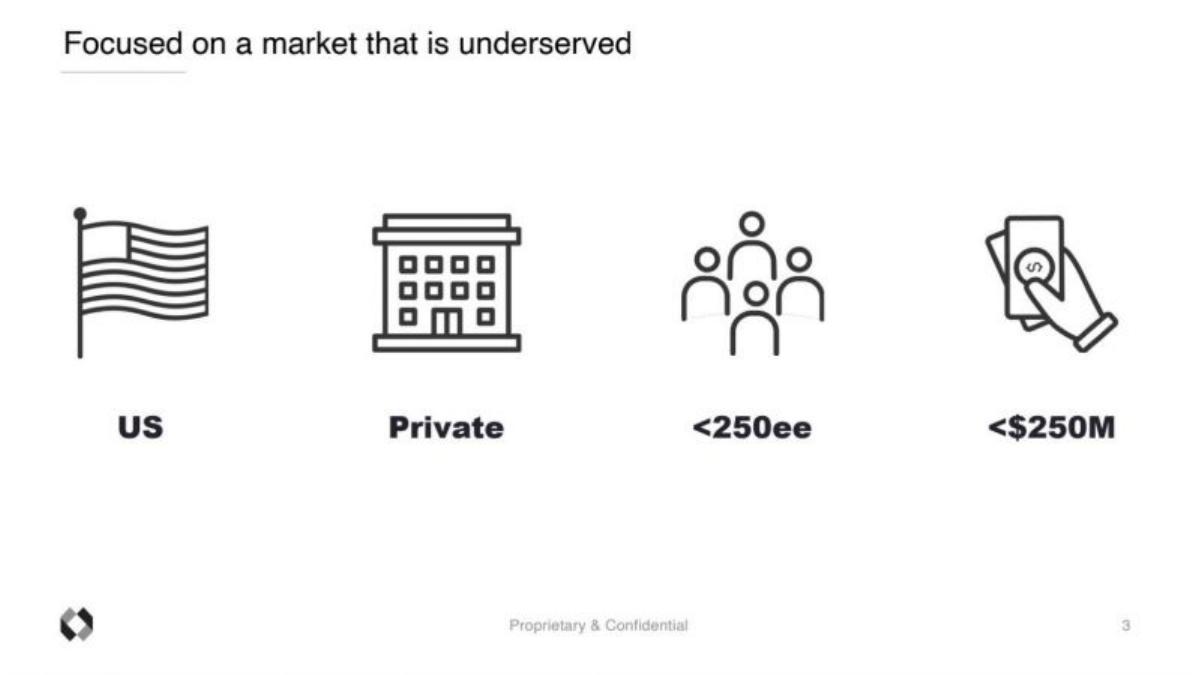
- Counterpart targets a specific underserved niche: US private companies with <250 employees and <$250M in revenue (Slide 3).
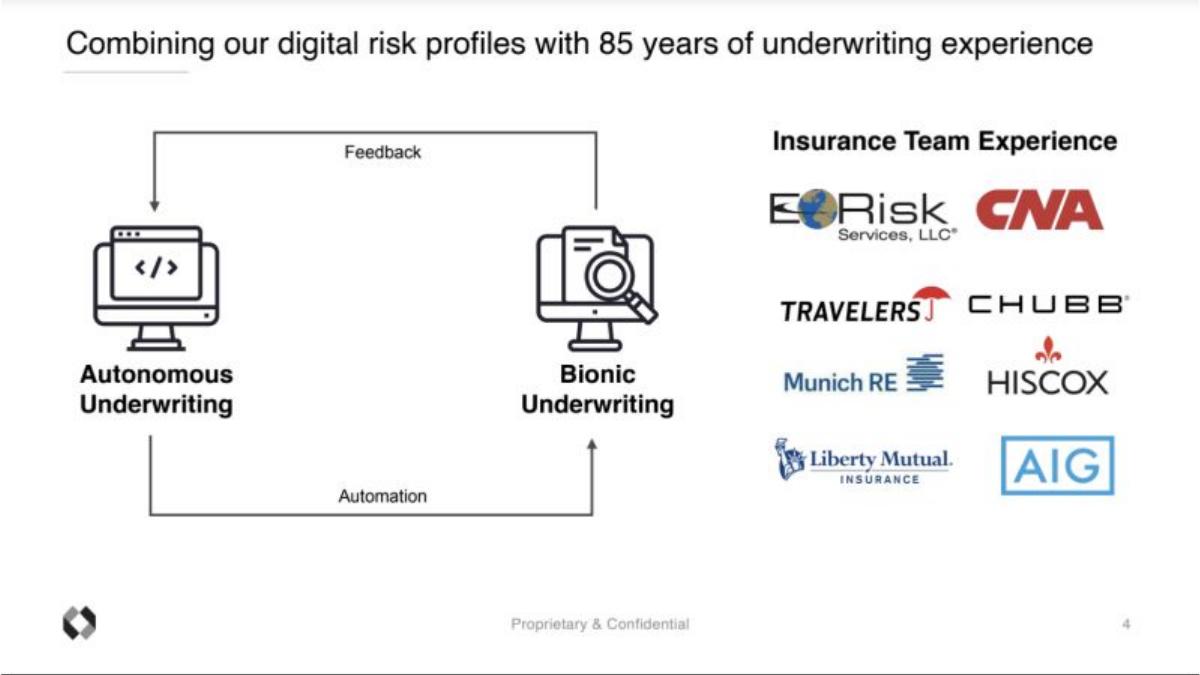
- The 'Bionic Underwriting' model combines digital risk profiles with 85 years of collective experience from legacy firms like AIG, Chubb, and Travelers (Slide 4).
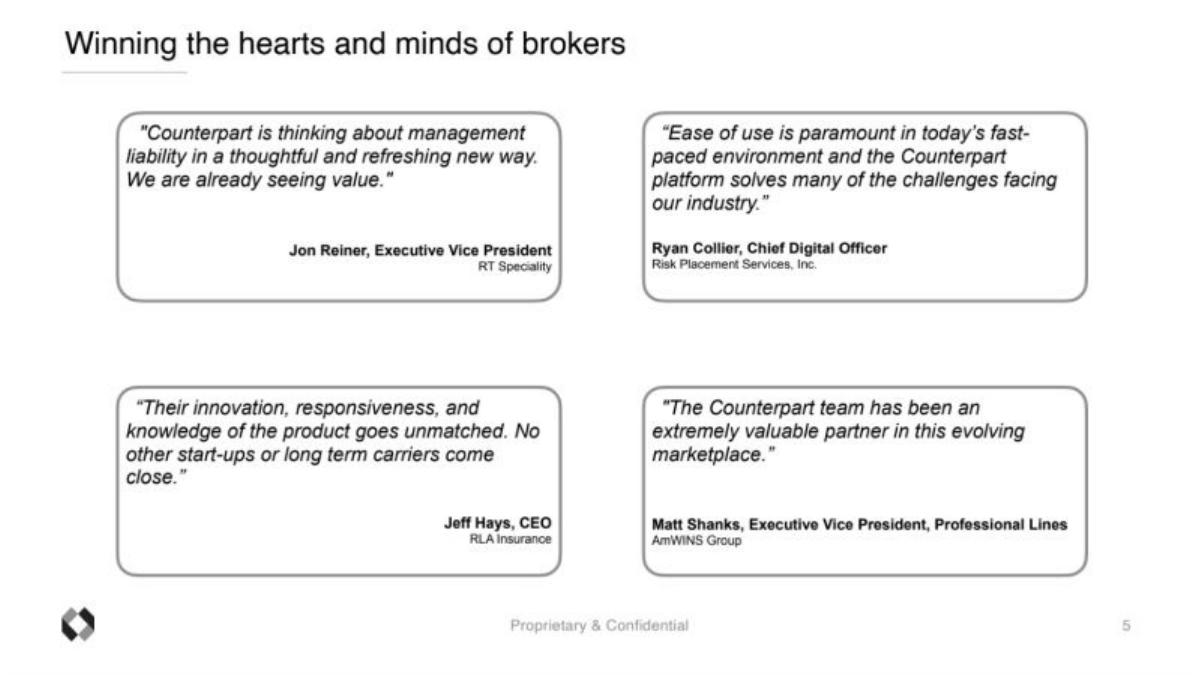
- Broker adoption is validated through testimonials from executives at RT Specialty, Risk Placement Services, and AmWINS Group (Slide 5).
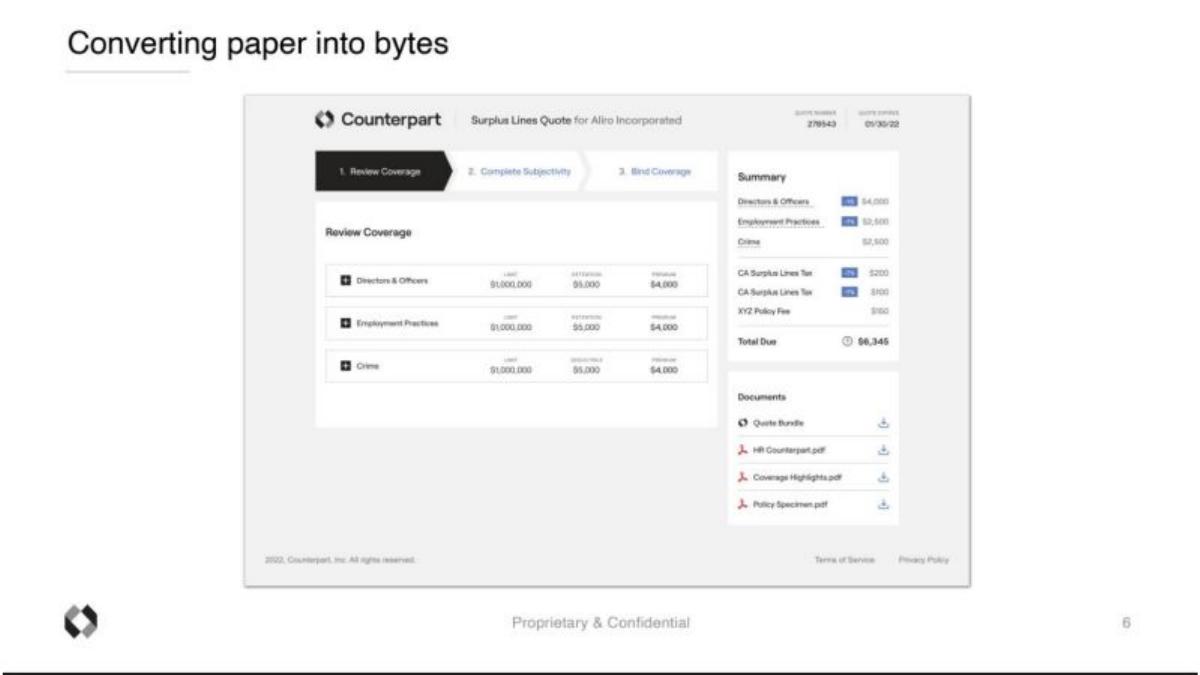
- The product interface focuses on digitizing the quote process, showing a sample 'Surplus Lines Quote' for a hypothetical client (Slide 6).
- Risk mitigation is a core product feature, offering small businesses a 'Risk Assessment' and an 'HR Counterpart' resource center (Slide 7).
- The business model relies on a flywheel where 'More Data' leads to 'Fewer Losses,' which in turn fuels 'Better Rates' and 'Expanded Coverage' (Slide 8).
- The deck completely omits a team slide, financial projections, and a specific use-of-funds breakdown, suggesting it was used as a high-level narrative tool rather than a comprehensive data room (Slides 1-9).
The Series B Narrative: Simplicity Over Complexity
Counterpart’s 2022 Series B deck is an exercise in restraint. In an industry as complex as management liability insurance, the temptation is to drown the investor in actuarial tables and regulatory minutiae. Instead, Counterpart uses nine slides to tell a story of market neglect and technological opportunity. The deck focuses heavily on the 'Why Now' and the 'How,' leaving the 'Who' and the 'How Much' for the verbal pitch or the data room. This teardown explores how a company raised $30M by highlighting a massive awareness gap in the SME sector.
Slide 1: Title and Branding
The cover slide is minimalist, featuring the Counterpart logo and the text 'Investor Presentation' dated February 2021. While the catalogue facts state the round was raised in 2022, this slide indicates the materials were in development or used for early-stage conversations well before the close. The 'Proprietary & Confidential' footer is standard for late-stage venture rounds.
Slide 2: The Awareness Gap as a Market Opportunity
Slide 2 is perhaps the most important slide in the deck. It defines the problem not as a lack of product, but as a lack of awareness. It cites that 29% of SMEs have never heard of D&O (Directors & Officers) insurance, and 18% have never even considered it. By showing that only 26% of the market is currently covered, Counterpart establishes a clear path for growth: market expansion rather than just stealing market share. The right side of the slide quantifies this, showing a US Private Company Management Liability Market growing from a 'Current' $20B to a 'Future' $50B.
Slide 3: Defining the Sandbox
Slide 3 uses four simple icons to define the company's target market: US-based, Private companies, fewer than 250 employees ( Insurance tech (InsurTech) often struggles to balance 'tech' with 'insur.' Counterpart addresses this on Slide 4 by introducing 'Bionic Underwriting.' They visualize a feedback loop between 'Autonomous Underwriting' (automation) and 'Bionic Underwriting' (human expertise). To provide credibility to the 'Bionic' side, they display the logos of eight major insurance carriers, including AIG, Chubb, and Travelers, claiming '85 years of underwriting experience' across their team. This is a clever way to show team strength without a traditional headshot-and-bio slide.
Slide 5: Social Proof via Broker Validation
In the insurance world, brokers are the gatekeepers. Slide 5, titled 'Winning the hearts and minds of brokers,' features four testimonials from high-ranking executives at major firms like RT Specialty and AmWINS Group. The quotes emphasize 'ease of use,' 'innovation,' and 'responsiveness.' For an investor, this slide mitigates distribution risk by proving that the people who actually sell the insurance like the product.
Slide 6: Product Visualization
Slide 6 shows a screenshot of the Counterpart platform. It illustrates a 'Surplus Lines Quote for Aliro Incorporated.' The UI is clean, showing a total due of $6,345 and a breakdown of coverages (D&O, Employment Practices, Crime). This slide proves the 'Converting paper into bytes' headline by showing a digital-first workflow that replaces the traditionally manual, paper-heavy quoting process in management liability.
Slide 7: Value-Add Beyond the Policy
To justify their position in the market, Counterpart shows they are more than just a policy issuer. Slide 7 introduces 'Risk Assessment' reports and the 'HR Counterpart' resource center. By offering tools that help small businesses identify and mitigate risks (like remote workforce challenges, as seen in the sample report), Counterpart moves from being a commodity expense to a strategic partner. This is a classic 'sticky' product play intended to reduce churn.
Slide 8: The Flywheel
The final content slide (Slide 8) presents the 'Virtuous circle fueled by organic growth and partnerships.' It’s a standard flywheel graphic: More Data leads to Fewer Losses, which leads to Refined Underwriting, Enhanced Risk Mitigation, and Improved Claims Management. This, in turn, allows for Expanded Coverage, Better Rates, and a Simplified Application, which attracts more customers and generates... More Data. It’s a concise way to explain the long-term competitive advantage of their data-driven approach.
Slide 9: External Resource
The final slide is a promotional placeholder for the source library. It contains no company-specific information.
What Counterpart Does Well
Market Education Focus: Instead of arguing why their tech is better than a competitor's, they argue that the market itself is vastly under-penetrated. This makes the investment opportunity feel like a 'rising tide' play rather than a 'bloody battle for market share' play.
Credibility by Association: By listing the logos of legacy insurance giants where their team previously worked, they immediately solve the 'do these tech kids actually know how to price risk?' question that plagues many InsurTech startups.
Distribution Clarity: The heavy emphasis on brokers (Slide 5) shows a mature understanding of the insurance industry. They aren't trying to 'disrupt' the broker; they are trying to empower them, which is a much more viable path to scale in B2B insurance.
What is Missing from the Deck
The Team Slide: While they mention '85 years of experience,' there are no names, titles, or specific backgrounds for the founders or executive leadership. At Series B, investors usually want to see the specific 'who' behind the 'what.'
Financial Performance: There is a total lack of hard metrics. We don't see Gross Written Premium (GWP), Loss Ratios, Retention Rates, or Revenue growth. For a $30M round, these numbers were certainly in the data room, but their absence here makes the deck feel more like a 'teaser' than a full pitch.
Competitive Landscape: The deck assumes Counterpart is operating in a vacuum. There is no mention of other InsurTechs (like Coalition or Vouch) or how they specifically beat the legacy carriers they mention on Slide 4.
The Ask: The deck ends without a 'The Ask' slide. There is no mention of how much they are raising (we know it was $30M from the catalogue facts) or what that capital will be used for (e.g., hiring, geographic expansion, new product lines).
Founder Takeaways: What to Copy
Use the 'Bionic' Framework: If you are building in a traditional industry (Law, Insurance, Finance), don't claim your AI will replace humans. Copy Counterpart’s 'Bionic' approach—show how your tech augments human expertise. It is a much more palatable narrative for both investors and industry partners.
Define Your Sandbox Narrowly: Counterpart’s Slide 3 is a perfect example of how to define a target market. By setting clear boundaries ( Focus on the Distribution Channel: If your product relies on third-party distributors (like brokers, agents, or resellers), give them their own slide. Show that you understand their pain points and that they actually like using your tool. Social proof from the channel is often more valuable than social proof from the end-user in enterprise sales.
Frequently asked questions
- What is the primary problem Counterpart is solving?
- Counterpart addresses the lack of management liability insurance coverage among small and medium-sized enterprises (SMEs). According to Slide 2, 29% of SMEs have never heard of D&O insurance, and only 26% currently carry it. The company aims to capture a market that is projected to grow from $20B to $50B by simplifying the application process and providing better risk assessment tools for this underserved segment.
- How does Counterpart differentiate its underwriting process?
- The company uses what it calls 'Bionic Underwriting' (Slide 4). This approach integrates 'Autonomous Underwriting' (digital risk profiles and automation) with 'Bionic Underwriting' (human expertise). They leverage the experience of a team with backgrounds at major carriers like Munich RE, Hiscox, and CNA to refine the automated feedback loops, ensuring that data-driven decisions are grounded in traditional insurance logic.
- Who is the target customer for Counterpart?
- Counterpart is strictly focused on the US private company market (Slide 3). Their ideal customer profile includes businesses with fewer than 250 employees and less than $250 million in annual revenue. By narrowing their focus to this specific 'underserved' niche, they avoid direct competition with carriers focused on large-cap public companies.
- What role do insurance brokers play in Counterpart's strategy?
- Brokers are a critical distribution channel for Counterpart. Slide 5 is dedicated to 'winning the hearts and minds of brokers,' featuring testimonials that praise the platform's ease of use and responsiveness. By providing brokers with tools like the 'HR Counterpart' resource center and digital quote bundles (Slides 6 and 7), Counterpart makes it easier for brokers to sell management liability products to their SME clients.
- What essential pitch deck elements are missing from this presentation?
- This deck is notably missing a Team slide (though logos of previous employers are shown), a Competition slide, and a Financials/Projections slide. Most importantly for a Series B, there is no 'The Ask' slide detailing how the $30M will be spent. This suggests the deck was likely a supplemental piece for a process where the data room and founder meetings handled the heavy lifting of due diligence.