Core Capital Venture Indonesia’s pitch deck outlines a multi-faceted business strategy centered on the Indonesian subsidized housing market. The company aims to address a government-identified need for 30 million subsidized houses by 2025, valued at $300 billion. Their model is unique, blending real estate development with 'supporting products' like gas stations, venture capital, and stock brokerage. The deck seeks $15 million in funding, primarily for working capital, offering a profit-sharing investment instrument. While the market opportunity is clearly defined using government data, the o…
Key takeaways
- The company targets a $300 billion market for subsidized housing in Indonesia, citing a need for 30 million units by 2025 (Slide 4).
- Revenue is split into two streams: 'Monetization A' from $10,000 house sales and 'Monetization B' from gas, venture capital, and brokerage (Slide 6).
- The growth plan is aggressive, projecting an increase from 9,000 units in 2019 to 63,000 units per year by 2025 (Slide 10).
- The funding ask is $15 million USD, with 90% of proceeds allocated to working capital (Slide 14).
- The investment structure is proposed as a profit-sharing model rather than traditional equity, with an estimated valuation of 6x the investment (Slide 14).
- The advisor team includes individuals with backgrounds in the Mendeng Group, KBR inc. Texas, and Indosat (Slide 8).
- The 2019 roadmap shows a monthly cycle of land acquisition and development, targeting 90 units per month starting in June (Slide 12).
- The deck lacks a dedicated slide for the core executive management team, focusing instead on the Board of Commissary/Advisors (Slide 8).
Slide-by-Slide Teardown
Slide 1: Title Slide
The cover slide features the 'CVenture' logo with the full name 'Core Capital Venture Indonesia' underneath. It includes the company website (www.cc-venture.com) and a background image of a laptop and a hand using a tablet, suggesting a tech-enabled approach, though the subsequent slides focus heavily on physical assets.
Slide 2: Solution
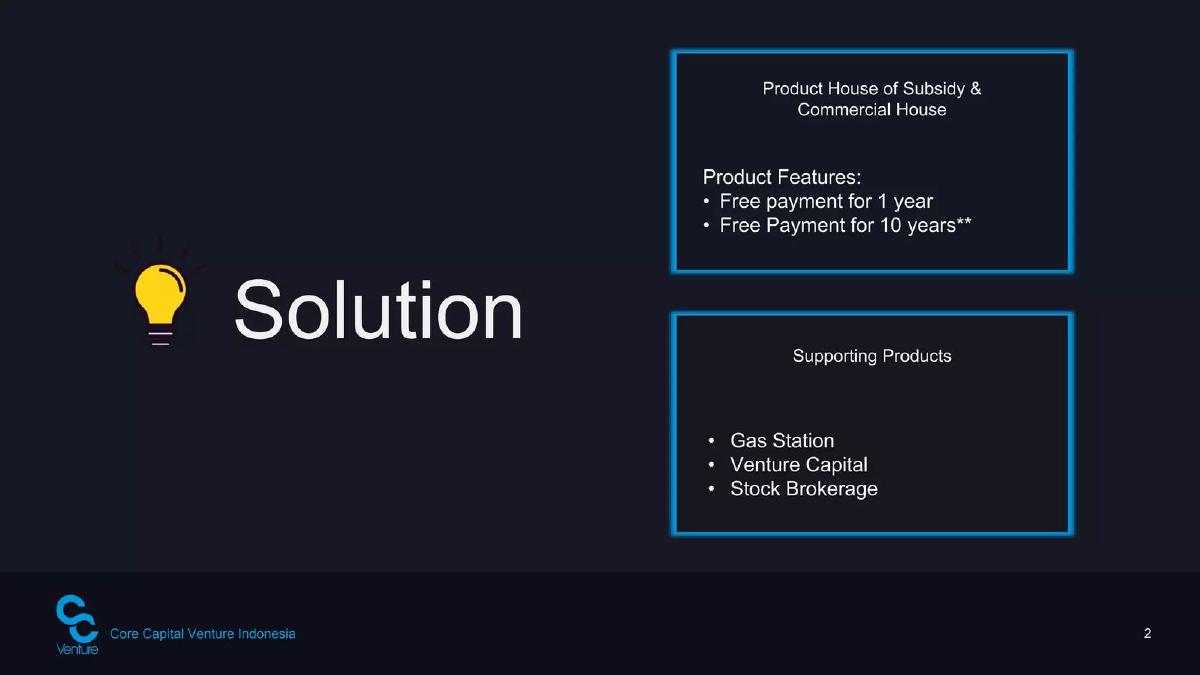
The solution is presented in two distinct categories. The first is the 'Product House of Subsidy & Commercial House,' which includes features like 'Free payment for 1 year' and 'Free Payment for 10 years' (the double asterisk is not explained on this slide). The second category is 'Supporting Products,' which lists Gas Station, Venture Capital, and Stock Brokerage. This indicates a highly diversified business model where real estate acts as the anchor for other financial and retail services.
Slide 4: Market Sizing
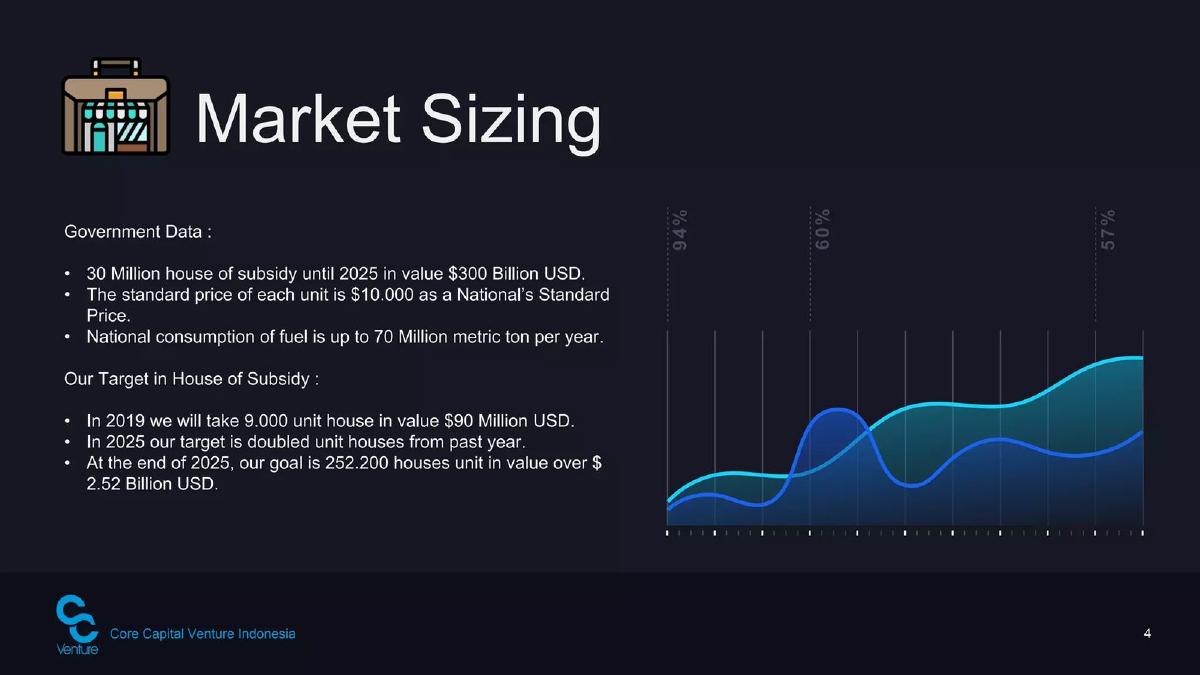
This slide uses government data to validate the opportunity. It states there is a need for 30 million subsidized houses until 2025, with a total market value of $300 billion USD. The slide defines the national standard price for these units as $10,000. It also notes the national fuel consumption at 70 million metric tons per year, justifying the gas station component of their business. The company sets a target to capture 9,000 units ($90 million value) in 2019, growing to a cumulative 252,200 units ($2.52 billion value) by the end of 2025.
Slide 6: Business Model
The business model is split into two streams. 'Monetization A (Stream 1)' is the main revenue source: selling houses at $10,000 per unit. 'Monetization B (Stream 2)' includes gas selling, capital share selling from venture capital, and stock brokerage/investment. The slide uses progress-bar-style graphics, though they do not represent percentages or specific ratios between the two streams.
Slide 8: Advisor Team
Instead of a management team slide, the deck presents an 'Advisor Team' consisting of five members of the 'Board of Commissary.' The advisors bring experience from the Mendeng Group, KBR inc. Texas, AJ Baron Capital, and Indosat. The presence of a CFO and CEO from the Mendeng Group suggests a close relationship or parent-subsidiary dynamic with that entity.
Slide 10: Tractions
The traction slide provides a bar chart of 'Unit House Per Year' projections from 2019 to 2025. The growth is linear and aggressive: 9,000 units (2019), 18,000 (2020), 27,000 (2021), 36,000 (2022), 45,000 (2023), 54,000 (2024), and 63,000 (2025). There is a small '1' noted under the 2019 bar, which may refer to a starting point or a specific phase, but it is not explicitly defined.
Slide 12: Milestone & Strategy
This slide provides a month-by-month roadmap for the year 2019. It begins in March 2019 with the company foundation and a $50,000 initial fund. By June 2019, the company aims to be in a repeating cycle of 'Land Acquisition, House Development, and Selling 90 Units' every month through December. This shows a very short window between founding and active development/sales.
Slide 14: Funding Needs & Allocation
The company is asking for a 'First Total Funds Needed' of $15 million USD. The allocation is heavily weighted toward 'Working Capital' at 90%, with 5% for marketing and 5% for operational expenses. The slide also notes a 6-month runway and a current/future burn rate of 5%. Interestingly, it proposes a 'Profit Sharing' investment instrument rather than equity, and estimates a valuation of 6x the investment amount.
Slide 17: Contact Detail
The final slide provides the office address in South Jakarta (Graha Simatupang Tower), a phone number, and an email address for 'boby@cc-venture.com.' The right side of the slide features a collage of images representing their business lines: housing, fuel, and finance.
What Core Capital Venture Indonesia Does Well
The deck excels at identifying a massive, government-backed market opportunity. By anchoring their pitch in the Indonesian government's goal of 30 million subsidized houses, they immediately establish the scale and necessity of the project. The use of a fixed price point ($10,000 per unit) makes the revenue projections easy to follow, even if they are ambitious. Furthermore, the 2019 roadmap is granular, showing a clear intent to move from land acquisition to sales within a single quarter, which demonstrates a sense of urgency.
What is Missing from the Deck
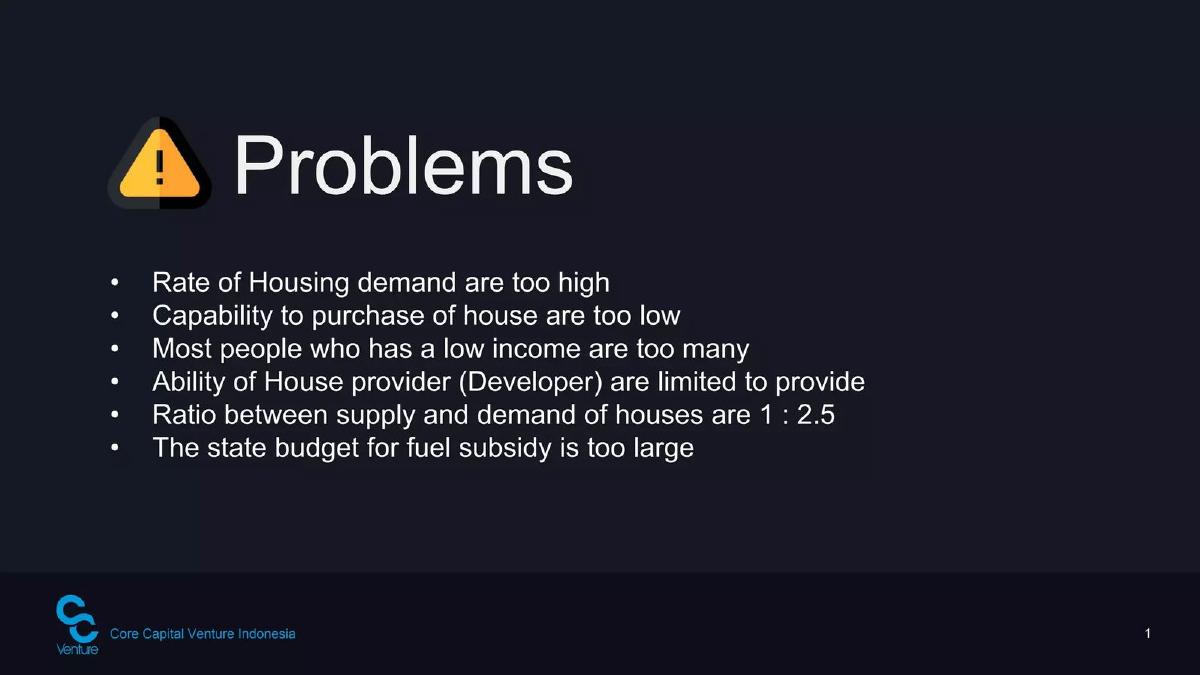
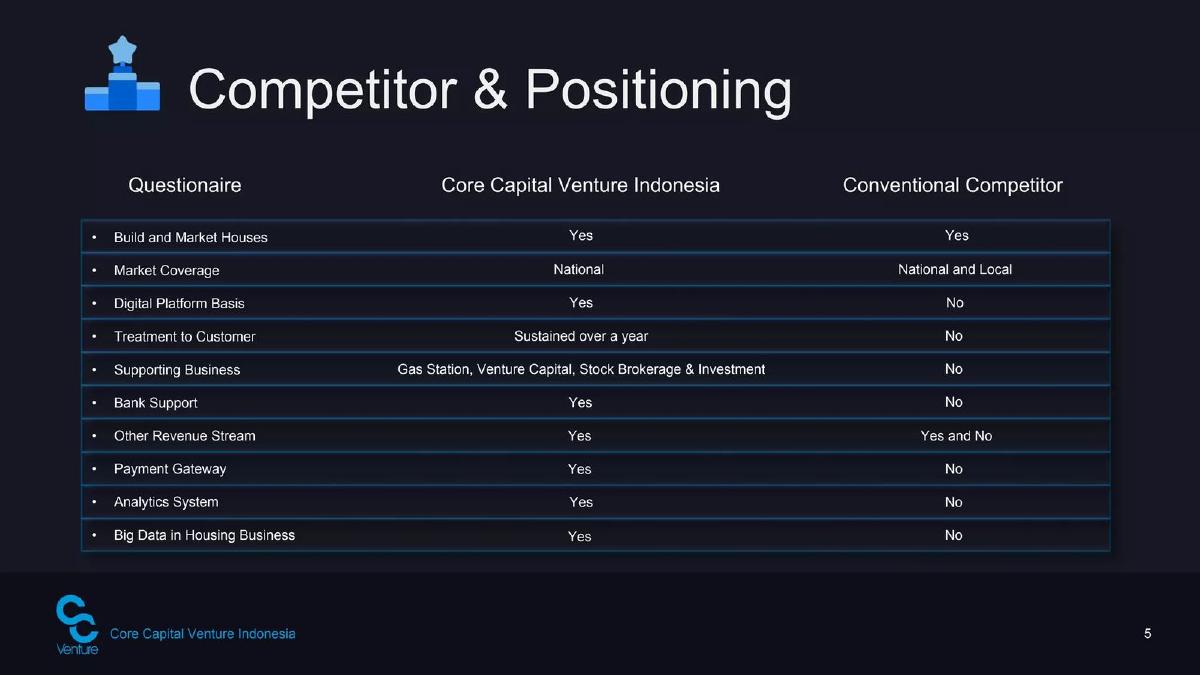
The most significant omission is a slide detailing the executive management team. While the advisors are listed, investors need to know who is running the day-to-day operations, especially for a project requiring $15 million in working capital. Additionally, the deck lacks a 'Problem' slide. While the market size implies a shortage of housing, there is no discussion of why current developers are failing to meet the demand or what specific pain points Core Capital is solving for the buyers. The connection between the housing units and the 'Supporting Products' (like stock brokerage and gas stations) is also not explained; it is unclear if these services are offered to the house buyers or if they are entirely separate business units under the same corporate umbrella. Finally, there is no mention of competition or the regulatory hurdles involved in land acquisition in Indonesia.
What a Founder Should Copy
Founders should emulate the clear 'Funding Needs & Allocation' slide. By breaking down exactly where the money goes (90% to working capital) and stating the expected runway (6 months), the company makes it easy for an investor to understand the capital efficiency of the deal. The use of government data to frame the TAM (Total Addressable Market) is also a best practice, as it provides an objective third-party baseline for the company's growth targets. Lastly, the specific 'Monetization' slide that separates the core product from secondary revenue streams is a helpful way to visualize a complex business model.
Frequently asked questions
- What is the primary business of Core Capital Venture Indonesia?
- Based on Slide 2 and Slide 6, the primary business is the development and sale of 'Subsidy & Commercial' houses. The main revenue stream comes from selling these units at a national standard price of $10,000 per unit. However, they also list gas stations, venture capital, and stock brokerage as supporting products, suggesting a conglomerate-style approach to the real estate ecosystem.
- How much funding is the company seeking and for what purpose?
- According to Slide 14, the company is seeking $15 million USD. The allocation is highly concentrated, with 90% designated for working capital. The remaining 10% is split equally between marketing efforts (5%) and operational expenses (5%). This suggests the capital is intended to fund the actual construction or acquisition of the housing units described in their milestones.
- What is the projected growth trajectory for the housing units?
- Slide 10 illustrates a steep upward trend. The company started with a target of 9,000 units in 2019 and projects reaching 63,000 units annually by 2025. Slide 4 further clarifies that their ultimate goal by the end of 2025 is to have handled 252,200 units in total, representing a cumulative value of over $2.52 billion USD.
- What kind of investment instrument is being offered?
- Unlike most tech startups that offer equity, Slide 14 specifies an 'Investment instrument: Profit Sharing up to 2,5 by investment.' It also mentions an 'Estimated valuation: 6 x Investment.' This indicates a debt-like or revenue-participation structure which is more common in real estate project financing than in traditional venture capital.
- Who is advising the company?
- Slide 8 lists five members of the Board of Commissary/Advisor Team. Notable mentions include Lutvy Arisandi (CEO of Mendeng Group), Julius Dulimar (formerly of KBR inc. Texas and PT. JGC Indonesia), Ali Masu’ud (CFO of Mendeng Group), Chad Seiler (formerly of AJ Baron Capital LA), and Mahrus (Tech Manager at Indosat).