Copper Cow Coffee utilized a minimalist 11-slide deck for their 500 Startups Demo Day, emphasizing brand aesthetics and high-level financial health. The deck avoids the typical clutter of early-stage pitches, instead opting for large-scale imagery of their Vietnamese pour-over coffee products and clear, bold typography. Key highlights include a $32 billion market opportunity and a strong margin profile of 45% on $80,000 of monthly revenue as of June 2018. While the deck lacks a formal team slide or a detailed breakdown of the 'Ask,' it successfully leverages the founder's supply chain experti…
Key takeaways
- The deck identifies a $32 billion American coffee industry as the primary target market on slide 4.
- Financial traction is clearly stated as $80,000 in revenue for the month of June 2018 on slide 5.
- The company maintains a 45% margin, a critical metric for physical CPG products, as shown on slides 5 and 6.
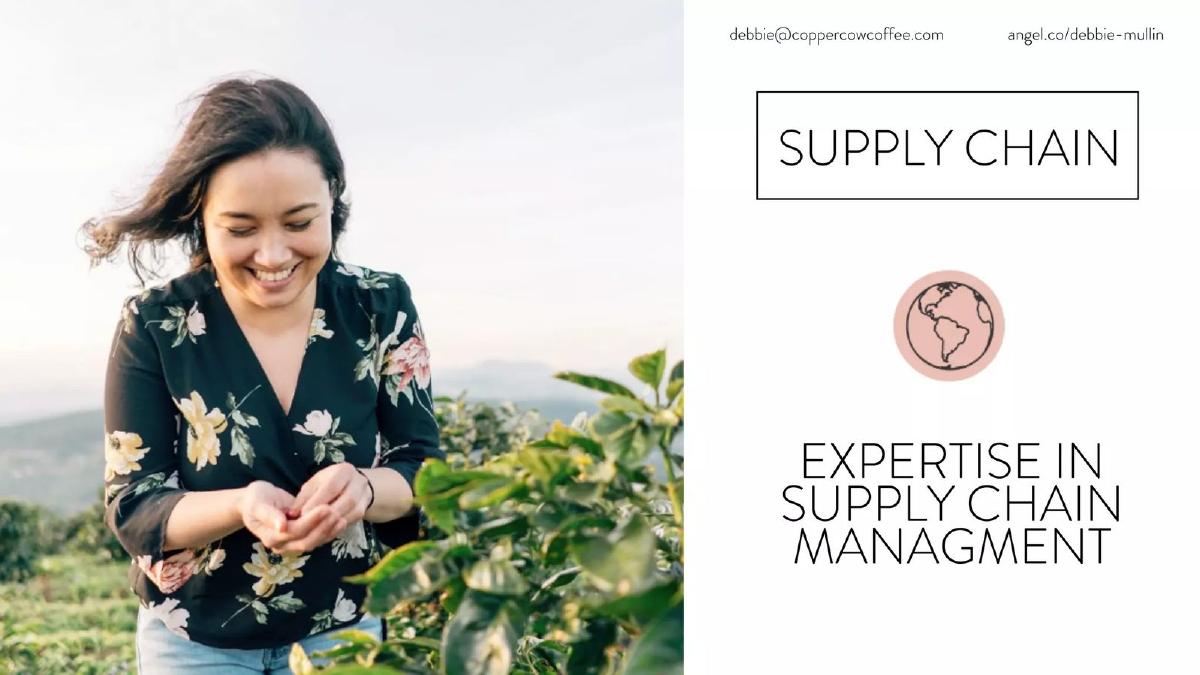
- Founder expertise is centered on 'Supply Chain Management,' positioned as a core competency on slide 3.
- The product is explicitly branded as 'Women Owned' and 'Sustainably Grown' on the packaging featured on slide 2.
- The deck utilizes a minimalist contact strategy, repeating the founder's email and AngelList profile on almost every slide.
- There is no explicit 'Ask' slide detailing the amount of capital being raised or the intended use of funds.
- The deck omits a traditional competitor matrix, relying instead on the uniqueness of the Vietnamese pour-over format.
The Power of Visual Minimalism in CPG Fundraising
Copper Cow Coffee’s deck for the 500 Startups Demo Day (Batch 23) is a masterclass in the 'less is more' philosophy. In a Demo Day environment, founders typically have between two and three minutes to present. This deck is designed to be a backdrop for a spoken narrative, rather than a document intended to be read in isolation. It relies on high-quality lifestyle photography and massive, bold numbers to anchor the audience's attention while the founder provides the context.
Slide 1: Title and Brand Identity
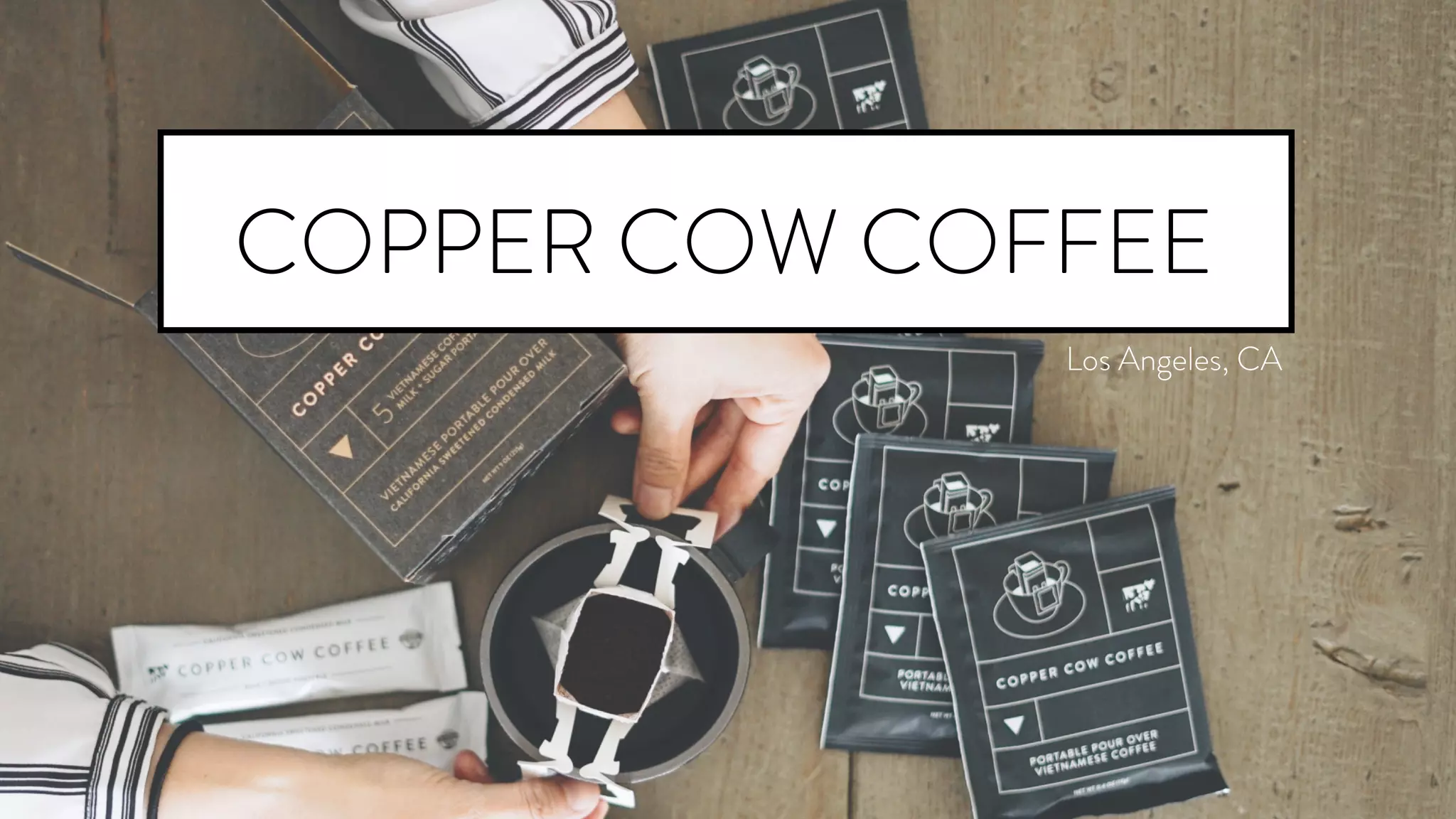
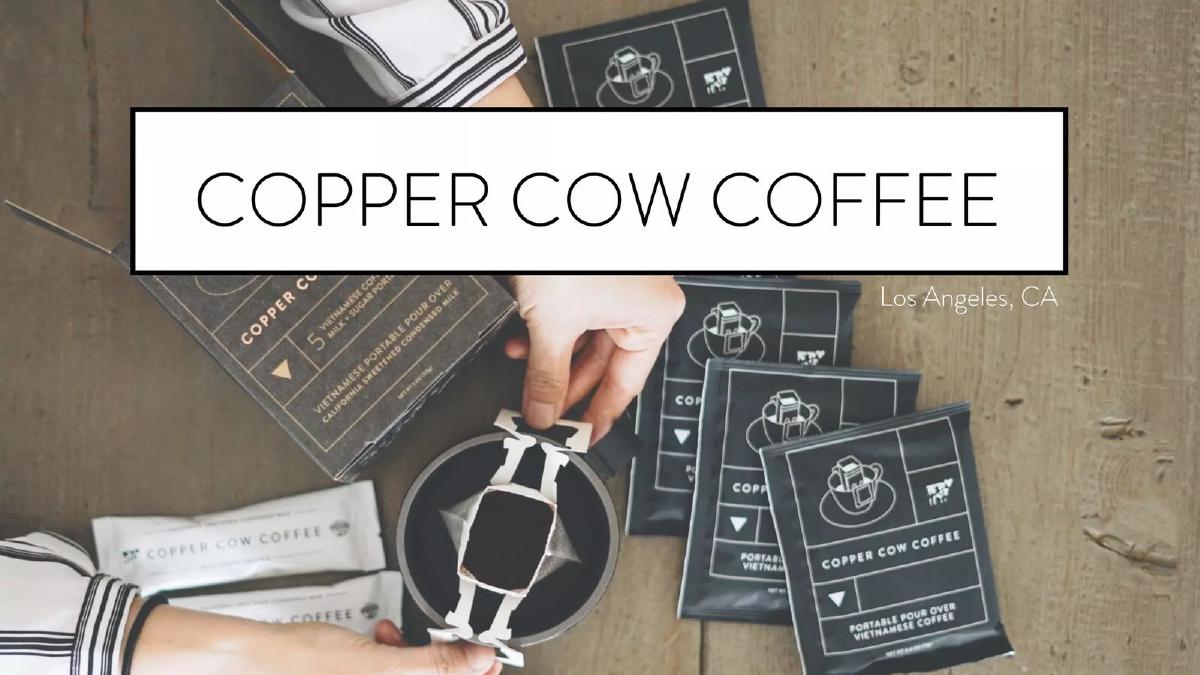
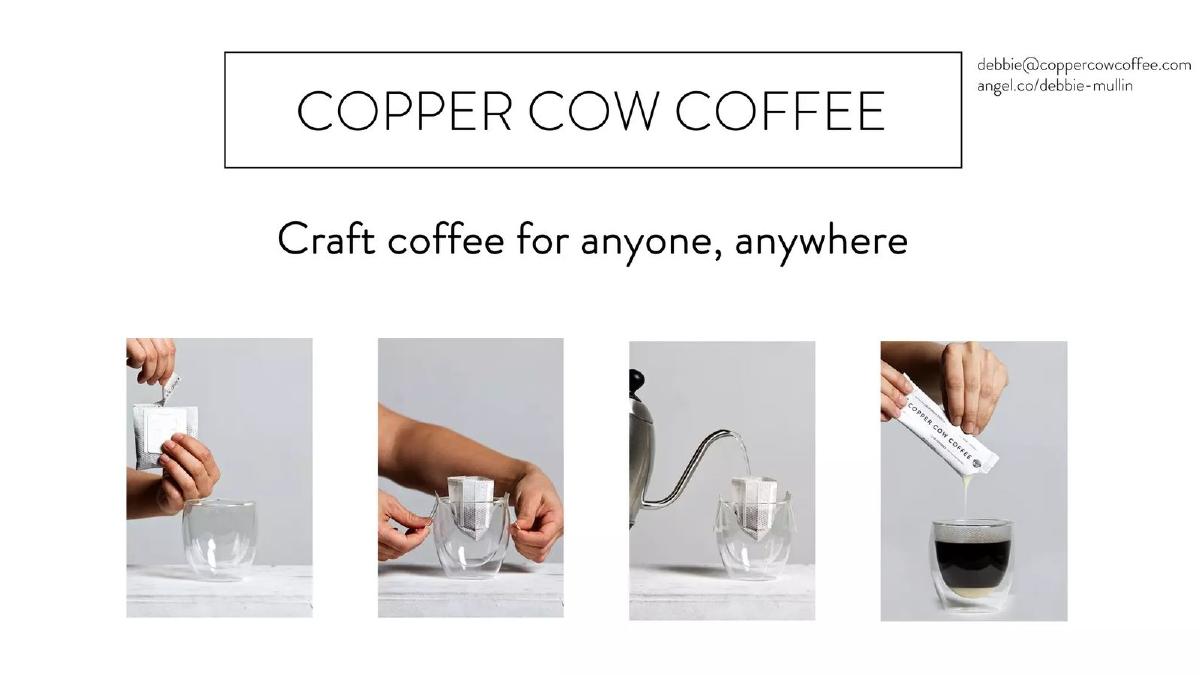
The opening slide sets a clean, sophisticated tone. It features the company name, 'COPPER COW COFFEE,' in a minimalist serif font, centered within a white box. The background image shows the product in action: a hand preparing a portable pour-over filter over a mug, surrounded by individual coffee and condensed milk packets. The location 'Los Angeles, CA' is noted, grounding the brand in a major US cultural and commercial hub.
Slide 2: Product and Values
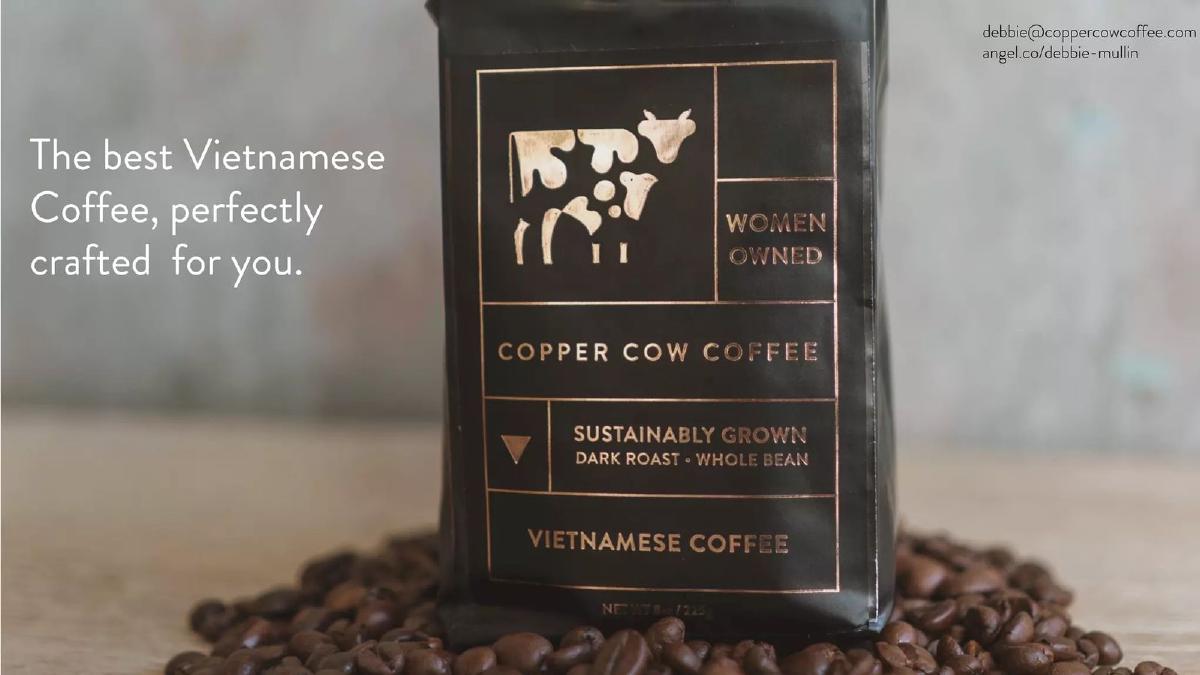
Slide 2 focuses on the physical product packaging. The text 'The best Vietnamese Coffee, perfectly crafted for you' serves as the value proposition. The packaging itself communicates several key selling points that are not repeated in the slide text: 'Women Owned,' 'Sustainably Grown,' and 'Dark Roast • Whole Bean.' This is an efficient use of visual real estate, allowing the brand's certifications and product attributes to speak for themselves through the label design. The founder's contact information and AngelList link appear in the top right corner, a recurring element throughout the deck.
Slide 3: The Supply Chain Advantage
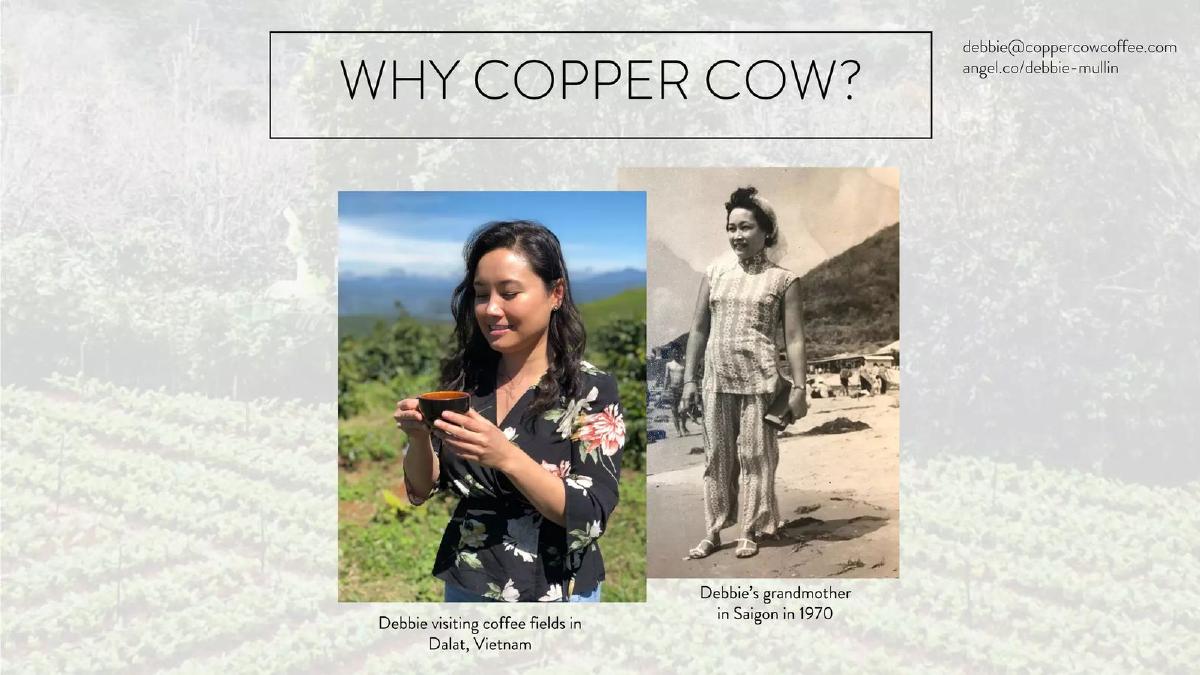
Instead of a traditional 'Problem' slide, Copper Cow Coffee moves straight to their 'Secret Sauce.' Slide 3 features a photo of founder Debbie Mullin in a coffee plantation, paired with the text 'SUPPLY CHAIN' and 'EXPERTISE IN SUPPLY CHAIN MANAGMENT.' (Note: the slide contains a typo in 'MANAGMENT'). For a CPG (Consumer Packaged Goods) company, supply chain is everything. By highlighting this early, the company signals to investors that they have the operational capability to handle scaling and maintain quality, which is often a failure point for young food and beverage brands.
Slide 4: Market Opportunity
Slide 4 is the 'Market Slide,' but it avoids the typical TAM/SAM/SOM concentric circles. It simply states '$32 BILLION' in a large box, followed by 'AMERICAN COFFEE INDUSTRY.' The imagery shows a finished cup of Vietnamese coffee (identifiable by the creamy color from the condensed milk). This slide is designed to prove that the 'niche' of Vietnamese coffee is actually a play for a massive, established market.
Slide 5: Traction and Unit Economics
This is the most important slide in the deck for a financial analyst. It lists two critical figures: '$80K Revenue June 2018' and '45% Margins.' For a company in a 500 Startups batch, $80,000 in monthly revenue is a strong indicator of product-market fit. Furthermore, 45% margins are healthy for a physical product, suggesting that the supply chain expertise mentioned on Slide 3 is translating into actual bottom-line efficiency. The background image shows the product on a retail shelf, hinting at a successful omnichannel or retail strategy.
Slide 6: The Closing and Call to Action
The final slide in the provided sequence repeats the traction metrics ($80K Revenue, 45% Margins) and adds a playful 'YOU GET A COFFEE!' call to action, likely referring to the samples provided to the audience at Demo Day. It features another photo of the founder and the primary contact email. This repetition of the core financial wins ensures that these are the last things the investor sees before the presentation ends.
What Works in This Deck
Clarity of Financials: By highlighting only two numbers—revenue and margin—the deck avoids the 'metric soup' that often confuses investors. These two numbers tell a complete story: people want the product, and the company can make money selling it.
Visual Storytelling: The photography is professional and consistent. It bridges the gap between a 'startup' and a 'premium brand.' In CPG, the brand is the moat, and this deck looks like a brand that belongs on the shelves of Whole Foods or Nordstrom.
Founder-Market Fit: Slide 3 establishes the founder's authority. By showing her in the field, it validates the 'Sustainably Grown' claim and the 'Supply Chain' expertise without needing a long list of bullet points.
What is Missing
The Ask: There is no slide indicating how much money the company is raising or what the milestones for the next 18 months are. While common in Demo Day decks to keep the 'Ask' verbal, it leaves a gap in the document's utility as a standalone file.
Competitive Landscape: The deck assumes the audience understands how Copper Cow differs from Starbucks, Blue Bottle, or instant coffee brands. A slide addressing the 'Why Now' or the specific competitive advantage of the portable pour-over format versus traditional brewing would have added depth.
Team Breakdown: While the founder is prominent, there is no mention of advisors, lead investors, or key hires. Investors often want to see who else is in the 'cow' before they write a check.
What Other Founders Should Copy
The 'One Big Number' Rule: Slide 4 ($32 Billion) and Slide 5 ($80K) are impossible to miss. Founders should copy this bold approach to key data. If you have a winning metric, don't hide it in a chart; put it in 100-point font.
Consistent Branding: The contact information and AngelList URL are on every slide. This makes it incredibly easy for an investor sitting in a dark room to know exactly how to follow up without waiting for the final slide.
Packaging as Content: If you are a CPG founder, your packaging is your best marketing tool. Copper Cow uses the packaging to communicate their 'Women Owned' and 'Sustainable' status, saving slide space for other topics. If your product looks good, let it do the talking.
Frequently asked questions
- What is the primary product offered by Copper Cow Coffee?
- Based on the visual evidence in slides 1 and 2, the company produces portable Vietnamese pour-over coffee. The packaging indicates a 'Portable Pour Over' system that includes Vietnamese coffee filters and sweetened condensed milk, aiming to provide a premium, specialty coffee experience in a convenient, single-serve format.
- How does the company justify its competitive advantage?
- The deck points to 'Expertise in Supply Chain Management' on slide 3 as a key differentiator. By showing the founder in a coffee field, the deck suggests a direct-trade or deeply integrated sourcing model, which likely contributes to the 45% margins highlighted later in the presentation.
- What stage of growth was the company in during this pitch?
- The company was at a post-revenue, early-growth stage. Slide 5 notes $80,000 in revenue for June 2018. As part of 500 Startups Batch 23, this deck represents a seed-stage company that has already achieved significant monthly traction and product-market fit in the retail or D2C space.
- Is there a specific breakdown of the target customer?
- The deck does not include a specific 'Customer Persona' slide. However, the high-end packaging design, emphasis on 'Sustainably Grown' and 'Women Owned' status (Slide 2), and the $32 billion market figure (Slide 4) suggest they are targeting the premium segment of the American coffee market.
- What is missing from this deck compared to a standard VC pitch?
- This is a Demo Day deck, which is intentionally brief. It lacks a detailed team slide (though the founder is pictured), a multi-year financial forecast, a competitive landscape analysis, and a specific breakdown of the investment round terms or 'Ask'.