InfiniteUp is a Canadian-incorporated startup targeting the massive informal retail sector in Sub-Saharan Africa. Their 9-slide deck, dated July 2020, proposes a 'software-first' ecosystem that combines business management tools, B2B/B2C marketplaces, and gig-economy delivery. The company emphasizes a unique user-ownership model where retail partners earn shares, aiming to drive viral growth and retention. While the deck is light on current financial traction, it leverages the founder's previous success with CanGo/SafeMotos and a clear understanding of the 'ecosystem gap' in African markets.…
Key takeaways
- The startup is targeting over 10,000,000 micro, small, and medium enterprises (MSMEs) in Africa that still rely on pen-and-paper systems (Slide 2).
- InfiniteUp positions itself as a 'multi-sided ecosystem' replacing the functions of companies like Square, Equifax, DHL, and Shopify in a single product (Slide 3).
- A competitive matrix claims InfiniteUp is the only player offering a full suite of services—from business tools to decentralized delivery—across a Pan-African reach (Slide 4).
- The growth strategy relies on a 'share scheme' where users earn equity in the company by using and sharing the app (Slide 5).
- Market sizing estimates a $2 billion USD opportunity in Sub-Saharan Africa based on a 1% transaction fee (Slide 6).
- The company is incorporated in Quebec, Canada, to leverage 65% government-led salary recoveries on R&D and software developers (Slide 7).
- Founder Barrett Nash highlights significant prior experience, including raising $2M USD in VC for previous ventures and being featured by TechCrunch and Forbes (Slide 8).
- The ask is $500,000 USD via a SAFE with a $3.5M cap and a 20% discount (Slide 9).
Slide-by-Slide Teardown
Slide 1: Title Slide
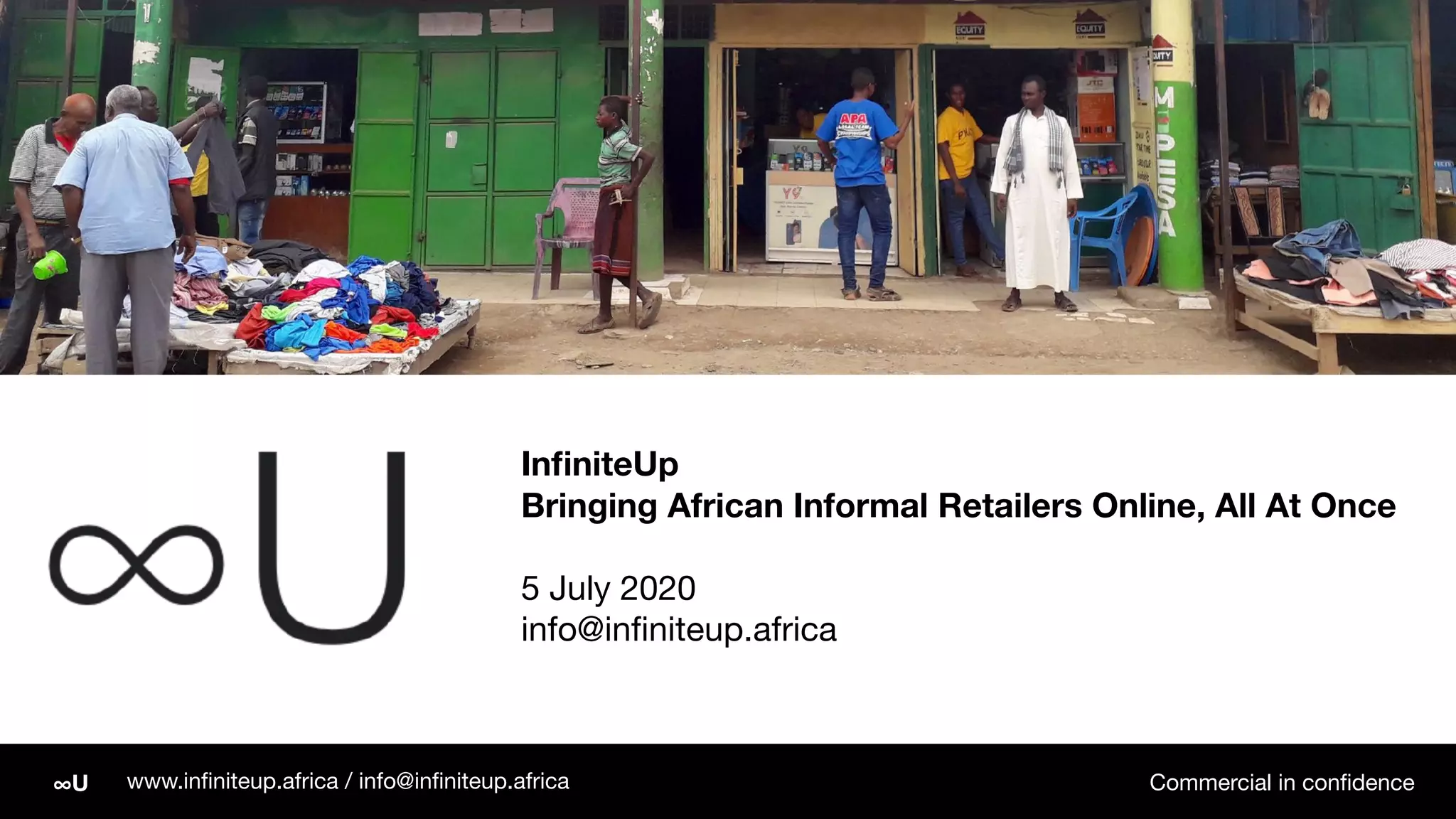
The deck opens with a high-resolution photograph of an informal retail setting in Africa, immediately grounding the pitch in its physical reality. The tagline, "Bringing African Informal Retailers Online, All At Once," signals a broad, platform-level ambition. The slide includes the date (5 July 2020) and contact information.
Slide 2: The Problem and Opportunity
This slide uses a split layout to contrast the digital explosion in Africa with the stagnant processes of small businesses. It cites that Sub-Saharan active mobile internet users have doubled in two years to 239 million, with a projection of 483 million by 2025. However, it notes that 10,000,000+ MSMEs still use "century old processes" for sales and inventory. The solution is defined as "smartphone based business software built from the ground up."
Slide 3: The Ecosystem Vision
InfiniteUp maps its product against well-known Western equivalents to explain its breadth. It claims to handle Business Tools (Square/Quickbooks), Formal Records (Equifax), Delivery (DHL/FedEx), Sales Agents (Google/Facebook Ads), B2B Marketplace (Supply Chain), and B2C Marketplace (Amazon/Shopify). The central graphic shows a circular flow between Sellers, Buyers, and a Delivery Marketplace, mediated by Agents and Institutions.
Slide 4: Competitive Landscape and Strategy
A detailed competitive matrix compares InfiniteUp to regional players like Sokowatch, Jumia Market, and M-Pesa. InfiniteUp claims a 'green sweep' across all categories, specifically highlighting its "Pan-African Focus" and "Software Only" approach as differentiators. The bottom half of the slide uses a metaphor of a 'vine' in a jungle versus a 'cactus' in a desert to explain that in Africa, a company must build its own supportive ecosystem to survive.
Slide 5: Growth and Retention
This slide focuses on the "User Experience as the Beating Heart." It mentions deep-dive interviews in Kenya, Rwanda, Malawi, and the DRC. The most notable claim is a "share scheme" where users earn equity in the company. The text argues that making every retail partner a shareholder creates a "novel viral referral engine" that aligns the company's success with the users' success.
Slide 6: Business Model and TAM
The business model is a percentage-based transaction fee. The slide breaks down the Total Available Market (TAM) into three phases: Initial (Refugee camps in Kenya, Malawi, Rwanda), Follow-on (Major cities like Kinshasa and Kigali), and Sub-Saharan Africa as a whole. At a 1% fee, the Sub-Saharan TAM is valued at $2B USD; at 5%, it is $10B USD. Demographic charts reinforce Africa as the fastest-growing population region.
Slide 7: Progress and Roadmap
This slide provides proof of execution. V1 of the app is built for Android, iOS, and PWA, featuring sales tracking, inventory management, and business intelligence. The roadmap includes a target of 1,000 active weekly users by October 1. It also details the strategic choice of Quebec, Canada for incorporation, citing R&D tax recoveries and legal stability.
Slide 8: The Team
Founder Barrett Nash is the focal point, highlighting his history as a co-founder of CanGo (SafeMotos), which raised $2M in VC and was named the 7th Most Innovative Company in Africa by Fast Company in 2017. The slide also introduces coordinators for Kenya/DRC, Rwanda/Burundi, and Malawi, emphasizing a localized, on-the-ground presence. It notes the diversity of the Board of Directors and Advisory Board.
Slide 9: The Ask
The final slide is a clear call to action: $500,000 USD via a SAFE with a $3.5M cap and a 20% discount. The funds are earmarked for research, marketing, and technology development. The slide concludes with the UN Sustainable Development Goals, framing the investment as one of "patient capital" for both profit and social impact.
What Works Well
Founder-Market Fit: The deck heavily leverages Barrett Nash's previous experience in the African tech ecosystem. Citing specific metrics from his past venture (4,500 trips per day in Kinshasa) builds immediate credibility that the team understands the operational hurdles of the region.
Strategic Incorporation: Explaining the Canadian incorporation as a way to subsidize R&D costs (65% recovery) is a sophisticated financial move that shows the founders are thinking about capital efficiency from day one.
Clear Ecosystem Mapping: By comparing their features to Square, Shopify, and DHL, the founders help investors quickly grasp the 'Super App' or 'Full Stack' nature of the product without needing to explain each feature from scratch.
What Is Missing
Current Traction Metrics: While the deck mentions V1 is built and testing is "promising," it lacks hard data on current users, transaction volume, or retention from the initial pilots in the refugee camps. Investors usually want to see the results of the "promising" tests before committing to a $3.5M valuation cap.
Unit Economics: The deck discusses a 1-5% transaction fee but does not detail the cost of customer acquisition (CAC) or the expected lifetime value (LTV). Given the complexity of the ecosystem (delivery, agents, software), understanding the margins is critical.
Regulatory and Infrastructure Risks: Building a decentralized delivery network and a B2B marketplace across multiple African borders involves significant regulatory and logistical friction. The deck brushes over these challenges by focusing on the 'software-first' nature of the solution.
Founder Takeaways
Leverage Metaphors for Complex Markets: The 'vine vs. cactus' metaphor on Slide 4 is an effective way to explain why a broad ecosystem approach is necessary in an underdeveloped market, rather than a narrow niche focus. · Align Incentives with Equity: The idea of giving users shares to drive virality is a powerful narrative, especially in a social impact context. It turns customers into advocates. · Be Specific About the Ask: Slide 9 is a model of clarity. It states the amount, the instrument (SAFE), the cap, the discount, and the specific use of funds. · Use Comparative Benchmarking: If you are building in an emerging market, mapping your product to well-known Western counterparts (Slide 3) helps bridge the knowledge gap for international investors.
Frequently asked questions
- What is InfiniteUp's core product functionality?
- According to Slide 7, the V1 app includes sales tracking, employee management, inventory management, business intelligence, and an advertising campaign generator. It is available as an Android, iOS, and Progressive Web App. The broader vision described on Slide 3 includes a B2B marketplace for inventory, a B2C marketplace for customer sales, and a gig-economy delivery system.
- How does the company plan to acquire users at scale?
- InfiniteUp utilizes a 'novel viral referral engine' inspired by multi-level marketing and companies like Uber. Slide 5 explains a share scheme where retail partners earn actual shares in the company for using and referring the app. Additionally, Slide 7 mentions a relationship with the Global Education Movement (GEM) to deploy growth teams via refugees across 30+ African countries.
- What is the revenue model for the platform?
- Slide 6 explicitly states that the business model takes a percentage-based transaction fee. The deck provides market projections based on both a 1% and a 5% transaction fee. It also suggests future revenue streams from supply chain ownership, fintech services, and new product rollouts.
- Why is the company incorporated in Canada if it operates in Africa?
- Slide 7 outlines several strategic reasons for the Quebec, Canada incorporation: building a Pan-African diaspora-led team, accessing 65% government-led salary recoveries for R&D, operating under a strong rule of law, and navigating both common law and civil law jurisdictions.
- What is the current stage of the company according to the deck?
- As of the July 2020 deck, the company is in the early testing phase. Slide 7 notes that V1 is built and being tested, with a target of 1,000 active weekly users by October 1. Initial testing is focused on refugee camps in Kenya, Malawi, and Rwanda (Slide 6).