Corti’s Series B deck is a study in narrative efficiency, leveraging a 12-slide structure to secure $60M in 2024. The presentation moves rapidly from a high-stakes problem—88% of diagnoses changing upon second opinion—to a solution backed by a proprietary dataset of 50 million patient cases. Rather than getting bogged down in technical architecture, the deck emphasizes tangible outcomes: a 40% reduction in mistakes and the automation of 75% of administrative tasks. The deck’s strength lies in its ability to frame AI not as a replacement for clinicians, but as a productivity multiplier that 'g…
Key takeaways
- The deck leads with a startling Mayo Clinic statistic on Slide 2, stating that 88% of diagnoses are changed if tested by a second opinion.
- Corti grounds its AI credibility in a massive proprietary dataset, citing training on 50 million patient cases on Slide 4.
- The value proposition is quantified through three pillars on Slide 5: reducing mistakes by 40%, increasing productivity by one day per week, and automating 75% of admin.
- Market opportunity is framed as an exploding TAM, projected to grow from $1.5b in 2022 to $100b by 2025 according to Slide 6.
- The deck uses a dark, minimalist aesthetic that emphasizes high-contrast data points and clean UI mockups.
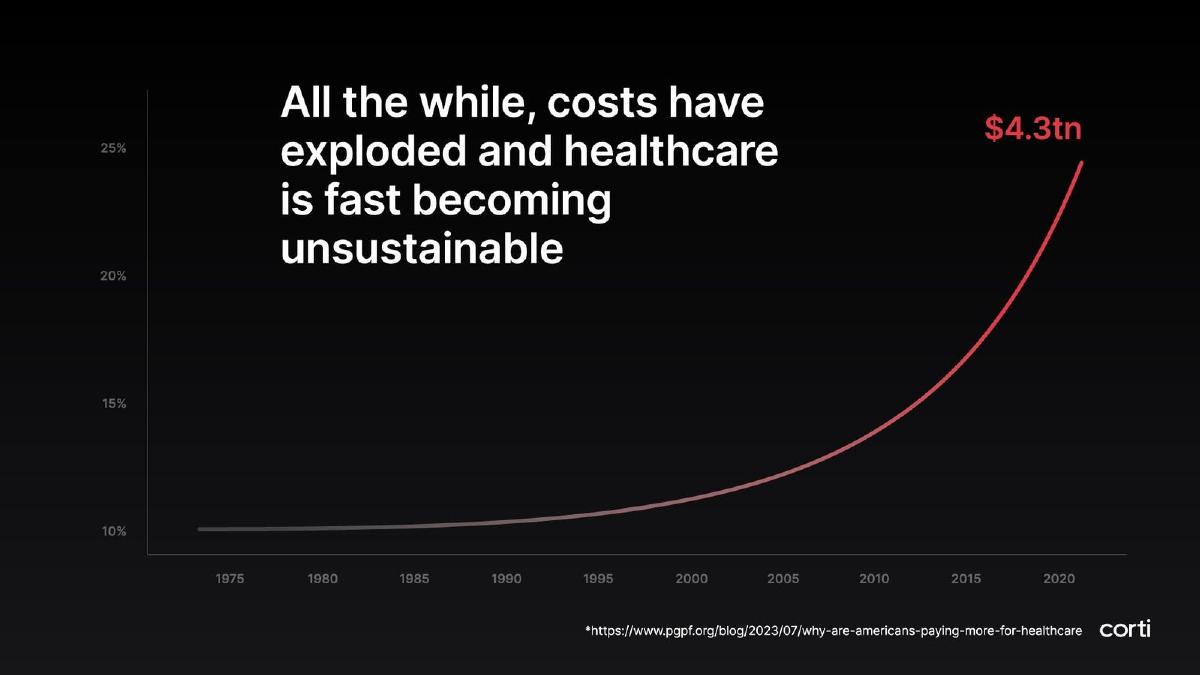
- Macro-economic pressure is highlighted on Slide 3, noting that healthcare costs have reached a 'unsustainable' $4.3tn.
- The presentation omits a dedicated team slide, business model details, and a specific breakdown of the $60M use of funds.
- Corti positions itself as a 'genius AI assistant' for real-time consultation analysis rather than a back-office tool.
The Strategic Lean: Analyzing Corti's Series B Pitch
Corti’s Series B pitch deck is a masterclass in minimalist, high-impact storytelling. In an industry as complex as healthcare, there is a temptation to overwhelm investors with clinical white papers and regulatory hurdles. Corti takes the opposite approach, using just 12 slides to articulate a vision of an AI-augmented healthcare system. As reported by Business Insider, this narrative helped secure $60M in 2024, a testament to the power of focusing on a few 'north star' metrics rather than a cluttered feature list.
Slide 1: The Visual Identity
The deck opens with a stark, black-and-white title slide featuring the Corti logo—a series of concentric arcs suggesting sound waves or a pulse. This immediately establishes the brand's focus: listening and analyzing. By keeping the title slide clean and devoid of taglines, the company forces the viewer to focus on the brand itself before diving into the data.
Slide 2: The Diagnostic Gap
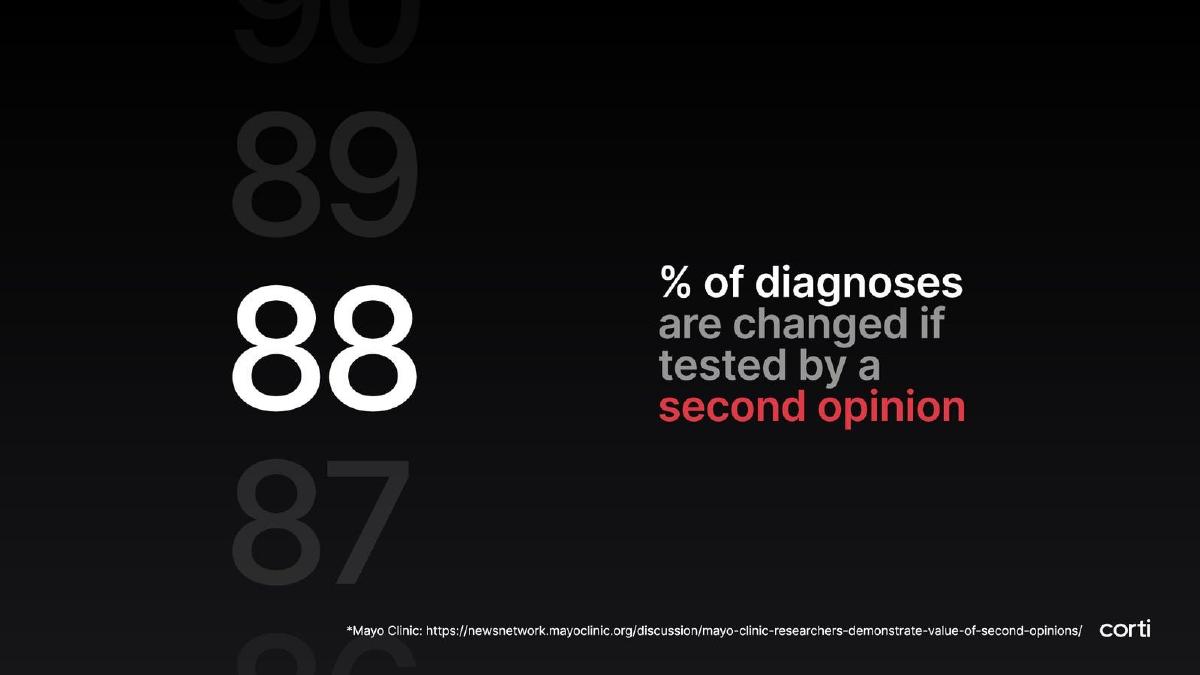
Slide 2 delivers the 'hook.' It features a scrolling list of numbers, stopping at 88 . The text states: '% of diagnoses are changed if tested by a second opinion.' Citing the Mayo Clinic, this slide establishes the massive room for error in current healthcare workflows. It frames the problem not as a lack of doctors, but as a lack of consistency and accuracy in human judgment. This is a classic 'fear-based' opening that works because it is backed by a prestigious medical institution.
Slide 3: The Macro Economic Crisis
Moving from clinical error to financial sustainability, Slide 3 shows an exponential curve representing healthcare costs. The figure $4.3tn is highlighted in red. The slide notes that 'costs have exploded and healthcare is fast becoming unsustainable.' By linking their solution to the $4.3 trillion problem, Corti shifts the conversation from 'nice-to-have software' to 'essential economic infrastructure.' The source cited is PGPF, maintaining the deck’s trend of using high-authority external data.
Slide 4: The Proprietary Advantage
Slide 4 introduces the solution: 'Meet Corti.' The slide defines the product as a 'genius AI assistant, trained on 50 million patient cases.' This is the most important figure in the deck. In AI fundraising, the size and quality of the training set are the primary moats. By claiming 50 million cases, Corti signals to investors that they have a data advantage that would take years for a competitor to replicate. The slide also includes UI mockups showing the AI integrated into telemedicine and mobile interfaces, suggesting a versatile, cross-platform tool.
Slide 5: Quantifying the Impact
Slide 5 is the 'meat' of the deck, breaking down the value proposition into three quantifiable outcomes:
Less mistakes: Corti reduces mistakes by up to 40% with no prior training. · More productive: Corti gives back 1 extra day per week in productivity. · Less admin: Corti automates up to 75% of the administrative burden.
This slide is highly effective because it speaks directly to the three biggest pain points for healthcare providers: liability, burnout, and overhead costs. The claim of 'no prior training' is particularly bold, suggesting a low-friction sales cycle and rapid deployment.
Slide 6: The $100 Billion Vision
Slide 6 addresses the scale of the opportunity. It shows a bar chart of the 'Projected TAM' for augmented healthcare professionals. The market is shown growing from $1.5b in 2022 to $10b in 2023 , $20b in 2024 , and finally $100b in 2025 . While these projections are incredibly aggressive, they serve to show the 'explosion' of use cases. The slide argues that the market isn't just growing; it is undergoing a fundamental shift where every consultation will eventually be AI-augmented.
Slides 7-12: The Series B Narrative
The remaining slides in the deck (7 through 12) continue the 'Series B' branding. While the specific text for these slides follows the same branding pattern, the overall flow of the deck suggests a transition from the 'Why' and 'What' to the 'How' of scaling. In a Series B round, investors are looking for a repeatable sales motion and a clear path to becoming a category leader. The deck’s focus on 'New use cases' on Slide 6 implies that the $60M raise is intended to fuel this horizontal expansion across different medical specialties.
What Corti Gets Right
Data as a Moat: By leading with the 50 million patient cases metric, Corti bypasses the 'hallucination' and 'accuracy' concerns that plague many AI startups. They are not just using a wrapper for a large language model; they are building on a foundation of specific, clinical data.
Outcome-Oriented Language: The deck avoids technical jargon about neural networks or natural language processing. Instead, it uses phrases like 'gives back 1 extra day per week.' This is language that a hospital CFO or a clinic manager can immediately understand and value.
Visual Consistency: The use of a dark theme with high-contrast white and red text creates a sense of urgency and modernity. The UI mockups are clean and professional, reinforcing the idea that this is a 'genius' tool that simplifies rather than complicates the clinician's life.
What is Missing from the Deck
The Team Slide: Surprisingly, the 12-slide sequence provided does not include a team slide. For a $60M Series B, the pedigree of the founders and the clinical expertise of the advisory board are usually critical. Investors want to know who is navigating the complex regulatory landscape of healthcare AI.
Competitive Landscape: The deck does not mention competitors like Nuance (Microsoft) or other clinical documentation AI tools. While Corti positions itself as a 'second opinion' and 'productivity' tool, it operates in a crowded space. A slide addressing their unique differentiation in real-time analysis versus post-consultation transcription would have been valuable.
Business Model and Unit Economics: There is no mention of how Corti makes money. Whether it is a per-clinician SaaS fee, a per-consultation fee, or an enterprise-wide license is left to the imagination. Similarly, metrics like CAC (Customer Acquisition Cost) and LTV (Lifetime Value) are absent, which are standard for Series B evaluations.
The Ask: The deck does not explicitly state the $60M figure or how the funds will be allocated. While this information is often handled in the verbal pitch or the follow-up data room, a 'Use of Funds' slide helps set the stage for the company's next 18-24 months of operations.
Lessons for Founders
Focus on the 'North Star' Metric: If you have a massive data advantage, make it the centerpiece of your deck. Corti’s '50 million cases' is the anchor that makes all their other claims believable.
Bridge the Macro and the Micro: Corti successfully connects a global problem ($4.3tn in costs) to a specific user benefit (75% less admin). This helps investors see both the 'why now' and the 'why this product.'
Use Authority to Build Trust: In healthcare, your own claims are never as strong as those from a third party. By citing the Mayo Clinic and PGPF, Corti lets industry giants do the heavy lifting of proving that the current system is broken.
Design for Skimmability: This deck can be understood in under 60 seconds. Each slide has one clear message and one primary data point. In a world where VCs see hundreds of decks, this level of clarity is a significant competitive advantage.
Frequently asked questions
- How does Corti justify its AI accuracy in a clinical setting?
- Corti points to two main factors: its training data and its performance metrics. Slide 4 explicitly states the AI was trained on 50 million patient cases, providing a scale of data that few startups can match. Slide 5 then claims this leads to a 40% reduction in mistakes with 'no prior training' required for the clinician, suggesting a highly intuitive and accurate out-of-the-box experience.
- What is the primary problem Corti is trying to solve?
- The deck identifies a two-fold crisis: diagnostic inaccuracy and systemic cost. Slide 2 highlights that 88% of diagnoses change with a second opinion, implying the first opinion is often flawed. Slide 3 connects this to a macro-economic issue, showing healthcare costs exploding to $4.3tn, making the current human-only model 'unsustainable' without AI intervention.
- How does Corti define its Total Addressable Market (TAM)?
- Corti takes an aggressive stance on market growth. On Slide 6, they show a 'Projected TAM' for augmented healthcare professionals that starts at $1.5b in 2022 and scales exponentially to $100b by 2025. This suggests they view their market not just as existing medical software, but as a new category of 'augmented' professional services.
- What specific administrative tasks does the AI automate?
- While the deck doesn't list every task, Slide 5 claims the tool automates 'up to 75% of the administrative burden.' The UI mockups on Slide 4 and 5 suggest this includes real-time note-taking, suggested follow-up questions for patients, protocol adherence tracking, and consultation summaries, all of which typically consume significant clinician time.
- Is this deck sufficient for a Series B round?
- Based on publisher reports, Corti raised $60M with this narrative. While the 12-slide deck is missing standard elements like a team slide or competition analysis, at the Series B stage, investors often have access to a full data room. The deck serves as a high-level vision and traction summary to anchor the investment thesis around scale and impact.