Mobiome's 2016 pitch deck presents a compelling case for digitizing the antiquated patient survey industry, which reportedly costs U.S. hospitals $3.5 billion annually. By leveraging real-time data from wearables (Fitbit, Google) and natural language processing (NLP) of social media, Mobiome proposes a solution that is more accurate and cost-effective than traditional methods. The deck outlines a dual B2B and B2C revenue model, projecting a significant net income of $40 million by year five. With a strong team featuring medical and data analytics expertise from the Mayo Clinic and Harvard, Mo…
Key takeaways
- Current patient surveys cost U.S. hospitals approximately $3.5 billion annually, representing 0.1% of total healthcare costs (Slide 2).
- Mobiome integrates data from wearables like Fitbit and social media platforms like Facebook and Twitter to provide real-time patient insights (Slide 4).
- The healthcare analytics market is projected to reach $18.7 billion by 2020, up from $5.8 billion in 2016 (Slide 5).
- Mobiome's B2B model aims to reduce hospital healthcare costs by at least 25%, charging $68 per patient (Slide 7).
- The company plans a B2C 'Freemium' model, charging $9.99 per month for advanced monitoring features (Slide 7).
- Financial projections estimate a net income of $122.9 million by Year 5, based on adding 240 hospital departments (Slide 10).
- Mobiome identifies Ginger.io, Phytel, and Lyra as competitors but claims superiority through surgical condition tracking and wearable integration (Slide 11).
- The founding team includes medical professionals from the Mayo Clinic and experts in NLP and big data analytics (Slide 12).
Mobiome Pitch Deck Teardown
Mobiome's pitch deck, published in 2016, presents a vision for modernizing the patient survey industry through the integration of real-time data and advanced analytics. The 13-slide presentation outlines a clear path from identifying a multi-billion dollar inefficiency to proposing a technology-driven solution backed by a specialized team.
Slide 1: Title Slide
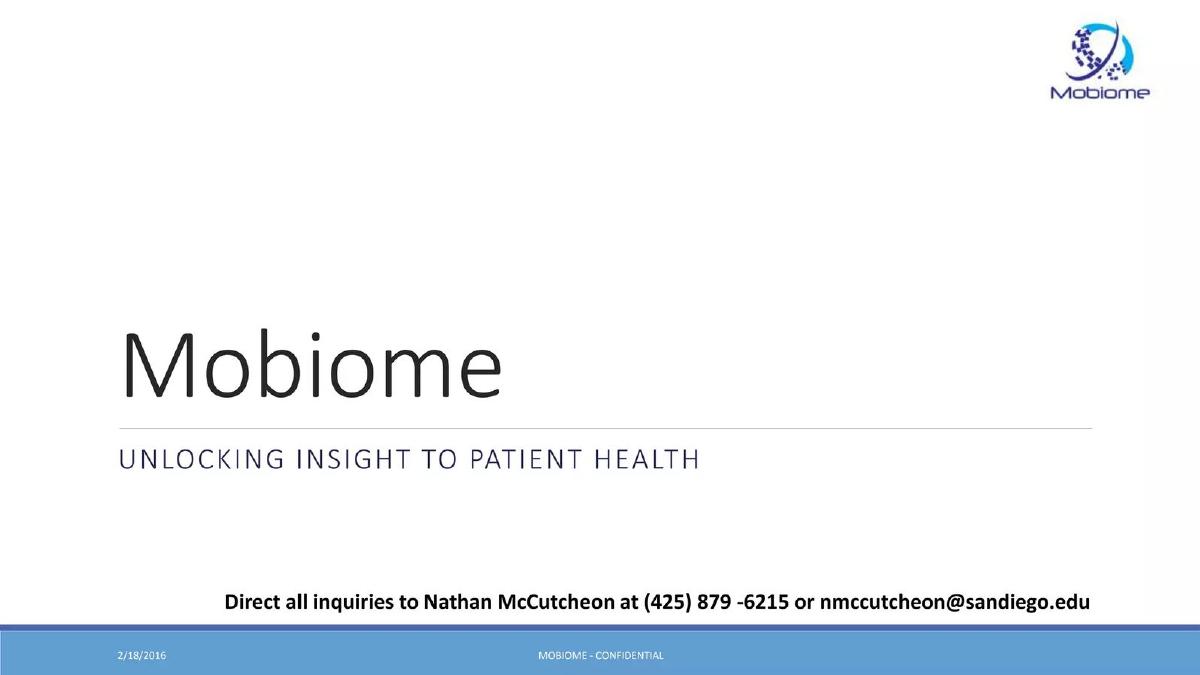
The title slide is clean and professional, featuring the company name, "Mobiome," and the tagline, "Unlocking Insight to Patient Health." It includes contact information for Nathan McCutcheon and a confidentiality notice. The logo, a stylized blue globe with pixelated elements, suggests a focus on global health and digital data.
Slide 2: The Problem
This slide quantifies the pain point Mobiome intends to address. It states that hospital surveys cost approximately $3.5 billion annually in the U.S., which is 0.1% of total healthcare costs. The slide uses a hexagonal graphic to list six key issues: Expensive, Manual Process, Arbitrary Intervals, Subjective, Inaccurate, and Time Consuming. A critical observation is that the current survey standards were published in 1980 and last revised in 2000, highlighting a lack of innovation in the field.
Slide 3: The Solution
The solution is presented as "Next Generation Surveys" that operate in real-time. Key features include NLP (Natural Language Processing) and wearable integration, which lead to provider recommendations for interventions. The ultimate goal is to reduce hospital costs while improving reporting accuracy. The slide uses a simple three-step chevron process to illustrate the transition from data collection to cost reduction.
Slide 4: The Product
Slide 4 provides a visual workflow of the Mobiome product. It shows a patient generating health-related data via Fitbit, Facebook, Twitter, and Google smartphones. This data flows into the Mobiome platform, which "unlocks health-relevant insight." The final step shows a healthcare provider receiving these insights to make data-driven treatment decisions. This slide effectively demonstrates how Mobiome bridges the gap between daily patient activity and clinical care.
Slide 5: Market Dynamics
This slide provides broader context for the opportunity. It notes that the healthcare analytics market is expected to reach $18.7 billion by 2020. Supporting trends include the rise in smartphone ownership (65% of U.S. adults in 2016) and the growth of the wearables market (from 21 million units in 2014 to a projected 150 million in 2019). Notably, it mentions that 52% of patients surveyed agreed to allow their doctors to analyze their social media information, suggesting consumer readiness for Mobiome's approach.
Slide 6: Market Opportunity
Mobiome narrows its focus to the hospital sector, stating that a large hospital unit spends $1 million a year on healthcare surveys. The Affordable Care Act is cited as a driver for increased oversight of the patient recovery process. The company plans to start with neurosurgical units before expanding to orthopedics, cardiology, and physical therapy. A circular graphic reiterates the $3.5 billion annual market and mentions a $91 per patient cost factor.
Slide 7: Revenue Model
The revenue model is split into B2B and B2C segments. For hospitals (B2B), Mobiome charges $68 per patient, aiming for a 25% cost reduction and projecting $40 million in net income by year five. For patients (B2C), a "Freemium" model is proposed, with advanced features costing $9.99 per month. This dual approach provides multiple streams of recurring revenue and allows for expansion into various medical specialties.
Slide 8: Growth Strategy
The growth strategy is divided into three phases: Launch, Growth, and Expansion. The Launch phase involves a beta version and proof-of-concept to build a sales plan, with a goal of $8.5 million in revenue by the end of year two. The Growth phase focuses on strategic alliances, specifically mentioning IBM Health Watson. The Expansion phase (Years 4-5) targets the consumer market and potential IPO or acquisition.
Slide 9: Competitive Advantage
Mobiome identifies four pillars of competitive advantage: First Mover Advantage in the medical survey space, a "world-renowned" NLP team, intellectual property protection through patenting, and a team with deep networks in hospitals. The slide mentions a partnership with Mayo Clinic as a resource for defending patents and facilitating hospital adoption.
Slide 10: Financials – Net Income
This slide provides a detailed breakdown of financial projections. It uses a variable model based on hospital unit size and probability. Year 1 projections start with 10 departments and $9.3 million in revenue, growing to 240 departments and $223.5 million in revenue by Year 5. The projected net income for Year 5 is a substantial $122.9 million. A bar chart visually represents the aggressive growth in expected net income over the five-year period.
Slide 11: Competition
A competitive matrix compares Mobiome against Ginger.io, Phytel, and Lyra. Mobiome claims to be the only provider covering all six listed categories: Behavioral/Medical Diseases, Surgical Conditions, GPS Data, Text Messaging Patterns, NLP/Free Text Content, and Wearable Integration. This slide positions Mobiome as a more comprehensive solution than existing players who focus primarily on behavioral health or text messaging.
Slide 12: The Team
The team slide highlights strong clinical and analytical credentials. Mohamad Bydon, MD, and Brandon McCutcheon, MD, bring expertise from the Mayo Clinic, with backgrounds in neurosurgery, bioinformatics, and statistics. Nathan McCutcheon adds business and leadership experience from the US Army and Pratt & Whitney. The advisory board includes experts in engineering and NLP, reinforcing the company's technical claims.
Slide 13: The Ask
The final slide requests $147,500 to cover the first six months of operations. A detailed table breaks down the budget, including $72,000 for recurring monthly expenses (salaries for a programmer, CEO, and business development) and $46,000 for one-time expenses (beta application development, legal fees, and server costs). The ask includes a 25% buffer, bringing the total to the specified amount. The slide notes that the founders will work unpaid if necessary to drive sales after the initial two-month beta development.
What Works in the Mobiome Deck
Clear Problem Identification: The deck does an excellent job of quantifying the inefficiency of the current patient survey market, using the $3.5 billion figure to establish significant scale. · Strong Team Credentials: The involvement of Mayo Clinic-affiliated MDs and Harvard-trained statisticians lends immediate credibility to a healthcare startup. · Specific Use of Funds: The detailed breakdown of the $147,500 ask is transparent and shows a disciplined approach to early-stage capital. · Dual Revenue Model: By targeting both hospitals and consumers, Mobiome demonstrates a broad understanding of the healthcare ecosystem and multiple paths to monetization.
What is Missing or Could Be Improved
Product Mockups: While the workflow is clear, actual screenshots or mockups of the beta application would help investors visualize the user experience. · Regulatory Strategy: In the healthcare space, HIPAA compliance and FDA considerations are paramount. The deck mentions "protection" through patents but omits the regulatory hurdles for data collection and provider recommendations. · Evidence of NLP Efficacy: The deck claims a "world-renowned" NLP team but provides no data or case studies to back up the effectiveness of their specific algorithms in a medical context. · Conservative Financials: The jump from 10 departments in Year 1 to 240 in Year 5, resulting in over $122 million in net income, is extremely aggressive for a seed-stage startup.
Founder Takeaways
Quantify the Status Quo: Like Mobiome, founders should find the "cost of doing nothing" or the cost of outdated methods to prove their market opportunity. · Leverage Institutional Credibility: If your team has ties to prestigious institutions like the Mayo Clinic or Harvard, highlight them prominently to build trust. · Be Granular with Your Ask: Providing a line-item budget for your initial funding round shows investors that you have a realistic plan for their capital. · Map the Data Flow: For complex tech products, a simple visual representation of how data moves from the source to the end-user (as seen on Slide 4) is essential for clarity.
Frequently asked questions
- What specific problem is Mobiome trying to solve?
- Mobiome targets the inefficiency of traditional patient surveys, which are described as expensive, manual, time-consuming, and often inaccurate. According to slide 2, these surveys cost U.S. hospitals $3.5 billion annually. The current methods are based on standards from 1980, revised only once in 2000, leading to subjective data collected at arbitrary intervals rather than real-time health insights.
- How does the technology work?
- The product acts as a bridge between patient-generated data and healthcare providers. As shown on slide 4, it collects data from wearables (like Fitbit), smartphones (Google), and social media (Facebook, Twitter). Using Natural Language Processing (NLP), Mobiome 'unlocks' health-relevant insights from this data, allowing doctors to make data-driven treatment decisions based on a patient's dynamic state of health.
- What is the business model for Mobiome?
- Mobiome employs a two-pronged revenue strategy. For B2B (hospitals), they charge $68 per patient, aiming to save large units $250,000 annually. For B2C (patients), they offer a 'Freemium' model where basic access is free, but advanced monitoring and analytics features cost $9.99 per month. They also mention potential revenue from wearable sales (Slide 7).
- Who are the key members of the Mobiome team?
- The team combines medical expertise with data science. Key members include Mohamad Bydon, MD (Medical Director at Mayo Clinic), Brandon McCutcheon, MD (Mayo Clinic resident with Harvard training in statistics), and Nathan McCutcheon (MBA/MSF candidate with leadership experience). The advisory board includes PhDs specialized in engineering and 'world-renowned' NLP experts (Slide 12).
- What are the funding requirements and planned use of funds?
- Mobiome is seeking $147,500 for its first six months of operation. The budget includes $72,000 for recurring expenses (salaries for a programmer, CEO, and business development, plus rent and travel) and $46,000 for one-time costs like beta application development ($20,000), legal fees, and server costs. A 25% buffer is included in the final ask (Slide 13).