Mojave’s 13-slide seed deck is a masterclass in technical credibility and problem-solving for the hardware sector. By focusing on the massive environmental and economic costs of traditional HVAC—specifically the 10% of global electricity use and 2 billion tons of annual CO2 emissions cited on Slide 2—Mojave positions its liquid desiccant system as a necessary evolution. The deck leans heavily on its institutional pedigree, highlighting a decade of research supported by Xerox PARC and the Department of Energy (Slide 3). While the deck lacks traditional venture metrics like a team slide, financ…
Key takeaways
- The deck identifies a massive global problem: air conditioning accounts for 10% of total global electricity use (Slide 2).
- Mojave leverages significant institutional credibility by citing a decade of research at Xerox PARC and the Department of Energy (Slide 3).
- The core technical value proposition is the independent control of humidity and temperature through a dual-loop system (Slide 4).
- The company targets high-value niche markets first, including specialized environments like indoor pools and commercial offices (Slide 5).
- A 'Next Generation' slide introduces electrochemical technology with the potential to be 20 times more efficient than thermal regeneration (Slide 6).
- The deck focuses almost entirely on technology and market fit, omitting standard slides for team, competition, and financials.
- Mojave successfully raised $12.5M in 2024 despite the high-capital requirements typical of hardware startups (Publisher-reported facts).
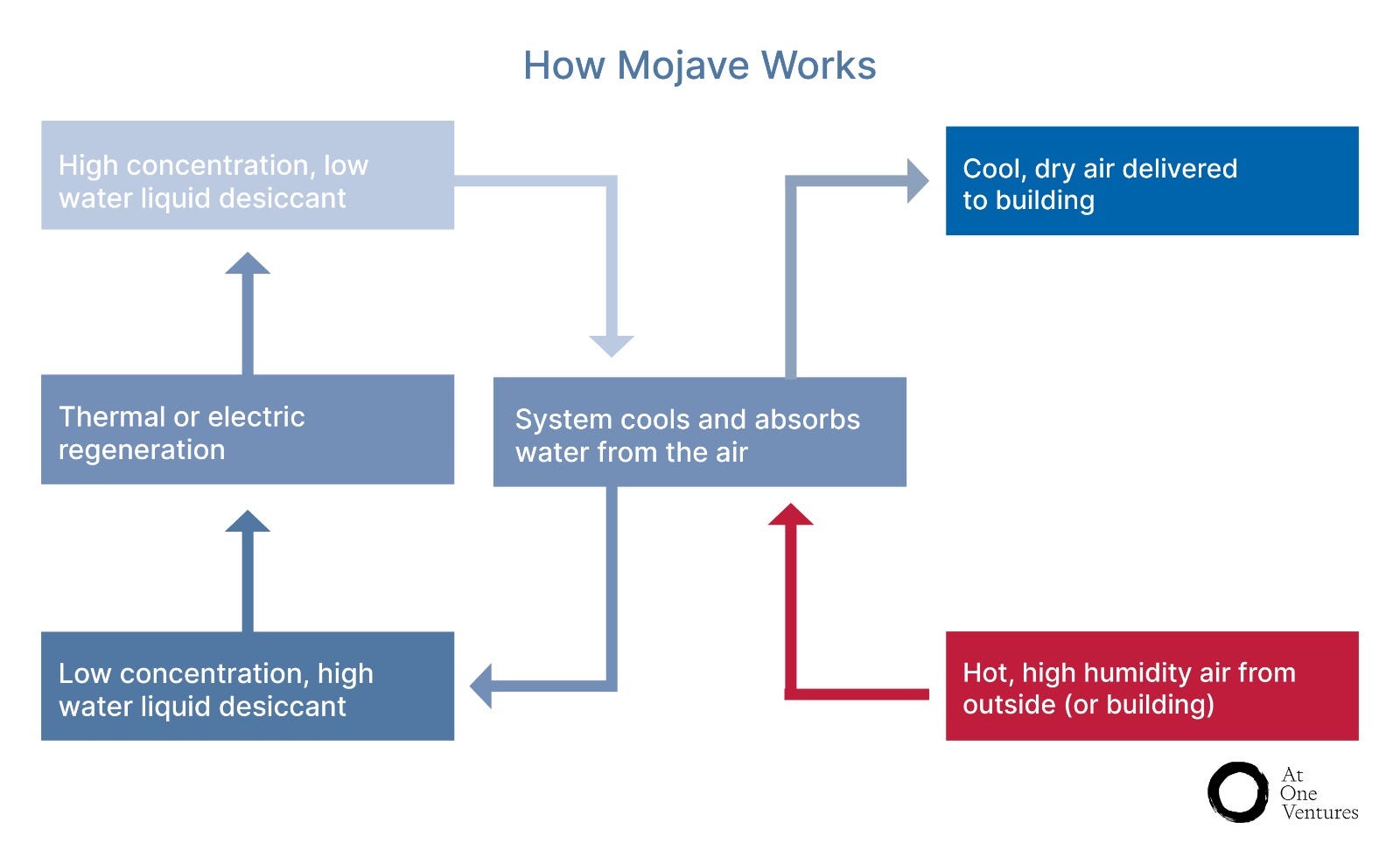
- The visual communication of complex thermodynamic cycles is simplified into clear, color-coded flowcharts (Slide 1 and Slide 4).
The Hardware Hurdle: Raising $12.5M on Technical Merit
Raising a seed round for a hardware company is notoriously difficult compared to software. Investors are wary of 'hardware is hard' pitfalls: high CapEx, long R&D cycles, and supply chain complexities. Mojave’s 2024 seed deck, which secured $12.5M, succeeds by front-loading technical validation and institutional pedigree. Instead of starting with a team slide or a market size graph, the deck leads with the 'How it Works' and the 'Who Backed the Research'—a strategy that signals this isn't a garage prototype, but a decade-long engineering project ready for commercialization.
Slide 1: The Functional Overview
The deck opens with a technical flowchart titled 'How Mojave Works.' This is an unconventional choice for a first slide, which usually features a logo and a tagline. However, for a deep-tech hardware play, establishing the thermodynamic cycle immediately is a power move. The slide illustrates a closed-loop system where high-concentration liquid desiccant absorbs water from hot, humid air to deliver cool, dry air to a building. It clearly delineates the 'Thermal or electric regeneration' phase, showing how the low-concentration desiccant is cycled back. This slide sets the tone: this is a deck for technical investors who understand HVAC fundamentals.
Slide 2: The Macro Problem
Slide 2 shifts to the 'Why.' It frames air conditioning not just as a luxury, but as an 'essential part of our lives' for the global middle class. The stakes are quantified with two heavy-hitting metrics: AC accounts for 10% of total global electricity use and 2 billion tons of CO2 equivalent emissions annually. The slide ends with a provocative question about maintaining comfort and cost while lowering impact. By anchoring the problem in global electricity consumption, Mojave justifies the need for a fundamental hardware shift rather than incremental software optimization.
Slide 3: The Pedigree Slide
In the absence of a traditional team slide in this selection, Slide 3 serves as the primary credibility driver. It titles the company’s history as 'The Origin of Mojave Energy Systems.' It explicitly states that the technology is the 'culmination of a decade of research' and prominently features the logos of Xerox PARC, NREL, and the Department of Energy. For a seed-stage company, this level of institutional backing is a massive de-risking signal. It tells investors that the 'science risk' has already been paid for by government and corporate labs, leaving only the 'execution risk' for the venture round.
Slide 4: The Core Innovation
Slide 4 dives deeper into the 'Innovative Liquid Desiccant System.' The key takeaway here is the 'Best of Both Worlds' approach. Traditional AC units are often inefficient because they must cool air below the dew point to remove moisture, then reheat it to a comfortable temperature. Mojave’s system separates these tasks: a liquid desiccant loop manages humidity while a vapor compression system controls temperature. The slide emphasizes that these can operate independently, allowing for 'optimized control.' This is the 'aha' moment for the product’s efficiency claims.
Slide 5: Market Application
Slide 5, 'Meeting Today’s Building Needs,' identifies the beachhead markets. Hardware startups must prove they aren't just a 'cool lab project' but a commercial product. Mojave targets three sectors: 1) Specialized Environments (pools), 2) Hospitality + Multifamily, and 3) Office/Commercial. By highlighting specialized environments like indoor pools, Mojave shows a path to early revenue in niches where humidity control is a mission-critical, high-cost pain point that current systems struggle to solve efficiently.
Slide 6: The Future Roadmap
Slide 6 introduces 'Patented Next Generation Electrochemical Technology.' This slide is crucial for venture scale. While the current product is efficient, this 'In Development' tech promises to be 20 times more thermodynamically efficient. It mentions 'refrigerant-free cooling' through 'DeVaporative' air conditioning. This gives investors a 'moonshot' upside—the current product provides the immediate business case, while the electrochemical tech provides the potential for total market dominance and a massive exit.
Slide 13: Contact Information
The final slide is a standard contact page. It lists the headquarters in Sunnyvale, CA, and provides basic contact details. While simple, it confirms the company's location in a major tech hub, which is often a subtle requirement for certain tiers of Silicon Valley investors.
What Mojave’s Deck Does Well
Technical Clarity: The use of flowcharts (Slides 1 and 4) and 3D cutaways (Slide 6) makes a very complex thermodynamic process understandable. It avoids 'black box' descriptions, which builds trust with technical due diligence teams.
Credibility by Association: By leading with Xerox PARC and the DOE (Slide 3), Mojave bypasses the need to prove their engineering chops from scratch. They are standing on the shoulders of giants, and they make sure the investor knows it.
Problem Scaling: The deck doesn't just say 'AC is expensive.' It links the product to global electricity grids (Slide 2). This turns a hardware pitch into a 'climate tech' pitch, which opens up a much larger pool of ESG and impact-focused capital.
What is Missing from the Mojave Deck
The Team: In the provided slides, there is no dedicated team slide. While the PARC association is strong, investors invest in people. Knowing who the CEO and CTO are, and their specific backgrounds in HVAC or chemistry, is a standard requirement that is absent here.
Competition: There is no mention of incumbents (Carrier, Trane, Daikin) or other startups in the desiccant space (like Blue Frontier or 75F). A competitive matrix or a 'Why We Win' slide against traditional vapor compression would have strengthened the commercial argument.
Unit Economics and Ask: The deck lacks a slide on the cost to manufacture versus the sale price. Furthermore, there is no 'The Ask' slide detailing how much they are raising (though we know it was $12.5M) or what the milestones for that capital will be (e.g., 'Build 50 units,' 'Complete UL certification').
Lessons for Founders
Lead with your strongest asset: If you have spent 10 years in a lab like PARC, that is your 'unfair advantage.' Mojave puts that front and center rather than burying it at the end of the deck. For deep tech, pedigree is often more important than early revenue.
Solve a 'Two-Pronged' Problem: Mojave doesn't just promise to be green; they promise to be 'at a price that most can afford' (Slide 2). In hardware, sustainability without cost-parity is a difficult sell. Mojave’s focus on 'Total Cost of Ownership' (Slide 5) is the right way to pitch to commercial building owners.
Visualize the Future: Even if your current product is a version 1.0, show the 'Next Gen' (Slide 6). Venture capitalists aren't looking for 10% improvements; they are looking for the 20x improvements Mojave claims are possible with their electrochemical research. Always show the path to a much larger breakthrough.
Frequently asked questions
- What is Mojave's core technology?
- Mojave utilizes an innovative liquid desiccant system. As shown on Slide 4, their hardware combines a liquid desiccant loop to manage humidity with a standard vapor compression system to control temperature. This allows the two functions to operate independently, which is more energy-efficient than traditional AC units that must over-cool air just to remove moisture.
- How does Mojave justify its environmental impact?
- Slide 2 of the deck states that air conditioning currently accounts for 2 billion tons of carbon dioxide equivalent emissions annually. Mojave’s goal is to maintain current comfort and purchase costs while significantly lowering energy use and climate impact through their more efficient thermodynamic process.
- Who developed the technology behind Mojave?
- The technology is the result of ten years of research. Slide 3 credits the Palo Alto Research Center (formerly Xerox PARC), the National Renewable Energy Laboratory (NREL), and the U.S. Department of Energy’s Office of Energy Efficiency & Renewable Energy as the foundational supporters of the development.
- What markets is Mojave targeting?
- According to Slide 5, Mojave is focusing on three primary segments: Specialized Environments (like indoor pools requiring precise dew point control), Hospitality + Multifamily (improving indoor air at lower costs), and Office + Other Commercial (reducing total cost of ownership and improving air quality).
- What is the 'Next Generation' technology mentioned in the deck?
- Slide 6 introduces a patented electrochemical technology currently in development. This system aims for electrochemical regeneration that could be 20 times more efficient than thermal regeneration by overcoming the 'heat of mixing' rather than the 'heat of vaporization,' potentially leading to refrigerant-free cooling.