Molekule’s pitch deck is a masterclass in scientific storytelling, focusing on the transition from a 1940s technology (HEPA) to their proprietary PECO system. By framing the air purification market as a 'growing global crisis' affecting 3 billion people, the company elevates a home appliance to a public health necessity. The deck successfully addresses the 'hardware is hard' stigma by highlighting a $129/year recurring filter subscription and claiming a 3x increase in YoY subscription revenue. However, the deck is notably missing a team slide, a detailed competitive landscape beyond legacy te…
Key takeaways
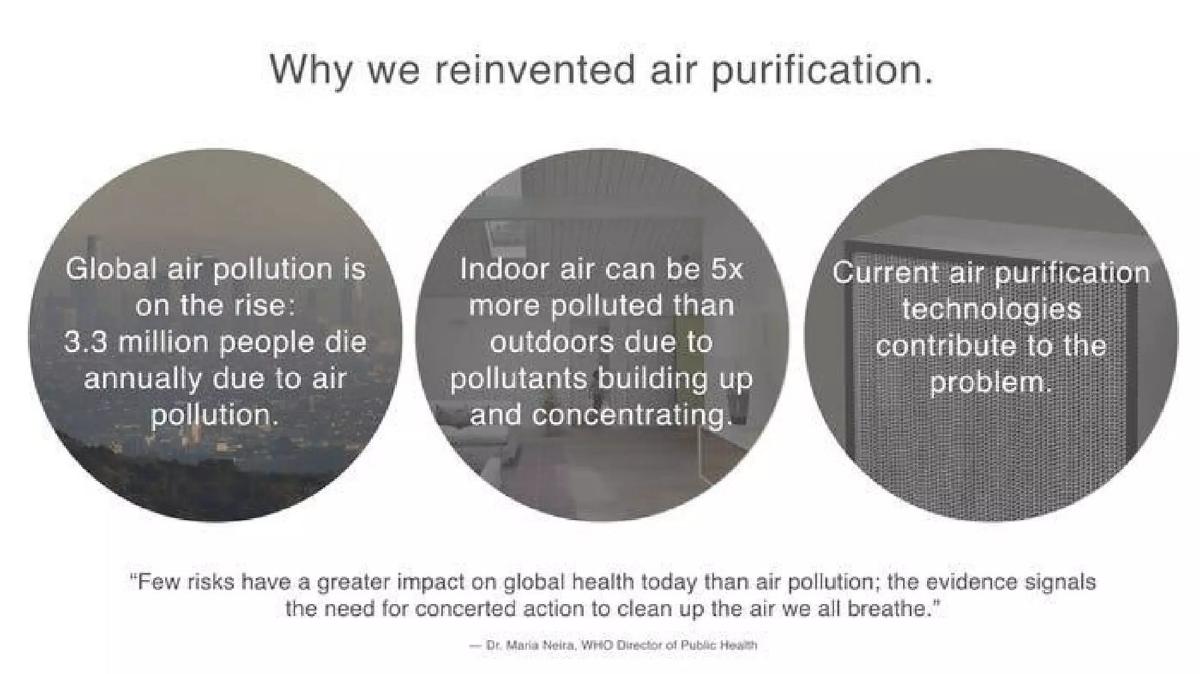
- The deck positions the product as a solution to a global health crisis, citing 3.3 million annual deaths due to air pollution on Slide 2.
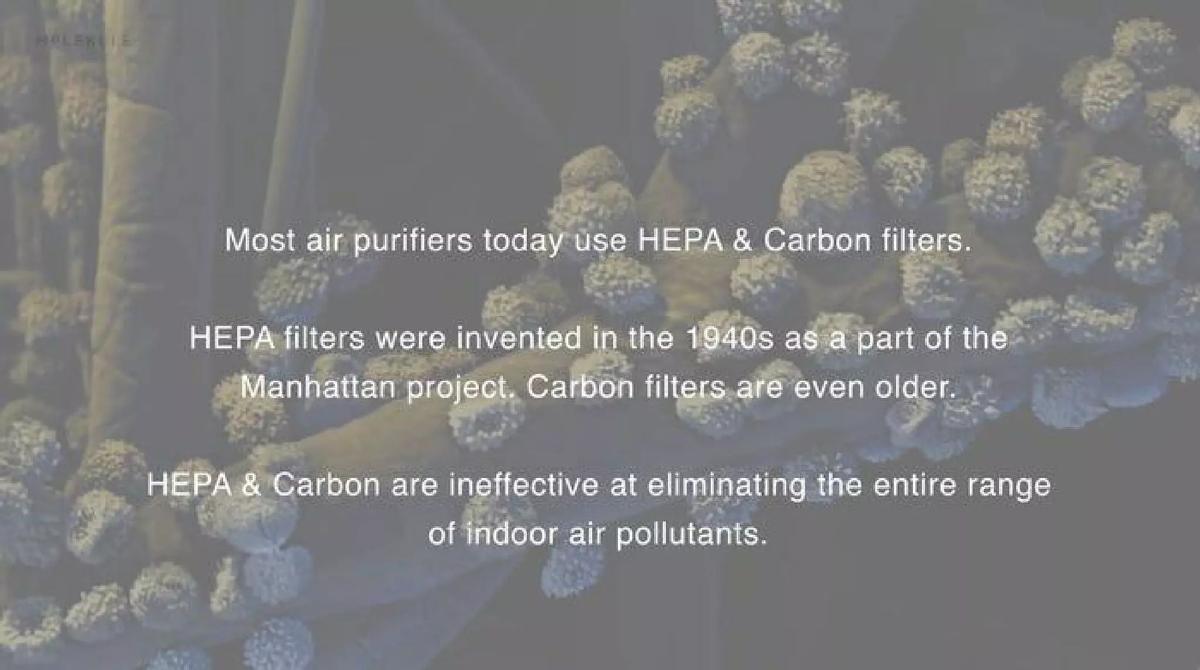
- Molekule attacks the industry standard, claiming HEPA filters were invented in the 1940s and are ineffective at eliminating the full range of pollutants on Slide 3.
- Technical differentiation is supported by a graph on Slide 6 showing Molekule destroying pollutants to 'minimum detection levels' while carbon filters re-emit them.
- The business model emphasizes recurring revenue, noting a $129/year filter subscription on Slide 10.
- Market validation is presented through customer reviews for both the flagship Molekule Air and the Air Mini on Slide 9.
- The company claims significant customer loyalty with approximately 200% growth of repeat customers stated on Slide 10.
- The total addressable market is framed by 300 million global asthma sufferers and 800 million allergy sufferers on Slide 8.
- The deck lacks a team slide, omitting the Stanford engineering backgrounds and 25 years of R&D mentioned in the company's catalogue listing.
The Future of Air: A Strategic Teardown
Molekule’s pitch deck is a focused narrative that prioritizes technical superiority and market necessity over traditional corporate metrics. Founded in 2014, the company sought to disrupt a stagnant air purification market. This teardown examines how they used a 15-slide presentation to communicate a complex scientific breakthrough as a scalable consumer business.
The Hook and the Problem (Slides 1-2)
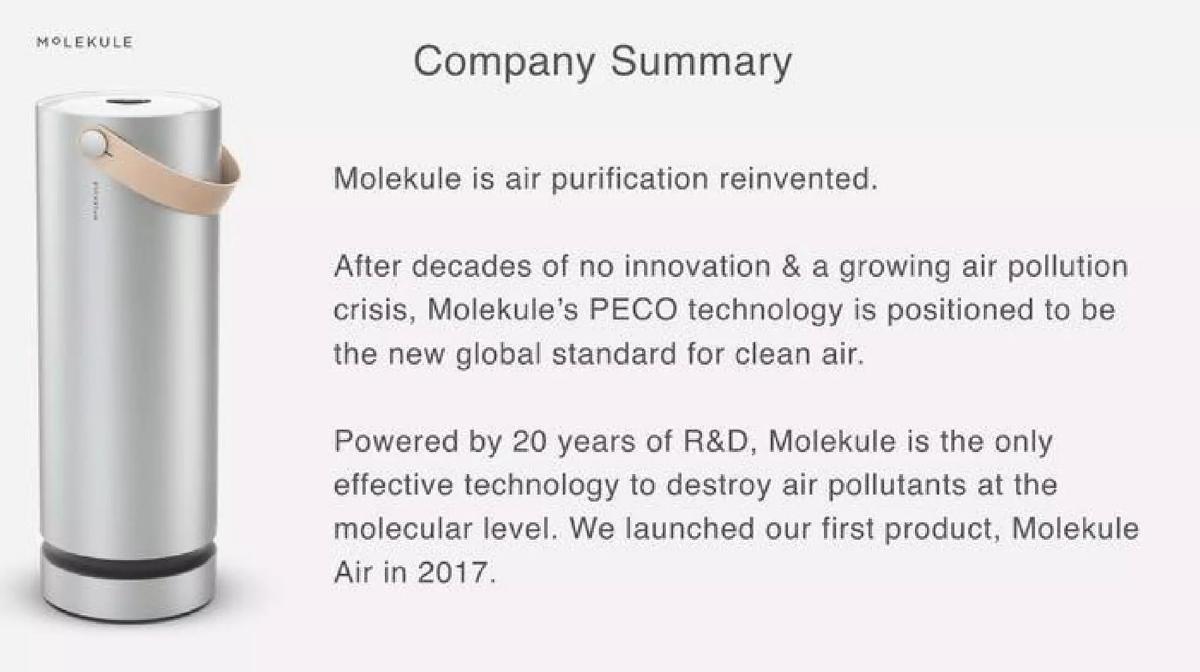
The deck opens with a minimalist title slide: "The Future of Air." This sets a visionary tone immediately. Slide 1, titled "Company Summary," introduces the core value proposition: air purification reinvented. It establishes credibility by mentioning "20 years of R&D" and the launch of their first product in 2017. By stating that Molekule is the "only effective technology to destroy air pollutants at the molecular level," they immediately stake a claim to a unique market position.
Slide 2, "Why we reinvented air purification," shifts the focus to a global health crisis. It uses three data points to build urgency: 3.3 million annual deaths from air pollution, the fact that indoor air can be 5x more polluted than outdoor air, and the provocative claim that "current air purification technologies contribute to the problem." This last point is a strategic pivot, turning the existing market into a villain that the company must defeat.
The Technical Takedown (Slides 3-5)
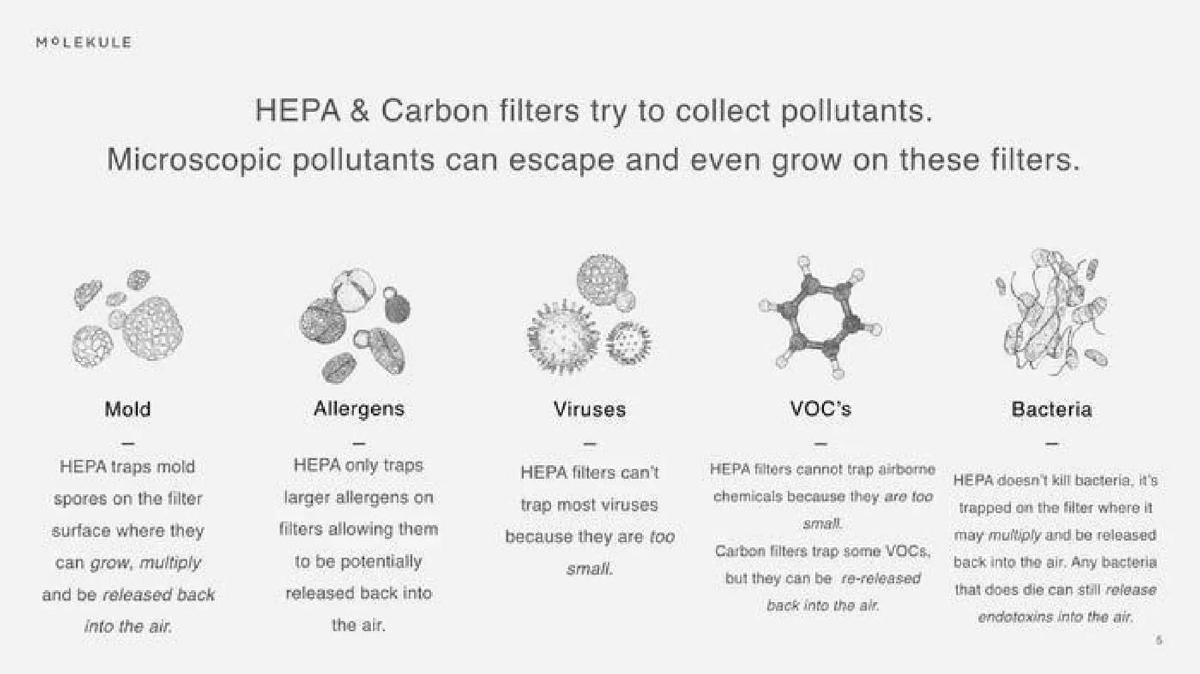
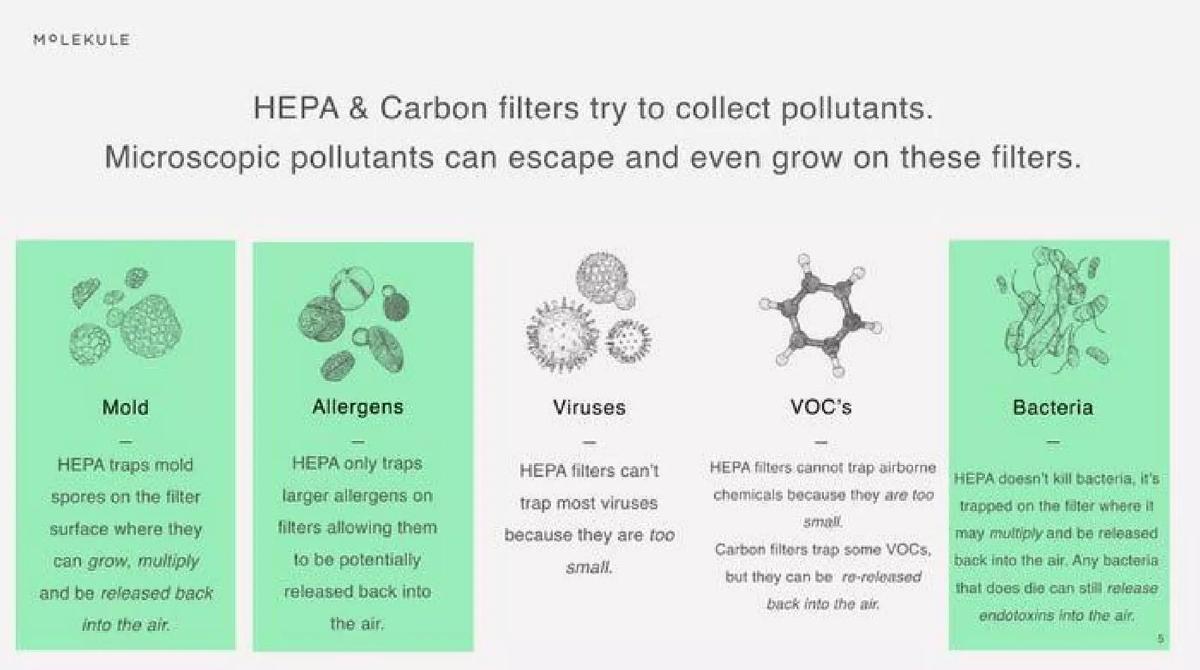
A significant portion of the deck is dedicated to delegitimizing the industry standard: HEPA filters. Slide 3 notes that HEPA filters were invented in the 1940s as part of the Manhattan Project, framing them as antiquated. Slide 4 and Slide 5 go into granular detail about the failures of HEPA and Carbon filters. These slides use a repetitive visual structure to show how Mold, Allergens, Viruses, VOCs, and Bacteria are handled. The core argument is that HEPA merely traps these pollutants, allowing them to "grow, multiply and be released back into the air." This creates a 'fear, uncertainty, and doubt' (FUD) effect that makes the viewer question the efficacy of every other product on the market.
The Solution and Proof (Slides 6-7)
After establishing the failure of legacy tech, Slide 6 introduces the PECO technology performance. A line graph shows Molekule’s performance compared to HEPA and Carbon. According to the chart, Molekule "destroys pollutant down to minimum detection levels" within 140 minutes, while Carbon filters are shown re-emitting pollutants back into the air. The slide cites independent test labs, including the University of Minnesota and the University of South Florida, to provide third-party validation.
Slide 7, "Science at the nanoscale," provides visual evidence through microscopic imagery. It reinforces the academic pedigree of the technology, citing 20 years of research at the University of Florida and emphasizing that the process is both peer-reviewed and patented. This slide is critical for hardware investors who are wary of 'black box' technologies; it shows the physical reality of the destruction process.
Market Size and Validation (Slides 8-9)
Slide 8, "A Growing Global Crisis," quantifies the opportunity. It breaks down the market into three categories: Asthma, Allergy, and Pollution sufferers. The figures are massive: 300 million global asthma sufferers and over 3 billion global pollution sufferers. By mapping these numbers over a global heat map, Molekule suggests that their TAM (Total Addressable Market) is essentially the entire human population.
Slide 9 provides social proof through "Strong Customer Reviews." It displays 5-star ratings for both the Molekule Air and the Air Mini. While these are anecdotal, they serve to show that the high-science concept translates into a positive user experience in real-world homes. This bridges the gap between a lab experiment and a commercial product.
Business Model and Scalability (Slides 10-11)
Slide 10 is perhaps the most important for the 'Later Stage' investor. Titled "Devices are just the beginning," it breaks down the unit economics. The flagship device sells for $799, but the real value lies in the $129/year filter subscription. The slide claims a "3x increase in YoY filter subscription revenue since launch" and "~200% growth of repeat customers." This demonstrates that the company has solved the retention problem common in consumer hardware.
Slide 11, "PECO is a Technology Platform," hints at future growth. It shows the existing consumer products and a large grey placeholder for "Commercial" applications. This suggests that the technology is not limited to home use but can be scaled into office buildings, hospitals, and industrial settings, significantly increasing the company's long-term valuation ceiling.
The Mission and Omissions (Slides 12-15)
The deck concludes with a mission statement on Slide 12: "We are on a mission to eliminate global air pollution and the suffering it causes." This is followed by a closing slide and an appendix marker.
What Works in the Molekule Deck
The deck is highly effective at category creation. Rather than trying to be a 'better' air purifier, Molekule positions itself as a 'molecular destruction' company. The use of scientific validation (Slide 7) and independent lab results (Slide 6) provides a level of technical depth that is often missing from consumer electronics pitches. Furthermore, the emphasis on recurring revenue (Slide 10) directly addresses the primary concern of hardware investors: the 'treadmill' of constant new customer acquisition.
What is Missing from the Molekule Deck
Despite raising $118.5 million, this deck has several glaring omissions that a typical seed or Series A founder might not be able to get away with. First, there is no Team slide. The catalogue listing mentions Stanford engineers and decades of R&D, but the deck fails to put faces or names to the leadership. Second, there is no 'Ask.' The deck does not state how much money is being raised or what the specific valuation expectations are. Third, the competitive landscape is oversimplified. While it attacks HEPA technology, it does not address how Molekule competes with other premium brands on price, design, or smart-home integration. Finally, there is a lack of detailed financial projections. While subscription growth is mentioned, there are no charts showing burn rate, CAC (Customer Acquisition Cost), or LTV (Lifetime Value) in hard dollars.
What a Founder Should Copy
Founders building complex hardware or 'Deep Tech' should copy Molekule’s problem-framing strategy. By making the current industry standard (HEPA) look dangerous and outdated, they make their own solution feel like an inevitability rather than an alternative. Additionally, the way they visualize the 'invisible' (the destruction of pollutants at the nanoscale) is a great example of how to make abstract technology tangible for investors. Finally, the clear separation between the 'Device' (upfront revenue) and the 'Subscription' (long-term value) is a model that every hardware founder should emulate to improve their company's risk profile.
Company: Molekule · Sector: Other (Air Purification/Health Tech) · Stage: Later · Year: 2014 (Founded), Deck likely 2019/2020 based on Air Mini launch mention. · Slides: 15 · Amount Raised: $118,500,000 · Outcome: Significant capital raise and commercial expansion.
Frequently asked questions
- What is the core technology differentiator in the Molekule deck?
- Molekule focuses on PECO (Photo Electrochemical Oxidation) technology. Unlike traditional HEPA filters that merely trap particles, Slide 1 and Slide 6 emphasize that PECO destroys pollutants at the molecular level. The deck uses microscopic imagery on Slide 7 to visualize this 'science at the nanoscale,' positioning the product as a proprietary tech platform rather than a simple mechanical filter.
- How does Molekule address the challenges of a hardware business model?
- Hardware companies often struggle with one-off sales. Molekule addresses this on Slide 10 by highlighting their 'Filter Subscription' priced at $129/year. They claim a 3x increase in year-over-year subscription revenue since launch, demonstrating a path to high-margin recurring revenue that complements the $799 upfront cost of the Molekule Home One device.
- What market data does the deck use to justify its scale?
- The deck uses a two-pronged approach to market size on Slide 8. It cites specific US figures (25 million asthma sufferers, 80 million allergy sufferers) and then scales to a global context, claiming over 3 billion people suffer from pollution worldwide. This framing suggests the company is not just a premium home decor item but a critical health intervention.
- Is there a competitive analysis included in the slides?
- The competitive analysis is limited to a technology comparison rather than a brand comparison. Slides 3, 4, and 5 compare PECO against HEPA and Carbon filters, arguing that legacy filters allow microscopic pollutants to 'escape and even grow.' It does not mention other modern competitors like Dyson or Blueair, focusing instead on the obsolescence of the underlying technology.
- What are the most significant omissions in this pitch deck?
- The most glaring omission is the lack of a Team slide. While the catalogue listing mentions Stanford engineers and decades of research, the deck itself does not introduce the founders. Additionally, there is no financial roadmap, no 'Ask' slide, and no detailed breakdown of how the $118.5 million raised would be allocated across R&D, marketing, or international expansion.