Moleaer’s Series C deck is a masterclass in using specific, measurable outcomes to justify a late-stage investment in hard-tech. The company moves quickly past the 'what' of its nanobubble technology to focus on the 'so what'—citing a 93% decrease in disease for leafy greens (Slide 5) and a 50% reduction in chemical dosing for reservoirs (Slide 6). While the deck is light on traditional financial metrics like ARR or burn rate, it compensates with deep technical moats, citing 7 granted patents and 5 pending applications (Slide 4). The narrative is built around versatility, showing that the sam…
Key takeaways
- The company positions itself as the leader in nanobubble technology, emphasizing scalability to any liquid flow rate (Slide 4).
- Moleaer claims a significant technical moat with 7 granted patents and 5 additional applications in the pipeline (Slide 4).
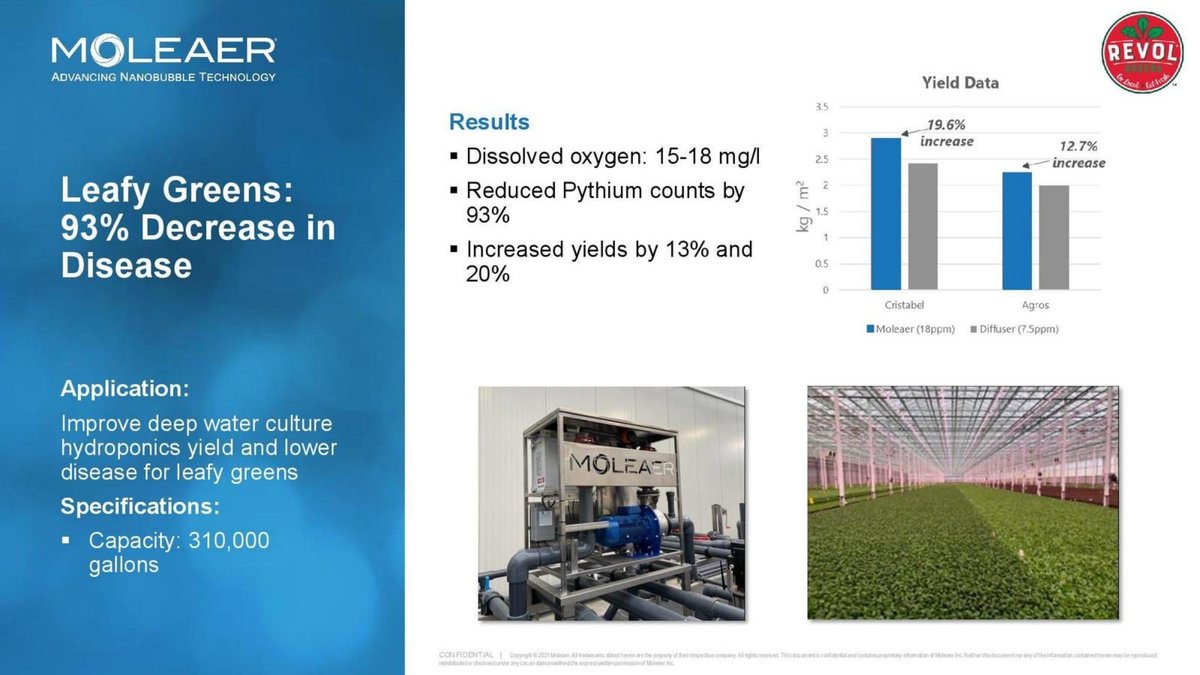
- Specific agricultural outcomes are used as primary proof points, including a 19.6% yield increase in Cristabel lettuce (Slide 5).
- The technology demonstrates industrial versatility, citing applications in mining, energy, and even household appliances (Slide 2, 3).
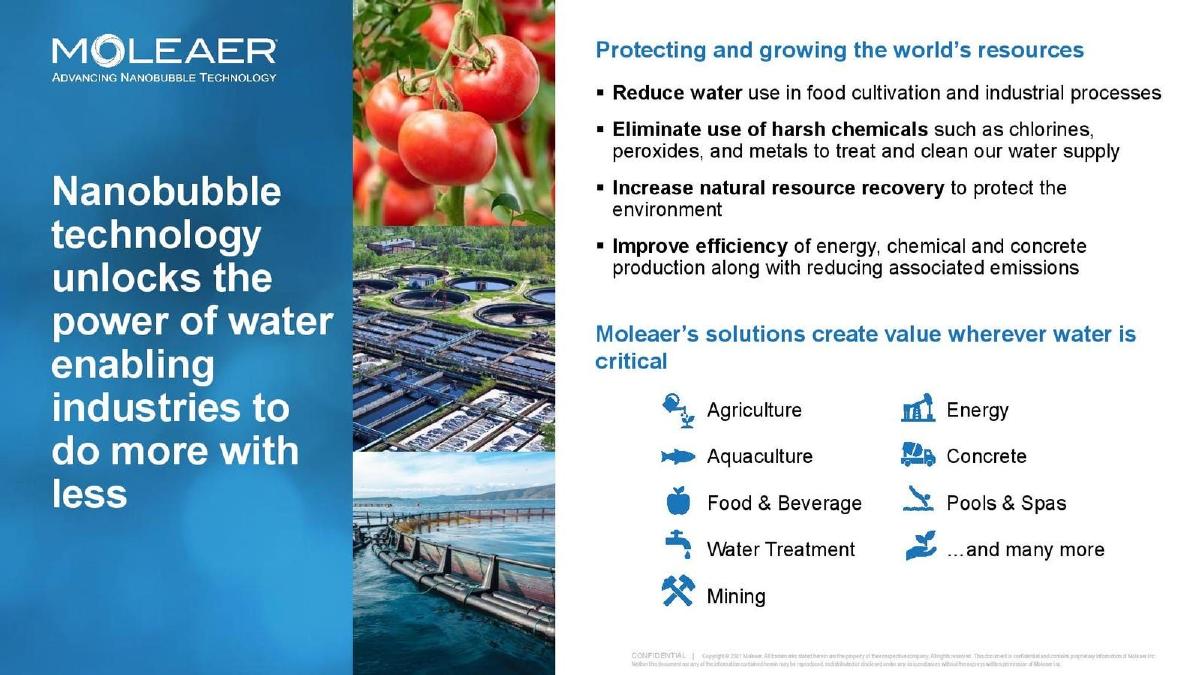
- Environmental impact is a core value prop, specifically the elimination of harsh chemicals like chlorines and peroxides (Slide 2).
- The hardware is described as a 'Nanobubble Generator' capable of producing 200M-to-1B nano-sized bubbles per ml (Slide 4).
- Operational efficiency gains are quantified, such as reducing backflushing frequency from every 2 hours to every 6 hours (Slide 6).
- The deck omits a traditional 'Team' slide and a specific 'Ask' or use of funds breakdown in the provided materials.
Moleaer Series C: Proving Hard-Tech at Scale
Moleaer’s Series C pitch deck is a focused, technical document that prioritizes industrial validation over flashy marketing. In an era where many ESG-adjacent startups struggle to prove economic viability, Moleaer uses its 13 slides to demonstrate that 'doing good' for the environment is synonymous with 'doing better' for the bottom line. The deck is structured to move from a broad vision of resource protection to granular, data-backed case studies that prove the technology works in the field.
Slide 1: Title and Positioning
The deck opens with a clean, blue-themed title slide dated June 2022. The central branding is 'Moleaer: Advancing Nanobubble Technology.' The subtitle, 'The Leader in Nanobubble Technology,' establishes an immediate claim to market dominance. The inclusion of four distinct images—splashing water, a mountain lake, fish in an aquaculture setting, and tomatoes—signals the breadth of their application before a single word of text is read.
Slide 2: The Value Proposition
Slide 2 serves as the executive summary. It frames the technology as a tool to 'do more with less.' The bullet points are highly specific about the outcomes: reducing water use, eliminating harsh chemicals (chlorines, peroxides, metals), increasing natural resource recovery, and improving efficiency in energy and concrete production. The right side of the slide lists nine target industries, ranging from Mining to Pools & Spas, indicating that Moleaer views its generator as a horizontal platform technology rather than a niche agricultural tool.
Slide 3: Cross-Industry Proof Points
This slide provides the 'so what' for three diverse sectors. For Food and Beverage, the benefit is pathogen and biofilm removal. For Natural Resources (Mining), the deck claims an increase in copper and gold recovery rates by over 10%. For Appliances, it suggests a reduction in detergent and water usage. By grouping these together, Moleaer demonstrates that their IP is versatile enough to impact both heavy industry and consumer goods.
Slide 4: The Technology Moat
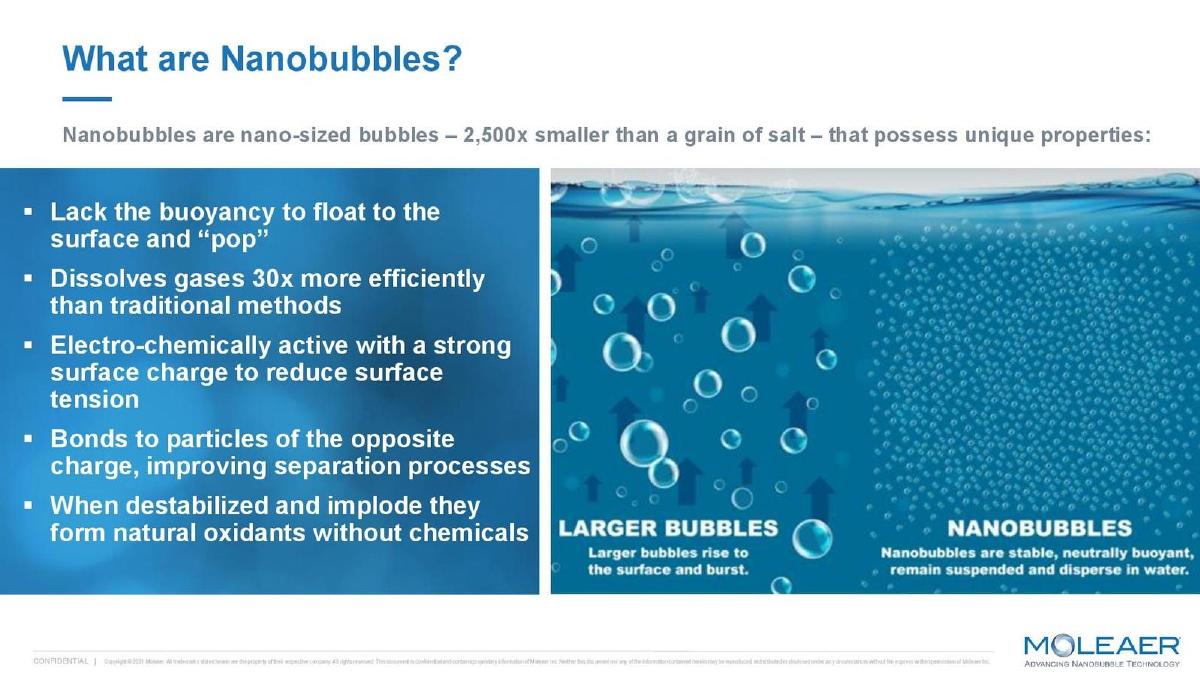
Slide 4 is perhaps the most critical for a Series C investor. It details the 'Nanobubble Generator' (NBG). The slide explains that compressed gas is diffused into flowing water at 25-to-1000 gpm, creating 200M-to-1B bubbles per ml. The technical defensibility is highlighted by 7 granted patents and 5 pending applications. The claim that this is the 'most scalable, versatile and cost-effective nanobubble technology available' is a direct challenge to any potential competitors in the space.
Slide 5: Case Study - Leafy Greens
Moleaer leans heavily on agricultural data to prove efficacy. Slide 5 focuses on a deep water culture hydroponics application. The results are impressive: a 93% decrease in disease (specifically Pythium) and yield increases of 12.7% and 19.6% for different lettuce varieties. The inclusion of a bar chart comparing Moleaer’s 18ppm dissolved oxygen levels against a standard diffuser’s 7.5ppm provides a clear scientific basis for the improved crop performance.
Slide 6: Case Study - Water Reservoirs
The final case study slide looks at a 2-million-gallon irrigation reservoir. Here, the metrics shift from yield to operational efficiency. Moleaer claims a 50% reduction in H2O2 dosing and a significant reduction in maintenance, moving backflushing requirements from every 2 hours to every 6 hours. This slide targets the 'pain points' of facility managers, showing that the technology pays for itself through reduced chemical costs and labor.
Slide 7-13: Conclusion and Supplemental Info
The remaining slides (as indicated by the publisher's summary and the final 'Thank You' slide) continue the theme of technical validation. Slide 13 provides contact information and reinforces the 'Advancing Nanobubble Technology' tagline. The deck concludes without a public 'Ask' slide in this version, which is common for late-stage decks where the terms are often negotiated in private placement memorandums rather than the pitch deck itself.
What Moleaer Does Well
Moleaer excels at quantifying the intangible. Many water-tech companies talk about 'purity' or 'health,' but Moleaer talks about '19.6% yield increases' and '50% chemical reduction.' This shift from qualitative to quantitative benefits is essential for a Series C round where investors are looking for a repeatable, scalable business model. The use of real-world photos of their machinery (Slide 4, 5, 6) also grounds the 'nano' technology in physical reality, proving that this is a manufactured product ready for deployment, not just a laboratory concept.
What is Missing from the Deck
The most notable omission in the provided slides is a Team slide. At the Series C level, investors are betting heavily on the leadership's ability to scale global operations. There is also a lack of financial disclosure; while the technical metrics are strong, there is no mention of current revenue, customer acquisition costs (CAC), or the total addressable market (TAM) for each of the nine industries mentioned on Slide 2. Finally, the deck does not outline the competitive landscape. While they claim to be the 'leader,' a slide acknowledging other aeration or chemical treatment methods would have provided helpful context for their market positioning.
Founder's Playbook: Lessons from Moleaer
Founders in the hard-tech or industrial space should take note of Moleaer's 'Proof over Promise' approach. Instead of spending five slides on the 'Problem' of global water scarcity, they spend one slide on the vision and then immediately dive into the data. Key lesson: if your technology is complex (like nanobubbles), don't try to explain the physics in depth; explain the results the physics produce. Another takeaway is the 'Horizontal Platform' strategy. By showing applications in both mining and dishwashers, Moleaer protects itself against a downturn in any single industry, a strategy that likely helped them secure their $40M raise.
Frequently asked questions
- What exactly is Moleaer's core technology?
- Moleaer develops a 'Nanobubble Generator' (NBG) that diffuses compressed gas into flowing water at rates between 25 and 1000 gallons per minute. This process creates between 200 million and 1 billion nano-sized bubbles per milliliter. According to Slide 4, this technology is patented and represents the most scalable and cost-effective method for nanobubble production currently available.
- How does the technology improve agricultural yields?
- As shown on Slide 5, the technology increases dissolved oxygen levels to 15-18 mg/l. In a deep water culture hydroponics application for leafy greens, this resulted in a 93% reduction in Pythium counts (a common plant pathogen) and yield increases ranging from 12.7% to 19.6% depending on the plant variety.
- What industries does Moleaer target beyond agriculture?
- Slide 2 and Slide 3 list a wide array of target sectors including Aquaculture, Food & Beverage, Water Treatment, Mining, Energy, Concrete, and Pools & Spas. Specific industrial benefits mentioned include increasing copper and gold recovery rates by over 10% in natural resource extraction and reducing detergent and water needs in household appliances.
- What are the primary environmental benefits of nanobubbles?
- The deck emphasizes the reduction of 'harsh chemicals' such as chlorines and peroxides in the water supply (Slide 2). In a practical application for a 2-million-gallon irrigation reservoir, Moleaer demonstrated a 50% reduction in H2O2 (hydrogen peroxide) dosing required for sanitation and biofilm removal (Slide 6).
- Is the technology protected by intellectual property?
- Yes, Slide 4 explicitly states that Moleaer has 7 granted patents protecting both the device and the process for producing nanobubbles. Furthermore, they have 5 additional patent applications pending to expand their 'technology moat,' suggesting a strong defensive position against competitors.