Modern Picnic’s 2022 pitch deck is a masterclass in brand validation for a direct-to-consumer (DTC) startup. By the time this deck was circulated, the company had already established a clear demographic stronghold, with 38% of customers in the 25-34 age bracket. The deck emphasizes social proof, showcasing dozens of top-tier press logos and strategic partnerships with brands like American Express and PETA. While the deck omits specific CAC and LTV dollar amounts in the provided slides, it demonstrates strong channel diversification, with SMS, Affiliate, and SEO each contributing roughly 10% o…
Key takeaways
- The core customer base is concentrated in urban centers, with New York, Los Angeles, Chicago, and Houston listed as the top four cities (Slide 6).
- Product pricing ranges from a $45 scarf to a $250 tote, positioning the brand in the premium 'accessible luxury' tier (Slide 5).
- The brand achieved significant social media traction on TikTok, reporting over 3 million likes and 125,000 followers by late 2021 (Slide 10).
- Revenue is well-diversified across marketing channels: SMS (9%), Affiliate (10%), and SEO (11%) all contributed to Q4 results (Slide 10).
- The founder, Ali Kaminetsky, brings relevant industry experience from Macy’s Executive Development Program and a background in Supply Chain Management (Slide 13).
- The company raised a total of $900,000 across 2020 and 2021 to fuel its pre-seed growth (Slide 12).
- Future growth is predicated on three specific pillars: Product, Licensing, and Distribution (Slide 11).
- The deck uses a 'Returning Customer Rate' of 22% as a key retention metric, though specific LTV and CAC figures are redacted in this version (Slide 10).
The Modern Picnic Teardown: Selling the 'Not Your Average Lunchbox'
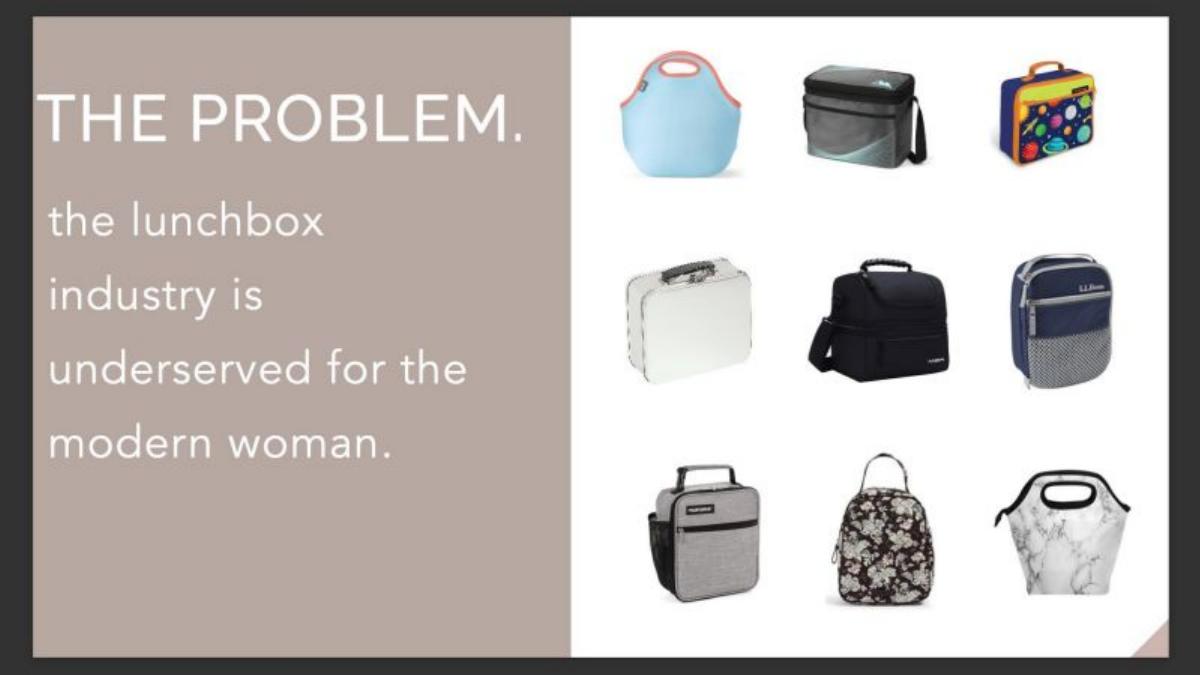
Modern Picnic entered the market to solve a specific, aesthetic problem: the lack of stylish, functional lunch containers for professional women. Their 2022 pitch deck reflects a brand that has moved past the 'idea' phase and into the 'optimization' phase. With a $138 Average Order Value (AOV) and a clear grasp of their digital footprint, the deck focuses on proving that their niche is actually a scalable lifestyle category.
Slide 1-2: Brand Identity and Navigation
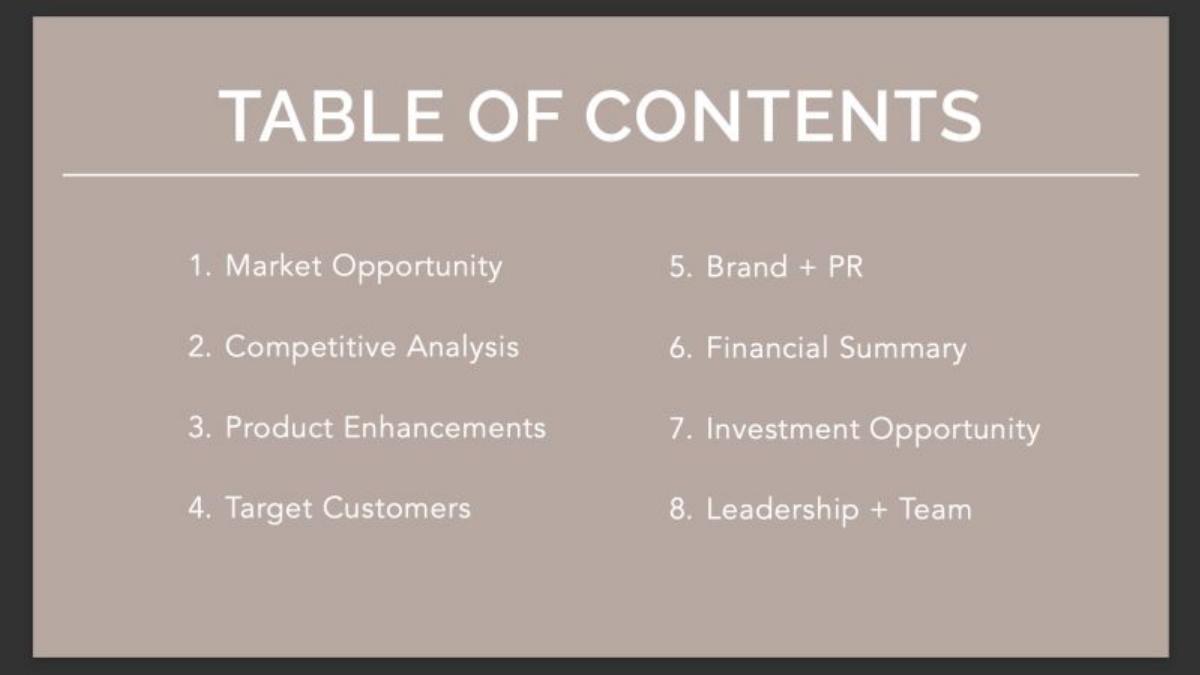
The deck opens with a minimalist title slide featuring the Modern Picnic logo in a simple black frame. This is followed by a Table of Contents (Slide 2) that outlines an eight-part narrative: Market Opportunity, Competitive Analysis, Product Enhancements, Target Customers, Brand + PR, Financial Summary, Investment Opportunity, and Leadership + Team. This structure is standard for a Pre-Seed to Seed stage deck, signaling to investors that the founders understand the necessary components of a business case.
Slide 3-4: The Problem and Visual Solution
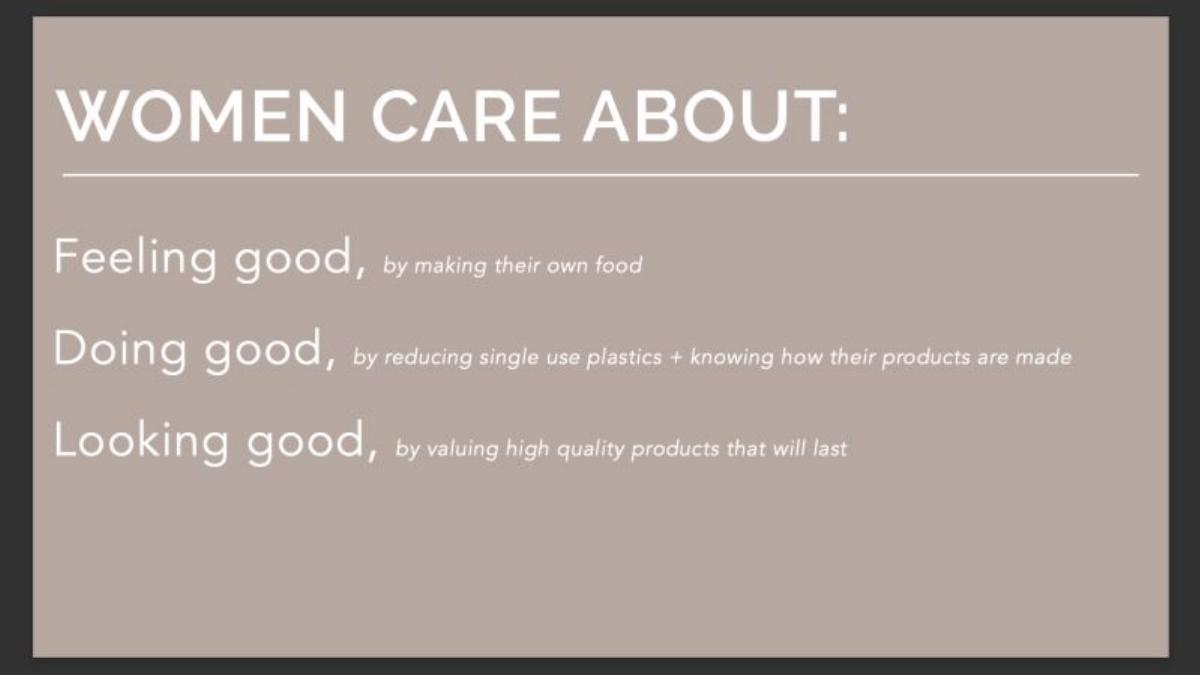
Slide 3 uses a 'Women Care About' framework to establish the value proposition. It highlights three pillars: Feeling good (making their own food), Doing good (reducing single-use plastics), and Looking good (high-quality products). This connects the product to broader trends in wellness, sustainability, and fashion. Slide 4 is a placeholder for a video, showing a top-down view of a bag being packed with a S.Pellegrino bottle, an apple, and personal items, effectively demonstrating the product's dual-purpose as both a lunchbox and a handbag.
Slide 5: Product Expansion and Pricing
This slide is critical for showing the transition from a single-product company to a brand. It lists nine distinct items, including:
Tote: $250 · Large Luncher: $189 · Backpack: $210 · Luncher: $159 · Mini Luncher: $129 · Pouch: $79 · Snacker: $59 · Pet Collection: $100 · Scarf: $45
By showing a range of price points, Modern Picnic demonstrates an 'entry-to-upsell' strategy. A customer might start with a $59 snacker and eventually move to a $250 tote.
Slide 6: Data-Driven Demographics
Slide 6 provides a breakdown of 'Actual Customer Demographics.' The data, sourced from Google Analytics (April 2018 to date), shows a clear peak in the 25-34 age range (38%) . The 'Top 4 Cities' (New York, Los Angeles, Chicago, and Houston) confirm that the brand resonates most in urban environments where professional women are likely to commute to offices. Notably, the 'Total Unique Customers To-Date' box is left blank in this version, likely for confidentiality during the initial circulation.
Slide 7-9: Brand Validation and Social Proof
Slide 7 is a simple transition slide stating, 'We have built a brand and product people love.' This is immediately backed up by Slide 8, which displays logos from hundreds of press features , including Vogue, Forbes, Cosmopolitan, and The New York Times. Slide 9 follows with 'Strategic Brand Partnerships,' featuring heavy hitters like American Express, Martha Stewart, PETA, and S'well . For a CPG brand, this level of third-party validation is essential to prove that the brand has 'cultural currency.'
Slide 10: E-Commerce Performance Metrics
This is the 'meat' of the deck for financial investors. It lists:
Average Order Value (AOV): $138 · Returning Customer Rate: 22%
The slide also breaks down new marketing channels opened in 2021. SMS (launched May 2021) accounts for 9% of Q4 revenue, Affiliate (launched August 2021) accounts for 10%, and SEO (launched September 2021) accounts for 11%. The mention of TikTok Ads resulting in 3M+ likes and 125k followers suggests a strong organic-to-paid funnel. However, the boxes for Average LTV, Average CAC, and LTV:CAC ratio are empty in this slide, which are the exact figures a Series A investor would require.
Slide 11-12: Future Growth and Funding History
Slide 11 introduces the '3 Pillars of Growth': Product, Licensing, and Distribution. This indicates the company is looking beyond direct-to-consumer sales, perhaps eyeing retail partnerships or brand licensing. Slide 12 provides a transparent look at their financing history, showing a $100,000 raise in 2018 , followed by $350,000 in 2020 and $550,000 in 2021 , totaling the $900k Pre-Seed round mentioned in the catalogue facts.
Slide 13: The Founder's Pedigree
The final content slide focuses on Ali Kaminetsky. It highlights her Supply Chain Management degree, her time as a Division 1 Tennis Captain, and her experience in Macy’s Merchant Buying/Planning Executive Development Program . This is a strong 'founder-market fit' slide; she has the technical background to manage inventory and the retail background to understand consumer trends. It also mentions her winning a pitch competition judged by Imaginary Ventures and Female Founders Fund , further bolstering her credibility.
What Modern Picnic Does Well
Modern Picnic excels at category creation . They aren't just selling a bag; they are selling a solution to a daily habit (bringing lunch to work) that was previously underserved by the fashion industry. The deck does an excellent job of using logos—both from press and partners—to create a sense of inevitability. If American Express and Martha Stewart are partnering with them, the brand is perceived as 'safe' for an investor. Additionally, the channel diversification data on Slide 10 shows they aren't overly reliant on a single platform like Facebook/Instagram, which is a common pitfall for DTC brands.
What is Missing from the Deck
The most glaring omissions are the unit economics and revenue totals . While AOV is provided, we don't see the Gross Margin per unit or the Contribution Margin after marketing spend. The empty boxes for CAC and LTV on Slide 10 are likely intentional for a public-facing version of the deck, but their absence makes it impossible to judge the efficiency of their growth. Furthermore, there is no 'The Ask' slide in the provided 14 slides. We know from the catalogue facts they raised $900k, but the deck doesn't explicitly state what the next round's target is or how that capital will be allocated across the '3 Pillars of Growth.'
Founder's Playbook: What to Copy
1. Use a Table of Contents: It seems old-fashioned, but for decks over 15 slides, it helps investors navigate and revisit specific data points. 2. Map Your Channels: Slide 10 is a great template for showing how different marketing efforts contribute to the bottom line. Don't just say 'we use social media'; show the percentage of revenue each channel generates. 3. Highlight 'Founder-Market Fit': Ali Kaminetsky’s slide is a perfect example of how to link education and early career experience directly to the needs of the startup. Her Macy’s experience is the perfect 'proof of work' for a retail founder. 4. Leverage Partnerships: If you have done a small collab or a pilot with a known brand, give it a full slide. In CPG, who you associate with is often as important as what you sell.
Frequently asked questions
- What is Modern Picnic's primary product offering?
- Modern Picnic specializes in high-end, insulated, vegan leather lunch bags designed for women. Their product line has expanded to include totes ($250), backpacks ($210), and smaller accessories like 'snackers' ($59) and pouches ($79), as shown on Slide 5.
- How much did Modern Picnic raise and from whom?
- According to the catalogue facts and Slide 12, the company raised $900,000 in a Pre-Seed round between 2020 and 2021. Investors included Michael Cline, Backstage Capital, Michelle Cordeiro Grant, Yossi Nasser, and Michael Setola.
- Who is the target demographic for these products?
- Slide 6 indicates a primary target of women aged 25-34, who make up 38% of the customer base. The secondary market is the 35-44 age group (18%) and 18-24 age group (17%). Geographically, they focus on major US metropolitan hubs.
- What marketing channels are most effective for the brand?
- The brand relies heavily on a mix of organic and paid digital channels. Slide 10 highlights TikTok as a major awareness driver with 3M+ likes, while SMS, Affiliate marketing, and SEO provide consistent revenue contributions of approximately 10% each.
- What is the founder's background?
- Founder Ali Kaminetsky graduated from Lehigh University with a degree in Supply Chain Management and Marketing. She previously worked in the Merchant Buying/Planning Executive Development Program at Macy’s, providing her with foundational retail and inventory experience (Slide 13).