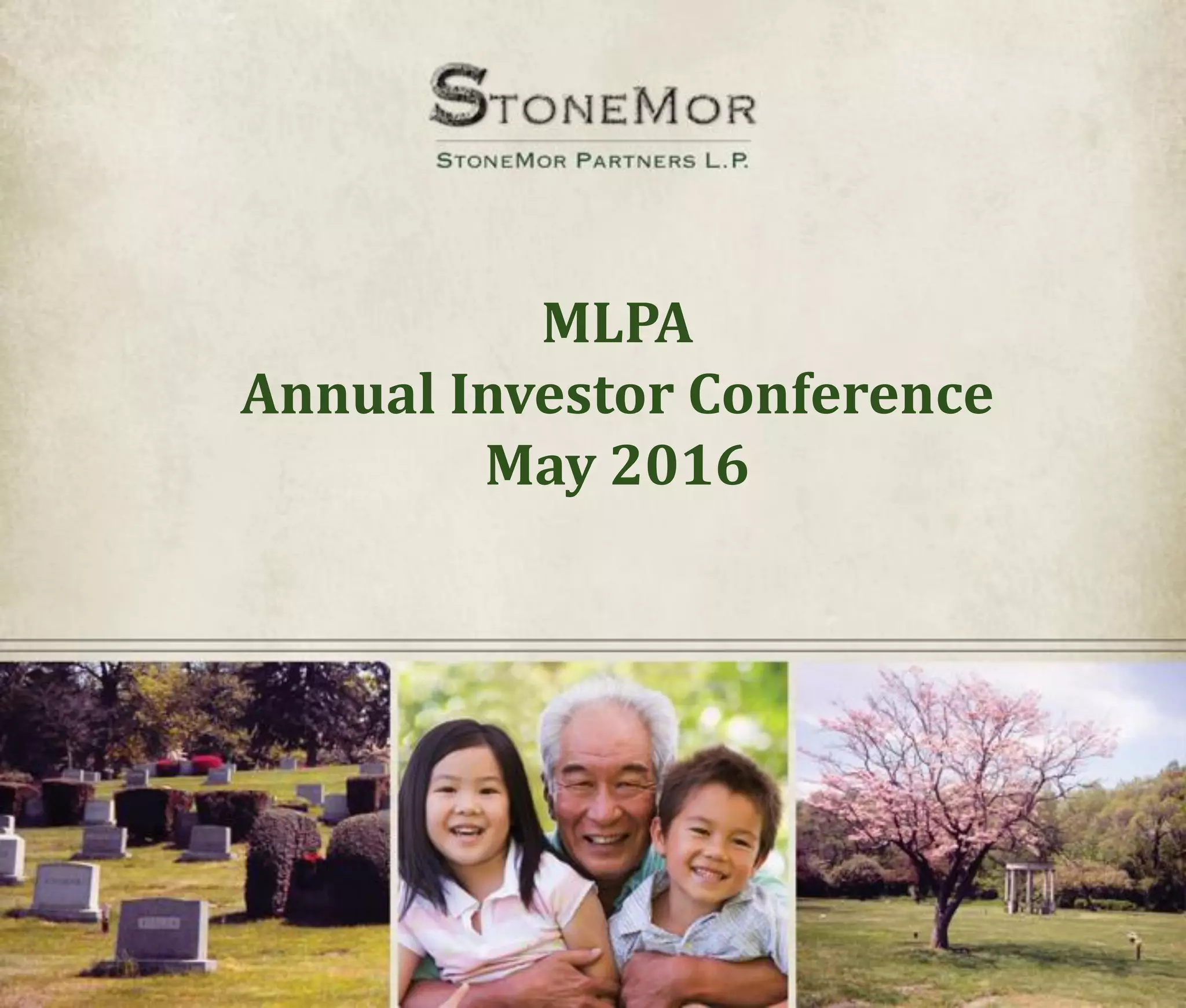
StoneMor Partners L.P. utilized this 37-slide deck for the MLPA Annual Investor Conference in May 2016 to showcase its position as a leader in the death care industry. The presentation leans heavily on the 'predictable' nature of the business, citing demographic trends and high barriers to entry as core strengths. StoneMor highlights a 12.8% ten-year total stock return and a strategy focused on consolidating a fragmented market where 80% of properties are independently owned. Notably, the deck reframes cremation—often seen as a threat to traditional burial revenue—as a high-margin opportunity…
Key takeaways
- The industry is marketed as having stable and predictable cash flows driven by demographic trends (Slide 5).
- StoneMor claims a 12.8% ten-year total stock return as of March 31, 2016 (Slide 5).
- The market is highly fragmented, with 80% of cemetery and funeral home properties owned by independents (Slide 9).
- Cremation is positioned as a growth driver, with memorialization rates for cremations reaching 35.5% (Slide 13).
- Organic growth initiatives include a digital lead generation strategy via burialplanning.com, which saw 296,373 new visitors (Slide 17).
- Digital marketing efforts through their website resulted in $5.8mm in revenue compared to $4.4mm in 2014 (Slide 17).
- Distributable Available Cash grew from $79 million in 2013 to $86 million in the trailing twelve months (Slide 21).
- Trust assets are split between Merchandise and Perpetual Care, with the Merchandise Trust reaching $480 million by March 2016 (Slide 25).
StoneMor Partners: A Deep Dive into the Death Care Business Model
The StoneMor Partners L.P. presentation for the MLPA Annual Investor Conference in May 2016 is a masterclass in defensive industry positioning. While many startups pitch disruption, StoneMor pitches stability, predictability, and the inevitability of their market. The deck is structured to reassure institutional investors of the company's long-term viability through demographic certainty and disciplined financial management.
Slide 1: Title and Branding
The cover slide establishes a somber yet professional tone. It features the StoneMor Partners L.P. logo and the specific event details: MLPA Annual Investor Conference, May 2016. The imagery at the bottom—a cemetery, a multi-generational family, and a peaceful park—seeks to bridge the gap between the business of death and the emotional reality of the families they serve. This sets the stage for a presentation that balances cold financial metrics with the human element of the industry.
Slide 5: Key Investment Appeals
This slide serves as the executive summary of the company's value proposition. StoneMor lists six primary appeals: predictable death rates, stable cash flows, geographic scale, barriers to entry, a conservative financial profile, and a 12.8% ten-year total stock return as of 03-31-2016. The mention of a large sales force (~650) is highlighted as a key strength, suggesting that their growth is driven by active outbound efforts rather than just passive demand. This slide is designed to check the boxes for a value-oriented investor looking for yield and safety.
Slide 9: Industry Snapshot
StoneMor defines the death care market as a $20 billion industry. The slide emphasizes that the market is highly fragmented, with 80% of properties owned by independent operators. This is a classic 'roll-up' strategy indicator; the company is signaling that there is significant room for growth through acquisition. The 'Substantial Barriers to Entry' section reinforces the moat, citing a lack of new supply and heavy regulation as factors that protect incumbents from new competition.
Slide 13: Cremation: Friend (not Foe)
One of the most strategic slides in the deck addresses the industry's biggest perceived threat: the shift from expensive traditional burials to lower-cost cremations. StoneMor reframes this as an opportunity. They note that 35.5% of cremations now include memorialization, which leads to higher profit margins and better land utilization. The slide includes images of urns, memorial jewelry, and columbariums (niches for urns), visually demonstrating how they monetize the cremation trend. This is a critical pivot to maintain investor confidence in the face of changing consumer preferences.
Slide 17: Organic Growth Initiatives
This slide breaks down how StoneMor intends to grow beyond acquisitions. It focuses on three pillars: expanded product offerings (jewelry, keepsakes), real estate optimization (working with Cushman & Wakefield to sell land or add vertical structures), and digital marketing. The inclusion of burialplanning.com is notable; they report 296,373 new visitors and a revenue increase to $5.8mm from $4.4mm in 2014. This shows a traditional industry successfully adopting modern lead generation tactics.
Slide 21: Sustained and Stable Cash Flows
Financial performance is visualized through a bar chart comparing Distributable Available Cash (DAC) against actual Distributions from 2013 through the Trailing Twelve Months (TTM). The green bars (DAC) consistently exceed the orange bars (Distributions), showing a healthy coverage ratio. For an MLP (Master Limited Partnership), this is the most important slide, as it proves the company's ability to pay out cash to its unit holders. The TTM DAC is listed at $86 million against $81 million in distributions.
Slide 25: Trust Fund Overview
Because death care companies collect money for future services (pre-need), they manage massive trust funds. This slide provides transparency into those assets. Historical Trust Assets for the Merchandise Trust grew to $480 million by March 2016, while the Perpetual Care Trust reached $310 million. The slide also boasts strong historical returns, with the Merchandise Trust seeing an 8.5% return over 10 years. This indicates that StoneMor is not just a service provider, but also an effective asset manager.
Slide 29: Appendix Introduction
The appendix transition slide mirrors the cover, signaling the end of the narrative and the beginning of the supporting data. It maintains the same thematic imagery, ensuring brand consistency throughout the 37-slide deck.
Slide 33: Non-GAAP Reconciliations
This slide is purely for the analysts. It provides the specific formulas StoneMor uses to calculate Adjusted EBITDA, Distributable Cash Flow (DCF), and Distributable Available Cash. By defining these terms—such as adding back non-cash stock compensation and asset impairments—StoneMor ensures that investors are comparing their performance accurately against peers. It adds a layer of professional rigor to the presentation.
Slide 37: Thank You
The final slide is a simple 'Thank You' with the company logo and the same tripartite imagery used on the cover and appendix slides. It lacks a specific call to action or contact information for the IR team, which is a minor omission, though typical for a conference presentation where the speakers are present for Q&A.
What StoneMor Does Well
The deck is exceptionally strong at addressing industry headwinds. By dedicating an entire slide to why cremation is a 'friend,' they proactively answer the most likely objection from a skeptical investor. Furthermore, the use of clear, consistent charts for cash flows and trust fund performance provides the transparency required for a publicly traded partnership. The focus on 'predictability' is a recurring theme that aligns perfectly with the risk profile of their target investor base.
What is Missing from the Deck
Despite the 37-slide length, the 10 slides provided lack a detailed competitive landscape. While they mention that 80% of the market is fragmented, they do not name their primary large-scale competitors or explain why a customer would choose a StoneMor property over another scale player. Additionally, there is no specific 'Team' slide in this selection, which is a missed opportunity to highlight the operational experience of the management team responsible for the roll-up strategy. Finally, the deck does not explicitly detail the debt structure, which is a critical component for any capital-intensive MLP.
Founder Takeaways: What to Copy
Founders in traditional or 'boring' industries should study how StoneMor uses data to prove predictability. If your business relies on long-term trends (like demographics), make that the cornerstone of your pitch. The way they reframed a threat (cremation) into a high-margin opportunity is a brilliant tactical move that every founder facing market shifts should emulate. Lastly, providing clear definitions for non-standard financial metrics (as seen on Slide 33) builds trust with sophisticated investors and prevents misunderstandings during the due diligence process.
Frequently asked questions
- How does StoneMor view the rise of cremation?
- StoneMor explicitly labels cremation as a 'Friend (not Foe)' on slide 13. They argue that cremation increases land utilization and offers higher profit margins through memorialization products like jewelry, keepsakes, and cremation gardens. They note that 35.5% of cremations now include some form of memorialization, creating a new revenue stream that offsets the decline in traditional burials.
- What are the primary barriers to entry in this industry according to the deck?
- According to slide 9, the death care industry suffers from 'No new supply' and is governed by 'Significant financial and operating regulations.' These factors create a moat for existing large-scale players like StoneMor, making it difficult for new competitors to enter the market and disrupt established cemetery and funeral home operations.
- What is StoneMor's digital strategy for customer acquisition?
- StoneMor utilizes burialplanning.com as a centralized lead generation engine. As shown on slide 17, this platform attracted nearly 300,000 new visitors and generated $5.8 million in revenue. This indicates a shift toward direct-to-consumer marketing in an industry traditionally reliant on local reputation and physical presence.
- How does the company manage its trust funds?
- Slide 25 explains that trust funds are managed by third-party professional consultants and administrators. The assets are invested in a diversified portfolio of fixed income and equity mutual funds. The deck tracks two specific types: the Merchandise Trust and the Perpetual Care Trust, both of which have shown historical returns ranging from 6.4% to 8.9% over various time horizons.
- What financial metrics does StoneMor emphasize to investors?
- StoneMor focuses on Distributable Available Cash (DAC) and Adjusted EBITDA. Slide 21 shows a steady increase in DAC and actual distributions to shareholders. Slide 33 provides a detailed reconciliation, defining Adjusted EBITDA as net income plus interest, taxes, depreciation, asset impairments, and acquisition costs, ensuring investors understand the cash-generative nature of the business.