MobilFlex presents a highly technical, hardware-centric vision to decentralize computing through what they call the Personal Data Center (PDC). The deck argues that current x86 architecture is fundamentally inefficient, wasting over 50% of its power on system 'chores.' By introducing a 'LAN of Things' (LOT) architecture, MobilFlex claims it can deliver 3x the processing power at the same cost as current systems. The fundraising goal is a modest $1 million, with $250,000 specifically earmarked for a proof-of-concept. However, the deck is notably light on business execution details, featuring a…
Key takeaways
- The core product is the Personal Data Center (PDC), an edge data center designed for 10-20 users priced at $1,500 (Slide 4).
- MobilFlex claims their architecture provides 80% more compute power and eliminates I/O bottlenecks with up to 16 concurrent M2M I/O transactions (Slide 3).
- The company identifies a 'compute gap' where 90% of generated data remains unprocessed due to the end of Moore's Law (Slide 12).
- The team is currently incomplete, with the CEO, Software Architect, Semiconductors Partner, and Sales/Marketing roles all listed as 'TBD' (Slide 5).
- The funding ask is $1M total, with $250k specifically required to build the 'proof of concept' (Slide 7).
- MobilFlex positions itself as a potential 'next Sun Micro' within 3 to 5 years (Slide 10).
- The deck cites a 2018 IoT Analytics report to highlight that zero projects were focused on the Smart Home, framing this as a market opportunity (Slide 13).
- The technical premise dates back to 2007, when the idea was allegedly first presented to Intel, HP, and 3COM (Slide 8).
Executive Summary and Vision
Slide 1: Title Slide
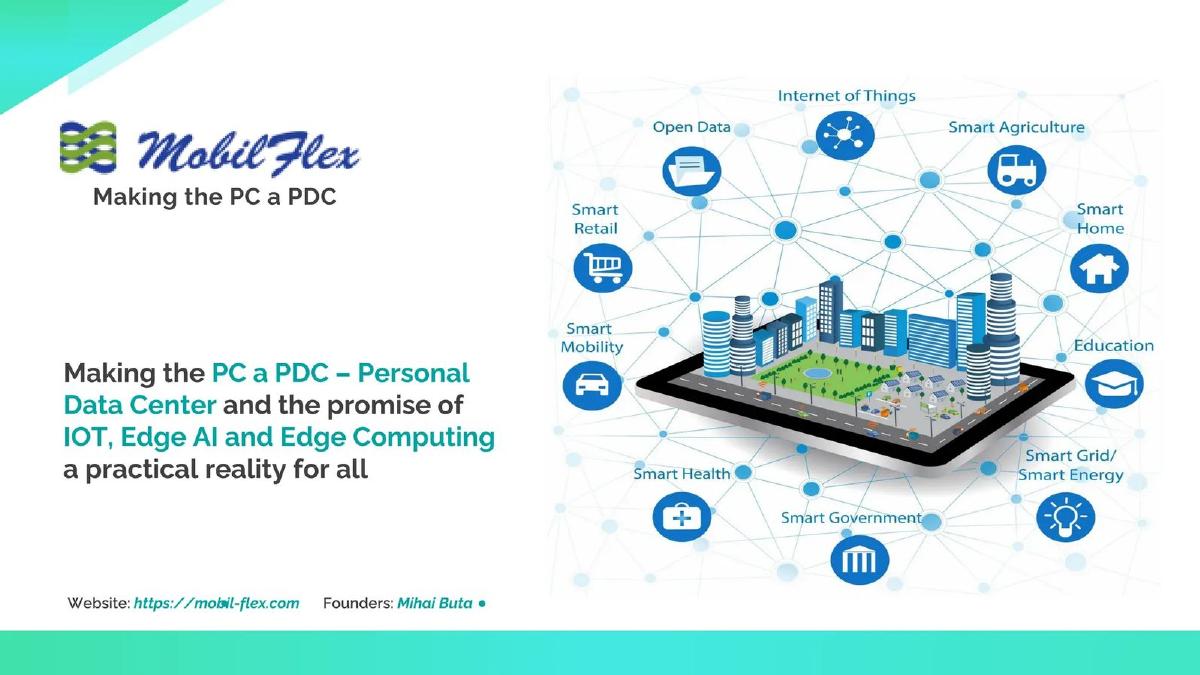
The deck opens with the company name, MobilFlex , and the tagline "Making the PC a PDC." The slide defines PDC as a Personal Data Center and claims to make the promise of IOT, Edge AI, and Edge Computing a "practical reality for all." The founder is listed as Mihai Buta , and the company website is provided. The visual features a tablet-like device acting as a hub for various sectors including Smart Retail, Smart Health, Smart Home, and Smart Agriculture.
Slide 2: State of Edge - IOT
This slide presents the problem: a huge enterprise market without "1st level Managers." It displays a 4 Stage IoT Solutions Architecture diagram. The key claim here is that while there are 630+ IOT platforms , none of them provide Stage 3 and 4 local processing. MobilFlex introduces the concept of LOT (LAN of Things) , which they claim must be completed on the "last 30 yards" to unify sub-networks and allow direct M2M (machine-to-machine) interoperability.
Slide 3: Base Product Line - LAN of Things
The company describes its base product line as "LAN of Things" Accelerators and Chipsets [LOT] . The core value proposition is to transform the "flat and inefficient x86 architecture" into a vertically layered architecture similar to mainframes. Technical claims include:
Eliminating I/O limitations with up to 16 concurrent M2M I/O . · Eliminating CPU waste, resulting in 80%+ more compute power . · Providing 3x+ over processing power at the same cost for 4-core systems.
Slide 4: End Product - PDC
The end product is the PDC (Personal Data Center) , described as an Edge Data Center for 10-20 users . It is a bare-metal platform priced at $1,500 , which the slide compares to the price of a Mac. A bold claim in red text states that this allows Windows PC OEMs to "20x their profits" by selling the PDC as a PC replacement. A small image shows various server-like chassis labeled 740, 730, 720, 170, and 250.
The Team and Partnerships
Slide 5: Team and Key Roles
This slide is explicitly labeled as "work in progress." The current team consists of:
Mihai Buta: Founder, CTO, and Computer Architect. · Lina Sawalha, PhD: Associate Professor and Computer Architecture Lab Chief. · Alex Russakovsky, PhD: Expert in databases, NLP, and a "Top 500 chess player."
Crucially, the CEO position is TBD , as are the roles for Software Architect, Semiconductors Partner, and Sales and Marketing.
Slide 6: Help Wanted - Partnership Opportunities
MobilFlex acknowledges that building this system is a complex task. They state they will provide the bare metal H/W and the "what's," while seeking partners for the "how" in fields like semiconductors, OS, and middleware. The slide includes a complex software stack diagram (resembling the macOS architecture) to illustrate the layers involved.
The Ask and Market Timing
Slide 7: Summary and Conclusions
The financial ask is stated as $1M now to reach profitability. Specifically, $250k is needed to build the "proof of concept." The slide mentions "lots of interest and 'tires kicking'" from stakeholders. It sets a goal of reaching unicorn status and claims the ability to profit "Billions year after year."
Slide 8: Why Now
The company claims the idea was first presented to Intel, HP, and 3COM in 2007 , but was ahead of its time. They argue that today, the technology and market are ready. The slide lists massive acquisitions by Intel ($17B+ for Altera), AMD ($34B for Xilinx), and Nvidia ($34B for ARM) as evidence that industry giants are looking for alternative solutions to x86 inefficiency.
Value Propositions
Slide 9: Promise to Developers
For developers, the PDC offers a miniature data center under the desk. Key features include cloud-independent Edge AI , 16 concurrent I/O transactions, and accessibility from any BYOD (Bring Your Own Device). It is framed as a tool for "Personal analytics" and "Assisted Productivity."
Slide 10: Promise to Investors
The pitch to investors is that MobilFlex is a "safer investment than any construction project." They claim they will become the "next Sun Micro in 3-5 years." The strategy involves minimizing in-house expertise and maximizing 3rd party services to reach profitability with only $1M.
Slide 11: New User Experiences
This slide focuses on the user interface, promising interoperability, mobility, and flexibility . It lists features like using any surface as a display, controlling appliances by pointing at them, using biometrics instead of passwords, and voice control. The visuals include VR headsets and projected interfaces.
Market Analysis and Technical Gaps
Slide 12: The Compute Gap
This slide uses two charts to illustrate the "Compute Gap." One shows the end of Moore's Law scaling, and the other shows data growth outpacing IT resources. It claims that 90% of data generated is left unprocessed . MobilFlex positions its solution as a way to eliminate the x86 "birth defect" and provide 3x+ processing capability.
Slide 13: The Top 10 IoT Segments in 2018
Using a chart from IoT Analytics (Jan 2018) , the slide shows that Smart Cities and Connected Industry lead IoT projects. It highlights in yellow that there were "Zero projects on Smart Home" in this specific dataset, implying a massive untapped opportunity for the PDC.
Slide 14: No IT Manager Needed
This slide uses a meme of a frustrated child on a phone to argue that the system will be easy to use. It claims "No IT Manager needed," though ITaaS (IT as a Service) will be available for those who want it.
Slide 15: Our "Secret Sauce"
The final slide in this set uses a metaphor: the ability to make a "drivable Bugatti" from a "pile of Lego pieces." It mentions that the company has some patents and that many more will come. The visual shows a life-sized Bugatti made of Lego bricks alongside a pile of loose bricks.
What Works and What is Missing
What Works
Clear Technical Thesis: The deck does a good job of identifying a specific technical pain point (x86 I/O inefficiency) and proposing a hardware-based solution. · Defined Product Specs: Unlike many early-stage decks, this one provides a specific price point ($1,500) and target user count (10-20) for the hardware. · Market Context: Citing the massive acquisitions by Intel, AMD, and Nvidia helps validate that the industry is searching for the types of architectural improvements MobilFlex is proposing.
What is Missing
A Complete Team: The most significant red flag is the "TBD" status for the CEO and other critical roles. Investors generally fund teams, not just ideas, and a missing CEO is a major hurdle. · Go-to-Market Detail: While the deck mentions using customers' sales organizations, it lacks a concrete plan for how to acquire those customers or which OEMs have expressed interest. · Financial Projections: The deck claims a path to "Billions," but provides no revenue model, margin analysis, or 3-5 year financial roadmap. · Intellectual Property Details: While Slide 15 mentions patents, it does not list patent numbers or specific areas of coverage, which is vital for a hardware/architecture play. · Competitive Analysis: The deck mentions 630+ IoT platforms but doesn't name specific competitors or explain why existing edge computing startups aren't already solving this problem.
Founder Takeaways
Don't pitch an empty C-suite. Listing your CEO as "TBD" signals to investors that the company is still just a project. If you are the founder and CTO, you are the de facto CEO until someone else is hired. Own the role or find the partner before you start the roadshow.
Hardware requires a higher bar for proof. MobilFlex is asking for $250k just to build a POC. In the current venture climate, hardware founders often need a working prototype or at least a simulation with verified data before seeking institutional capital. The "trust us, we have a secret sauce" approach is difficult to sell for physical products.
Update your data. Slide 13 relies on a market report from 2018. In the fast-moving world of IoT and Edge AI, five-year-old data is considered ancient. Using outdated charts can make a founder look out of touch with the current state of the market.
Be specific about the 'Secret Sauce.' Using a Lego metaphor is fine for a high-level overview, but for a technical architecture play, investors need to see a block diagram of the proprietary IP. If you're claiming to fix a "birth defect" in x86, you need to show exactly where in the stack your intervention occurs.
Frequently asked questions
- What is the primary problem MobilFlex is trying to solve?
- MobilFlex targets the inefficiency of the x86 architecture, which they describe as having a 'birth defect' that causes it to waste more than half of its computing power on background I/O tasks. They aim to bridge the 'compute gap' caused by the explosion of data outpacing the growth of IT resources, specifically for Edge AI and IoT applications.
- What exactly is a Personal Data Center (PDC)?
- According to the deck, a PDC is a 'miniature data center' that sits under a desk. It is a bare-metal platform designed for 10-20 users, intended to replace traditional PCs for families and small businesses. It is priced at $1,500 and is marketed as being 'IoT and AI/ML ready' with local intelligence that doesn't rely on the cloud.
- How does the company plan to use the requested $1 million?
- The immediate priority is spending $250,000 to build a 'proof of concept' (POC). The remaining funds from the $1 million ask are intended to take the company to profitability by leveraging third-party services and a 'smart go-to-market strategy' that uses the sales organizations of their customers rather than building a large internal team.
- Who is currently leading the company?
- The deck lists Mihai Buta as the Founder and CTO, an expert in I/O systems for IBM and x86. He is supported by two PhDs: Lina Sawalha (Associate Professor and Computer Architecture Lab Chief) and Alex Russakovsky (Expert in databases and NLP). Notably, the CEO position is currently vacant and listed as 'TBD'.
- What is the 'LAN of Things' (LOT) mentioned in the slides?
- The 'LAN of Things' is MobilFlex's term for a local infrastructure that unifies all sub-networks and devices within a 30-yard radius. They argue that before a global Internet of Things (IOT) can exist, a local LAN of Things must be established to allow direct machine-to-machine (M2M) interoperability without cloud dependence.