BuzzFeed’s 2008 Series A deck is a masterclass in positioning a service-heavy business (media) as a scalable technology platform. Raising $3.5M from Hearst Ventures, the deck highlights a lean operation—just two editors producing all content—supported by patent-pending technology. The core thesis was that 'buzz' could be detected, measured, and manufactured through a combination of editorial, algorithmic, and user-generated content. By framing advertising as content rather than a distraction, BuzzFeed addressed the growing inefficiency of standard banner ads. While the deck lacks a specific f…
Key takeaways
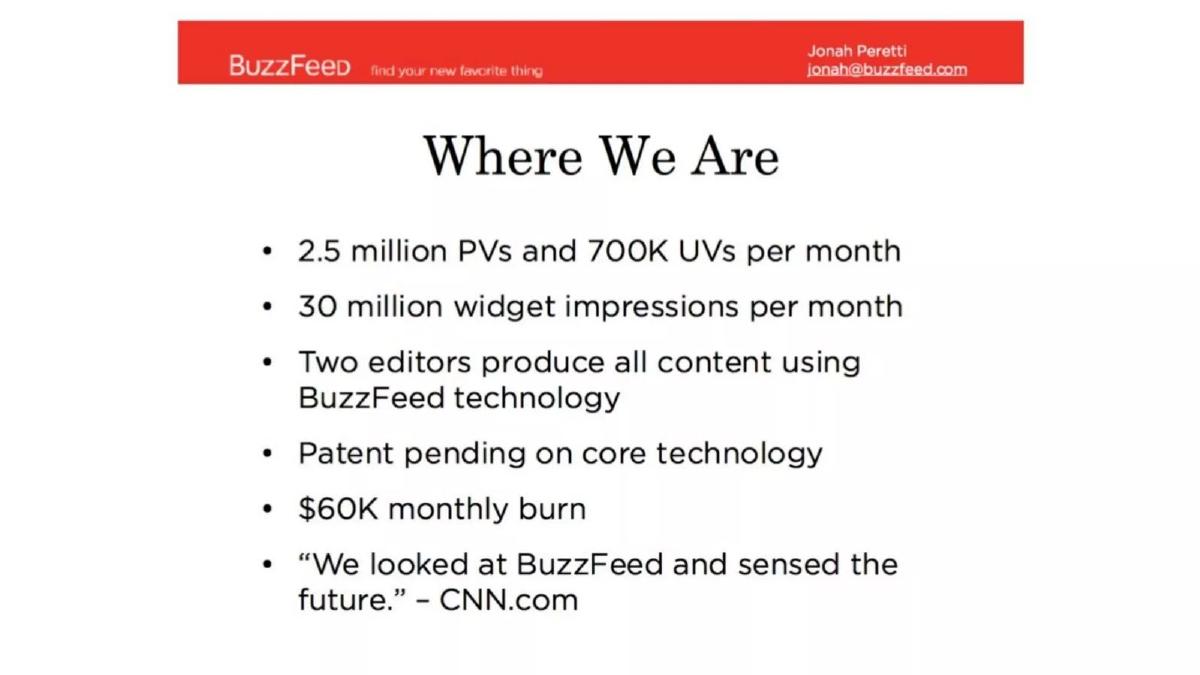
- The company reported 2.5 million page views and 700K unique visitors per month at the time of the raise (Slide 2).
- BuzzFeed operated with a lean team of only two editors, relying on internal technology to scale content production (Slide 2).
- The deck highlights a patent-pending status on its core technology for detecting web trends (Slide 2).
- A monthly burn rate of $60K was explicitly stated, showcasing capital efficiency (Slide 2).
- The revenue model focused on 'Advertising as Content,' moving away from standard display units toward native integration (Slide 12).
- The deck defines the competitive landscape as an intersection between Media (Reddit, Digg) and Advertising (BuzzMetrics, Viral Agencies) (Slide 18).
- The 'Web App' slides reveal a sophisticated internal dashboard for measuring viral effects and 'contagiousness' (Slide 10).
- The team slide lists high-pedigree backgrounds including Gawker Media, The Washington Post, and MTV (Slide 20).
Introduction: The Tech-First Media Play
The 2008 BuzzFeed pitch deck is a significant artifact in digital media history. At a time when traditional publishing was struggling to adapt to the social web, Jonah Peretti pitched a model that treated 'virality' as a data science problem rather than a purely creative one. This teardown examines the 21-slide deck used to raise a $3.5M Series A.
Slides 1-3: The Current State and Vision
Slide 1 is a minimalist title slide featuring the classic red BuzzFeed logo and the tagline, "What’s Buzzing on the Web?" It establishes the brand identity immediately.
Slide 2 , titled "Where We Are," is the most important slide for establishing credibility. It lists hard metrics: 2.5 million page views (PVs) and 700K unique visitors (UVs) per month. Most notably, it mentions that only "Two editors produce all content using BuzzFeed technology." This is a critical point for investors; it suggests a high-margin, scalable business model that isn't dependent on a massive, expensive newsroom. The slide also notes a $60K monthly burn and a patent-pending status on their core technology, providing a defensive moat. A quote from CNN.com—"We looked at BuzzFeed and sensed the future"—serves as powerful third-party validation.
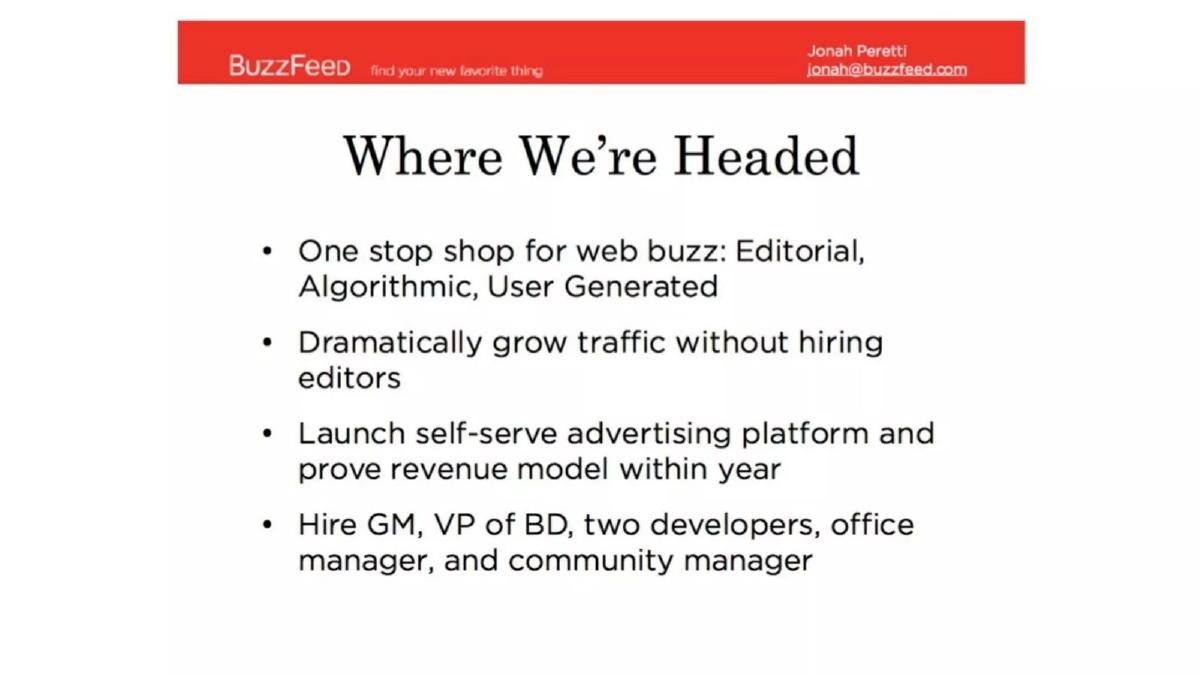
Slide 3 , "Where We’re Headed," outlines the roadmap for 'BuzzFeed 2.0.' The goals are clear: become a one-stop shop for web buzz through editorial, algorithmic, and user-generated content (UGC). The intent to "dramatically grow traffic without hiring editors" reinforces the scalability of the tech. The slide also mentions the launch of a self-serve advertising platform and specific hiring needs, including a GM, VP of BD, and developers.
Slides 4-8: The Content Engine
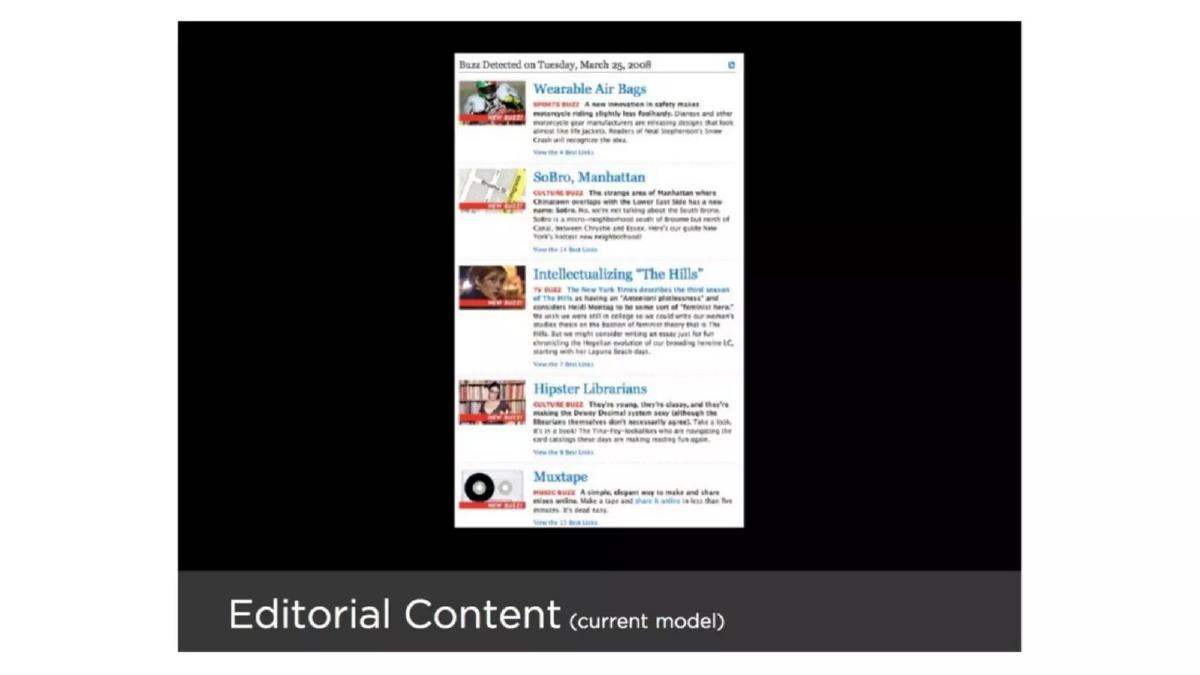
Slide 4 shows the "Editorial Content (current model)." It is a screenshot of the site featuring early stories like "Wearable Air Bags" and "Hipster Librarians." This represents the human-curated element of the site.
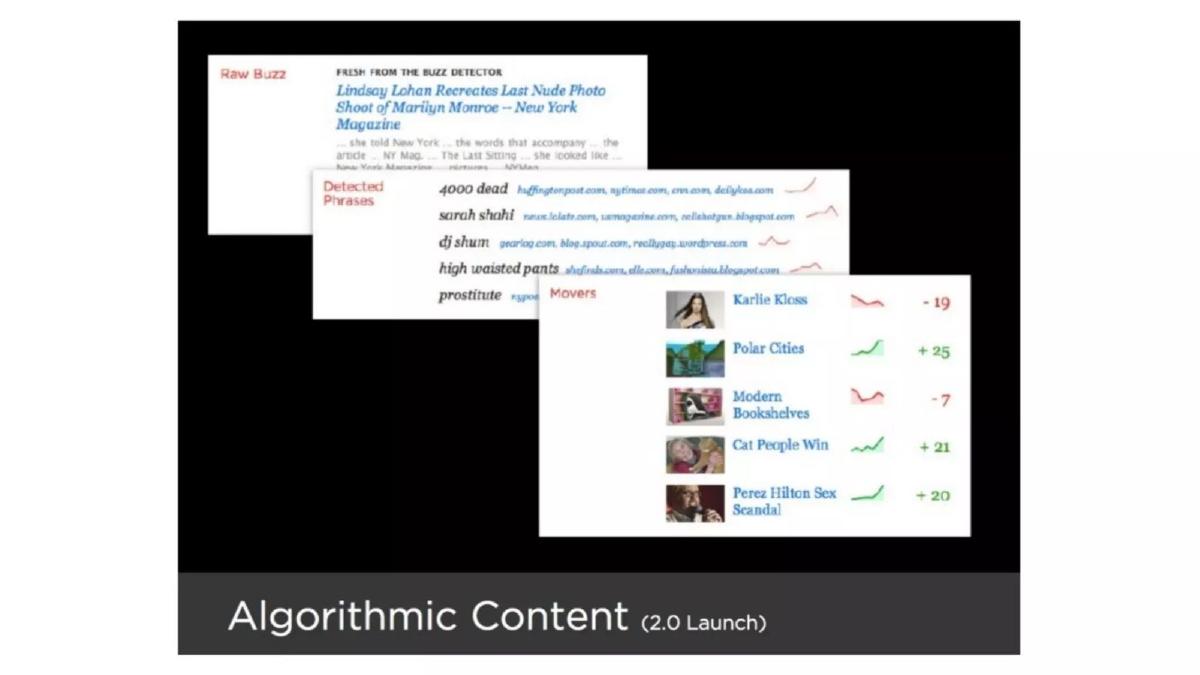
Slide 5 introduces "Algorithmic Content (2.0 Launch)." It displays the "Buzz Detector," which identifies phrases like "4000 dead" or "high waisted pants" that are trending across the web. This slide visualizes the 'tech' part of the media company, showing how they identify what to write about before it peaks.
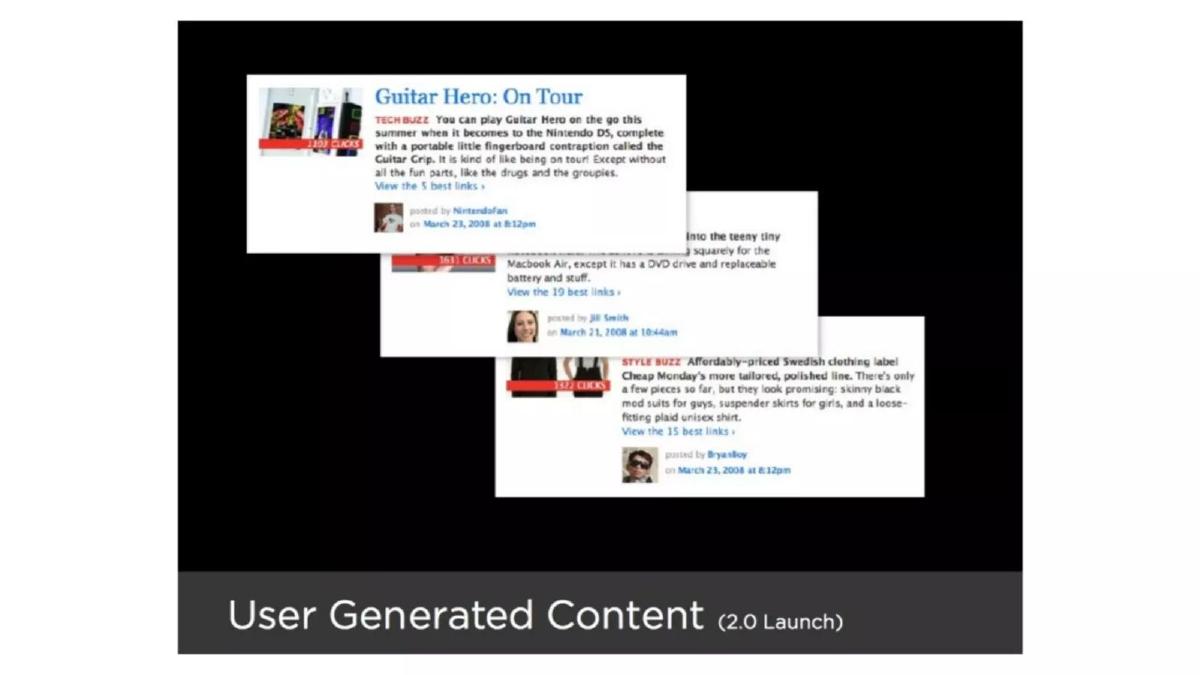
Slide 6 focuses on "User Generated Content (2.0 Launch)." It shows community members like 'NintendoFan' and 'Jill Smith' contributing links and commentary. This indicates a move toward a platform model where the audience provides the labor.
Slide 7 and Slide 8 show the "New Front Page" and "The Platform for Web Buzz." These slides demonstrate how the three content types (Editorial, Algorithmic, UGC) merge into a single interface. Slide 8 specifically highlights different content formats: Aggregation, Video Buzz, Links, and New Buzz Words.
Slides 9-11: The 'Web App' and Optimization
Slide 9 and Slide 10 are technical deep dives into "The Web App." These screenshots show the internal tools BuzzFeed built to manage the site. Slide 10 is particularly impressive, pointing out features like "Measure Viral Effects," "Landing Page Performance Metrics," and "Search Engine & Referrer Optimization." It frames BuzzFeed not as a blog, but as a sophisticated optimization engine designed to capture and hold attention.
Slide 11 shows the "Leaderboard," which gamifies content discovery. It lists "Top Buzz Spotters" with metrics like "Average Click Rate" and "Average Viral." This slide proves that BuzzFeed was already thinking about the social mechanics that would later define the Facebook era of the web.
Slides 12-17: The Revenue Model
Slide 12 introduces the "Revenue Model." The strategy is two-pronged: a free open platform for users and "Premium services for paying clients." The core of their monetization is "Advertising as Content."
Slide 13 and Slide 14 contrast traditional ads with BuzzFeed’s approach. Slide 13 shows Google and YouTube’s sponsored content, while Slide 14 shows "Advertising as Content on BuzzFeed." The visual argument is that BuzzFeed ads look and feel like the organic content, reducing 'banner blindness.'
Slide 15 , "Distributed Promotion," shows how BuzzFeed content (and ads) can live on other sites via widgets. It includes a "Widget Optimizer Controls" screenshot, showing that their ad tech is as data-driven as their content tech.
Slide 16 and Slide 17 provide examples of "Custom Promotion" and "Trend Targeting." Slide 16 shows a microsite for the movie Cloverfield , while Slide 17 shows a Ticketmaster "Paid Direct Action Link" placed next to a trending story about Miley Cyrus. This demonstrates the practical application of their 'buzz detection' for advertisers.
Slides 18-21: Competition, Scale, and Team
Slide 18 uses a Venn diagram to position BuzzFeed at the intersection of "Media" and "Advertising." By listing competitors like Reddit and Digg on one side and viral agencies on the other, BuzzFeed claims a unique space in the middle. The text states: "BuzzFeed is a tech company that takes the best from media and advertising."
Slide 19 asks, "How Big Can This Get?" The answers are ambitious: a global technology platform, the most advanced social-media-aware system for publishing, and the "YouTube/Wikipedia for Buzz and Viral Media." It frames the opportunity as a fundamental shift in how brands grow word-of-mouth.
Slide 20 presents "The Team." It is a high-signal slide. Jonah Peretti (Founder/CEO) is joined by co-founders Kenneth Lerer and John S. Johnson. The staff includes veterans from Gawker Media, The Washington Post, NYU, and MTV. This mix of high-level tech and media experience was likely a major selling point for Hearst Ventures.
Slide 21 is a simple contact slide with Jonah Peretti’s email and the company URL.
What Works in This Deck
The Efficiency Narrative: The claim that two editors could drive 2.5 million PVs is a powerful hook. It promises the margins of a software company with the cultural impact of a media company. · Internal Tooling: Showing the "Web App" and "Widget Optimizer" (Slides 9-10) proves that the 'technology' isn't just a buzzword. It shows the investors the actual engine behind the growth. · Native Advertising: In 2008, the concept of 'Ads as Content' was relatively new. The deck does an excellent job of explaining why this is superior to standard banner ads (Slides 13-14). · Social Proof: The CNN quote on Slide 2 and the high-pedigree team on Slide 20 provide the necessary trust to back an early-stage venture.
What Is Missing
The Financial Ask: There is no slide stating how much money they are raising, at what valuation, or what the specific milestones for this round are. While the catalogue facts state $3.5M, the deck itself is silent on the 'Ask.' · Unit Economics: While the burn rate is mentioned ($60K), there is no detail on the Cost Per Acquisition (CPA) for users or the Lifetime Value (LTV) of a visitor. · Exit Strategy: There is no mention of potential acquirers or an IPO path, though the 'How Big Can This Get?' slide hints at a massive outcome. · Detailed Financial Projections: The deck lacks a three-to-five-year revenue forecast, which is common in Series A decks to show the path to profitability.
What a Founder Should Copy
Positioning as a Platform: If you are in a service-heavy industry, follow BuzzFeed’s lead and emphasize the technology that automates or scales your output. · Visualizing the Backend: Don't just show the customer-facing product. Show the internal dashboards and tools that give you a competitive advantage. · The 'Current vs. Future' Framework: Slides 2 and 3 clearly define the transition from a proven concept to a scalable platform. This helps investors see both the traction and the vision. · Venn Diagram Competition: Using a Venn diagram (Slide 18) to show how you sit at the intersection of two large industries is a classic and effective way to define a new category.
Frequently asked questions
- How much did BuzzFeed raise with this deck?
- According to the catalogue facts, BuzzFeed raised $3.5M in a Series A round in 2008. The lead investor for this round was Hearst Ventures. This capital was intended to help the company transition from a purely editorial model to a '2.0' platform that integrated algorithmic and user-generated content.
- What was BuzzFeed's primary value proposition to investors?
- BuzzFeed positioned itself as a 'one stop shop for web buzz.' Unlike traditional media companies that required massive editorial teams, BuzzFeed claimed it could 'dramatically grow traffic without hiring editors' by using technology to detect and amplify viral trends (Slide 3).
- How did BuzzFeed plan to make money in 2008?
- The revenue model was built on 'Premium services for paying clients,' specifically 'Advertising as Content.' This included distributed promotion via widgets, custom-skinned microsites, and 'Trend Targeting,' which allowed brands to place ads next to content that was currently trending (Slide 12, 17).
- Who were BuzzFeed's main competitors at the time?
- Slide 18 identifies two groups of competitors. In Media, they listed Mahalo, Squidoo, Wikipedia, Reddit, Digg, and Y! Buzz. In Advertising, they listed Viral Agencies, BuzzMetrics, BuzzLogic, and social media ad platforms like FB's Beacon. BuzzFeed aimed to sit in the center of these two circles.
- What metrics did the deck use to prove traction?
- The deck cited 2.5 million monthly page views, 700K unique visitors, and 30 million widget impressions (Slide 2). It also showcased internal 'Leaderboard' stats, showing top 'Buzz Spotters' like Peggy Wang with over 853 million total views (Slide 11).