Bytez uses a concise 10-slide Demo Day deck to address the explosion of data and machine learning research. The company positions itself as a 'Leaderboard for the Deep Learning Race,' providing practitioner metrics like training cost and inference speed that are often missing from academic papers. By highlighting that ML research grew from 7 papers a week in 2009 to thousands per week by 2020, Bytez makes a case for a centralized, ready-to-use model repository. While the deck excels at illustrating the 'why now' through macro trends, it lacks specific details on its own business model, curren…
Key takeaways
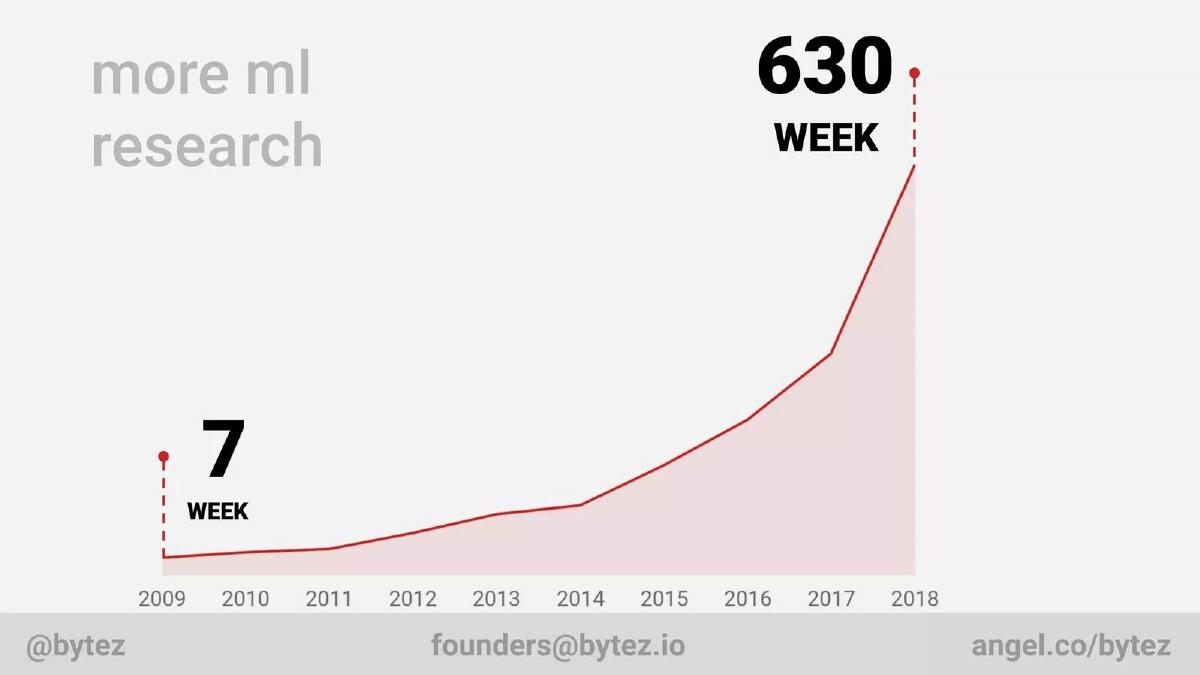
- The deck identifies a massive surge in ML research, citing a jump from 7 papers per week in 2009 to 630 per week in 2018 (Slide 5).
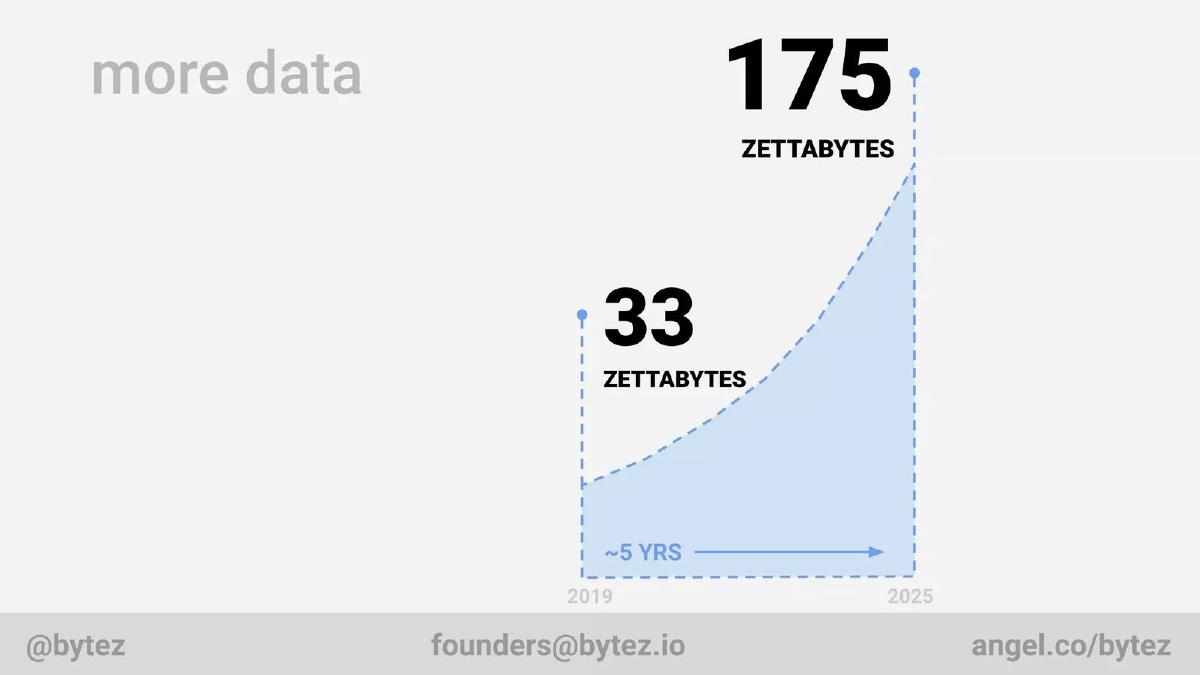
- Bytez projects that global data will grow from 33 zettabytes in 2019 to 175 zettabytes by 2025 (Slide 3).
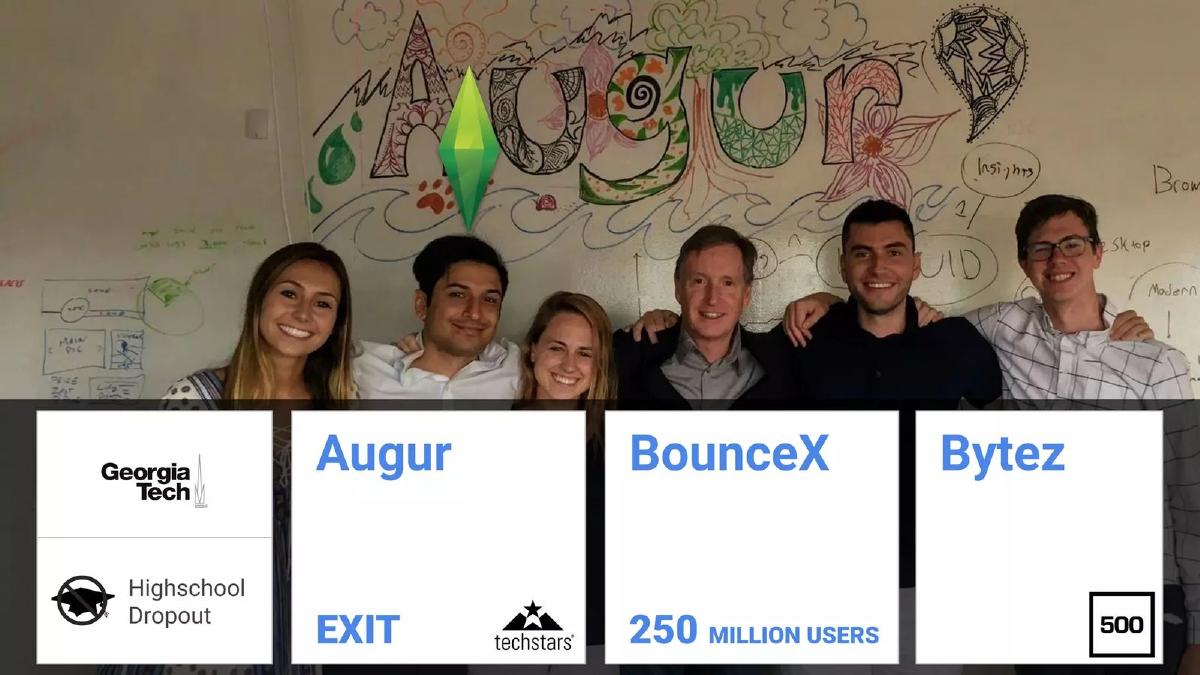
- The team slide highlights prior experience with Augur (Exit/Techstars) and BounceX (250 million users), alongside a 500 Startups affiliation (Slide 2).
- A core value proposition is providing 'Practitioner Metrics' such as training cost ($245,000 for XLNet vs $7 for ULMFiT) and inference speed (Slide 7).
- The product aims to make data scientists '100% faster,' potentially saving up to 2080 hours annually (Slide 9).
- Bytez claims to save SMBs up to $250k annually per data scientist by providing ranked, ready-to-use models (Slide 9).
- The deck completely omits a financial 'Ask' slide, specific revenue figures, and a detailed go-to-market strategy.
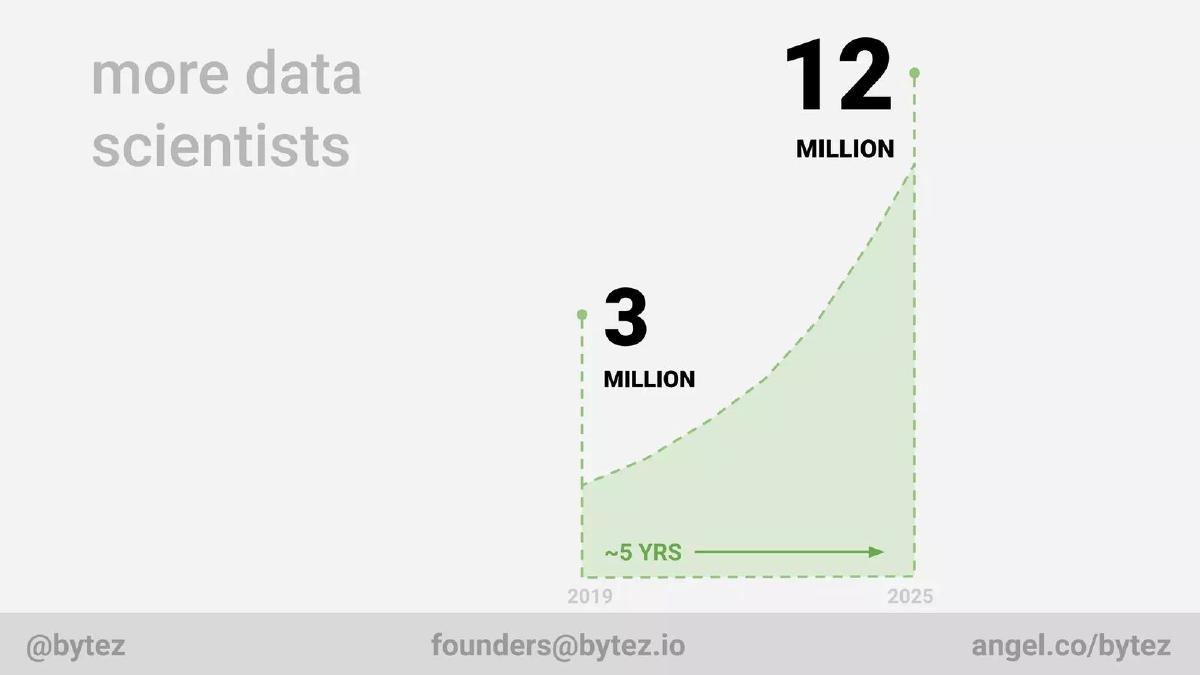
- Market demand is supported by the projected growth of data scientists from 3 million in 2019 to 12 million by 2025 (Slide 4).
Bytez Pitch Deck Analysis
The Bytez pitch deck, presented for 500 Startups Batch 25, is a masterclass in Demo Day brevity. With only 10 slides, the presentation focuses heavily on the macro trends of the Machine Learning (ML) industry and the specific pain points of data science practitioners. It positions the company as a necessary filter for an increasingly noisy research environment.
Slide 1: Title Slide
The deck opens with a minimalist black background featuring the Bytez logo in white. The subtitle, "Industry Benchmark for Deep Learning," immediately establishes the company's category. Contact information is provided via an email address (founders@bytez.io) and a Twitter handle (@bytez). This slide sets a professional, technical tone without unnecessary visual clutter.
Slide 2: Team and Pedigree
Slide 2 uses a group photo of six people in front of a whiteboard. Rather than listing individual titles, the slide uses four boxes to highlight the team's collective pedigree. It mentions Georgia Tech and a "Highschool Dropout" narrative, likely to appeal to the 'hacker' archetype. The most significant data points here are the logos for Augur (marked with "EXIT" and "techstars") and BounceX (noting "250 MILLION USERS"). The 500 Startups logo is placed in the bottom right, confirming their accelerator batch. This slide aims to prove the team has built and exited companies before, reducing perceived execution risk.
Slide 3: The Data Explosion
Slide 3 begins the 'Problem' section by focusing on the sheer volume of data. It features a blue area chart showing a growth curve. The slide quotes 33 ZETTABYTES in 2019, projected to reach 175 ZETTABYTES by 2025. The text "more data" is positioned in the top left. This slide establishes the foundational need for deep learning: there is too much data for traditional processing methods.
Slide 4: The Talent Gap
Continuing the trend analysis, Slide 4 focuses on the human element. It shows a green growth curve representing the number of data scientists. The figures quoted are 3 MILLION in 2019, growing to 12 MILLION by 2025. The header "more data scientists" suggests that while the workforce is growing, the demand for tools to make them efficient is growing even faster. This slide serves to define the Total Addressable Market (TAM) in terms of users.
Slide 5: Research Overload (Part 1)
Slide 5 introduces the specific friction point Bytez intends to solve: the volume of ML research. A red line graph shows that in 2009, there were only 7 papers per WEEK published. By 2018, that number climbed to 630 per WEEK . The header "more ml research" highlights the impossibility of a human staying current with every new development in the field.
Slide 6: Research Overload (Part 2)
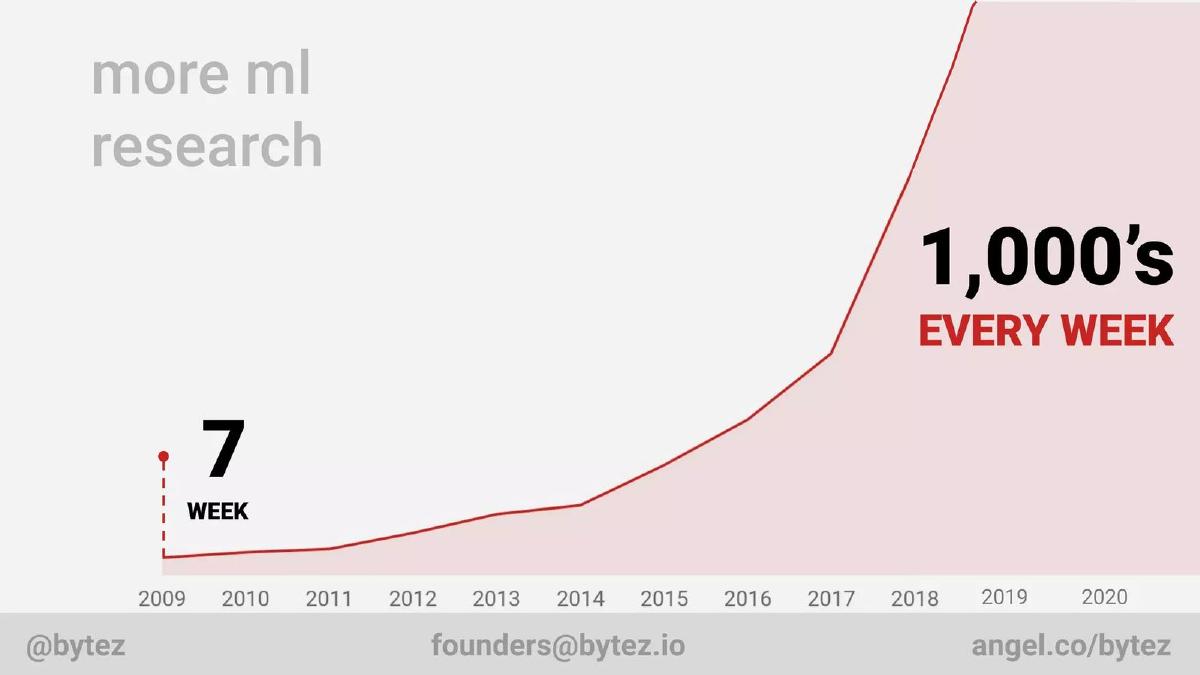
Slide 6 is a visual escalation of Slide 5. The red growth curve shoots off the top of the chart, with the text 1,000's EVERY WEEK appearing for the 2019-2020 period. This slide emphasizes the "Why Now?" factor. The explosion of research means that finding the most efficient model is no longer a simple task; it requires a dedicated platform for discovery and benchmarking.
Slide 7: The Solution - The Leaderboard
Slide 7 introduces the product: the "Leaderboard for the Deep Learning Race." This is the most information-dense slide in the deck. It shows a table comparing two models: Google's XLNet and Fast.ai's ULMFiT . The table includes standard metrics like Error (3.8% vs 4.6%) and Training time to 95% (54 hours vs 5 hours) . However, the slide highlights "Practitioner Metrics" in a call-out box, which include Training cost ($245,000 vs $7) , Inference speed (100 ms vs 300 ms) , and Inference cost . It also shows icons for Code , Container , and Weights , implying that Bytez provides the actual assets needed to deploy these models.
Slide 8: Product Value Proposition
Slide 8 uses an abstract 3D graphic to represent a pipeline. It lists three key product pillars: Ready to use , Ranked models , and All shapes & sizes . The tagline at the bottom, "Valuable today, Invaluable tomorrow," suggests that as the complexity of ML grows, the necessity of a benchmarking platform like Bytez will only increase. This slide is more conceptual and serves to transition from the technical product to the business value.
Slide 9: Quantified Business Value
Slide 9 breaks down the ROI of using Bytez. It claims a data scientist becomes 100% faster , which saves up to 2080 hrs annually . It then segments this value for two customer types:
Startup: Can operate with 1/2 the data scientists . · SMB: Saves up to $250k annually per data scientist .
By attaching a dollar figure to the time saved, Bytez makes a compelling case for its pricing power and the economic necessity of its toolset.
Slide 10: Closing Slide
The final slide is a duplicate of the title slide, featuring the logo, the tagline "Industry Benchmark for Deep Learning," and contact information. This is standard for Demo Day decks to ensure the contact details remain on screen during the Q&A or transition to the next speaker.
What Works in the Bytez Deck
The deck is exceptionally strong at establishing market momentum . By using three distinct growth curves (data, talent, and research), the founders create a sense of inevitability. The transition from Slide 5 to Slide 6 is a particularly effective use of visual storytelling to show that the problem has reached a breaking point.
The Practitioner Metrics on Slide 7 are the highlight of the deck. Most AI companies focus on accuracy (Error rate), but Bytez realizes that for a business, the Training cost ($245,000) is often the deciding factor. By highlighting these hidden costs, they demonstrate a deep understanding of their target customer's actual daily struggles.
What is Missing from the Bytez Deck
As a Demo Day deck, it is intentionally light, but several critical components are absent for a full seed round evaluation: 1. Business Model: There is no mention of how Bytez makes money. Is it a SaaS subscription, a marketplace for models, or a consulting play? While Slide 9 mentions savings for SMBs, it doesn't explain the revenue capture mechanism. 2. Traction: The deck lacks current user numbers, pilot programs, or revenue. While the team's past success is noted, there is no proof that this specific product has found product-market fit yet. 3. Competition: The deck ignores existing model hubs like Hugging Face or academic benchmarks like Papers With Code. A slide explaining why Bytez's "Practitioner Metrics" are a better moat than existing repositories would have been valuable. 4. The Ask: There is no information regarding the funding round. Investors don't know how much the company is raising or what the milestones for the next 18 months look like.
Founder's Takeaway: What to Copy
Founders building in technical or crowded spaces should copy the "Why Now" visualization used in Slides 3 through 6. Instead of just saying "the market is growing," Bytez showed three intersecting trends that make their solution mandatory. Additionally, the quantified ROI on Slide 9 is an excellent way to turn a technical tool into a business necessity. If you can tell a CEO that your tool saves $250k per head, you are no longer a "nice to have" developer tool; you are a bottom-line optimizer.
Frequently asked questions
- What problem is Bytez solving in the deep learning space?
- Bytez addresses the 'Deep Learning Race' where the volume of research and data is overwhelming for practitioners. According to Slide 6, thousands of research papers are published every week. Bytez provides a leaderboard that ranks these models based on practical metrics like cost and speed, rather than just academic accuracy, helping teams choose the right model without wasting resources.
- Who are the founders and what is their background?
- Slide 2 introduces the team through logos and past achievements rather than individual bios. It mentions affiliations with Georgia Tech and a 'Highschool Dropout' status. More importantly, it lists experience with Augur (a Techstars company that exited), BounceX (which reached 250 million users), and their current participation in 500 Startups.
- What specific metrics does Bytez track for ML models?
- On Slide 7, Bytez showcases its 'Practitioner Metrics.' These include Error rate, Creator (e.g., Google, Fast.ai), Method, Training time to 95% accuracy, Training cost, Inference speed, and Inference cost. They also provide direct links to Code (Python), Containers (Docker), and model Weights, aiming to make models 'ready to use.'
- How does Bytez quantify its value proposition for businesses?
- Slide 9 breaks down the value by segment. For individual data scientists, it claims a 100% speed increase, saving 2080 hours a year. For startups, it suggests the ability to operate with half the data scientists. For SMBs, it estimates a savings of up to $250,000 annually per data scientist.
- Is there a clear investment ask in this deck?
- No. As is common with Demo Day decks, the final slide (Slide 10) is a repeat of the title slide with contact information. There is no mention of the amount being raised, the valuation, or the intended use of funds. This deck is designed to generate interest for a follow-up conversation.