Cabral Resources Limited’s August 2017 deck is a technical investor presentation designed to facilitate a re-listing on the Australian Securities Exchange (ASX) under the new identity of Bowen Coking Coal. The presentation is heavily asset-centric, detailing the acquisition of the Comet Ridge, Cooroorah, and Hillalong projects. With a projected market capitalization of $10.8 million and a cash position of $4.2 million upon re-listing, the deck relies on JORC resource data to validate its $0.023 per share valuation. While it effectively maps out geographical advantages and joint venture partne…
Key takeaways
- The company planned to change its ASX ticker from CBS to BCB upon re-listing (Slide 3).
- Post-listing market capitalization was targeted at $10.8 million with a share price of $0.023 (Slide 3).
- The total effective JORC resource base across three projects was stated as 187 million tonnes (Slide 3).
- Cabral exercised an option on April 30, 2017, to acquire 100% of the Comet Ridge Project from Acacia Coal Limited (Slide 7).
- The Cooroorah project contains a 2012 JORC resource of 125Mt, located approximately 330m deep (Slide 9).
- Joint ventures with Stanmore Coal include a 15% interest in Lilyvale and a 5% interest in Mackenzie (Slide 11).
- The Lilyvale project is contiguous to Rio Tinto’s Kestrel mine, with quality correlating to that site (Slide 11).
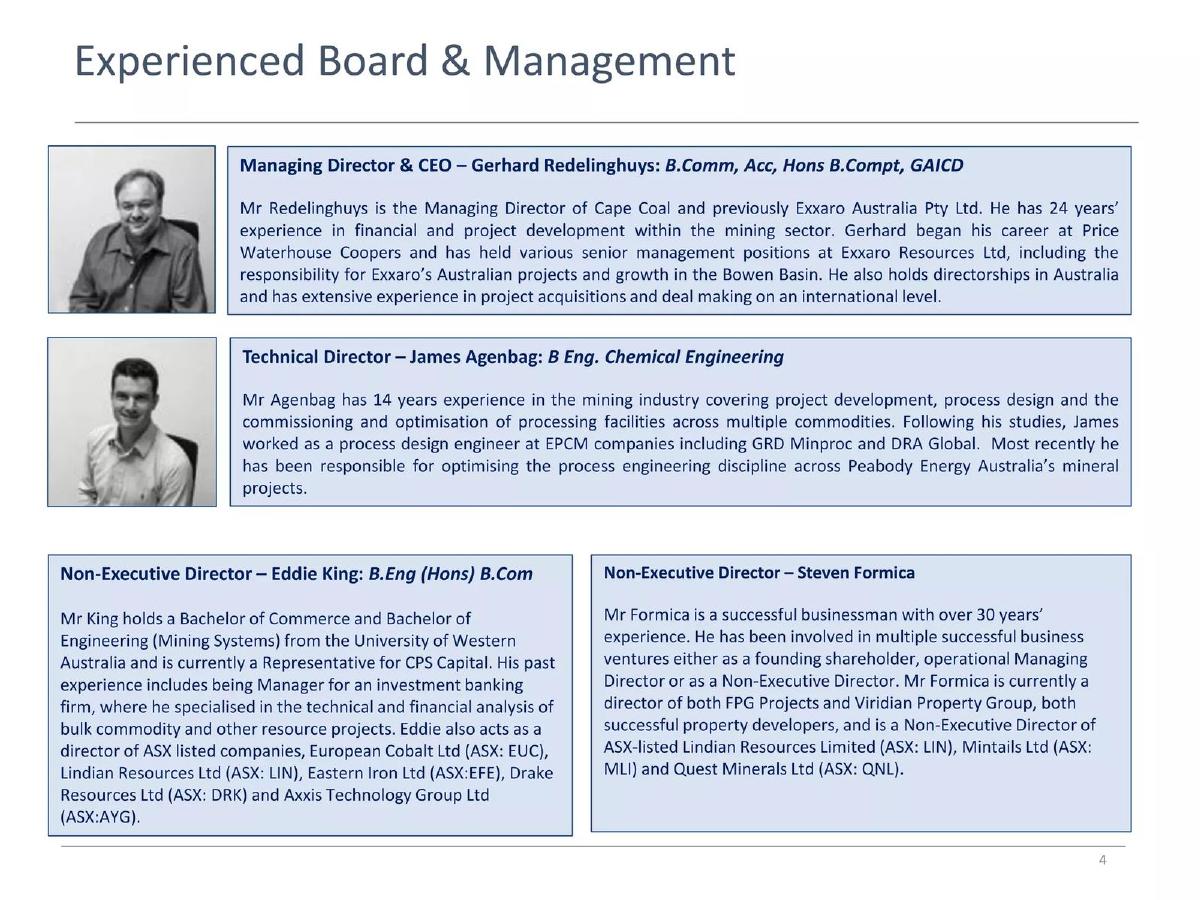
- The deck omits specific biographies for the 'Highly experienced Board and Management' mentioned on Slide 3.
Cabral Resources Limited: The Bowen Coking Coal Transition
The August 2017 investor presentation for Cabral Resources Limited represents a pivotal moment in the company's history. It serves as the formal introduction of the company's pivot toward coking coal and its rebranding as Bowen Coking Coal. Unlike a standard startup pitch deck seeking venture capital, this is a public markets document designed to satisfy regulatory transparency while drumming up interest for a re-listing on the Australian Securities Exchange (ASX).
Slide 1: Title Slide
The title slide establishes the date (August 2017) and the dual branding of Bowen Coking Coal and Cabral Resources Limited. The inclusion of the ASX ticker (ASX: CBS) immediately identifies this as a public company document. The background imagery of a large-scale bucket-wheel excavator signals the industrial nature of the business, though it is a generic sector image rather than a photo of a Cabral-owned asset.
Slide 3: Snapshot on Re-listing
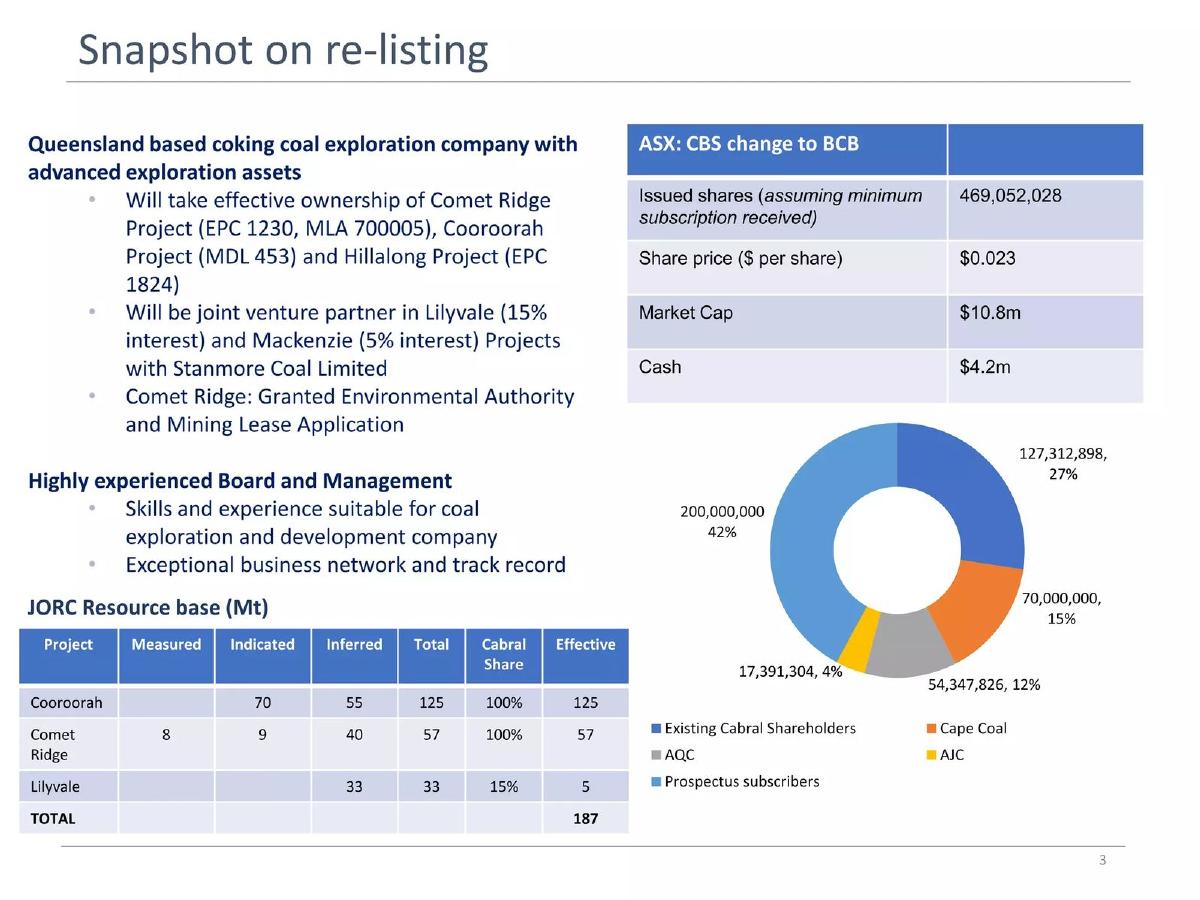
This is the most data-dense slide in the deck, providing the fundamental investment case. It defines the company as a "Queensland based coking coal exploration company with advanced exploration assets." The slide lists three primary acquisitions: Comet Ridge, Cooroorah, and Hillalong. It also notes joint venture interests in Lilyvale (15%) and Mackenzie (5%) with Stanmore Coal Limited.
The financial table is explicit: assuming a minimum subscription, the company will have 469,052,028 shares at $0.023 each, resulting in a $10.8 million market cap and $4.2 million in cash. A donut chart breaks down the shareholding: 42% for prospectus subscribers, 27% for existing Cabral shareholders, 15% for Cape Coal, 12% for AQC, and 4% for AJC. Crucially, a JORC Resource base table claims a total effective resource of 187 million tonnes (Mt), with 125Mt coming from Cooroorah and 57Mt from Comet Ridge.
Slide 5: Vision and Strategy
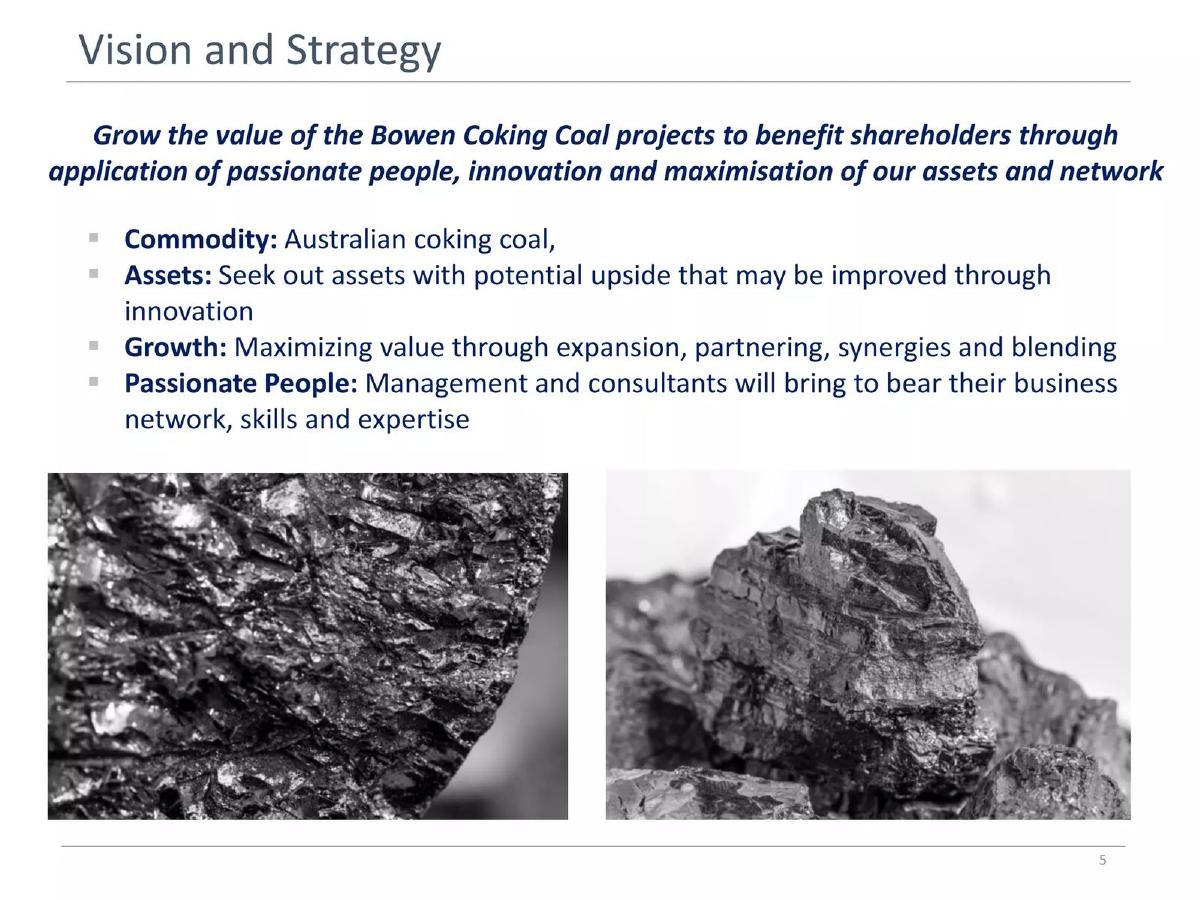
This slide outlines the corporate mission: "Grow the value of the Bowen Coking Coal projects to benefit shareholders." The strategy is broken down into four pillars: Commodity (Australian coking coal), Assets (seeking upside through innovation), Growth (expansion and blending), and Passionate People. The text is high-level and lacks specific operational KPIs, serving more as a philosophical framework for the new entity.
Slide 7: Coking Coal Projects Map
Geography is vital in mining, and Slide 7 provides a regional map of the Bowen Basin. It highlights the proximity of the company's tenements to Mackay and Emerald. The slide notes that the option to acquire 100% of Comet Ridge from Acacia Coal Limited was exercised on April 30, 2017. It also mentions a binding option to acquire Cooroorah and Hillalong from Australian Pacific Coal Limited (ASX: AQC). The map visualizes the tenement locations (EPC 1824, MDL 453, EPC 1230) relative to existing infrastructure, which is a key de-risking factor for investors.
Slide 9: Cooroorah (MDL 453) Detail
This slide focuses on the flagship asset. It describes Cooroorah as an "advanced project" situated down-dip from the Curragh Mine. Technical details include a 2012 JORC estimate of 125Mt (70Mt Indicated, 55Mt Inferred) at a depth of approximately 330 meters. The slide highlights washability tests that suggest potential for low ash PCI (Pulverized Coal Injection) and hard coking coal. The "Upside" section mentions further drilling to investigate shallower areas, suggesting the potential for lower-cost extraction in the future.
Slide 11: JVs with Stanmore Coal
The presentation details the minority interests that provide additional exposure without the full burden of operatorship. The Lilyvale (15%) project is described as having a 33M tonne Inferred JORC estimate and being contiguous to Rio Tinto’s Kestrel mine. The Mackenzie (5%) project is noted for its "open cut/trench highwall potential" and proximity to infrastructure. These partnerships with Stanmore Coal (a larger, established player) lend credibility to Cabral’s asset portfolio.
Slide 14: Conclusion
The final slide summarizes the pitch: attractive valuation, encouraging long-term fundamentals for Australian coking coal, and advanced projects with upside. It pairs these claims with two industrial photos—one of an underground mine tunnel and another of a processing plant at night—reinforcing the transition from an exploration shell to a resource developer.
What Works Well in This Deck
The deck is highly effective at communicating asset quality through standardized metrics . By using JORC resource estimates (Slide 3 and 9), the company speaks the language of institutional mining investors. The transparency regarding the share structure and the specific terms of the acquisitions (Slide 3 and 7) provides a clear picture of the company's capital stack and legal standing.
The geographical context provided on Slide 7 is also a strength. In the resources sector, proximity to existing mines (like Rio Tinto's Kestrel) and infrastructure is often more important than the raw size of the resource, as it dictates the feasibility of transport and processing. By explicitly naming these neighbors, Cabral positions itself as a player in a proven, high-value corridor.
What Is Missing From the Deck
The most glaring omission is the Team Slide . While Slide 3 claims a "Highly experienced Board and Management," there are no names or biographies provided in the seven slides reviewed. In a micro-cap re-listing, the track record of the directors is often the primary reason investors participate, as they are betting on the team's ability to navigate the permitting and development phases.
There is also a lack of a Use of Funds slide. While the deck mentions a $4.2 million cash position, it does not specify how much of that capital is earmarked for drilling at Cooroorah versus administrative costs or further acquisitions. Furthermore, there is no Timeline . Investors are left wondering when the first drill will hit the ground or when a Definitive Feasibility Study (DFS) might be expected.
What a Founder Should Copy
Founders in capital-intensive industries should emulate the clear tabular presentation of assets found on Slide 3. Breaking down resources by category (Measured, Indicated, Inferred) and then showing the "Effective" share based on ownership percentages is a masterclass in honest data presentation. It prevents the "headline number" from being misleading.
Additionally, the "Upside" bullet points on Slides 9 and 11 are a good way to frame future growth. Instead of just stating what the company has today, these sections tell the investor what the company could have if the next phase of exploration is successful. This creates a narrative of value creation beyond the initial re-listing price.
Final Analysis
Cabral Resources Limited’s presentation is a functional, technical document that successfully bridges the gap between a dormant shell company and a focused coking coal explorer. It relies heavily on the geological merits of the Bowen Basin and the credibility of the JORC reporting standard. While it lacks the personality and narrative flair of a modern tech pitch, it provides the specific data points—share count, cash, and tonnage—that public market investors require to assess a micro-cap mining play. The transition to Bowen Coking Coal is clearly defined, even if the specific individuals leading the charge remain unnamed in this portion of the deck.
Frequently asked questions
- What is the primary purpose of this pitch deck?
- The deck was created to support the re-listing of Cabral Resources Limited on the ASX in August 2017. It serves to inform potential and existing shareholders about the company's transition into a coking coal exploration entity, specifically highlighting new asset acquisitions in Queensland’s Bowen Basin and the resulting resource estimates.
- What are the key financial metrics presented for the re-listing?
- Slide 3 outlines the financial snapshot: 469,052,028 issued shares (assuming minimum subscription), a share price of $0.023, a market capitalization of $10.8 million, and a cash balance of $4.2 million. The ownership structure shows that 42% of shares would be held by prospectus subscribers.
- Which coal projects are central to the company's strategy?
- The strategy revolves around three core projects: Cooroorah (100% ownership), Comet Ridge (100% ownership), and Hillalong. Additionally, the company holds minority interests in joint ventures with Stanmore Coal at the Lilyvale (15%) and Mackenzie (5%) projects, all located within the Bowen Basin.
- How does the company justify its valuation?
- Valuation is justified through JORC (Joint Ore Reserves Committee) resource estimates. Slide 3 claims a total effective resource of 187 million tonnes. The deck also emphasizes 'expansion optionality' and proximity to established infrastructure and major mines, such as Rio Tinto’s Kestrel mine, to imply lower operational risk and higher upside.
- What information is missing from this presentation?
- The most notable omission is a dedicated team slide. While Slide 3 mentions a 'Highly experienced Board and Management,' it provides no names, photos, or specific career histories. Furthermore, the deck lacks a detailed use-of-funds breakdown for the $4.2 million in cash and does not provide a multi-year development timeline or production targets.