Cachet’s 14-slide deck for their 2022 strategic round is a masterclass in demonstrating product-market fit through specific regional dominance. The company tackles the 'unfair' risk assessment of gig workers by aggregating data across platforms like Uber, Bolt, and Yandex. The deck highlights a monthly top line of EUR 268K and a massive 40% market share in Estonia. While the deck is light on detailed financial projections and a specific dollar-amount 'ask' on the final slide, it compensates with strong traction metrics, including an NPS of 62 and a 5-month CAC payback period. The narrative fo…
Key takeaways
- Cachet achieved a 40% market share in the Estonia ride-hailing insurance market by 2021 (Slide 12).
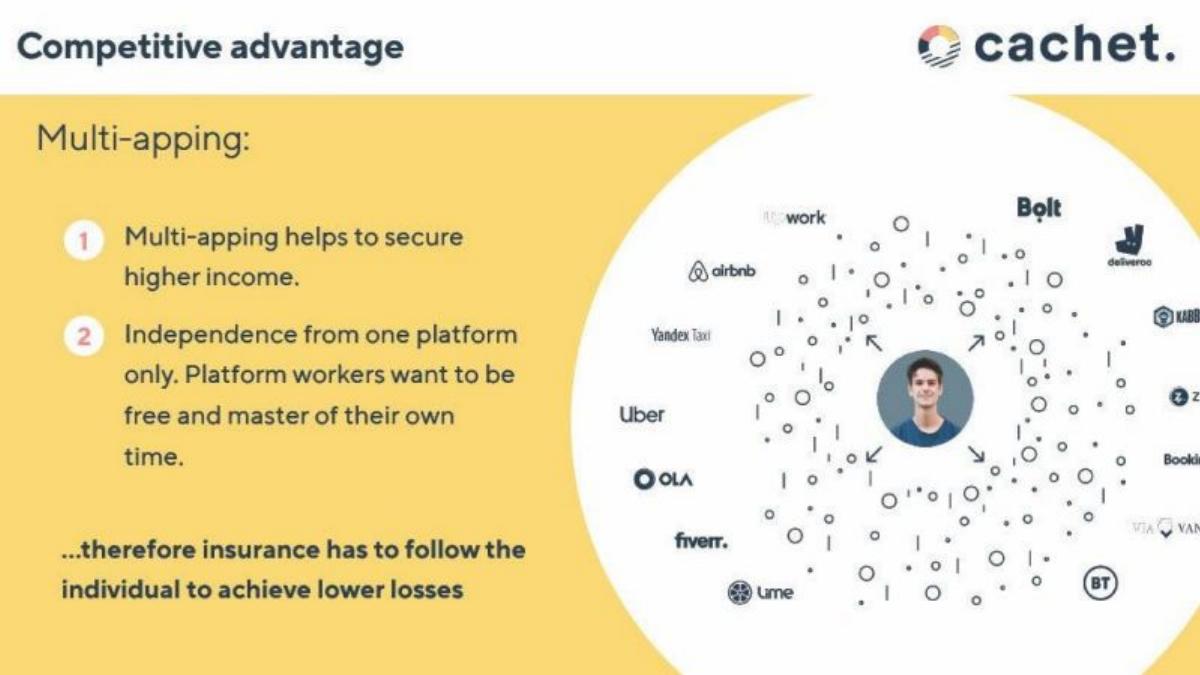
- The platform aggregates data from multiple gig apps to account for 'multi-apping' behavior, which traditional insurers often ignore (Slide 6).
- Financial traction is strong, with a reported monthly top line of EUR 268K and a CAC payback time of approximately 5 months (Slide 12).
- The company claims to offer insurance policies that are up to 50% cheaper for platform workers compared to traditional options (Slide 8).
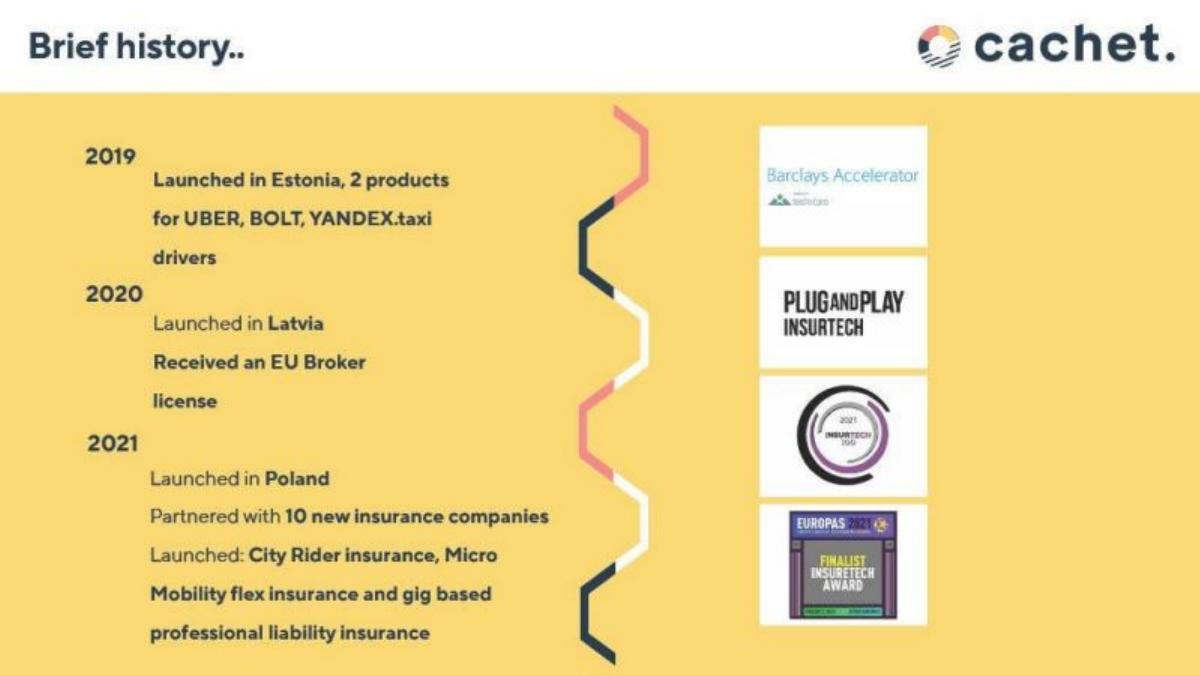
- Cachet holds an EU Broker license and has expanded operations into Latvia and Poland (Slide 3).
- The data bank includes 7 million trips, 30 million kilometers, and 1 million parking events (Slide 12).
- The leadership team includes a former Member of the Estonian Parliament and an ex-Uber Head of Public Policy (Slide 2).
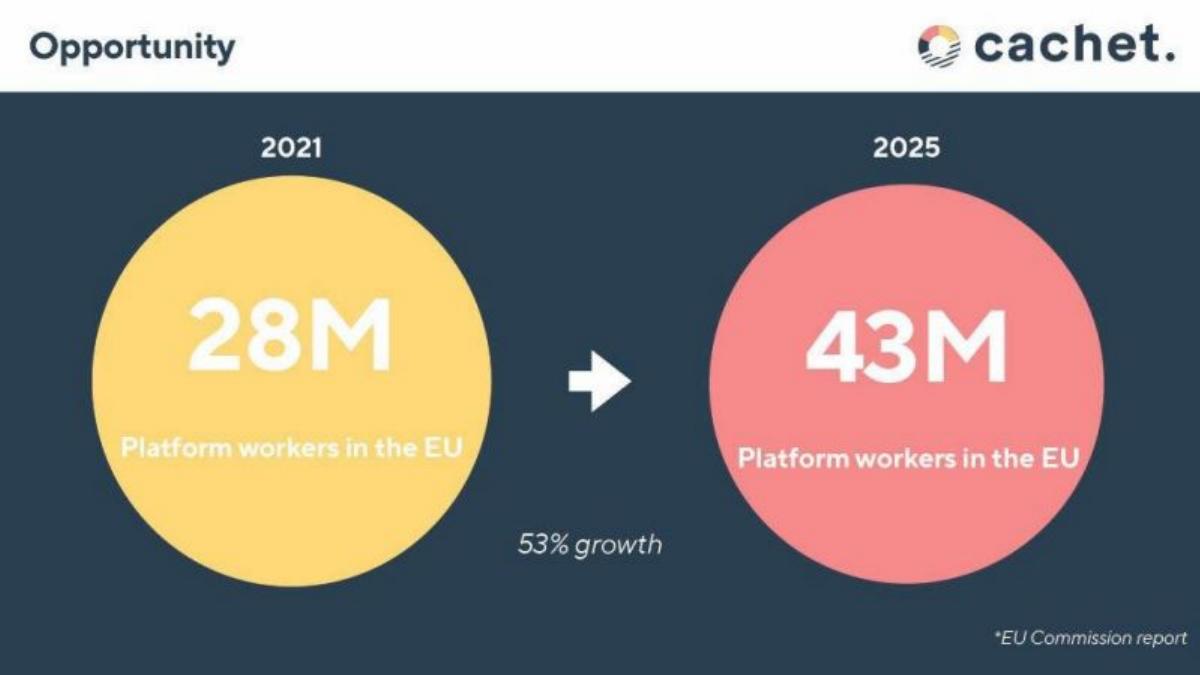
- The deck identifies a 53% projected growth in EU platform workers, reaching 43 million by 2025 (Slide 4).
The Hook: Enabling the Platform Economy Lifestyle
Slide 1: Title and Social Proof
Cachet opens with a clean title slide: "Enabling the platform economy lifestyle." Dated December 2021, the slide immediately establishes credibility by featuring logos from the Barclays Accelerator (powered by Techstars), Plug and Play Insurtech, and Sifted (backed by FT). It also notes their status as a finalist for the Europas 2021 Insurtech Award. This is a high-density social proof start that tells investors the company is already vetted by major accelerators and industry publications.
Slide 2: Leadership Team
Unusually, Cachet places the team slide second. This suggests the founders believe their personal backgrounds are a primary selling point. CEO Hedi Mardisoo brings 15 years of management experience, while COO Kalle Palling’s background is particularly strategic: 12 years as a Member of the Estonian Parliament and an architect of sharing economy regulation. Mateusz Litewski (GM, CEE) adds further weight as the former Head of Public Policy for Uber in CEE. The slide also lists advisors from the Bank of England, Google, and Barclays, emphasizing a deep bench of regulatory and tech expertise.
Slide 3: Brief History and Milestones
The timeline shows rapid geographic and product expansion. Starting in Estonia in 2019 with products for Uber, Bolt, and Yandex.taxi, they moved into Latvia and secured an EU Broker license in 2020. By 2021, they launched in Poland, partnered with 10 new insurance companies, and diversified into micro-mobility and professional liability insurance. This slide demonstrates execution speed and the ability to navigate complex licensing requirements across multiple jurisdictions.
The Market and the Problem
Slide 4: The Opportunity
Cachet quantifies the market using an EU Commission report. They show a jump from 28 million platform workers in the EU in 2021 to a projected 43 million in 2025—a 53% growth rate. By focusing on the number of workers rather than just a vague "Total Addressable Market" in dollars, they ground the opportunity in a tangible, growing demographic.
Slide 5: The Problem Statement
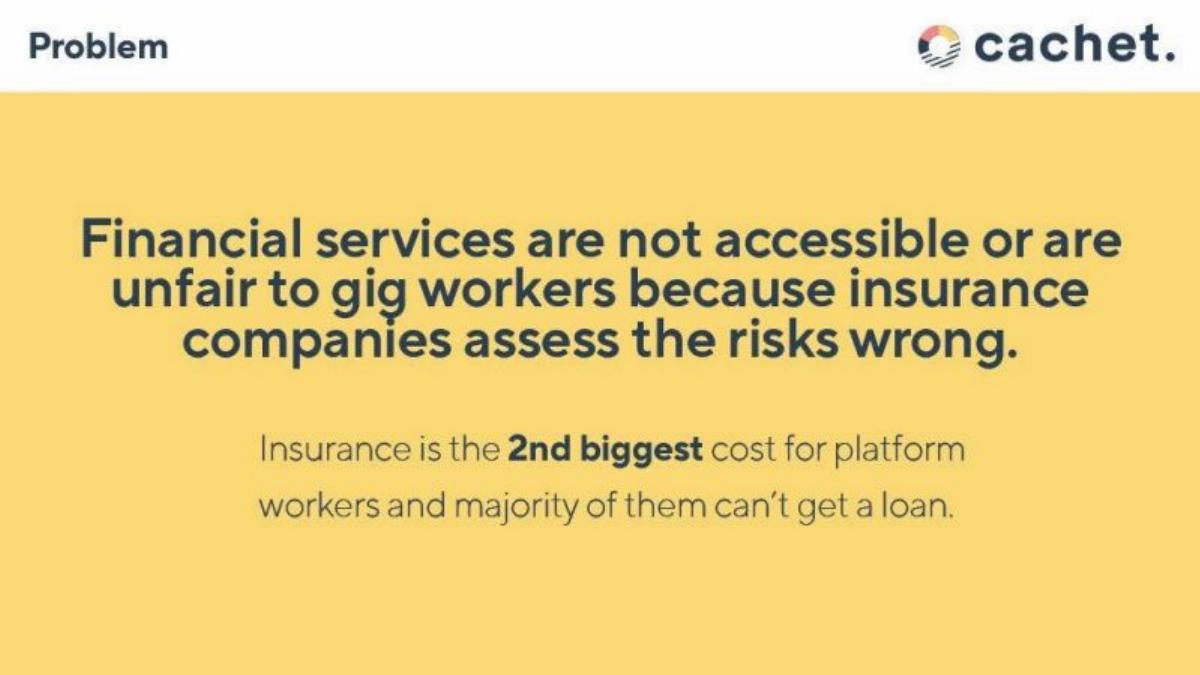
The problem is framed as a lack of accessibility and fairness. The slide states: "Financial services are not accessible or are unfair to gig workers because insurance companies assess the risks wrong." It highlights that insurance is the second biggest cost for platform workers and that the majority cannot even secure a loan. This sets up the need for a more granular, data-driven approach to risk.
Slide 6: Competitive Advantage - Multi-apping
This is the most critical slide for understanding Cachet’s moat. It explains "Multi-apping"—the practice of workers using multiple apps (Uber, Bolt, Deliveroo, etc.) simultaneously. Traditional insurance follows the platform; Cachet follows the individual. By aggregating data across all apps, they can achieve "lower losses" because they see the worker's total activity, not just a fragmented slice.
The Product and Value Proposition
Slide 7: Data Aggregation Interface
This slide shows the mobile interface, illustrating how they bring together data to offer flexible, personalized insurance. The screenshots show metrics like "Driving time" (7h 01m), habits, and safety scores. It visualizes the abstract concept of "data-driven insurance" into a concrete user experience.
Slide 8: The Win-Win-Win Value
Platform Workers: Up to 50% cheaper insurance policy prices. · Insurance Companies: Lower loss ratios. For a 10M GWP (Gross Written Premium), a 1% lower loss ratio equals 100KEUR more profit. · Gig Platforms: Lower insurance prices mean more cash in workers' hands and higher motivation, leading to fewer bonuses the platform needs to pay out.
This slide effectively argues that Cachet isn't just a tool for drivers, but a necessary piece of infrastructure for the entire ecosystem.
Slide 9: Product Ecosystem
The ecosystem is broader than just ride-hailing. It includes:
Flexible motor insurance for ride-hailing. · City rider insurance for couriers. · Professional liability for car washers (UpSteam). · SaaS solutions for parking, fleet management, and vehicle booking for car sharing.
This demonstrates that their data-scoring engine is horizontal and can be applied to various niches within the platform economy.
Slides 10 & 11: User Journey
These two slides walk through the mobile onboarding process. It’s a standard but necessary inclusion to show the friction-less nature of the product. Users select their region, choose a policy type (e.g., Ride-hailing Traffic Insurance), input their license number, and estimate their weekly hours. The app then provides quotes from providers like BTA, IF, and ERGO. The journey ends with a "Policy successfully purchased" screen and a dashboard to track hours.
Traction and Fundraising
Slide 12: Traction Today
This is the "money slide." It is packed with impressive figures:
Monthly Top Line: EUR 268K. · Market Share: 40% in Estonia. · Customer Satisfaction: NPS of 62, CSAT of ~90%. · Efficiency: CAC payback time of ~5 months. · Data Bank: 7M trips, 30M km, 1M parking events. · Expansion: ~700 customers in Poland and live pilots in 6 countries (indicated by flags).
The inclusion of the CAC payback time is a sophisticated touch that appeals to unit-economic-focused investors.
Slide 13: Fundraising
The final content slide lists previous investors and the current "New round" status. They name Icebreaker, Lemonade Stand, Barclays, and Techstars as existing backers. They also highlight high-profile angels like Chris Adelsbach (UKBAA Angel Investor of the Year). The slide specifies they are looking for investors who are "excited about decentralised and human centric approaches" and have "experience in scaling insurtech." Notably, it does not state the amount they are raising or the valuation.
Slide 14: Closing
The final slide is a standard promotional slide for the platform where the deck was hosted, offering no further company information.
What Cachet Does Well
Regulatory Moat: By highlighting their EU Broker license and the COO’s background in regulation, Cachet signals that they have cleared the highest barrier to entry in the insurance space. Most tech startups fail here; Cachet shows they are already inside the tent.
Specific Dominance: Claiming a 40% market share in Estonia (Slide 12) is far more powerful than claiming a 0.01% share of the global market. It proves the model works at scale in at least one geography, making the expansion story to Poland and Latvia much more credible.
Unit Economics: Including a 5-month CAC payback period is a strong signal of a healthy, scalable business. It moves the conversation from "we have a cool app" to "we have an efficient machine for acquiring profitable customers."
What is Missing
Financial Projections: While the current revenue (EUR 268K monthly) is clear, there are no forward-looking projections. Investors want to see how that 268K becomes 2.6M. Without a 3-5 year forecast, the scale of the ambition is left to the imagination.
The Ask: The deck mentions a "New round" but omits the dollar amount. While some founders do this to maintain flexibility in negotiations, it can sometimes make the round feel less urgent or poorly defined.
Loss Ratio Data: Slide 8 mentions that a 1% lower loss ratio increases profit, but the deck doesn't provide Cachet's actual loss ratio compared to the industry average. Since their value prop is "better risk assessment," this data point would have been the ultimate proof of their algorithm's efficacy.
What Other Founders Should Copy
The "Multi-Apping" Visual: Slide 6 is a perfect example of how to visualize a complex market behavior. It clearly shows the worker at the center of a web of apps, immediately explaining why traditional, platform-centric insurance is obsolete.
The Stakeholder Map: Slide 8 (Win-Win-Win) is an excellent way to show that your startup isn't just a "disruptor" that hurts incumbents, but a partner that adds value to everyone in the value chain. This is particularly important in highly regulated, partner-dependent industries like insurance.
Social Proof Placement: Don't wait until the end to show your credentials. Cachet puts their accelerator logos on Slide 1 and their heavy-hitter team on Slide 2. This ensures that every subsequent slide is read through a lens of "these people know what they are doing."
Frequently asked questions
- What is Cachet's core business model?
- Cachet acts as a data-driven insurance broker for the gig economy. They aggregate work data from various platforms (Uber, Bolt, etc.) to create a 'Cachet Risk Score.' This allows them to provide flexible, personalized insurance policies that are often significantly cheaper than traditional flat-rate commercial insurance, which assumes a worker is on the clock 24/7.
- How does Cachet differentiate itself from traditional insurance brokers?
- The primary differentiator is their ability to handle 'multi-apping.' Slide 6 explains that gig workers use multiple platforms to maximize income. Cachet follows the individual across these platforms to assess risk accurately, whereas traditional insurers struggle to see the full picture, leading to 'unfair' risk assessments and higher premiums.
- What are the key traction metrics mentioned in the deck?
- As of late 2021/early 2022, Cachet reported a monthly top line of EUR 268K, an NPS of 62, and a CSAT of ~90%. They have a 40% market share in Estonia and ~700 customers in Poland. Their data bank is substantial, containing records for 7 million trips and 30 million kilometers driven.
- Who is on the leadership team?
- The team is led by Co-Founder/CEO Hedi Mardisoo (15 years management experience) and Co-Founder/COO Kalle Palling (12 years in the Estonian Parliament). They are supported by Tech Lead Joosep Lall and CEE General Manager Mateusz Litewski, who previously served as Uber’s Head of Public Policy for Central and Eastern Europe.
- What is missing from the Cachet pitch deck?
- The deck lacks a detailed use-of-funds slide and a specific financial forecast beyond the current monthly top line. It also omits a clear 'Ask' regarding the total capital being raised in the strategic round, though it lists previous investors like Icebreaker and Barclays.