Prodsmart’s 2016 pitch deck, presented for the Caixa Empreender Award, focuses on bringing 'Interconnected Factory' capabilities to small and medium-sized manufacturers. The deck stands out for its transparent, two-tiered SaaS pricing model—charging €4.99 per work unit and €79.99 per management user—which lowers the barrier to entry compared to traditional, heavy ERP or MES systems. While the deck relies heavily on stock imagery for its problem and solution slides, it compensates with strong validation through awards and a strategic partnership with Festo, a multi-billion euro industrial auto…
Key takeaways
- The company positions itself within the 'Industry 4.0' and 'IIoT' space, specifically targeting factories with up to 300 workers (Slide 17).
- Prodsmart utilizes a clear SaaS recurring revenue model with per-unit pricing: €4.99/month for work units and €79.99/month for management users (Slide 17).
- Validation is established through the SIC Notícias/Audi Award and participation in the TechFounders acceleration program in Munich (Slide 13).
- A strategic relationship with Festo, an automation giant with €3bn in revenue, is central to their distribution strategy (Slide 13, Slide 25).
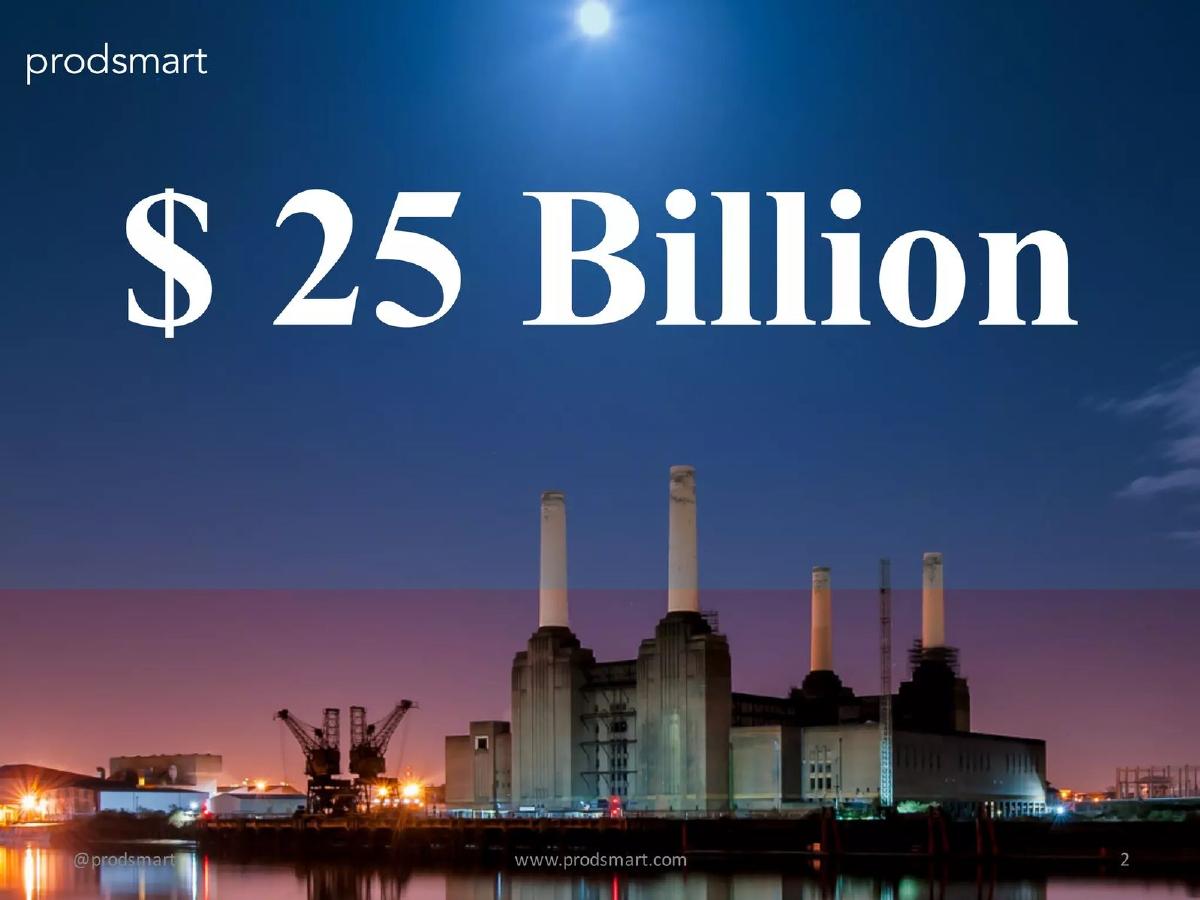
- The deck identifies a $25 billion ERP market and a $9 billion MES market in the USA, projecting $20 million in income within five years (Slide 21).
- Distribution is split into three channels: Partners, Internal sales, and the Festo partnership (Slide 25).
- The exit strategy is explicitly defined as an acquisition by a large ERP supplier, machinery manufacturer, or MES supplier (Slide 29).
- The deck lacks a dedicated team slide or specific historical growth metrics in the provided eight-slide sample.
Introduction and Context
The Prodsmart pitch deck from February 2016 was prepared for the Caixa Empreender Award. At this time, the company was positioning itself as a leader in the Industry 4.0 movement, specifically focusing on the digitization of the shop floor. The deck is a mix of high-level visionary statements and very specific, granular business model details. It aims to bridge the gap between complex industrial processes and modern SaaS efficiency.
Slide 1: Title Slide
The title slide is minimalist, featuring the Prodsmart logo in a clean, sans-serif font. It includes a 'as seen in' section featuring logos from Portuguese media outlets: Dinheiro Vivo, SIC Notícias, Jornal de Negócios, and Expresso. This immediately establishes local credibility and media traction. The slide is dated February 2016 and attributes the presentation to Gonçalo Fortes, the company's CEO.
Slide 5: The Problem
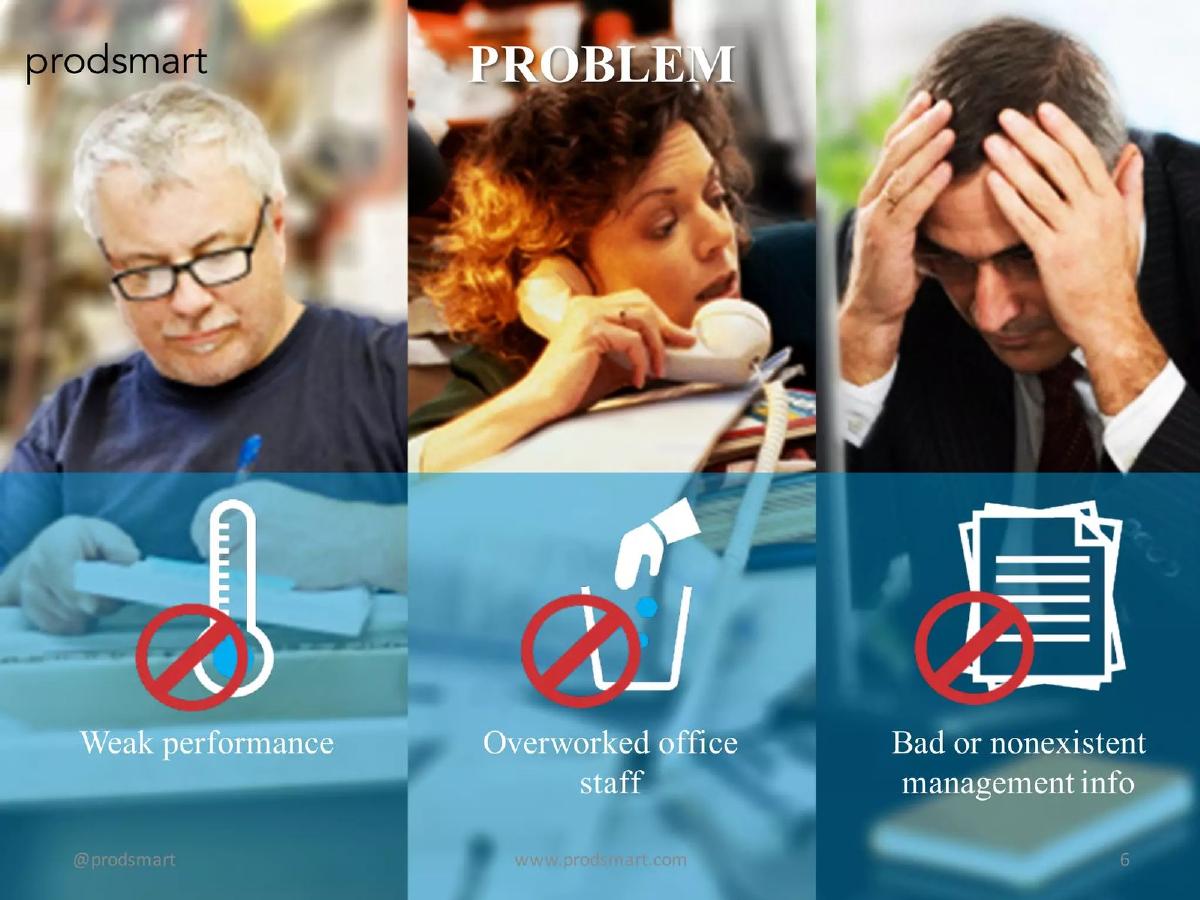
Slide 5 uses a full-bleed stock photo of a businessman in a suit with his head in his hands, sitting in front of a computer. The word 'PROBLEM' is written in a serif font at the top. While the visual is generic, it is intended to represent the frustration and lack of visibility inherent in traditional manufacturing management. However, the slide lacks text-based specifics regarding what the problem actually is (e.g., paper-based tracking, high error rates, or lack of real-time data), relying on the presenter to fill in those gaps.
Slide 9: The Solution - Interconnected Factory
Slide 9 introduces the solution with the phrase 'INTERCONNECTED FACTORY' overlaid on a photo of a large manufacturing facility. A blue geometric network graphic is superimposed on the image to visualize the concept of the Industrial Internet of Things (IIoT). This slide serves as the 'vision' slide, moving from the individual frustration shown in the problem slide to a modernized, data-driven industrial environment.
Slide 13: Awards and Validation
This is a high-impact traction slide. It highlights two major achievements: the 'SIC Notícias/Audi Award,' which included a visit to Audi’s factory in Germany, and participation in the 'TechFounders' acceleration program in Munich. Crucially, it mentions a €25,000 equity-free grant and a 5-month collaboration with Festo, described as an industrial automation giant with €3 billion in annual revenue and 300,000 customers. This slide effectively uses third-party logos (Audi, Festo) to borrow enterprise-grade credibility.
Slide 17: Business Model and Pricing
Slide 17 is perhaps the most important slide for an analyst. It explicitly defines the business model as 'SaaS Monthly Recurring Revenue.' It identifies the target market as 'factories up to 300 workers.' The pricing is broken down into two clear tiers: €4.99/month for each 'work unit' (worker or machine) and €79.99/month for each 'management user.' This granular pricing model is a significant departure from traditional industrial software, which often involves massive upfront licensing fees and implementation costs. It positions Prodsmart as a low-friction, scalable solution.
Slide 21: Market Opportunity
The market slide focuses specifically on the USA. It uses a bubble chart to represent three tiers of market size: a $25 billion ERP (Enterprise Resource Planning) market, a $9 billion MES (Manufacturing Execution System) market, and a projected 'Income in 5 years' for Prodsmart of $20 million USD. By placing their $20 million target inside the $9 billion MES bubble, the founders suggest that even a tiny fraction of market share leads to a significant business. However, the slide does not provide sources for these multi-billion dollar figures.
Slide 25: Distribution Strategy
Slide 25 outlines how the company intends to reach its customers globally. Using a world map background, it points to three main channels: 'Partners,' 'Internal' (direct sales), and 'FESTO.' The inclusion of Festo as a standalone distribution channel reinforces the importance of the partnership mentioned on Slide 13. It suggests that Prodsmart is leveraging Festo’s existing sales force or customer base to bypass the high cost of customer acquisition in the industrial sector.
Slide 29: Exit Strategy
The deck concludes its strategic section with an 'EXIT STRATEGY' slide. It focuses entirely on acquisition, listing three potential buyer profiles: 'Big ERP supplier' (seeking a complementary product), 'Big machinery manufacturer' (seeking a complementary product), and 'Big MES supplier' (seeking a complementary market segment). This slide is a clear signal to investors that the founders are thinking about liquidity and have identified the specific types of corporate development teams that would value their technology.
What Prodsmart Does Well
The deck excels at simplifying a very complex industry. Manufacturing software is notoriously difficult to sell and implement, but Prodsmart’s pricing slide (Slide 17) makes the product feel accessible and easy to trial. The use of 'work units' as a pricing metric aligns the company's success with the customer's scale. Furthermore, the validation through the Festo partnership is a masterclass in 'de-risking' a startup. By showing that a multi-billion dollar incumbent is working with them, they prove that their technology is relevant to the industry's biggest players.
What is Missing from the Deck
The most glaring omission in the provided slides is a dedicated 'Team' slide. While the title slide mentions the CEO, there is no information about the technical or industrial expertise of the founding team. Additionally, the deck is light on current performance metrics. While it projects $20 million in five years, it does not state current MRR, the number of active factories, or churn rates. The 'Problem' and 'Solution' slides are also quite generic, relying on stock imagery rather than showing the actual software interface or specific case study data (e.g., 'Factory X reduced waste by 20% using Prodsmart').
Founder Takeaways
Transparent Pricing as a Competitive Advantage: If you are entering a market dominated by 'call for a quote' legacy players, follow Prodsmart’s lead and put your pricing front and center. It signals that your product is modern, easy to buy, and transparent. Leverage 'Anchor' Partnerships: The way Prodsmart uses the Festo logo throughout the deck is highly effective. If you have a pilot or a partnership with a market leader, make it a central pillar of your distribution and validation story. Define Your Exit Early: While not always necessary in a seed deck, Prodsmart’s exit slide shows they understand the M&A landscape of their industry. It tells investors exactly who might buy the company and why, which helps in calculating potential returns.
Frequently asked questions
- What is Prodsmart's core product offering?
- Based on Slide 9, Prodsmart offers an 'Interconnected Factory' solution. This falls under the category of a Manufacturing Execution System (MES), designed to provide real-time visibility and data management for factory floors that are typically underserved by large, expensive ERP systems.
- How does Prodsmart price its software?
- Prodsmart uses a transparent SaaS model shown on Slide 17. They charge €4.99 per month for each 'work unit' (which can be a human worker or a machine) and €79.99 per month for each 'management user.' This allows smaller factories to scale their costs based on their actual floor size.
- Who is the primary target customer for Prodsmart?
- Slide 17 specifies that the company targets factories with up to 300 workers. This focus on the SME (Small to Medium Enterprise) segment differentiates them from legacy industrial software providers that usually target large-scale enterprise manufacturers.
- What kind of market traction does the deck show?
- While the provided slides do not list specific customer counts or MRR, Slide 13 highlights significant industry validation. This includes an award that involved visiting Audi’s factory in Germany and a €25,000 equity-free grant from the TechFounders accelerator, which partnered them with Festo.
- What is the projected financial outcome mentioned in the deck?
- On Slide 21, the company projects an 'Income in 5 years' of $20 million USD. This is framed against a total addressable market in the USA of $9 billion for MES and $25 billion for ERP systems.