Cadence’s 10-slide deck is a masterclass in minimalist storytelling, relying on visual cues and high-level social proof rather than dense data tables. The company successfully raised $4M in 2020 by positioning itself as a modern alternative to legacy translation services, citing a $1.52 billion acquisition of a competitor to validate the market's exit potential. With $50K in monthly revenue at the time of the pitch and a client list featuring Walmart and WeWork, the deck focuses heavily on traction and team pedigree. While it lacks traditional slides for unit economics, a detailed roadmap, or…
Key takeaways
- The deck highlights $50K in monthly revenue alongside logos from major enterprises like Walmart and BBDO on slide 7.
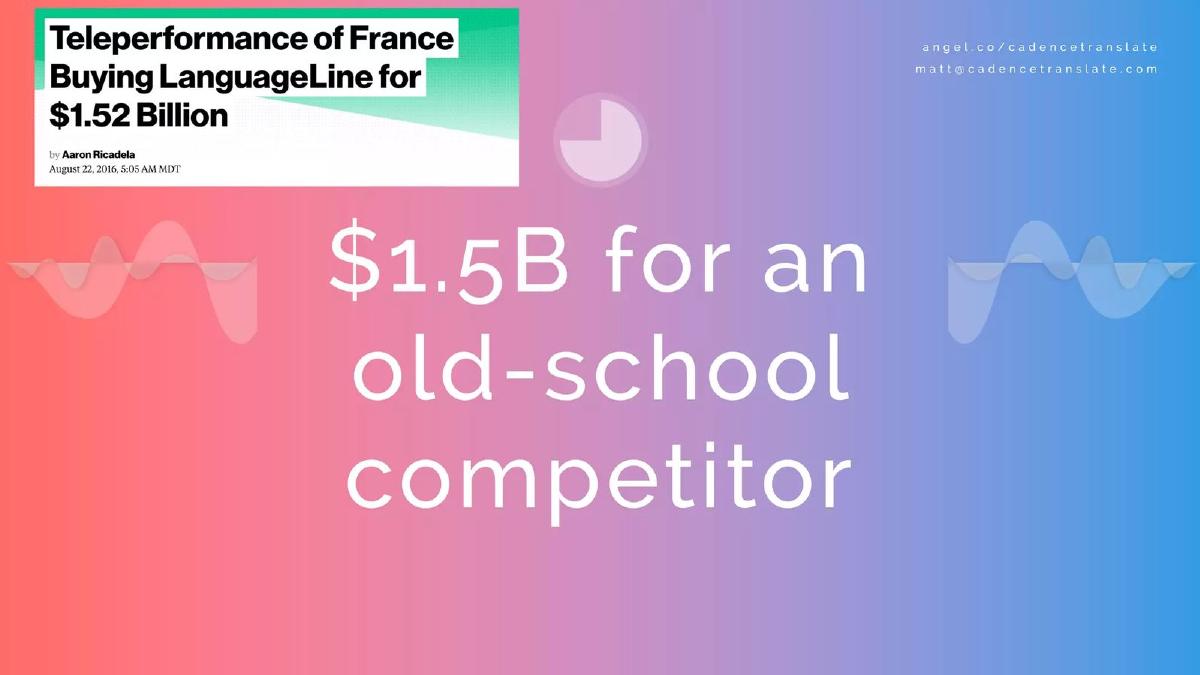
- Market validation is established on slide 4 by referencing the $1.52 billion acquisition of LanguageLine by Teleperformance.
- The problem is framed as 'unfair access to a hard-to-find resource,' illustrated by a grid of 36 professional interpreter headshots on slide 8.
- The team slide (slide 9) emphasizes pedigree with logos from Stanford, Wharton, Bain & Company, and Credit Suisse.
- One team member, Jonathan, is specifically noted for having '+10 years experience as a professional interpreter' on slide 9.
- The solution is categorized into three delivery methods: On-site, Conference Calls, and Livestreams on slide 5.
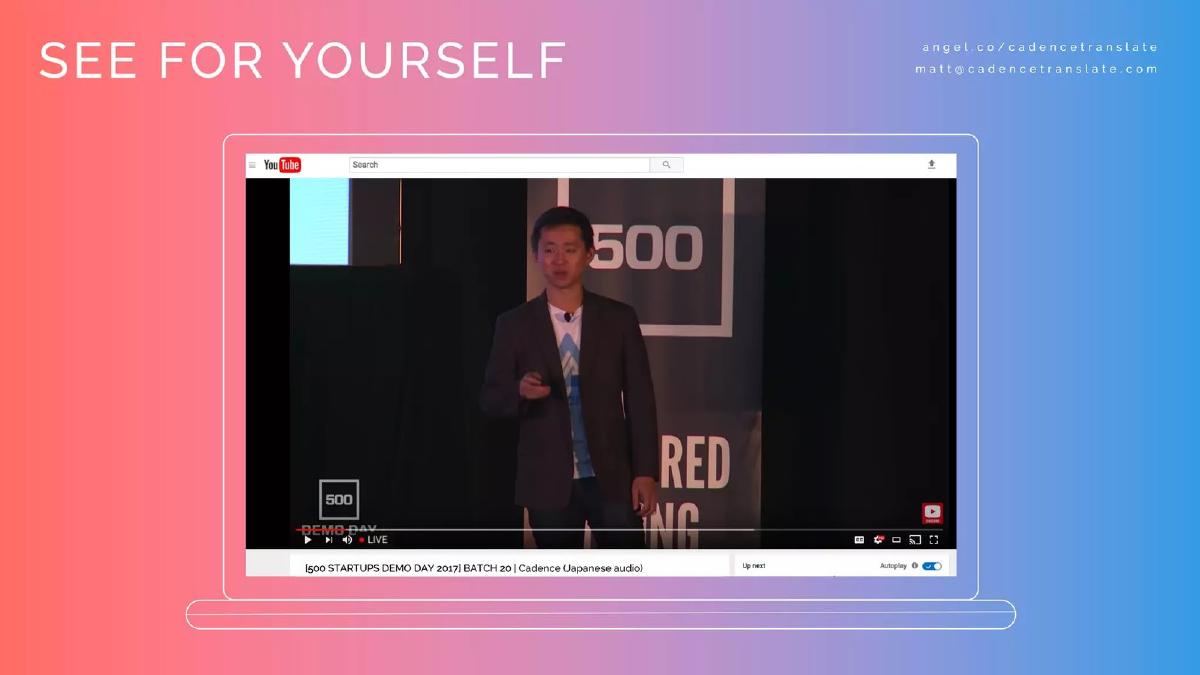
- A link to a 500 Startups Demo Day video is provided on slide 6 to demonstrate the product in action.
- The deck completely omits a specific 'Ask' slide, financial projections, and a detailed competitive landscape matrix.
The Minimalist Approach to a $4M Seed Round
The Cadence pitch deck is a notable example of the 'less is more' philosophy. Comprising only 10 slides, the deck avoids the dense bullet points and complex charts that often clutter fintech presentations. Instead, it uses high-resolution imagery and bold, singular statements to build a narrative of professional-grade quality and significant market opportunity. The company, which operates at the intersection of translation and payments, successfully used this deck to secure $4M in 2020.
Slide 1: Title and Branding
The opening slide is purely aesthetic, featuring the Cadence logo—a speech bubble containing sound waves—against a vibrant red-to-blue gradient. It includes contact information for 'Matt' and a link to their AngelList profile. There is no tagline or mission statement here, forcing the viewer to focus entirely on the brand identity.
Slide 2 & 3: The 'Zuckerberg' Hook
Slide 2 features a large photo of Mark Zuckerberg speaking in front of a 'Tsinghua x-lab' backdrop with the Chinese greeting '你好!' (Nǐ hǎo) overlaid. Slide 3 follows up with the text 'Don’t hack language barriers' alongside a photo of Zuckerberg with a professional interpreter. This is a classic 'show, don't tell' tactic. It identifies a high-stakes environment where language matters and suggests that even the world's most powerful tech CEOs cannot simply 'hack' their way through a language barrier—they need professional help.
Slide 4: Market Validation via Exit
Cadence addresses market size by pointing to a specific M&A event. The slide features a screenshot of a news headline: 'Teleperformance of France Buying LanguageLine for $1.52 Billion.' The text overlay reads '$1.5B for an old-school competitor.' This accomplishes two things: it proves there is a billion-dollar exit path in this industry and frames existing players as 'old-school,' implying that Cadence is the modern disruptor.
Slide 5: The Service Offering
This slide defines the product's scope. Under the headline 'Get treated like you’re at the UN,' Cadence lists three core service areas: On-site , Conference Calls , and Livestreams . The background image of a large assembly hall reinforces the 'professional/diplomatic' quality of the service, distancing the brand from low-cost, automated translation apps.
Slide 6: Product Demonstration
Slide 6 is a 'See For Yourself' call to action. It shows a laptop screen with a YouTube video titled '[500 STARTUPS DEMO DAY 2017] BATCH 20 | Cadence (Japanese audio).' This provides immediate social proof by showing they are graduates of a prestigious accelerator and offers a way for investors to see the product in a live, high-pressure environment without needing a live demo during the meeting.
Slide 7: Traction and Revenue
This is arguably the most important slide in the deck. It states '$50K MONTHLY REVENUE' in large white text. Surrounding this figure are logos for Walmart, WeWork, BBDO, Toms, D.E. Shaw & Co, Franklin Templeton, Capital Group, and others. For a seed-stage company, $600K in ARR (Annual Recurring Revenue) from blue-chip clients is a powerful signal of product-market fit.
Slide 8: The Problem - Unfair Access
Cadence frames the problem as 'UNFAIR ACCESS to a hard-to-find resource.' Below the text is a grid of 36 headshots of diverse professionals. This slide humanizes the supply side of their marketplace. It suggests that the 'resource' (high-quality interpreters) exists but is currently inaccessible to most businesses due to a lack of a centralized platform.
Slide 9: Team Pedigree
The team slide features four individuals: Matt (CEO), Phil (CFO), Jonathan (Partnerships), and Tom (Sales). The slide relies heavily on institutional logos to build credibility, including Stanford, University of Michigan, Wharton, Bain & Company, and Credit Suisse. Notably, Jonathan is credited with '+10 years experience as a professional interpreter,' providing the necessary domain expertise to back the technical and financial backgrounds of the other founders.
Slide 10: Conclusion
The deck ends as it began, with a 'Thank You' slide featuring the assembly hall background and contact information. There is no specific call to action or summary of the investment terms.
What Works in the Cadence Deck
The primary strength of this deck is its clarity of narrative . By avoiding the 'wall of text' trap, Cadence ensures that the investor remembers three things: they have $50K in monthly revenue, they serve massive clients like Walmart, and their competitors are 'old-school' billion-dollar companies. The use of the Mark Zuckerberg imagery is a clever way to illustrate the 'Problem' without using a single bullet point.
The Social Proof is also exceptionally high. Listing 500 Startups, Bain, and Wharton alongside $50K in revenue creates a 'safe bet' aura for a seed investor. It suggests that the founders are 'in-network' and that the business is already functioning at a professional level.
What is Missing
From a technical standpoint, this deck is missing several 'standard' slides that many VCs expect to see:
The Ask: There is no mention of how much money is being raised or what the milestones for the next 18 months are. · Unit Economics: While revenue is stated, there is no information on margins, customer acquisition cost (CAC), or lifetime value (LTV). · Roadmap: The deck shows what Cadence does now, but not what it will become. There is no mention of how they will scale from $50K/month to $5M/month. · Technology/IP: For a company listed in the 'Blockchain' and 'FinTech' sectors, there is zero explanation of the underlying technology or how blockchain is utilized in their payment flow.
Founder's Takeaway
If you are a founder with strong initial traction and a high-pedigree team , you can afford to be minimalist. Cadence proves that you don't need a 20-slide deck if your 'Traction' slide is strong enough to do the heavy lifting. However, founders should note that this deck was likely used as a presentation aid. If you are sending a deck via email to be read in silence, you may need to add the 'missing' slides mentioned above to answer the logical questions an investor will inevitably have regarding scale and defensibility.
The most copyable element here is the Competitive Positioning on Slide 4. Instead of a complex matrix of features, simply showing a massive acquisition of a 'legacy' player is a highly effective way to validate a market while simultaneously claiming the 'innovator' mantle.
Frequently asked questions
- How much did Cadence raise with this deck?
- According to catalogue facts from failory.com, Cadence raised $4M in a Seed round in 2020. The deck itself does not state the amount being raised or the valuation, which is common for decks used as visual aids during a pitch rather than as standalone reading materials.
- What is the core business model of Cadence?
- Cadence operates as a SaaS platform in the FinTech and Blockchain space, specifically focusing on payments for translation services. As noted on slide 5, they provide professional interpretation for on-site events, conference calls, and livestreams, connecting B2C and B2B clients with high-end linguists.
- Who are the key customers mentioned in the deck?
- Slide 7 displays a diverse range of high-profile clients, including Walmart, WeWork, Toms, BBDO, Franklin Templeton Investments, Capital Group, D.E. Shaw & Co, Donnelley Financial Solutions, and Publicis Groupe. This suggests a strong focus on the financial and corporate sectors.
- How does Cadence differentiate itself from competitors?
- Instead of a feature-by-feature comparison, Cadence uses slide 4 to label incumbents as 'old-school.' By highlighting a $1.52 billion acquisition in the space, they argue that the market is massive but currently served by legacy players, positioning Cadence as the modern, tech-enabled alternative.
- What is missing from the Cadence pitch deck?
- The deck is missing several standard elements: a slide detailing the specific 'Ask' (how much money they want), a financial projections slide, a go-to-market strategy, and a breakdown of unit economics. It relies almost entirely on current traction and team credibility to carry the narrative.