How fintech and insurtech startups show regulatory licences in a pitch deck: which licence, which regulator, where it applies, and what it lets the company do.
Fintech Licence Slide: Real Pitch Deck Examples
Seven slides from fintech, insurtech and investment decks, shown in full, compare how companies present the licences they hold, and whether an investor could tell what each licence actually allows.
TL;DR
For a regulated financial company, the licence is often the hardest thing to copy, so name it precisely: the type of licence, the regulator, the countries it covers, the date it was granted, and what it lets you do that an unlicensed competitor cannot. The clearest example below (Lunar) names the licence, the regulator (the Danish FSA) and why it mattered ("first independent bank in 10 years"). The weakest make a blanket statement: AFEX says it is "licensed and in full compliance with regulations in every jurisdiction where we operate" without naming one licence. Also say plainly when a licence is still pending or held by a partner.
Licence slides from real pitch decks
Each example shows the exact stored slide above its analysis and links to the full teardown. Licence statements are the companies' own claims as shown on the slide; we have not checked them against regulators' registers. Stage and year are given only where the slide or deck states them.
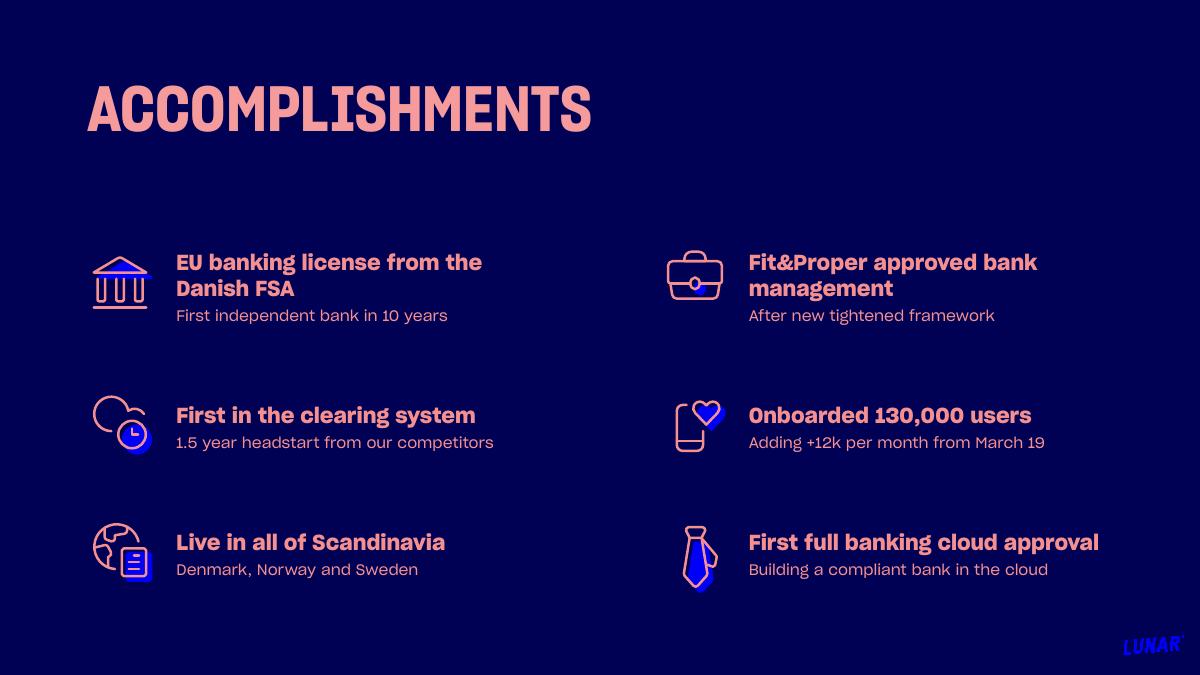
Lunar licensing slide — slide 4
Digital bank in the Nordics. Stage and year are not stated on the slide.
Lunar deck, slide 4. Exact stored slide matched to this analysis.
Our analysis: The licence type, the regulator and the reason it is rare all fit in one line. Management approval and clearing access are shown as further regulatory milestones, and each is framed as a head start.
Evidence and limitation: No dates are given for the approvals, and "1.5 year headstart" has no basis stated. Add the month each approval was granted.
What a founder can adapt: List each regulatory approval as its own milestone: what it is, who granted it, and why it is hard to get.
Supporting analysis
What the deck claims: "Accomplishments": "EU banking license from the Danish FSA — First independent bank in 10 years"; "Fit&Proper approved bank management — After new tightened framework"; "First in the clearing system — 1.5 year headstart from our competitors"; "Onboarded 130,000 users — Adding +12k per month from March 19"; "Live in all of Scandinavia"; "First full banking cloud approval".
Presentation choice: The licence type, the regulator and the reason it is rare all fit in one line. Management approval and clearing access are shown as further regulatory milestones, and each is framed as a head start.
When it does not fit: No dates are given for the approvals, and "1.5 year headstart" has no basis stated. Add the month each approval was granted.
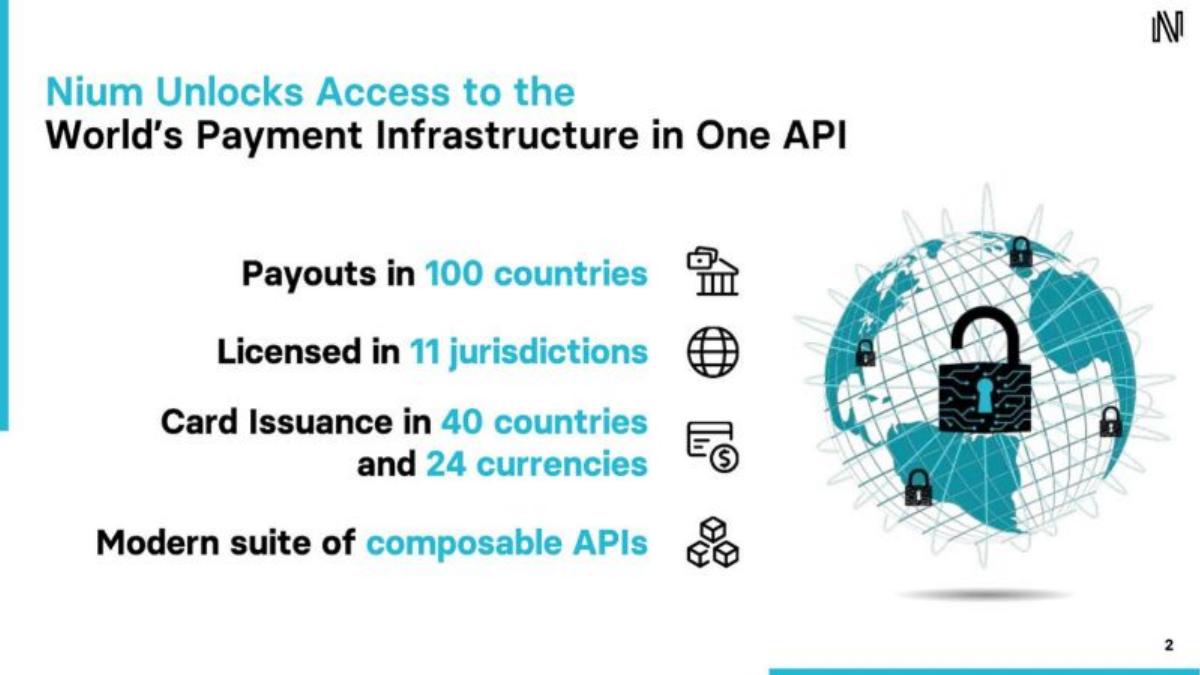
Cross-border payments infrastructure. Stage and year are not stated on the slide.
Nium deck, slide 2. Exact stored slide matched to this analysis.
Our analysis: Licensing is presented as one of four capacity numbers, next to payout and card-issuing reach. For a payments company that is the right frame: licences explain how the coverage is possible.
Evidence and limitation: Eleven jurisdictions are counted but none are named, and there is no licence type. Name the main markets and licences in a footnote or appendix.
What a founder can adapt: Put your licence count next to the coverage it makes possible.
Supporting analysis
What the deck claims: "Nium Unlocks Access to the World's Payment Infrastructure in One API": "Payouts in 100 countries", "Licensed in 11 jurisdictions", "Card Issuance in 40 countries and 24 currencies", "Modern suite of composable APIs".
Presentation choice: Licensing is presented as one of four capacity numbers, next to payout and card-issuing reach. For a payments company that is the right frame: licences explain how the coverage is possible.
When it does not fit: Eleven jurisdictions are counted but none are named, and there is no licence type. Name the main markets and licences in a footnote or appendix.
Commission-free investing app in the UK; the deck was prepared for a Crowdcube campaign. Year is not stated on the slide.
Freetrade deck, slide 5. Exact stored slide matched to this analysis.
Our analysis: This is the only example that links the licence to the growth plan: the authorisation is presented as the reason expansion is possible, not just a compliance fact.
Evidence and limitation: Passporting rights from the UK to the EU depend on the regulatory rules in force; a claim like this goes out of date. State the date and rule the claim relies on.
What a founder can adapt: If a licence opens new markets, say which, and put it on the slide where you discuss expansion.
Supporting analysis
What the deck claims: "Market" in three maps: the UK ("92% of people with investable assets have no brokerage account", "16 million people in the 'advice gap'", "c. 22k IFAs"), the EU ("FCA authorisation is a passport to the 500 million EU market", "Lower market penetration than the UK or USA but similar levels of wealth") and the world ("Less than 1% of the world owns shares directly"). Sources: ComPeer, Mintel, FCA, Euromonitor.
Presentation choice: This is the only example that links the licence to the growth plan: the authorisation is presented as the reason expansion is possible, not just a compliance fact.
When it does not fit: Passporting rights from the UK to the EU depend on the regulatory rules in force; a claim like this goes out of date. State the date and rule the claim relies on.
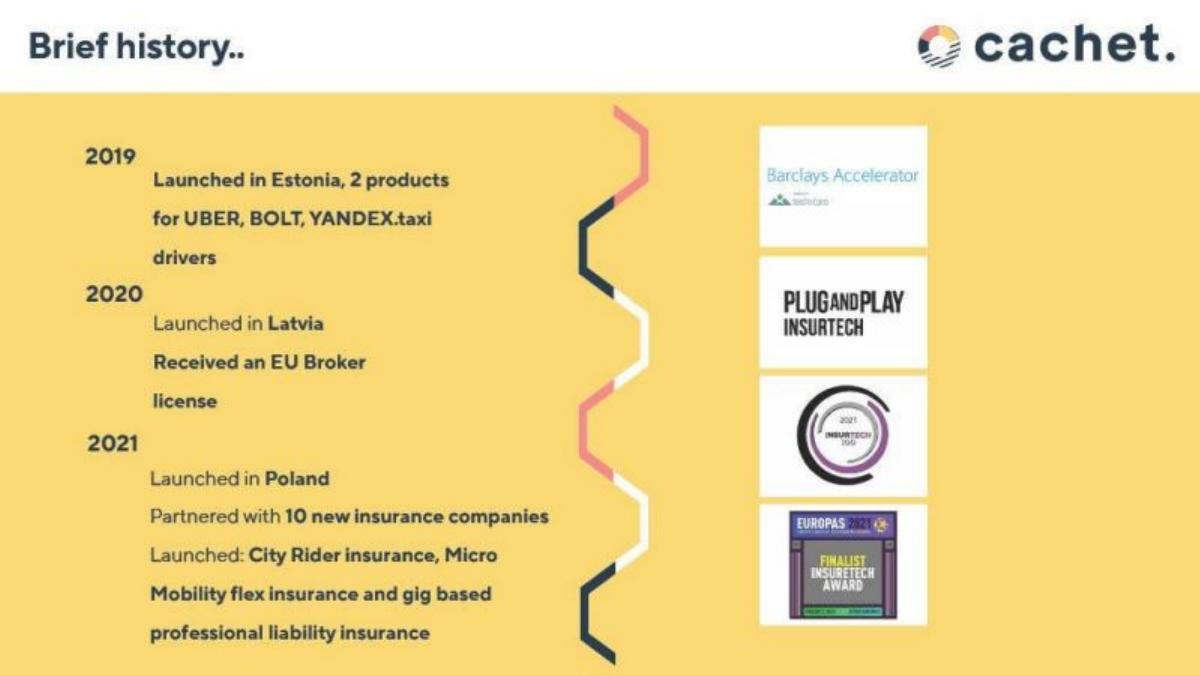
Insurance for gig-economy and ride-hailing drivers in the Baltics and Poland. The slide covers 2019 to 2021.
Cachet deck, slide 3. Exact stored slide matched to this analysis.
Our analysis: Placing the licence on a dated timeline shows when the company could legally expand, and the next year's launches follow it. It also makes clear the company is a broker working with insurers, not an insurer itself.
Evidence and limitation: "EU Broker license" doesn't name the regulator or the country that issued it. Add both.
What a founder can adapt: Put the licence on your timeline so investors see what it enabled next.
Supporting analysis
What the deck claims: "Brief history..": 2019, launched in Estonia with two products for Uber, Bolt and Yandex taxi drivers; 2020, launched in Latvia and "Received an EU Broker license"; 2021, launched in Poland, partnered with 10 new insurance companies, and launched City Rider, micro-mobility and gig-based professional liability insurance. Accelerator and award logos sit alongside.
Presentation choice: Placing the licence on a dated timeline shows when the company could legally expand, and the next year's launches follow it. It also makes clear the company is a broker working with insurers, not an insurer itself.
When it does not fit: "EU Broker license" doesn't name the regulator or the country that issued it. Add both.
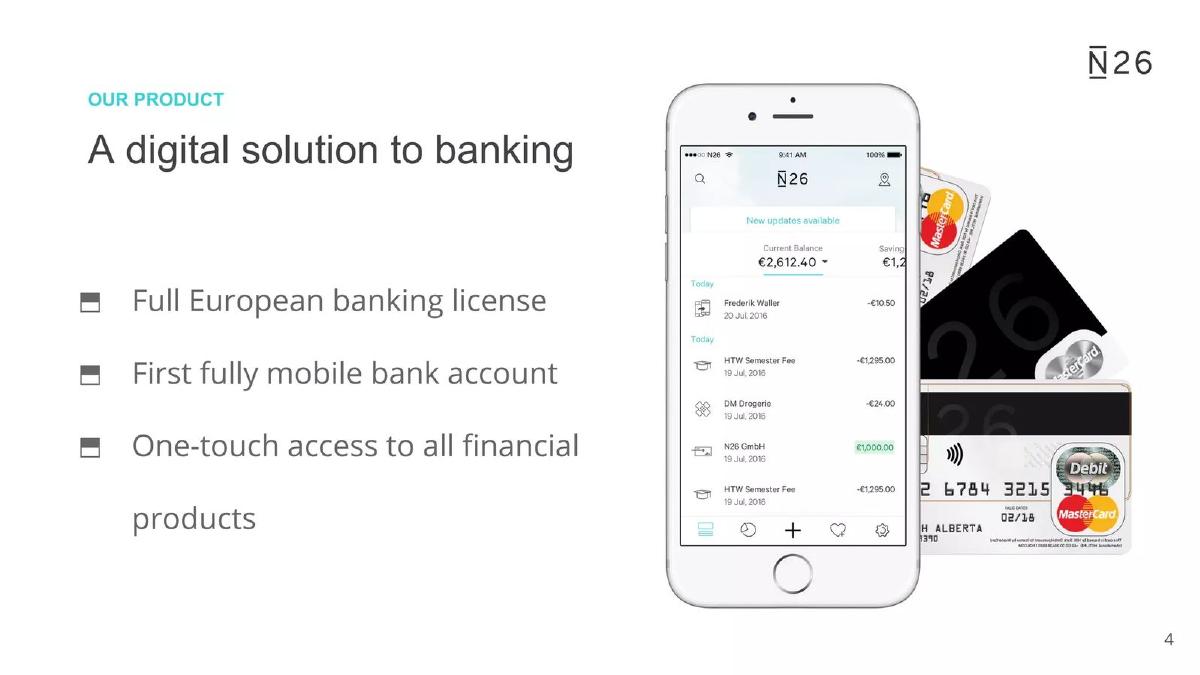
Mobile bank in Europe. Stage and year are not stated on the slide.
N26 deck, slide 5. Exact stored slide matched to this analysis.
Our analysis: Putting the licence first tells investors N26 is a bank, not an app on top of someone else's bank, which changes how they value it.
Evidence and limitation: The licence sits in a product list with no regulator, date or explanation of what it allows. Give it its own line with those details.
What a founder can adapt: If holding your own licence is a key difference, lead with it.
Supporting analysis
What the deck claims: "Our product — A digital solution to banking": three bullets, "Full European banking license", "First fully mobile bank account" and "One-touch access to all financial products", next to an image of the app and cards.
Presentation choice: Putting the licence first tells investors N26 is a bank, not an app on top of someone else's bank, which changes how they value it.
When it does not fit: The licence sits in a product list with no regulator, date or explanation of what it allows. Give it its own line with those details.
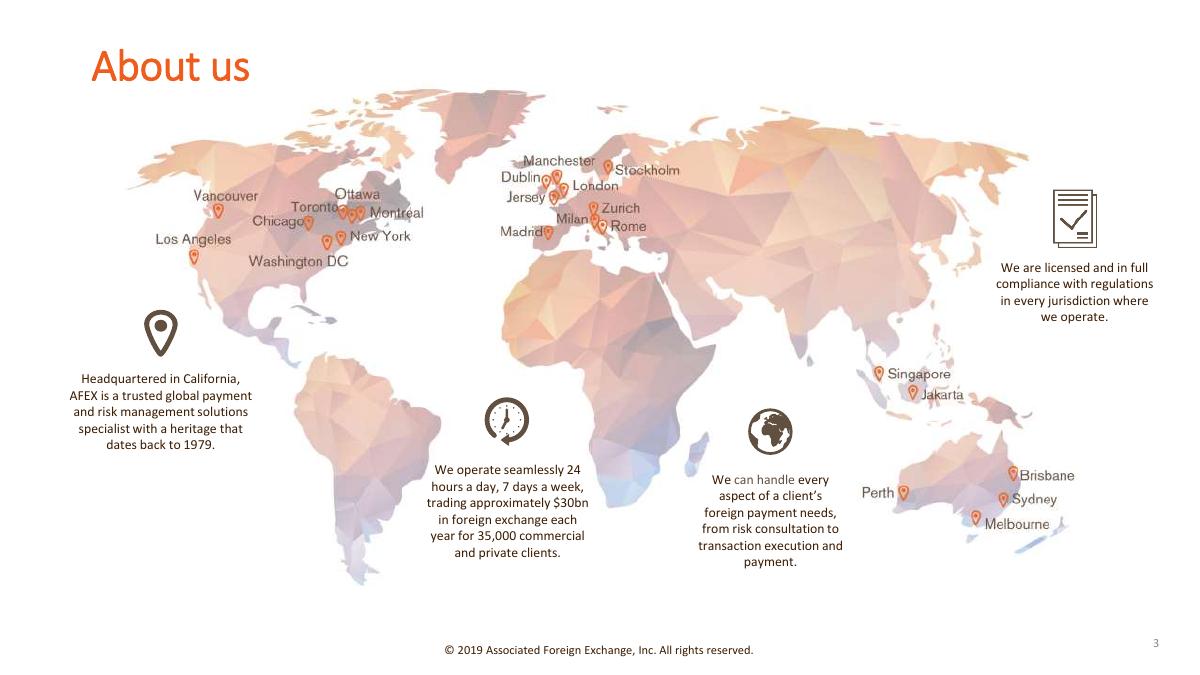
Foreign-exchange payments and risk management. The slide carries a 2019 copyright; the company says its heritage dates back to 1979.
AFEX deck, slide 3. Exact stored slide matched to this analysis.
Our analysis: For an established payments firm, stating regulatory standing next to volume and client numbers tells investors the business runs at scale within the rules.
Evidence and limitation: No licence, regulator or country is named, so the statement can't be checked. List the main licences (for example, by country and regulator) or reference an appendix.
What a founder can adapt: Treat this as a slide to improve on. Keep the scale figures, but replace the blanket statement.
Supporting analysis
What the deck claims: "About us": a world map of offices; headquartered in California; "trading approximately $30bn in foreign exchange each year for 35,000 commercial and private clients"; "We are licensed and in full compliance with regulations in every jurisdiction where we operate."
Presentation choice: For an established payments firm, stating regulatory standing next to volume and client numbers tells investors the business runs at scale within the rules.
When it does not fit: No licence, regulator or country is named, so the statement can't be checked. List the main licences (for example, by country and regulator) or reference an appendix.
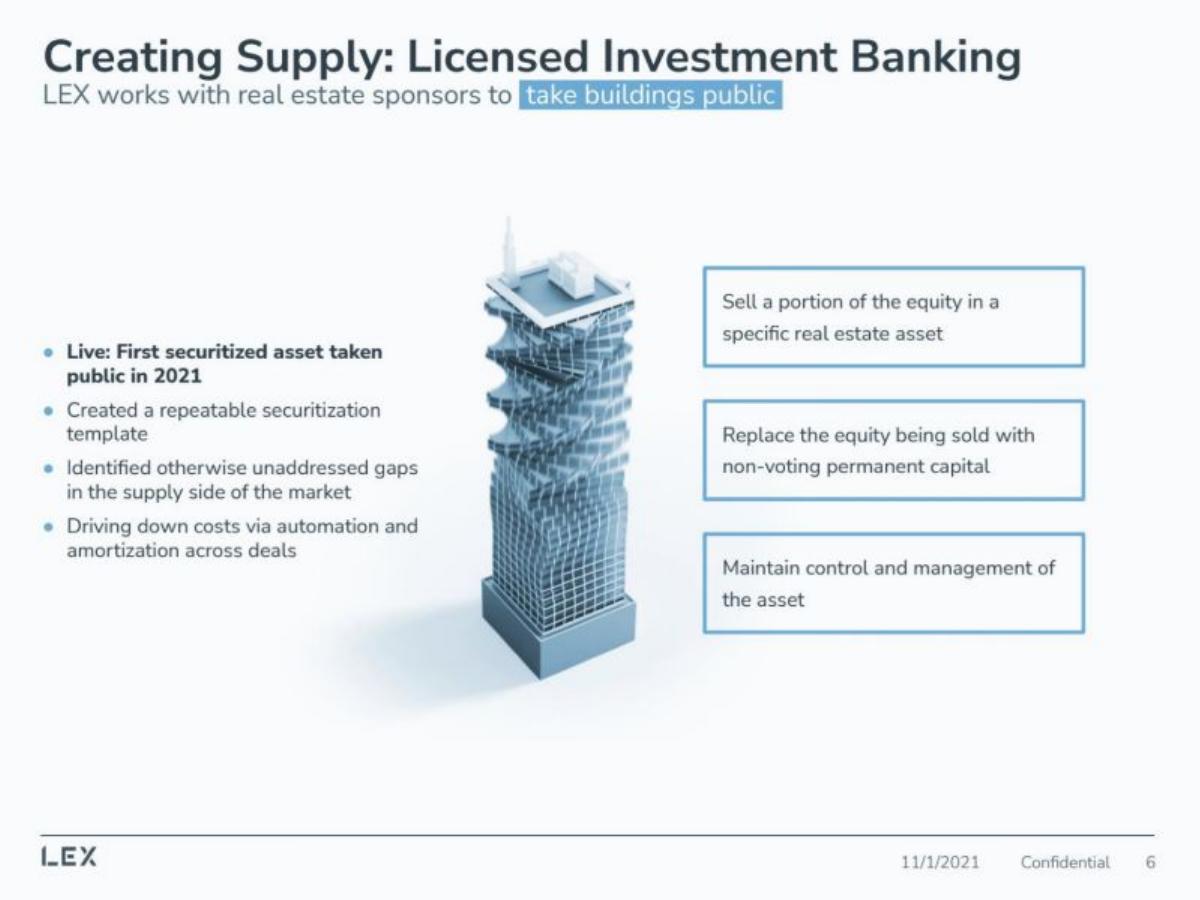
Platform for investing in shares of individual commercial buildings. The slide footer is dated 11/1/2021.
LEX Markets deck, slide 6. Exact stored slide matched to this analysis.
Our analysis: The licence is used to explain how the company gets supply, so it answers a business question, not only a compliance one. A dated first transaction shows the licence in use.
Evidence and limitation: "Licensed" appears in the title but the slide never says which licence, who holds it (the company or an affiliate) or which regulator oversees it. Add that line.
What a founder can adapt: Show one transaction your licence made possible.
Supporting analysis
What the deck claims: "Creating Supply: Licensed Investment Banking — LEX works with real estate sponsors to take buildings public": "Live: First securitized asset taken public in 2021", "Created a repeatable securitization template", with three boxes on what sponsors get (sell part of the equity, replace it with non-voting permanent capital, keep control of the asset).
Presentation choice: The licence is used to explain how the company gets supply, so it answers a business question, not only a compliance one. A dated first transaction shows the licence in use.
When it does not fit: "Licensed" appears in the title but the slide never says which licence, who holds it (the company or an affiliate) or which regulator oversees it. Add that line.
What each slide tells an investor about the licence
Can an investor look the licence up and see why it matters? Check your slide against each column.
Example
Licence type named
Regulator or country
Dated
What it unlocks
Lunar
Yes: EU banking licence
Yes: Danish FSA
No
Rarity and head start
Nium
No
Count only: 11 jurisdictions
No
Payout and card coverage
Freetrade
Yes: FCA authorisation
Yes: UK FCA
No
EU expansion (as claimed)
Cachet
Yes: EU broker licence
No
Yes: 2020
Launches that followed
N26
Yes: European banking licence
No
No
Implied: own bank
AFEX
No
No
No
Not stated
LEX Markets
No
No
First deal: 2021
Supply of buildings
Key Takeaways
Name the licence and the regulator. Lunar's "EU banking license from the Danish FSA" can be checked; "fully licensed" cannot.
Say where it applies. Nium counts "licensed in 11 jurisdictions"; the stronger version lists the main ones and the licence type in each.
Explain what the licence unlocks. Freetrade argues its UK FCA authorisation is "a passport" to the EU market, which ties regulation to growth. (That passporting claim depends on the rules at the time; check it before repeating it.)
Date it. Cachet places "Received an EU Broker license" in 2020 on a timeline, so an investor can see when the company could start selling.
Don't bury a licence in a product bullet. N26's "Full European banking license" sits among product features with no regulator or date, which undersells it.
Write your licence line
Fill in each prompt. If an answer is "pending" or "via a partner", say so on the slide.
Licence. What exactly do you hold: banking, e-money, payment institution, broker, lending, investment firm?
Regulator. Which regulator granted it, and in which country?
Status and date. Granted when? Or applied when, and at what stage?
Holder. Is it held by your company, an affiliate, or a partner you rely on?
What it unlocks. What can you do because of it that an unlicensed competitor can't?
Copyable framework: [Company] holds a [licence type] from [regulator, country], granted [month, year]. It lets us [activity] in [markets] without relying on a partner. [Pending: application for licence type in country submitted month, year.]
Illustrative example 1 — written by us
Before: Fully licensed and compliant.
After: We hold an [e-money licence] from [regulator] ([country]), granted [month, year], which lets us hold customer funds and issue cards directly. Our [licence type] application in [country] was submitted [month, year].
What improved: Our illustrative rewrite, not any company's text. It names the licence, regulator, country, date and what it allows, and states a pending application plainly; bracketed values are placeholders.
When a deck needs a licensing slide
Include one if your business can't legally operate without a licence: banking, payments, e-money, lending, insurance, brokerage, investment advice, crypto services. For these companies, investors will ask early whether you hold the licence yourself, rent it from a partner bank or insurer, or are still applying.
It doesn't have to be a slide of its own. Most examples below put the licence on a company overview, product or accomplishments slide. What matters is that the licence is specific enough to check in the regulator's public register.
This guide covers presenting regulatory status. It is not legal advice about which licence a business needs.
Common mistakes
"Fully licensed" with nothing named. Investors can't look it up, so it counts for little.
Hiding who holds the licence. Say if a partner bank or insurer holds it.
Pending shown as granted. Label applications as applications, with a date.
Out-of-date regulatory claims. Passporting and similar rights change; date the claim.
Licence buried in product bullets. If it is a key difference, give it its own line.
Diagnostic checklist
The licence type is named.
The regulator and country are named.
The date granted, or the application status, is given.
It is clear who holds the licence.
The slide says what the licence lets the company do.
Any market-access claim is dated.
Frequently asked questions
How we chose these examples
Corpus: published pitch deck teardowns on StartupFundraising.com. Founder-uploaded private decks are excluded.
Selection (2026-09-24): we searched extracted text of slides 2–6 for licence, regulated, FCA, e-money, PSD2, charter and money-transmitter language in slides that also mention banking, payments, lending, insurance or brokerage, where a stored slide image exists. Seven slides that present the company's own licence were selected. Slides that mention regulation only as part of the problem (for example ACIN) or as a future step (Fintern) were excluded. Fipto was not used because the deck already appears in another guide; Alan was not used for the same reason.
Overlap check: no existing guide covers licences or regulatory status. The technology and competition guides discuss defensibility in general, not regulatory licences. Lunar also appears in the vision guide, with a different slide (slide 2).
Protected experiments: this is a new slide-guide URL. It does not change the fintech industry pages in the frozen fintech cohort.
Review: all seven stored slide images were inspected on 2026-09-24 and matched to company, deck and slide number (editorial model review). No person has yet completed an editorial review of this page.
Licence and regulatory statements are the companies' own claims as shown on the slides and have not been checked against regulators' registers. This page is not legal advice. We make no claim that any slide caused a fundraising outcome.