How insurance startups explain how policies reach customers: direct digital, brokerage, embedded in partners, white-label for distributors, bundling.
Insurtech Distribution Slides: Real Examples
Seven insurance startup slides, shown in full, compare how founders answer the question investors ask first about insurance: how will policies reach customers, and at what cost?
TL;DR
In insurance, distribution often decides the business more than the product does, because acquiring a policyholder is expensive and brokers take a share. A strong insurtech distribution slide says which channel sells the policy (direct, broker, partner, embedded), who pays whom, and why that channel costs less than incumbents'. In the examples below, Clark draws the money flow and says 42% of revenue is recurring; Branch sets each incumbent problem against its channel; Sofia uses a national survey to show that distribution, not demand, holds the market back. The weakest name "a diversified distribution mix" or "embedded insurance" without a partner, a number or who pays.
Insurtech distribution slides from real pitch decks
Each example shows the exact stored slide above its analysis and links to the full teardown. Figures are the companies' own as shown on the slides and have not been independently verified. Stage and year are given only where the slide or deck states them.
Clark go to market slide — slide 5
Digital insurance broker in Germany. Stage and year are not stated on the slide.
Clark deck, slide 5. Exact stored slide matched to this analysis.
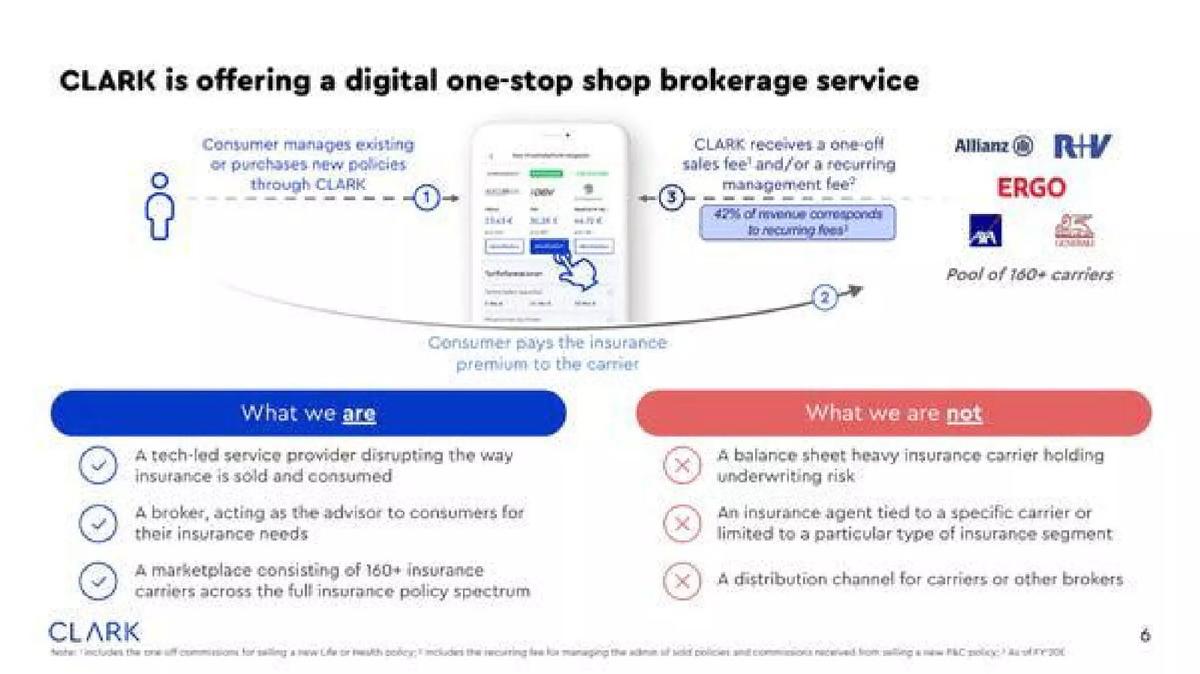
Our analysis: The money flow and the "what we are not" column answer the two questions investors ask about a broker: does it carry risk, and is it independent of any one carrier? The recurring-fee share gives a sense of revenue quality.
Evidence and limitation: The slide explains the model but not what it costs to win a customer. Add acquisition cost or payback next to the diagram.
What a founder can adapt: Draw who pays whom, and state plainly whether you carry underwriting risk.
Supporting analysis
What the deck claims: "CLARK is offering a digital one-stop shop brokerage service". A diagram: the consumer manages existing or buys new policies through Clark; the consumer pays the premium to the carrier; Clark receives a one-off sales fee and/or a recurring management fee ("42% of revenue corresponds to recurring fees"). Carrier logos (Allianz, R+V, ERGO, AXA) and "Pool of 160+ carriers". "What we are": a tech-led service provider, a broker acting as adviser, a marketplace of 160+ carriers. "What we are not": a balance sheet heavy carrier holding underwriting risk, an agent tied to one carrier, a distribution channel for carriers or other brokers.
Presentation choice: The money flow and the "what we are not" column answer the two questions investors ask about a broker: does it carry risk, and is it independent of any one carrier? The recurring-fee share gives a sense of revenue quality.
When it does not fit: The slide explains the model but not what it costs to win a customer. Add acquisition cost or payback next to the diagram.
US home and auto insurer. Stage and year are not stated on the slide.
Branch deck, slide 6. Exact stored slide matched to this analysis.
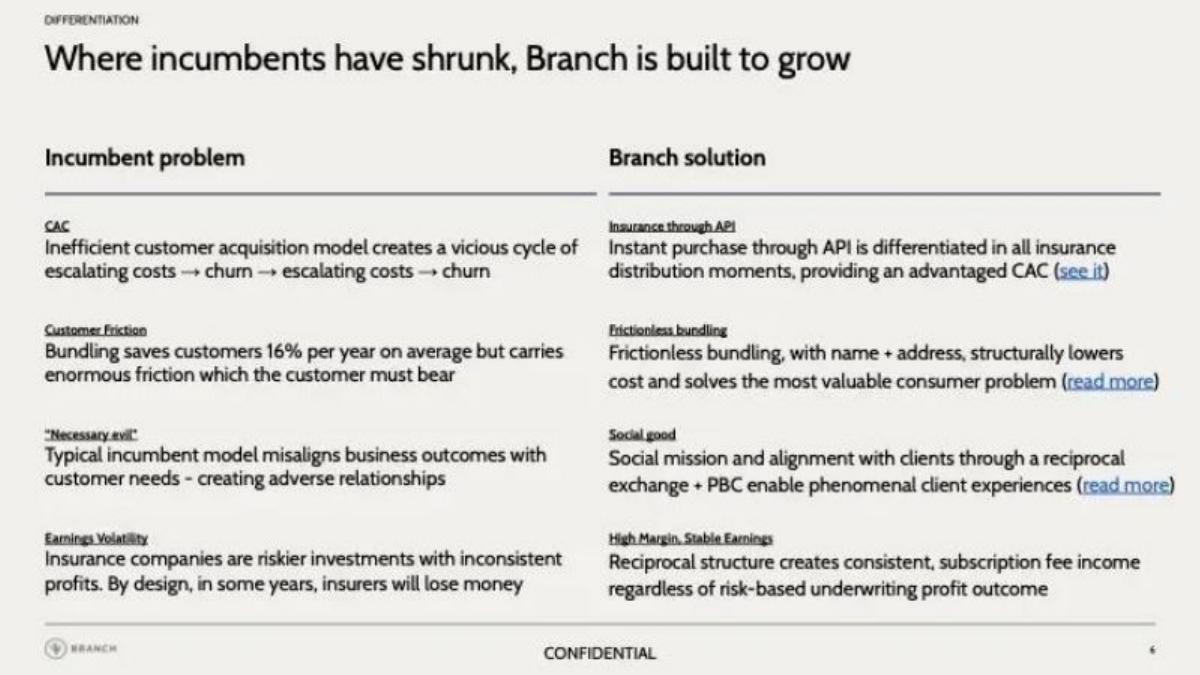
Our analysis: Each incumbent problem is paired with a specific distribution answer, so investors see why Branch's channel should cost less. The earlier summary slide (slide 2) names "unique distribution" and "a low CAC" as core to the company.
Evidence and limitation: "Advantaged CAC" is asserted, not shown. Give the figure or the ratio to incumbents, and name one API partner.
What a founder can adapt: Put the incumbent's distribution cost on the left and your channel on the right, point by point.
Supporting analysis
What the deck claims: "Where incumbents have shrunk, Branch is built to grow": a two-column table. Incumbent problem: "Inefficient customer acquisition model creates a vicious cycle of escalating costs → churn → escalating costs"; bundling "saves customers 16% per year on average but carries enormous friction". Branch solution: "Instant purchase through API is differentiated in all insurance distribution moments, providing an advantaged CAC"; "Frictionless bundling, with name + address"; a reciprocal exchange structure for "consistent, subscription fee income".
Presentation choice: Each incumbent problem is paired with a specific distribution answer, so investors see why Branch's channel should cost less. The earlier summary slide (slide 2) names "unique distribution" and "a low CAC" as core to the company.
When it does not fit: "Advantaged CAC" is asserted, not shown. Give the figure or the ratio to incumbents, and name one API partner.
Health insurance start-up in Mexico. Stage and year are not stated on the slide.
Sofía deck, slide 6. Exact stored slide matched to this analysis.
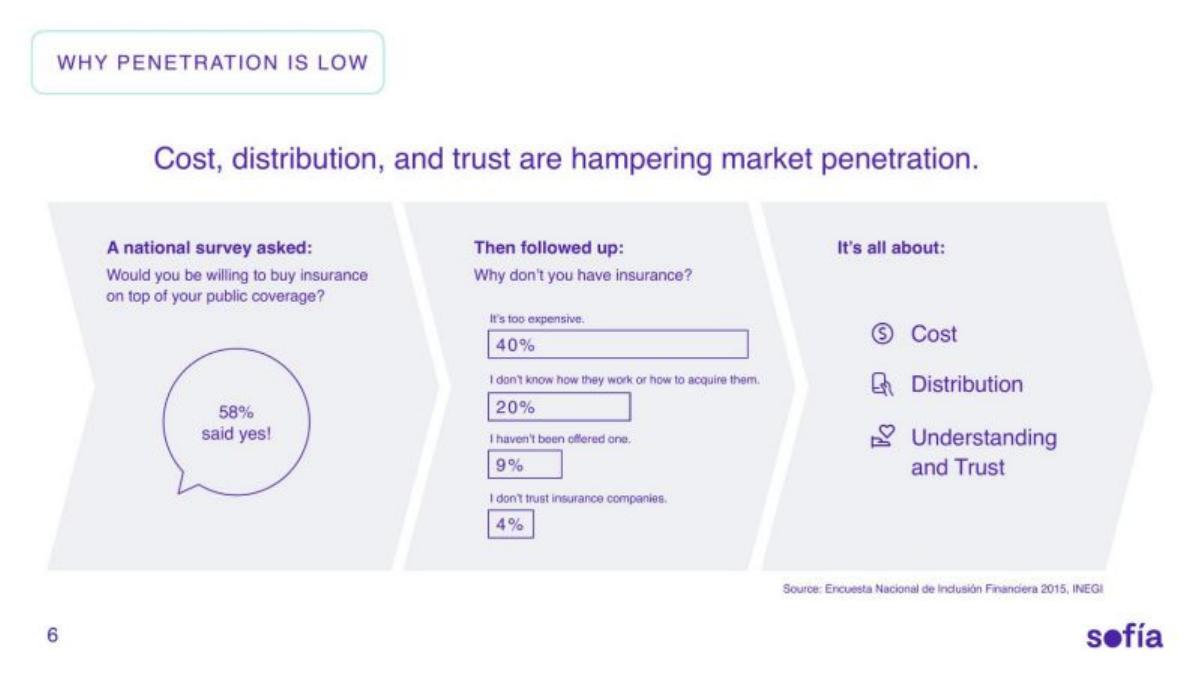
Our analysis: It separates demand from access with a cited national survey: 58% want cover, while 20% don't know how to get it and 9% were never offered it. That makes the case that distribution is the opportunity.
Evidence and limitation: The survey is from 2015, so check whether it is still the latest; and the slide stops at the problem. Follow it immediately with how Sofía reaches these people.
What a founder can adapt: If you claim distribution is broken, show evidence from customers, with a source and year.
Supporting analysis
What the deck claims: "Why penetration is low — Cost, distribution, and trust are hampering market penetration." "A national survey asked: Would you be willing to buy insurance on top of your public coverage?" 58% said yes. Follow-up "Why don't you have insurance?": 40% too expensive; 20% don't know how or how to acquire them; 9% haven't been offered one; 4% don't trust insurance companies. Source: Encuesta Nacional de Inclusión Financiera 2015, INEGI.
Presentation choice: It separates demand from access with a cited national survey: 58% want cover, while 20% don't know how to get it and 9% were never offered it. That makes the case that distribution is the opportunity.
When it does not fit: The survey is from 2015, so check whether it is still the latest; and the slide stops at the problem. Follow it immediately with how Sofía reaches these people.
Insurance platform in France. Parts of the stored slide are redacted. Stage and year are not stated.
Seyna deck, slide 2. Exact stored slide matched to this analysis.
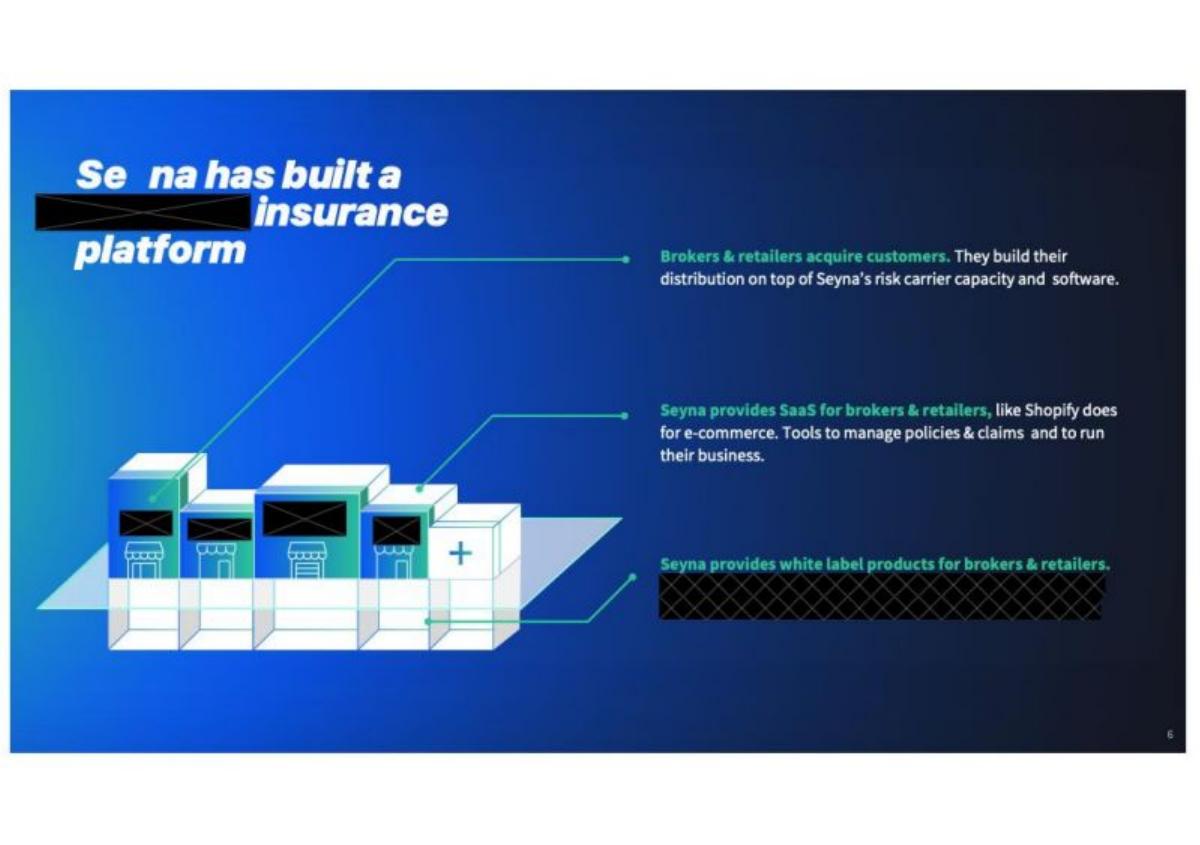
Our analysis: It is clear that Seyna does not sell to consumers: brokers and retailers do, on its capacity and software. The Shopify comparison makes the model easy to grasp.
Evidence and limitation: No partner is named and there is no count of partners or premium written through them; part of the slide is redacted in the stored copy. Add at least the number of distribution partners.
What a founder can adapt: If partners sell for you, say who they are and what you supply them.
Supporting analysis
What the deck claims: "Seyna has built a [redacted] insurance platform". Three points: "Brokers & retailers acquire customers. They build their distribution on top of Seyna's risk carrier capacity and software." "Seyna provides SaaS for brokers & retailers, like Shopify does for e-commerce. Tools to manage policies & claims and to run their business." "Seyna provides white label products for brokers & retailers."
Presentation choice: It is clear that Seyna does not sell to consumers: brokers and retailers do, on its capacity and software. The Shopify comparison makes the model easy to grasp.
When it does not fit: No partner is named and there is no count of partners or premium written through them; part of the slide is redacted in the stored copy. Add at least the number of distribution partners.
US health benefits start-up. Stage and year are not stated on the slide.
Vitable Health deck, slide 6. Exact stored slide matched to this analysis.
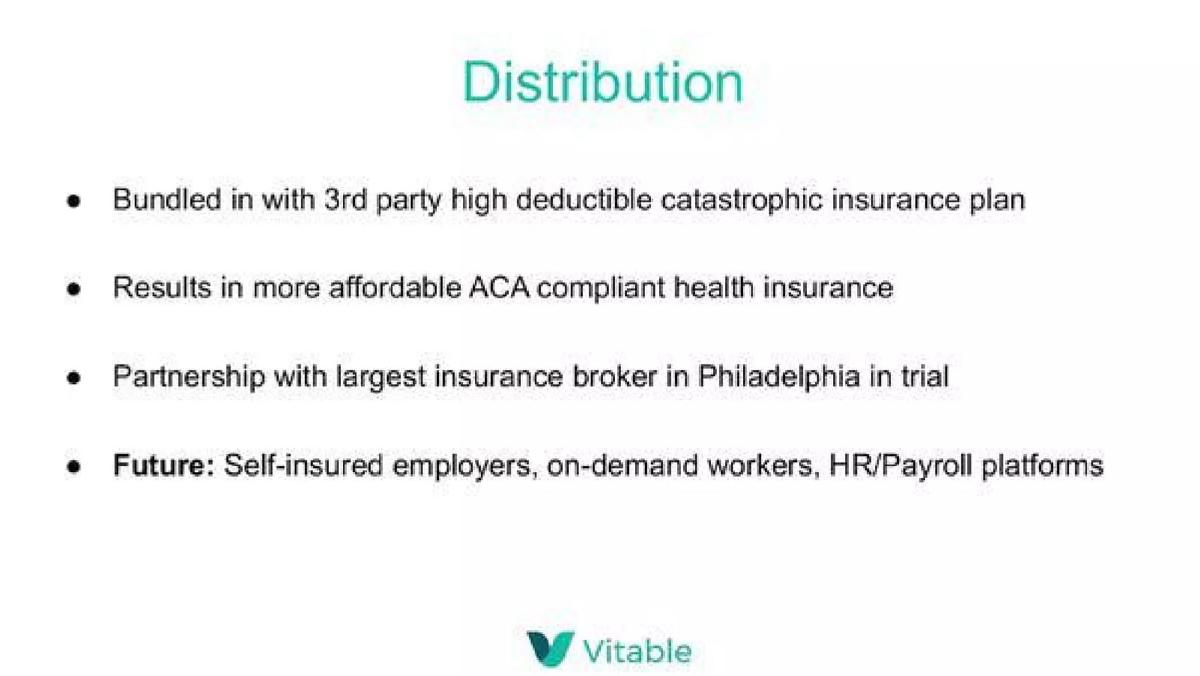
Our analysis: It separates what is happening now (bundling, a broker partnership in trial) from future channels, which is honest about the stage.
Evidence and limitation: Name the broker if you can, and say what the trial is measuring. Without volume, investors can't tell whether the channel works.
What a founder can adapt: Label each channel as live, in trial or planned.
Supporting analysis
What the deck claims: "Distribution": "Bundled in with 3rd party high deductible catastrophic insurance plan"; "Results in more affordable ACA compliant health insurance"; "Partnership with largest insurance broker in Philadelphia in trial"; "Future: Self-insured employers, on-demand workers, HR/Payroll platforms".
Presentation choice: It separates what is happening now (bundling, a broker partnership in trial) from future channels, which is honest about the stage.
When it does not fit: Name the broker if you can, and say what the trial is measuring. Without volume, investors can't tell whether the channel works.
Embedded insurance platform in the UK. Stage and year are not stated on the slide.
Wrisk deck, slide 4. Exact stored slide matched to this analysis.
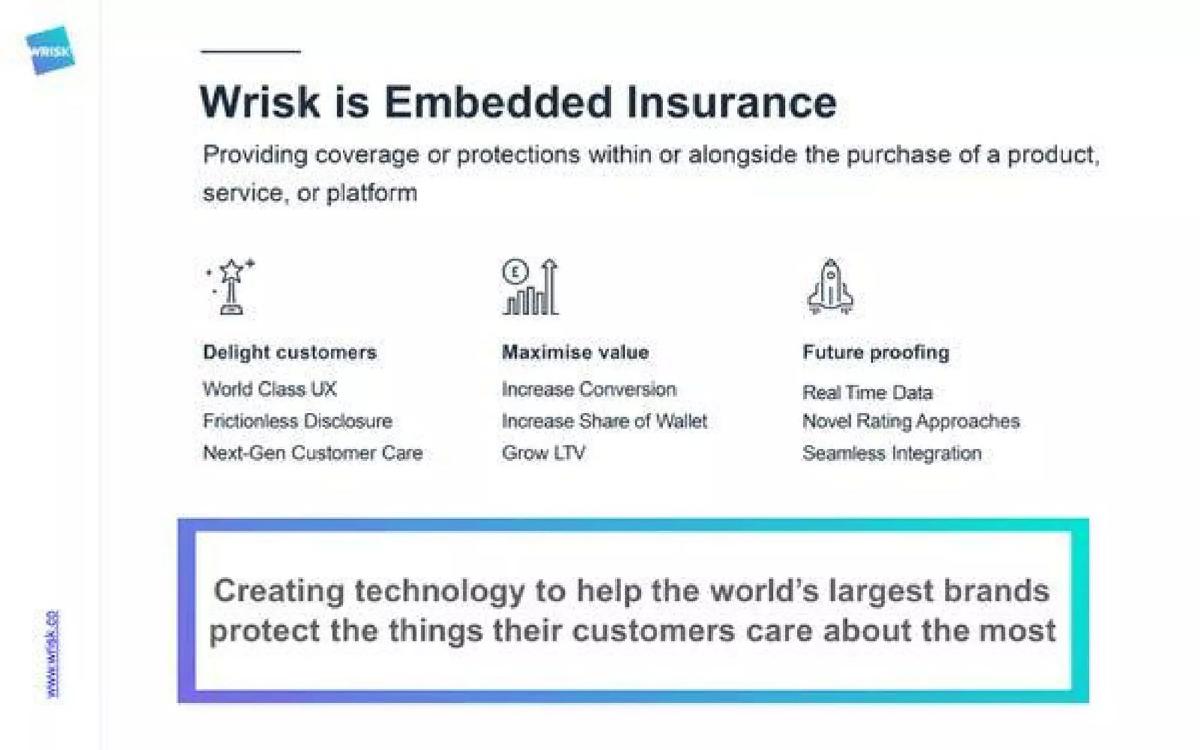
Our analysis: It defines embedded insurance in one line and frames the benefits from the partner brand's side (conversion, share of wallet), which is who Wrisk sells to.
Evidence and limitation: "The world's largest brands" are not named, and the benefits have no numbers. Name one live brand partner and the conversion or attach rate at checkout.
What a founder can adapt: Treat this as a slide to improve on. Keep the partner-side framing.
Supporting analysis
What the deck claims: "Wrisk is Embedded Insurance — Providing coverage or protections within or alongside the purchase of a product, service, or platform." Three columns: delight customers (world class UX, frictionless disclosure, next-gen customer care); maximise value (increase conversion, increase share of wallet, grow LTV); future proofing (real time data, novel rating approaches, seamless integration). "Creating technology to help the world's largest brands protect the things their customers care about the most."
Presentation choice: It defines embedded insurance in one line and frames the benefits from the partner brand's side (conversion, share of wallet), which is who Wrisk sells to.
When it does not fit: "The world's largest brands" are not named, and the benefits have no numbers. Name one live brand partner and the conversion or attach rate at checkout.
UK small-business insurance MGA. Stage and year are not stated on the slide.
Superscript deck, slide 3. Exact stored slide matched to this analysis.
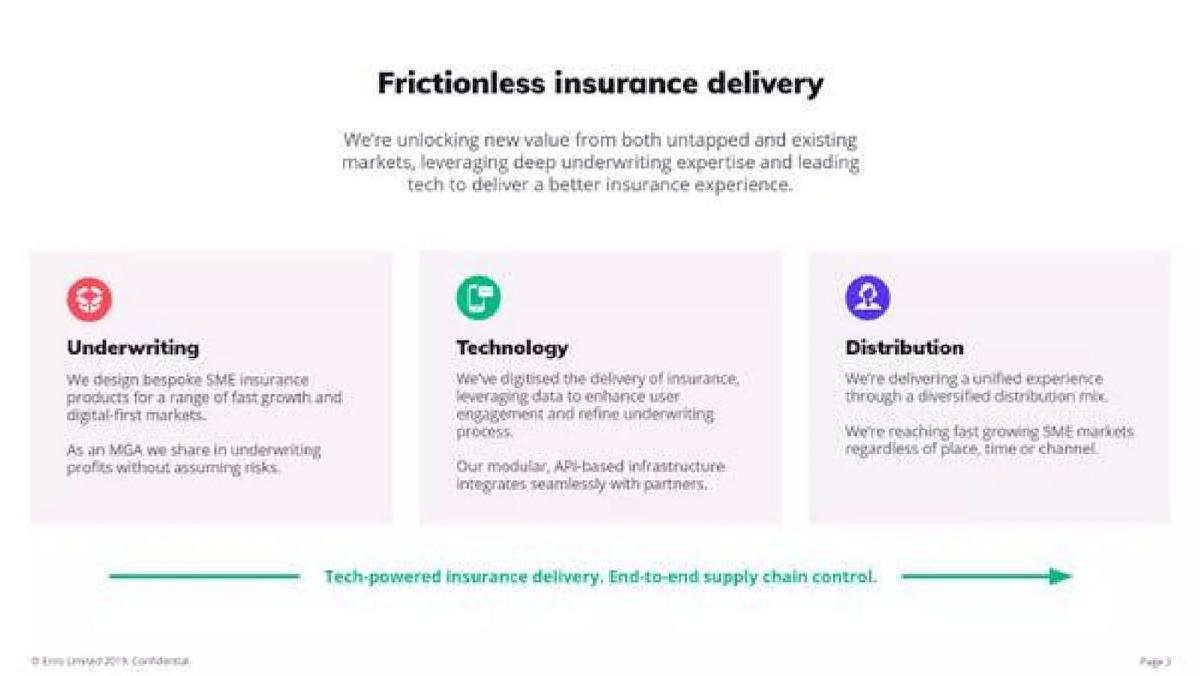
Our analysis: The underwriting column explains the MGA model clearly: profit share without carrying risk.
Evidence and limitation: The distribution column says nothing specific. Name the channels (direct, partners, brokers), the split between them and one partner.
What a founder can adapt: Treat this as a slide to improve on. Keep the one-line explanation of the risk model.
Supporting analysis
What the deck claims: "Frictionless insurance delivery": three columns. Underwriting (bespoke SME products; "As an MGA we share in underwriting profits without assuming risks"). Technology (modular, API-based infrastructure that "integrates seamlessly with partners"). Distribution: "We're delivering a unified experience through a diversified distribution mix. We're reaching fast growing SME markets regardless of place, time or channel."
Presentation choice: The underwriting column explains the MGA model clearly: profit share without carrying risk.
When it does not fit: The distribution column says nothing specific. Name the channels (direct, partners, brokers), the split between them and one partner.
Check your slide answers the last three columns; they're what investors test first.
Example
Model
Who sells the policy
Who carries risk
Evidence on slide
Clark
Digital brokerage
Clark, across 160+ carriers
Carriers, stated
42% recurring revenue
Branch
Direct + partner APIs
Branch and API partners
Reciprocal exchange
16% bundling saving (incumbent)
Sofía
Direct (problem framing)
Not shown on this slide
Not shown
National survey, 2015
Seyna
White-label + SaaS
Brokers and retailers
Seyna's carrier capacity
None; partly redacted
Vitable Health
Bundling + broker
Bundled plan, broker in trial
Third-party insurer
Stage labels
Wrisk
Embedded
Partner brands
Not stated
None
Superscript
MGA, mixed channels
Not specified
Insurers (MGA)
None
Key Takeaways
Draw the money flow. Clark shows who pays the premium, who receives commission, and what share of revenue is recurring.
Say why your channel is cheaper. Branch contrasts incumbents' acquisition costs with purchase through partner APIs at the moment of need.
Prove distribution is the bottleneck. Sofia cites a national survey: 58% would buy insurance, but many say it's too expensive or they don't know how to get it.
Name the partner and its stage. Vitable says its broker partnership is "in trial" rather than presenting it as signed.
"Embedded" and "diversified mix" are not a plan. Wrisk and Superscript describe the model but name no partner, volume or cost.
Build your insurtech distribution slide
Answer each prompt with a name or a number.
Channel. Who sells the policy: you, brokers, partners at checkout, or bundled with another product?
Money. Who pays the premium, who gets commission or fees, and what share of your revenue recurs?
Risk. Who carries the underwriting risk: you, an insurer, or a reinsurer?
Cost. What does it cost to acquire a policyholder in this channel, compared with incumbents?
Stage. Which channels are live, in trial or planned, and with which named partners?
Copyable framework: Policies are sold through [channel] via [named partners]. The customer pays [premium] to [carrier]; we earn [fee/commission], [X]% recurring. [Carrier] carries the risk. Acquisition cost: [£/$ figure] vs [incumbent figure]. Live: [channels]. In trial: [channels].
Illustrative example 1 — written by us
Before: Distribution: diversified, omnichannel, embedded with leading brands.
After: Distribution: embedded at checkout with [2] live retail partners ([names]); [X]% of their customers add cover. The customer pays the premium to [insurer]; we earn [Y]% commission. In trial with [broker].
What improved: Our illustrative rewrite, not any company's text. It names the channel, the money flow and the stage; bracketed values are placeholders.
What changes for insurance startups
The go-to-market guide covers how any startup reaches customers. Insurance adds three things investors check: who carries the risk (an insurer, an MGA with underwriting authority, or a broker who carries none), who owns the customer relationship, and how commissions and fees split between the parties. A distribution slide that leaves these unclear raises questions about margins and regulation.
The main models in the corpus: direct digital sales, a digital brokerage across many carriers, embedded insurance sold at a partner's checkout, white-label products and software for brokers and retailers, and bundling with another product. The fintech licence guide covers the licences behind these models.
Common mistakes
"Omnichannel" with no channels named. Say which channel sells the policy.
Money flow left out. Show premium, commission and fees.
Risk carrier unclear. Say who holds the underwriting risk.
Partners unnamed. Name at least one and its stage.
No acquisition cost. Give the figure or a comparison.
Diagnostic checklist
The selling channel is named.
Premium, commission and fee flows are shown.
Who carries risk is stated.
At least one partner is named with its stage.
Acquisition cost or a comparison is given.
Live, trial and planned channels are labelled.
Frequently asked questions
How we chose these examples
Corpus: published pitch deck teardowns on StartupFundraising.com. Founder-uploaded private decks are excluded.
Selection (2026-09-24): we searched extracted text of slides 2–6 for insurance slides mentioning distribution, brokers, agents, channels, embedded insurance or MGAs, and found about 30 slides, many of them non-insurance or passing mentions. We excluded Counterpart and Cachet (used in other guides), Faye (a summary slide), Beam (product features for brokers rather than distribution), Troy Medicare (excluded from new examples) and non-insurance matches. Seven slides remain.
Overlap check: the go-to-market guide covers how any startup reaches customers; the fintech licence guide covers regulatory licences. This guide covers only how insurance startups explain policy distribution.
Review: all seven stored slide images were inspected on 2026-09-24 and matched to company, deck and slide number (editorial model review). No person has yet completed an editorial review of this page.
Figures such as recurring revenue share, carrier counts and survey results are the companies' own or cited by them, and have not been independently verified. We make no claim that any slide caused a fundraising outcome.