Sofia’s 17-slide Series A deck is a masterclass in identifying market inefficiency. By highlighting that only 9% of private health spend in Mexico currently goes through insurance (Slide 4), the company positions itself as the primary solution for a $25B latent market. The deck focuses heavily on the structural failures of incumbents—specifically their reliance on brokers and intrusive sales tactics—and contrasts this with Sofia’s direct-to-consumer, digital-native approach. While the deck is light on specific financial performance or unit economics, it leans heavily on the pedigree of its ba…
Key takeaways
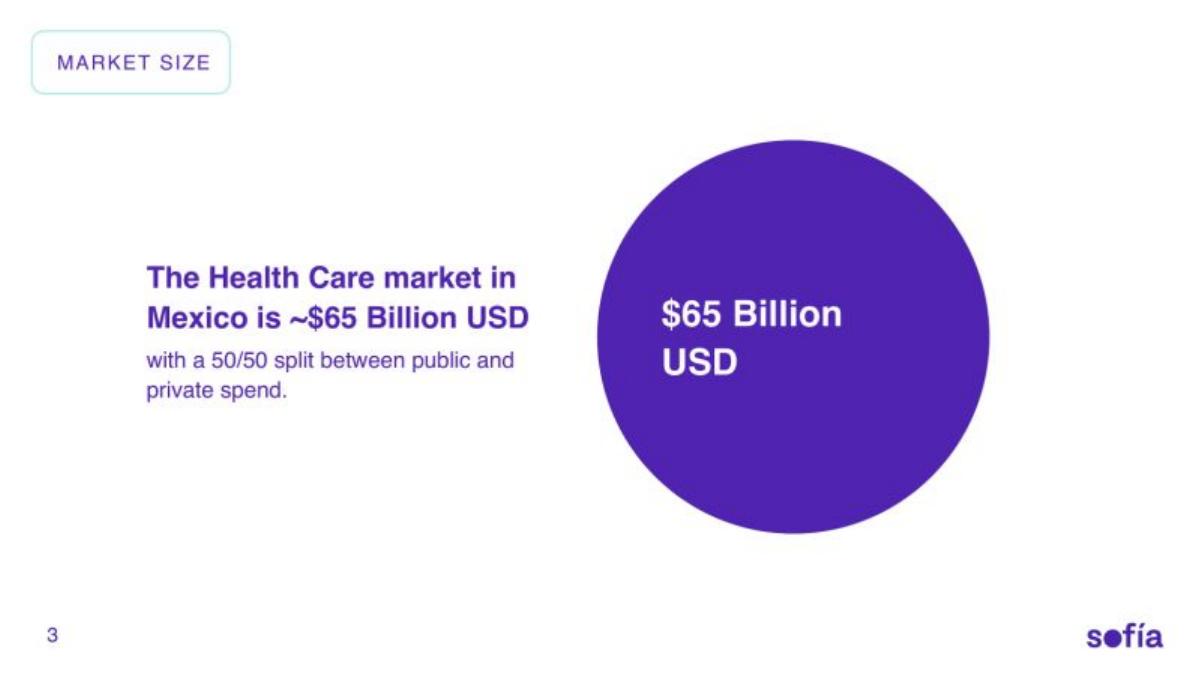
- The Mexican healthcare market is valued at ~$65 Billion USD with a 50/50 split between public and private spend (Slide 3).
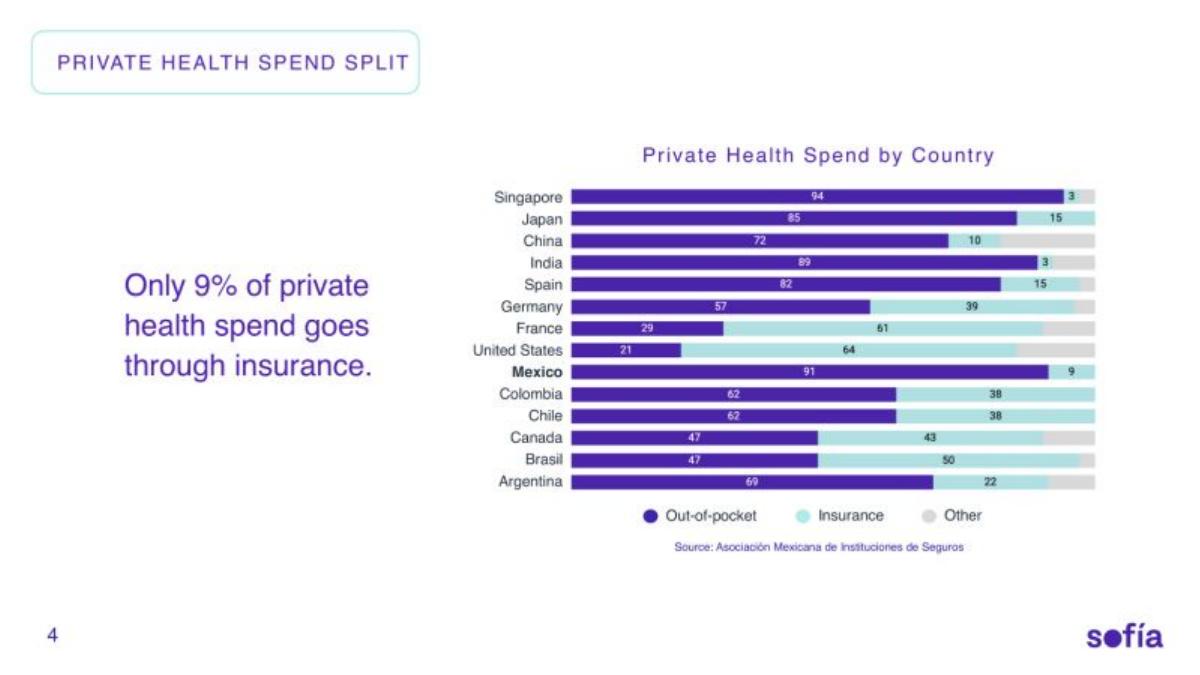
- A staggering 91% of private health spend in Mexico is out-of-pocket, compared to just 21% in the United States (Slide 4).
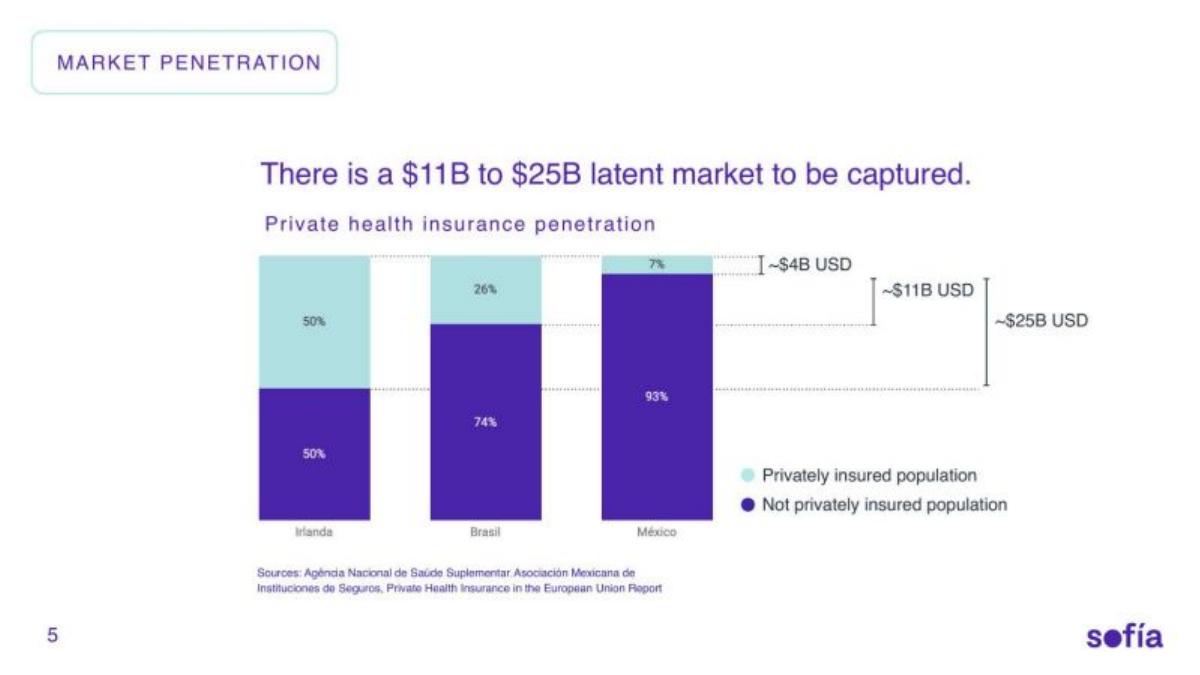
- Sofia identifies a latent market opportunity between $11B and $25B by comparing Mexico's insurance penetration to Brazil and Ireland (Slide 5).
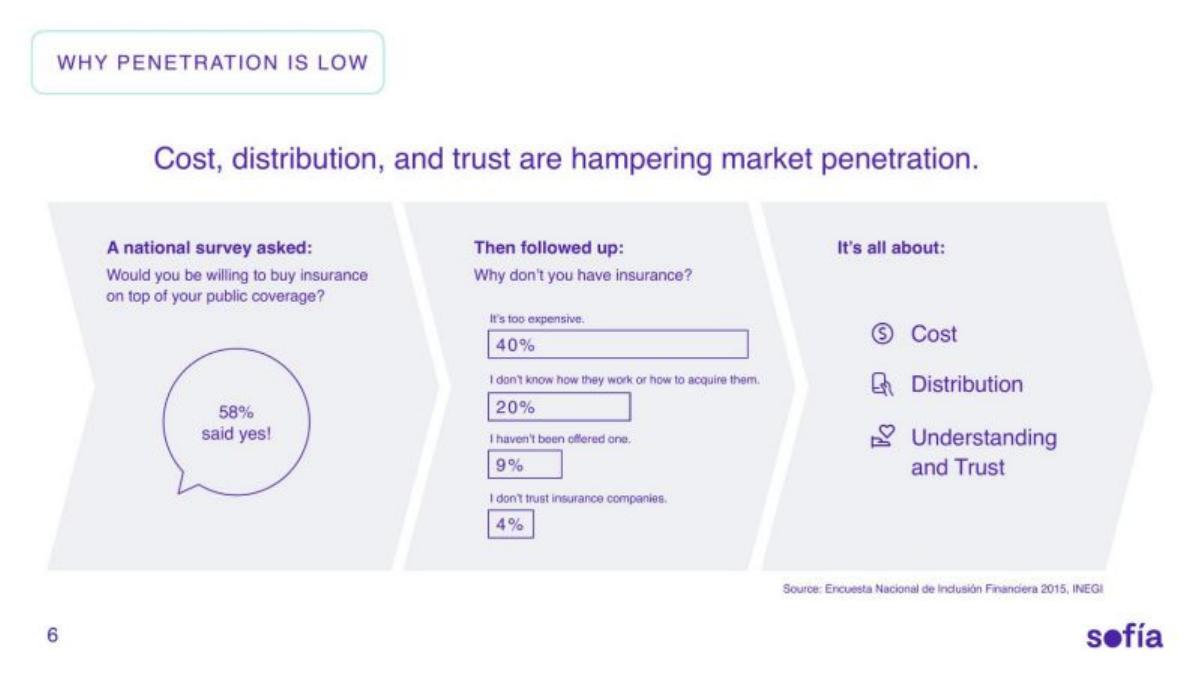
- The primary barriers to insurance adoption are cost (40%), lack of distribution knowledge (20%), and lack of trust (4%) (Slide 6).
- Sofia utilizes a 'closed group' of over 80 specialists and specific hospital partners like San Angel Inn and Reina Madre to control care quality (Slide 9).
- The product targets the middle class with an annual premium of $300-$500 USD per person and a sum insured of $50k-$75k USD (Slide 11).
- The business model is strictly direct-to-consumer, removing the broker intermediaries that characterize incumbent insurance models (Slide 13).
- The deck omits a traditional team slide, focusing instead on institutional backing from Ribbit Capital, Kaszek Ventures, and Cavalry Ventures (Slide 15).
The Macro Opportunity: A $65 Billion Gap
Slides 1-3: Introduction and Market Scale
Sofia opens with a minimalist brand identity, moving immediately into 'the problem' (Slide 2). The deck establishes the scale of the opportunity on Slide 3, stating that the health care market in Mexico is approximately $65 Billion USD . Crucially, they note a 50/50 split between public and private spend. This sets the stage for a venture-scale play by showing that $32.5 billion is already being spent in the private sector, even before accounting for market growth.
Slides 4-6: The Inefficiency of Out-of-Pocket Spend
Slide 4 is the 'anchor' of the entire pitch. It compares private health spend by country, showing that in Mexico, 91% of private health spend is out-of-pocket . This is contrasted with the US (21%), Germany (57%), and even regional peers like Colombia (62%) and Brazil (47%). This data point argues that the Mexican insurance market isn't just small; it is fundamentally broken.
Slide 5 quantifies the 'latent market' at $11B to $25B . By showing that only 7% of the Mexican population is privately insured compared to 26% in Brazil and 50% in Ireland, Sofia suggests that simply reaching regional parity represents a massive tailwind. Slide 6 uses survey data to explain why penetration is low: 40% cite cost, 20% don't know how to acquire it, and 9% haven't been offered a plan. This identifies the three pillars Sofia must solve: affordability, distribution, and awareness.
The Solution: A Full-Stack Health Plan
Slides 7-9: Value Proposition and Care Delivery
The solution (Slide 7) is presented as a 'complete' health plan. Slide 8 breaks this down into three attributes: Simple (digital experience), Close (direct contact, no intermediaries), and Complete (preventive, primary, and major health issues). This is a 'full-stack' approach where the company isn't just a software layer but the actual insurer and care coordinator.
Slide 9 details the 'Care Delivery Partners.' Sofia employs a closed group of 80+ specialists for video consultations (on payroll) and partners with established physical providers like San Angel Inn and Salud Digna for secondary care. This hybrid model—digital first, but physically integrated—is designed to control costs and quality, a necessity for a sustainable insurance business.
Slides 10-11: Medical Strategy and Pricing
Slide 10 outlines a shift in medical philosophy: prioritizing 'high value care organizations over brand driven providers' and 'episode based care over accumulation of fees for services.' This is a direct attack on the 'fee-for-service' model that often leads to over-treatment and high insurance claims.
Slide 11 defines the product for the 'growing middle class.' The Annual Premium is $300-$500 USD per person , with a Sum Insured of $50k-$75k USD . By setting these specific bounds, Sofia shows investors they have a clear target demographic and a price point that addresses the 'cost' barrier identified in Slide 6.
Business Model and Distribution
Slides 12-13: The Customer Journey and Competitive Advantage
Slide 12 visualizes the app experience, from subscription to video consultations and claims management. It emphasizes the 'Assistant' feature, suggesting a high-touch, concierge-style service delivered through a low-cost digital interface.
Slide 13 provides a direct comparison between 'Incumbents' and Sofia. The key takeaway is the Direct to Consumer (DTC) distribution . Incumbents are 'agent dependent,' meaning they pay high commissions to brokers who own the customer relationship. Sofia claims to own the relationship, utilize a 'one-off cost structure' for sales, and use data-driven marketing. This slide argues that Sofia's unit economics will inherently be superior to traditional insurers because they aren't paying away their margin to a middleman.
Slides 14-17: Backers and Conclusion
The deck concludes with 'Our Backers' (Slide 14). Slide 15 displays a world map highlighting Ribbit Capital, Kaszek Ventures, and Cavalry Ventures . For a Series A round, this level of institutional validation often replaces the need for deep financial disclosures in the initial deck. The final slides (16-17) reiterate the mission to 'improve the health of millions of people' and provide the website URL.
What Sofia's Deck Does Well
Extreme Clarity on Market Gap: The use of the 91% out-of-pocket statistic (Slide 4) is a perfect way to frame a 'why now' and 'why here' argument. · Vertical Integration: The deck clearly explains how they control the care (Slide 9) and the insurance (Slide 11), which is essential for managing the Loss Ratio in insurtech. · Competitive Contrast: Slide 13 effectively vilifies the incumbent model (brokers, intrusive sales) to make Sofia's digital-native approach seem like the only logical evolution.
What is Missing from the Sofia Deck
The Team: There is no slide introducing the founders or their specific expertise in insurance or healthcare. This is a significant omission for a $19M round. · Traction Metrics: The deck contains zero data on how many users Sofia has, their growth rate, or their claims experience to date. · The Ask: There is no slide detailing how much capital is being raised or how it will be allocated (e.g., hiring, marketing, regulatory capital). · Unit Economics: While they mention a $300-$500 premium, they do not disclose Customer Acquisition Cost (CAC) or Lifetime Value (LTV) projections.
What Founders Should Copy
The 'Latent Market' Argument: If you are in an emerging market, don't just show the current market size. Show the 'latent' size by comparing your country's penetration to more developed neighbors (Slide 5). · The 'Over/Under' Strategy: Slide 10 uses a 'this OVER that' format to explain their medical strategy. This is a very effective way to communicate company values and operational focus without using jargon. · Visualizing the Journey: Slide 12 uses simple mobile mockups and arrows to explain a complex service (insurance + telehealth) in a way that feels seamless and easy to understand.
Frequently asked questions
- What is Sofia's core business model?
- Sofia operates as a full-stack health insurance provider and telehealth platform. Unlike traditional insurers that rely on third-party brokers, Sofia uses a direct-to-consumer model. They provide a mobile app for video consultations, primary care, and insurance management, targeting Mexico's middle class with premiums ranging from $300 to $500 USD annually.
- How does Sofia differentiate itself from incumbent insurance companies?
- According to slide 13, incumbents are 'agent dependent' with 'intrusive sales behavior' and 'generic messaging.' Sofia differentiates by owning the customer relationship directly, utilizing a digital-native platform, and offering a 'one-off cost structure' for sales rather than the ongoing commission-heavy structure of traditional brokers.
- What is the size of the market Sofia is targeting?
- The deck identifies the total Mexican healthcare market at $65 billion. However, the 'latent' market—the opportunity created by moving out-of-pocket spend into insurance—is estimated between $11 billion and $25 billion, based on penetration levels in comparable markets like Brazil.
- Who are Sofia's medical partners?
- Sofia uses a 'closed group' strategy. Slide 9 lists over 80 specialists on payroll for video consultations. Physical care is delivered through partners including San Angel Inn (6 hospitals), Servicura (2 clinics), Reina Madre (maternity), and labs like Salud Digna and Chopo.
- What is missing from the Sofia pitch deck?
- The deck is notably missing a team slide detailing the founders' backgrounds. It also lacks a 'The Ask' slide specifying how the $19M would be spent, and it provides no historical traction data, such as current user count, Loss Ratio, or Customer Acquisition Cost (CAC).