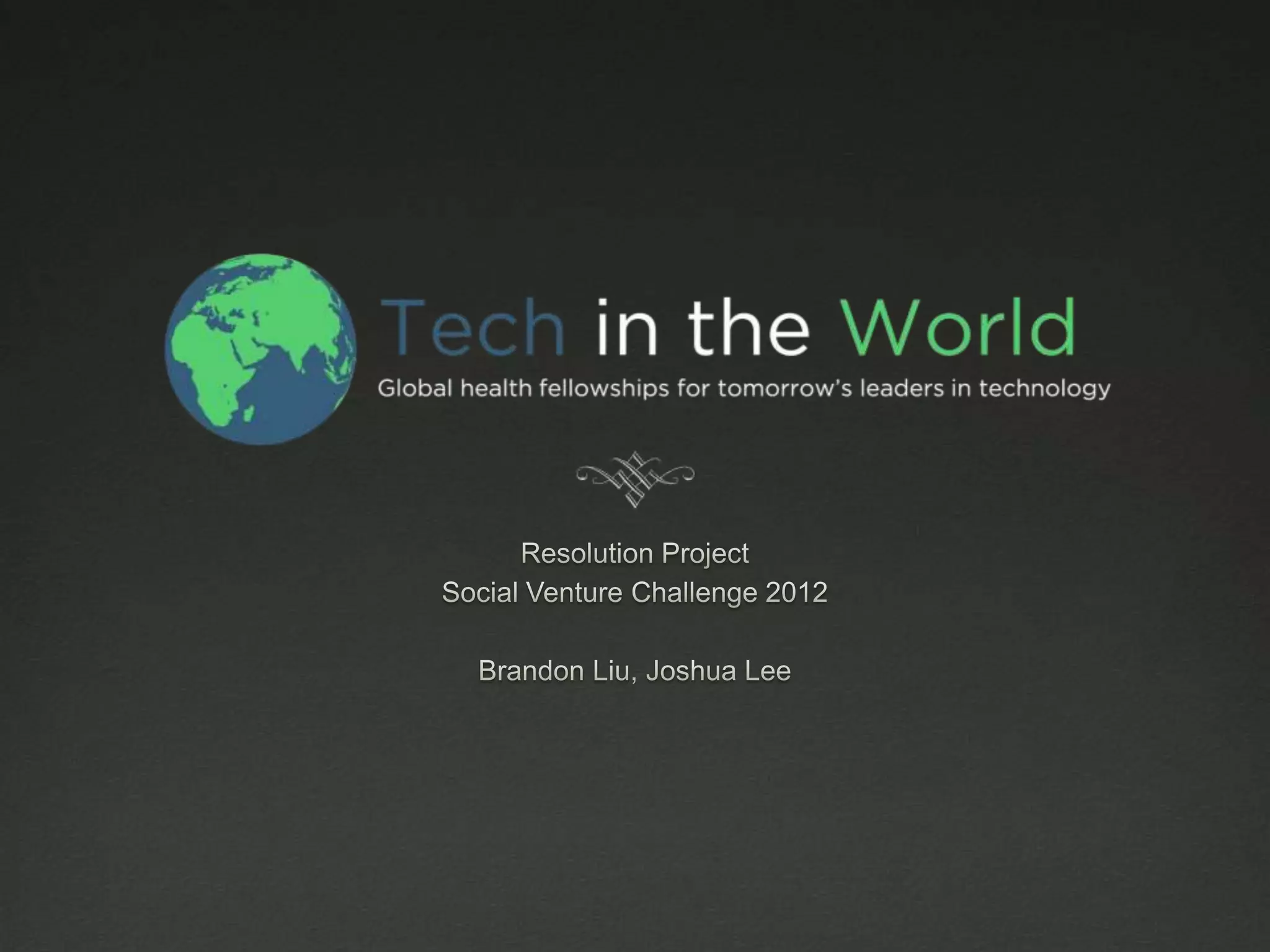
Tech in the World’s 2012 pitch deck is a minimalist presentation designed for a social venture competition. The company proposes a fellowship model, explicitly cited as being 'Modeled like TFA' (Teach For America), to bridge the gap between computer science students and global health organizations. The deck identifies three core pillars: addressing the lack of opportunities for CS students, providing prestige/career development, and managing the logistics and funding of these placements. While the deck features a strong advisory team including a Harvard Business School Senior Fellow, it lacks…
Key takeaways
- The venture identifies a disconnect between computer science students and global health organizations using a 'Road Closed' visual metaphor on Slide 2.
- The business model is explicitly compared to Teach For America (TFA) to provide instant context for the fellowship structure on Slide 3.
- The team includes high-profile academic and social enterprise advisors, such as David Ager, Ph.D. from HBS and Jackie Stenson of Essmart, shown on Slide 4.
- The deck utilizes four consecutive single-word or single-phrase slides (Slides 5-8) to emphasize values like 'Learning,' 'Evaluation,' and 'Transparency.'
- There is a complete absence of financial projections, unit economics, or a specific funding request in the 9-slide deck.
- The primary value proposition for participants is 'Prestige and career development,' as stated on Slide 3.
- The deck identifies 'logistics' and 'funding' as primary challenges to be evaluated rather than solved problems on Slide 3.
The Conceptual Pitch: Tech in the World Teardown
Tech in the World’s 9-slide deck, prepared for the 2012 Social Venture Challenge, is a study in minimalist, mission-driven storytelling. Rather than overwhelming the audience with data, the founders—Brandon Liu and Joshua Lee—focus on a clear problem-solution gap in the social enterprise space. The deck is designed for a competition environment where the 'why' and 'who' often take precedence over the 'how much' in the early stages.
Slide 1: Title and Mission
The cover slide introduces the brand 'Tech in the World' with a logo featuring a stylized globe. The subtitle, "Global health fellowships for tomorrow’s leaders in technology," immediately defines the product and the target demographic. It also notes the context: "Resolution Project Social Venture Challenge 2012." This sets the stage for a non-profit or social enterprise pitch rather than a commercial startup pitch.
Slide 2: The Gap
Slide 2 uses a literal visual metaphor to describe the market friction. On the left, a circle labeled "Comp Science Students" ; on the right, "Global Health Organizations." Between them is a graphic of a "ROAD CLOSED" sign and a construction barrier. A faint bridge is drawn behind the barrier, suggesting that the connection exists but is currently blocked. This slide effectively communicates that the problem isn't a lack of talent or a lack of need, but a lack of access.
Slide 3: The Fellowship Model
This slide provides the operational framework. It explicitly states the venture is "Modeled like TFA" (Teach For America), which serves as a powerful shorthand for investors to understand the recruitment, training, and placement cycle. The slide lists three focus areas:
1. Lack of opportunities for CS students: Identifying the underserved talent pool. · 2. Prestige and career development: Defining the incentive for the students. · 3. Evaluating opportunities; logistics; funding...: Acknowledging the operational hurdles.
The use of an ellipsis after 'funding' suggests that these are ongoing areas of development for the founders.
Slide 4: The Team and Advisors
This is arguably the strongest slide in the deck. It features headshots of the two Co-Founders, Brandon Liu and Joshua Lee . More importantly, it lists three high-signal advisors:
Jackie Stenson: Co-Founder of Essmart. · David Ager, Ph.D.: Senior Fellow at Harvard Business School (HBS). · Annemarie Ryu: CEO of Global Village Fruits.
Including these names lends immediate credibility to a student-led venture, suggesting that the founders have access to experienced mentors in both academia and social entrepreneurship.
Slides 5-8: The Value Pillars
The deck then moves into a series of four slides that each contain only one or two words. This is a stylistic choice often used in live presentations to keep the audience focused on the speaker's words.
Slide 5: "We don’t know all the answers" – A move toward radical honesty and coachability, which is often valued in social venture competitions. · Slide 6: "Learning" – Emphasizing the iterative nature of the pilot. · Slide 7: "Evaluation" – Signaling a commitment to measuring impact. · Slide 8: "Transparency" – A core value for non-profit entities.
While these slides work well for a speech, they provide zero information for a reader viewing the deck asynchronously.
Slide 9: Conclusion
The final slide repeats the mission statement: "Develop tomorrow’s leaders in technology" and the logo. It lacks a 'Call to Action' (CTA), contact information, or a summary of the 'Ask.'
What Tech in the World Does Well
The deck excels at contextual anchoring . By referencing Teach For America on Slide 3, the founders bypass the need for five slides explaining how a fellowship works. Everyone in the social impact space understands the TFA model: recruit top-tier talent, provide a prestigious badge, and place them where they are needed most.
The visual simplicity is also a strength for a live pitch. The 'Road Closed' graphic on Slide 2 is a clear, visceral representation of the problem that requires no explanation. Furthermore, the Advisory Board selection is excellent. For a 2012-era social venture, having a Senior Fellow from HBS and established social entrepreneurs like Jackie Stenson provides a 'safety net' for donors or judges who might otherwise worry about the founders' lack of experience.
What is Missing from the Deck
As a standalone document, this deck is significantly under-powered. The most glaring omission is Unit Economics . There is no mention of what it costs to send one fellow abroad, who pays for the flight, or how the global health organizations contribute to the cost. Without a 'Cost per Fellow' metric, it is impossible to judge the scalability of the model.
Second, the Ask is missing. In a Social Venture Challenge, there is usually a grant or prize at stake. The deck does not specify how much money they are seeking or how they would spend a hypothetical $10,000 or $50,000 grant. Would it go toward the first pilot? Marketing? Legal fees for international placements?
Finally, there is no Traction or Roadmap . Even if the venture was in the idea stage, a slide showing 'Target Partners' (specific health organizations) or a 'Pilot Timeline' (e.g., Summer 2013) would have transformed the deck from a conceptual exercise into a concrete business plan.
Founder's Guide: What to Copy
Use 'The Model' Shorthand: If your business is 'Uber for X' or 'TFA for Y,' say it. It saves time and allows you to focus on your unique differentiators rather than explaining basic mechanics. Tech in the World uses this perfectly with the TFA reference.
Leverage Your Advisors: If you are a young founder, your advisor slide is your most important asset. Tech in the World gives their advisors equal visual weight to the founders, which is a smart move when the founders' resumes are still developing.
Visual Metaphors: Slide 2's barrier graphic is much more memorable than a bulleted list of 'Market Inefficiencies.' Use simple icons or photos to represent the 'Before' state of the world you are trying to fix.
Founder's Guide: What to Avoid
Empty Slides: Avoid slides like 5 through 8 in a deck that will be shared via email. While 'Transparency' and 'Learning' are great values, they are 'dead air' in a PDF. If you must use them in a presentation, merge them into a single 'Our Values' slide for the version you send to investors.
Omitting the Ask: Never end a pitch without telling the audience exactly what you want. Whether it is $500k in seed funding or a partnership with a specific NGO, the final slide should be a clear invitation to take the next step.
Vague Logistics: On Slide 3, the founders list 'logistics' and 'funding' as things they are 'evaluating.' In a pitch, you should present a plan for logistics, not just an acknowledgment that logistics exist. Investors fund solutions, not a list of upcoming chores.
Frequently asked questions
- What is the primary mission of Tech in the World?
- According to Slide 1 and Slide 9, the mission is to provide 'Global health fellowships for tomorrow’s leaders in technology.' The organization aims to develop these leaders by placing computer science students into roles within global health organizations where their technical skills are needed but currently underutilized.
- Who are the key people involved in this project?
- Slide 4 lists Brandon Liu and Joshua Lee as Co-Founders. The advisory team includes Jackie Stenson (Co-Founder of Essmart), David Ager, Ph.D. (Senior Fellow at Harvard Business School), and Annemarie Ryu (CEO of Global Village Fruits). This suggests a strong connection to the Harvard/MIT social entrepreneurship ecosystem.
- How does the organization plan to operate?
- Slide 3 states the venture is 'Modeled like TFA' (Teach For America). This implies a selective recruitment process for high-achieving students who are then placed in high-impact environments for a set period, focusing on professional development and social contribution.
- What problems does the deck identify for CS students?
- Slide 3 highlights a 'Lack of opportunities for CS students' in the social impact sector. It suggests that while these students have valuable skills, there is no clear pathway for them to apply those skills to global health, unlike more established paths in finance or big tech.
- Is there a clear financial ask in the deck?
- No. The deck concludes on Slide 9 with a restatement of the mission and logo. There is no mention of the total amount of capital required, how the funds will be allocated, or the specific terms of the 'Social Venture Challenge' prize they were competing for.