Howdy's 31-slide Series A deck, which secured $18M in 2022, addresses the persistent shortage of US-based software engineers by streamlining the hiring of Latin American talent. The presentation moves beyond simple staffing, positioning Howdy as a comprehensive platform that automates sourcing, payroll, local benefits, and procurement. A significant portion of the deck is dedicated to the 'human' element of remote work, showcasing how the platform facilitates physical perks like branded welcome kits and ergonomic equipment to maintain company culture across borders. While the deck relies heav…
Key takeaways
- The deck positions Howdy as an automation layer for sourcing, vetting, payroll, and retention on Slide 9.
- Howdy uses a Wired article from Nov. 11, 2022, to validate that tech talent remains in high demand despite broader market layoffs on Slide 4.
- The platform includes a specific feature for procurement, allowing US companies to ship branded welcome kits and hardware to LATAM devs as shown on Slide 13.
- Management claims that growth has been driven 'solely through word-of-mouth referrals' on Slide 28.
- The 'dev-first' philosophy is a core theme, with Slide 21 stating that 'work will remain remote... but people will always be social.'
- The deck omits specific financial metrics, churn rates, or detailed unit economics, focusing instead on the operational workflow.
- A client logo slide (Slide 2) is used early to establish market credibility before explaining the developer shortage.
- The team slide (Slide 30) features co-founder bios but lacks a broader organizational chart or headcount details.
Executive Summary: The Automation of Nearshore Engineering
Howdy’s pitch deck for their $18M Series A round in 2022 is a study in narrative-driven fundraising. The company, headquartered in North America, targets a specific pain point: the difficulty of hiring and retaining high-quality software engineers within the United States. By focusing on Latin America (LATAM), Howdy positions itself not just as a recruiter, but as a full-stack infrastructure provider that handles the 'messy' parts of international employment—compliance, logistics, and culture.
Slides 1-2: Branding and Social Proof
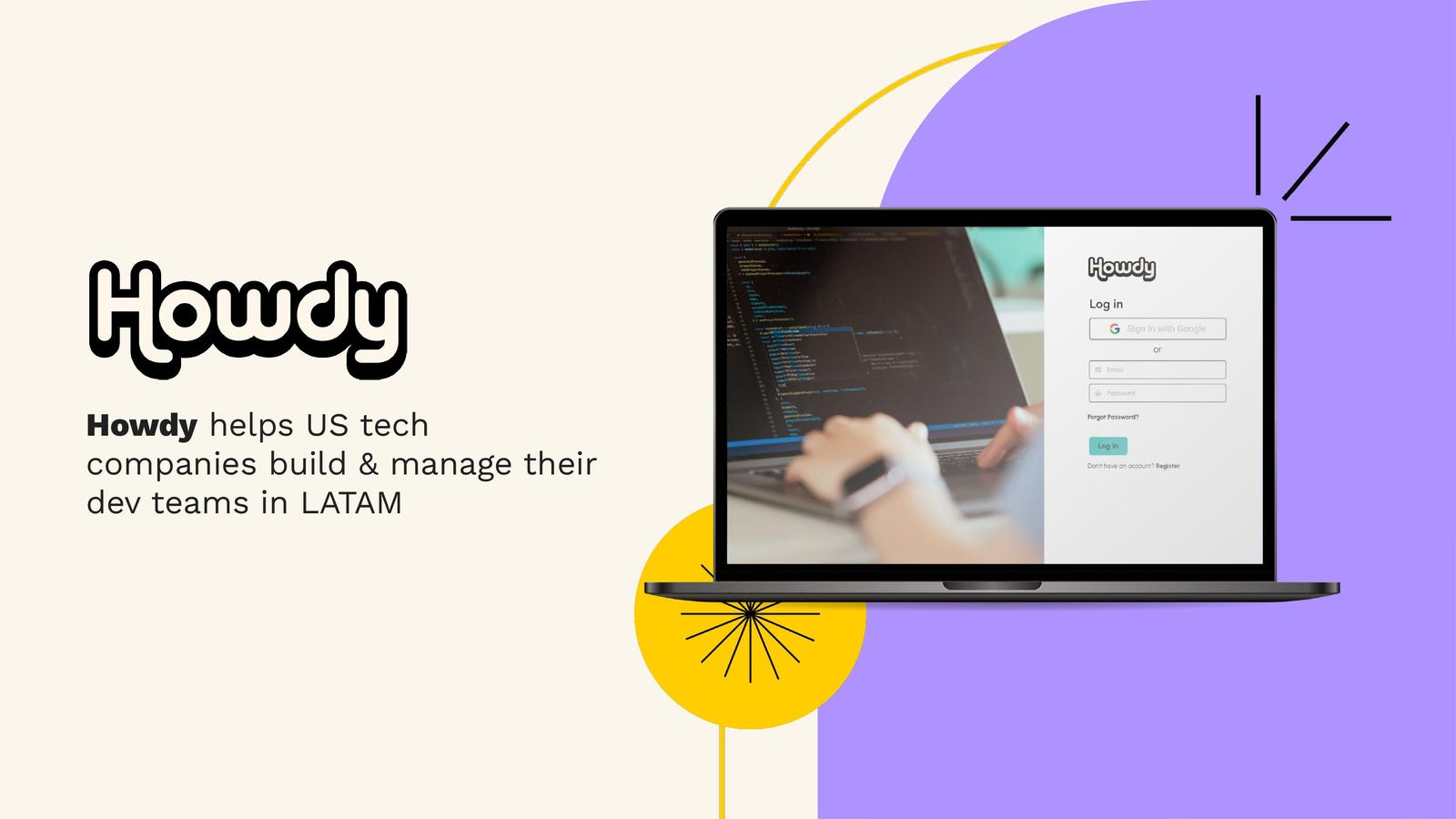
Slide 1 introduces the company with a clean, purple-and-white aesthetic. The value proposition is stated clearly: 'Howdy helps US tech companies build & manage their dev teams in LATAM.' This immediate clarity is essential for investors. Slide 2 follows up with a logo wall of existing clients. By placing social proof at the very beginning, Howdy establishes that their model is already functional and trusted by market participants before they even define the problem.
Slides 3-7: The 'Why Now' and Market Context
The deck uses a 'Why' slide (Slide 3) to transition into the macro-economic environment. Slides 4 through 7 address the developer shortage. Interestingly, Slide 4 features a quote from a Wired article dated November 11, 2022: 'Despite Big Layoffs, Tech Workers Are Still in Demand.' This is a strategic inclusion for a 2022 raise, as it directly counters the narrative of a tech downturn by arguing that the specific talent Howdy provides remains a scarce and necessary resource. Slides 5, 6, and 7 continue to build this case with data regarding the engineering talent gap.
Slides 8-9: The Solution and Automation Pillars
Slide 8 introduces how Howdy helps LATAM developers get hired, shifting the perspective to the supply side of their marketplace. Slide 9 is the 'product' meat of the deck. It lists six automated functions: Sourcing, Vetting, Payroll, Local Benefits & Perks, Procurement, and Retention . This slide is critical because it moves the company away from being a 'service business' (which gets lower valuations) and toward being a 'platform business' (which gets higher SaaS-style multiples).
Slides 10-13: The Employer Experience and Logistics
Slides 10 through 12 explain the hiring process from the employer's perspective. Slide 13 is particularly notable as it shows a screenshot of the Howdy platform. It lists specific equipment and benefits that can be added for remote employees, such as a MacBook Pro M2 (+$500), Ergonomic desk chair (+$150), and Pet Insurance (+$100/mo). This level of granular detail demonstrates that Howdy has solved the 'last mile' of remote work—getting physical goods and localized benefits to developers in different countries.
Slides 14-27: The Developer Experience and Community
A large section of the deck (Slides 14-27) is dedicated to the developer's side of the ecosystem. Slide 21 captures the company's core philosophy: 'We believe work will remain remote, talent will continue to be distributed, but people will always be social.' This section emphasizes that Howdy isn't just a payroll processor; they are building a community. Slide 27 reinforces this with the phrase 'Because great engineers know other great engineers,' suggesting that their talent acquisition strategy relies on high-quality internal networks rather than just cold outbound sourcing.
Slides 28-31: Growth and Team
Slide 28 makes a bold claim: 'Howdy has had this explosive growth solely through word-of-mouth referrals.' Slide 29 emphasizes 'And nothing else,' doubling down on the idea that their product-market fit is so strong they haven't needed a traditional sales and marketing spend yet. Slide 30 introduces the co-founders with headshots and bios, providing the necessary human context for the Series A investment. The deck concludes on Slide 31 with the company logo.
What Howdy Does Well
The deck excels at humanizing a technical and logistical problem. By showing photos of actual developers and screenshots of 'welcome kits,' they make the abstract concept of 'LATAM engineering' feel tangible and manageable. The focus on automation (Slide 9) is also a strong tactical move to justify a venture-scale valuation. They successfully frame the 'nearshore' advantage—similar time zones and cultural alignment—without explicitly using those buzzwords, instead showing it through the lens of 'social' work and community.
What is Missing from the Deck
For a Series A deck, there is a surprising lack of hard financial data in the provided slides. There are no charts showing Month-over-Month (MoM) revenue growth, no mention of Annual Recurring Revenue (ARR), and no breakdown of take rates or margins. While they mention 'explosive growth,' investors typically require quantitative proof of that explosion at this stage. Additionally, there is no competitive landscape slide. The 'Employer of Record' and 'Remote Hiring' space is crowded with giants like Deel and Remote.com, as well as specialized firms like Terminal. Howdy does not explicitly state how their platform differs from these multi-billion dollar incumbents, other than a implied focus on the LATAM region and 'community.'
Founder Takeaways: Copy the 'Last Mile' Focus
Founders building in the HR Tech or Future of Work space should take note of Slide 13. Most platforms stop at 'we handle payroll.' Howdy wins by showing they handle the physical reality of the job—the laptops, the chairs, and the branded hoodies. This 'full-stack' approach reduces the friction for a US HR manager who doesn't want to figure out how to ship a monitor to Medellin. If you are building a platform that manages people, show the investors that you understand the physical and cultural needs of those people, not just the legal ones.
Frequently asked questions
- What specific services does Howdy automate?
- According to Slide 9, Howdy automates six key pillars of the employment lifecycle: Sourcing, Vetting, Payroll, Local Benefits & Perks, Procurement, and Retention. This suggests the company acts as an Employer of Record (EOR) combined with a specialized recruitment agency for the Latin American market.
- How does Howdy handle company culture for remote teams?
- Slide 13 illustrates a platform feature that allows US employers to add benefits and equipment. This includes options for MacBook Pro M2s, ergonomic chairs, and branded welcome kits (T-shirts, mugs, hoodies). The deck argues that companies shouldn't have to compromise on culture just because their team is not based in the US.
- What is Howdy's primary argument for the LATAM market?
- The deck focuses on the developer shortage in the US (Slides 4-7) and positions LATAM as the solution. By emphasizing that 'great engineers know other great engineers' (Slide 27), they lean into the referral-heavy nature of the Latin American tech ecosystem to ensure talent quality.
- Does the deck include financial projections or revenue data?
- No. The provided slides do not contain a revenue bridge, P&L, or specific ARR figures. It mentions 'explosive growth' on Slide 28 but does not quantify this with a chart or hard numbers, which is unusual for a Series A deck unless those details were in a supplemental data room.
- Who are the founders of Howdy?
- Slide 30 includes headshots and bios for the co-founders. While the specific names are not transcribed in the slide text provided, the deck uses this slide to establish the leadership's background in the HR and engineering sectors before concluding the pitch.