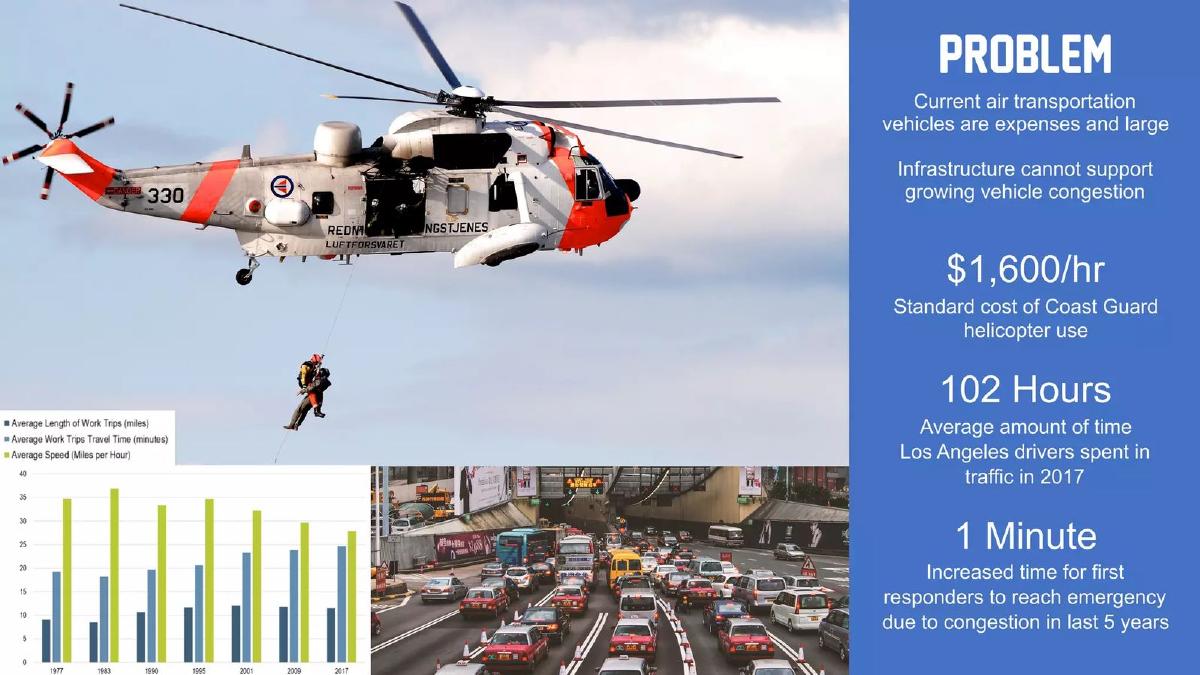
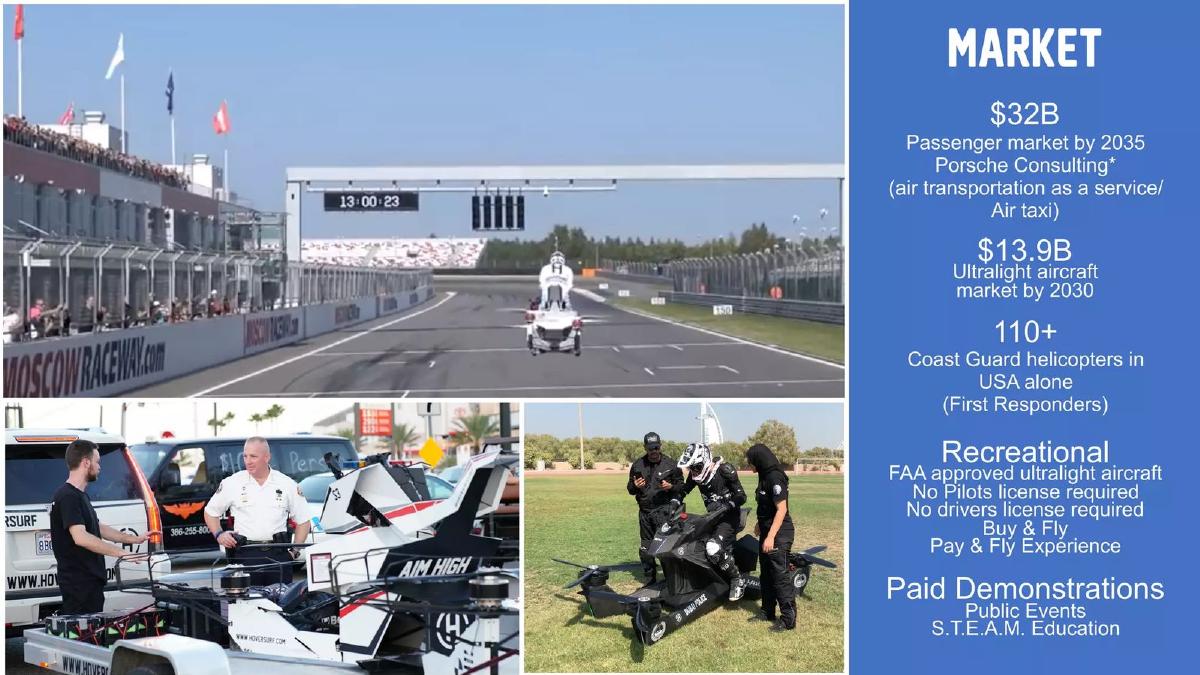
Hoversurf’s 2019 deck positions the company at the forefront of the Urban Air Mobility (UAM) sector. The narrative is built on tangible hardware milestones rather than theoretical concepts, citing the launch of six hoverbike models and two heavy-lift cargo drones within a three-year span (Slide 4). The company leverages a significant partnership with the Dubai Police for commercial deployment and claims a legal breakthrough with the world’s first FAA-approved personal drone that requires no pilot's license (Slide 4). While the deck excels at demonstrating technical feasibility and public inte…
Key takeaways
- The company claims to have developed the world's first FAA-approved personal drone that does not require a pilot's license (Slide 4).
- Hoversurf has secured a Memorandum of Understanding (MOU) with the Dubai Police Government for commercial deployment (Slide 4).
- The technical roadmap shows rapid iteration, with six hoverbike models and two heavy-lift cargo drones developed in three years (Slide 4).
- The product line extends beyond hoverbikes to include cargo drones with a 150 kg payload and a 2-seater air taxi (Slide 5).
- Proprietary technology includes a 'Venturi Engine' claimed to be 3x smaller and quieter than traditional propellers (Slide 5).
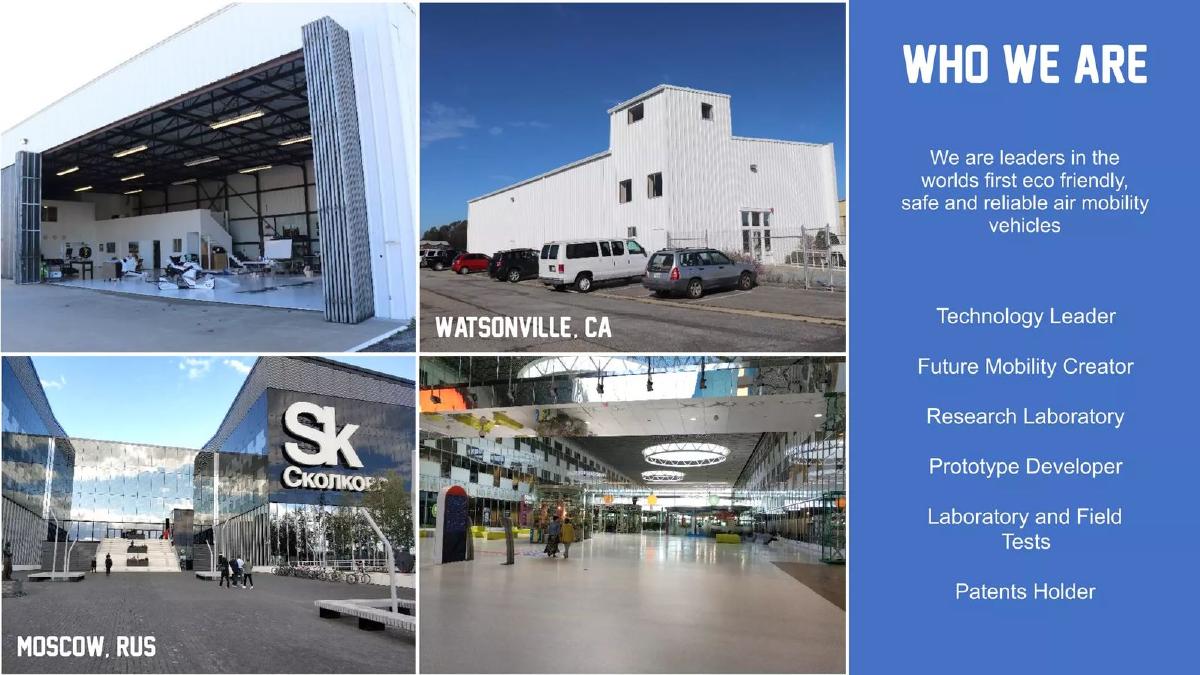
- The team is distributed across two locations: Watsonville, California, and Moscow, Russia (Slide 2).
- The company reports significant market demand with over 5,000 purchase and demonstration requests from government and public sectors (Slide 4).
- The deck mentions a rich IP portfolio with 16 key technologies protected by issued patents (Slide 5).
Executive Summary: Hardware-First Urban Air Mobility
Hoversurf’s pitch deck is a masterclass in using high-stakes imagery and tangible milestones to validate a futuristic concept. In an industry often plagued by 'vaporware' and CGI renders, Hoversurf leads with photos of actual flight tests and government partnerships. The deck focuses heavily on the technical achievements and the 'cool factor' of their personal aviation vehicles, specifically the S3 hoverbike series. By the time an investor reaches the end of these six slides, the message is clear: the technology exists, it is flying, and the authorities are interested.
Slide 1: Title and Vision
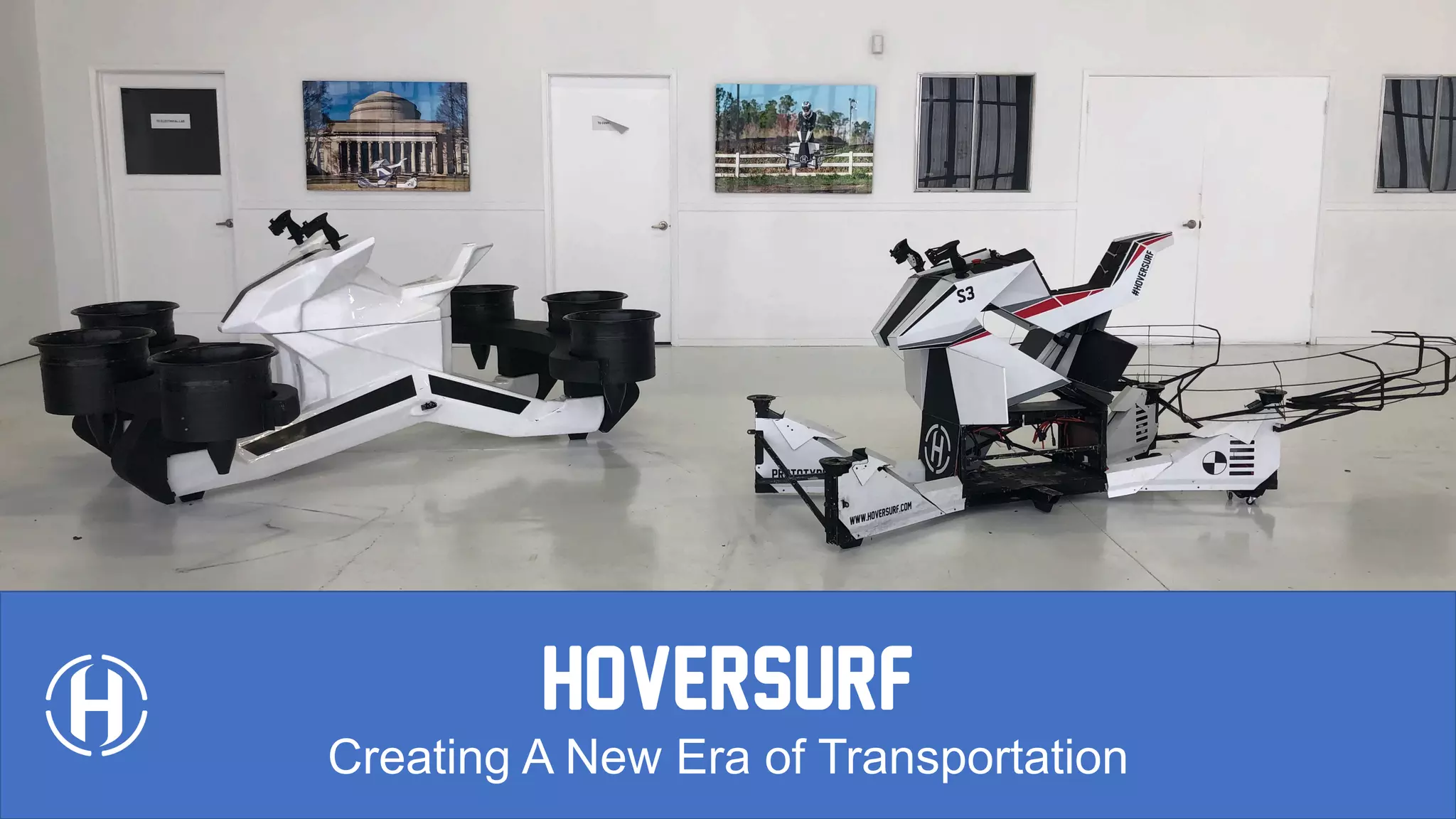
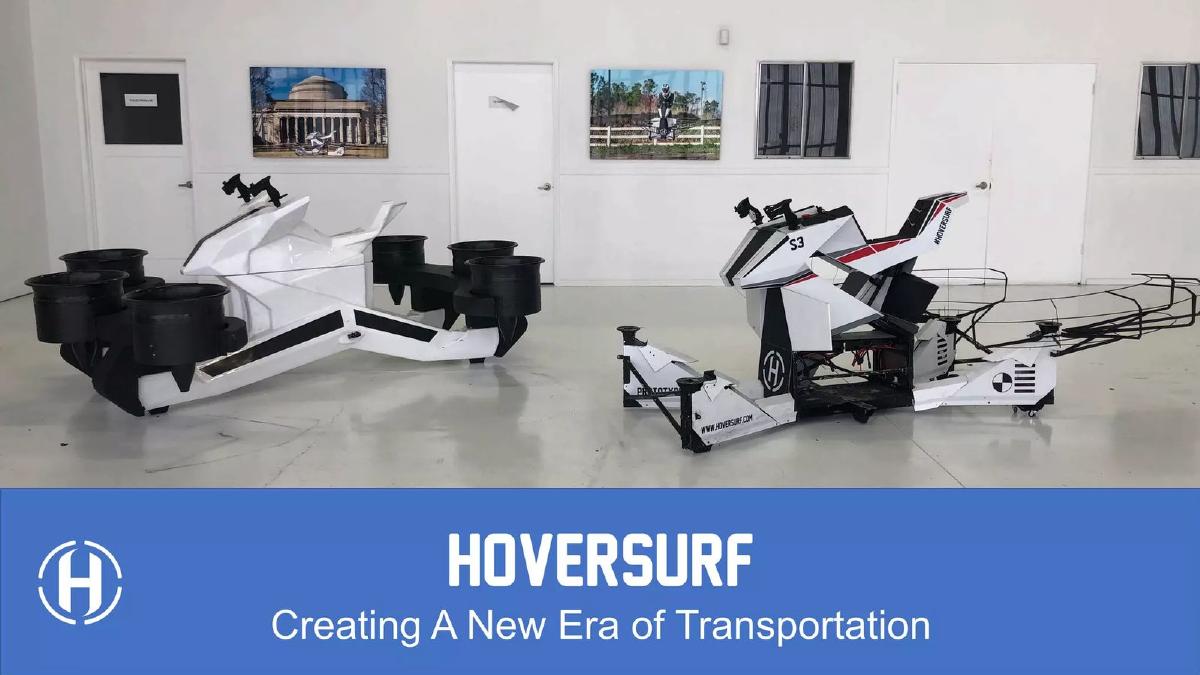
The title slide features two distinct prototypes in a hangar-like setting, immediately establishing that Hoversurf is a hardware-centric company. The tagline, "Creating A New Era of Transportation," is standard for the sector, but the visual of the S3 and a larger white prototype provides immediate scale. The branding is clean, utilizing a blue and white color palette that evokes aviation and technology.
Slide 2: The Team and Global Footprint
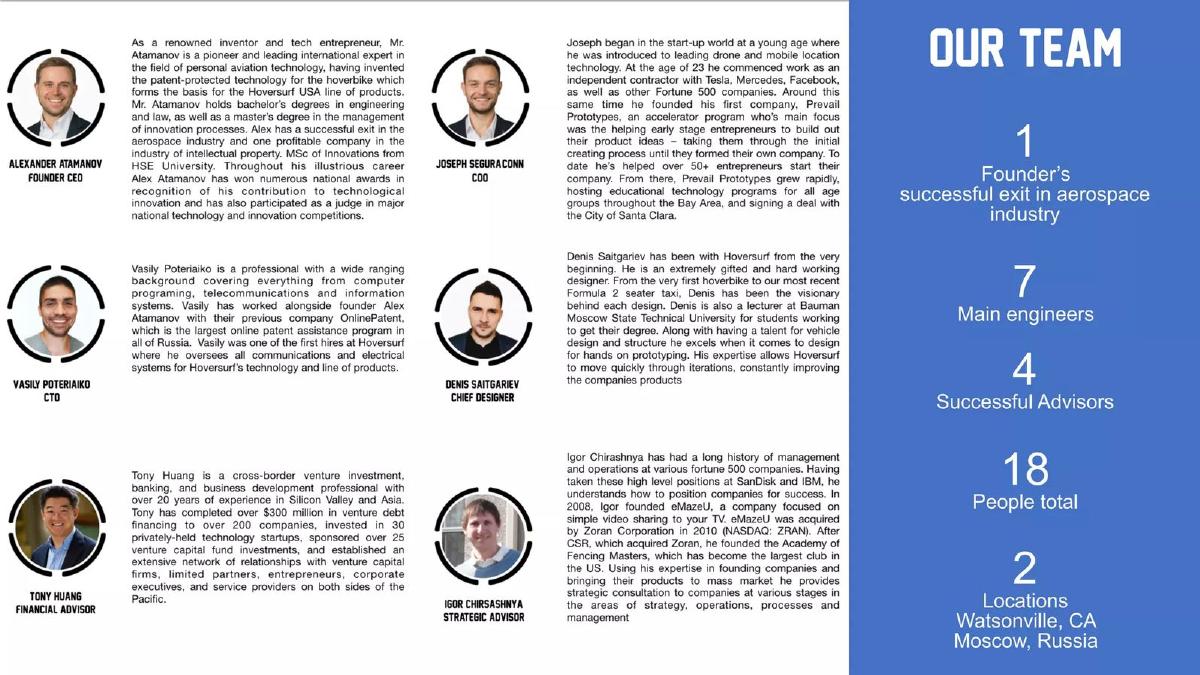
Slide 2 introduces the leadership team and provides a numerical summary of the organization. Alexander Atamanov (Founder/CEO) is positioned as a "renowned inventor" with a previous exit in the aerospace industry. The inclusion of Joseph Segura-Conn (COO) adds a Silicon Valley connection, noting his work with Tesla and Facebook. Crucially, the slide notes that the 18-person team is split between Watsonville, CA, and Moscow, Russia. This dual-location strategy suggests a play for both US regulatory approval and Russian engineering talent. The slide also lists 7 main engineers and 4 advisors, emphasizing a lean but specialized workforce.
Slide 3: The Solution and UAM Context
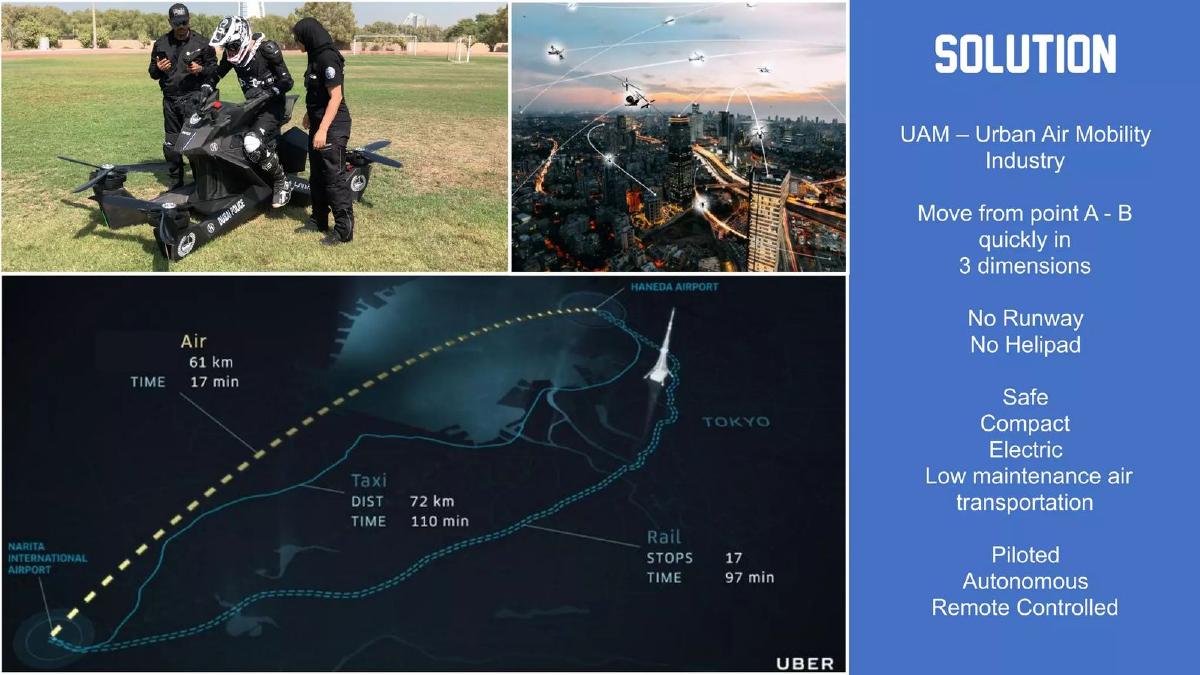
This slide defines the problem space: Urban Air Mobility (UAM). It uses a graphic attributed to Uber to illustrate the time savings of air travel versus ground transport (e.g., 17 minutes by air vs. 110 minutes by taxi for a 61km trip). The text highlights the removal of infrastructure barriers, stating "No Runway, No Helipad." The solution is described as a "Safe, Compact, Electric" mode of transportation that can be piloted, autonomous, or remote-controlled. The inclusion of a photo showing a Dubai Police officer next to the craft serves as a powerful visual proof of concept for the "Solution" being more than just a theory.
Slide 4: Traction and Milestones
Slide 4 is the strongest slide in the deck. It provides a timeline from Q1 2017 to Q1 2019, showing a rapid cadence of launches, including the Hoverbike S3.1, S3.2 Carbon, and the S3 2019 model. The traction metrics are specific and impressive:
World’s first FAA approved personal drone (no pilot's license required). · MOU with Dubai Police Government. · 200M+ worldwide views on social media. · 5k+ purchase and demonstration requests.
These figures suggest that Hoversurf has solved two of the biggest hurdles in UAM: regulatory legality and market demand.
Slide 5: Core Technologies and IP
This slide dives into the technical 'moat.' It lists the Hoverbike (20-mile range), Cargo Drone (150 kg payload), and a 2-seater Air Taxi. The most significant technical claim is the "Venturi Engine," which the company asserts is "3x smaller, more powerful, more efficient, safer and significantly quieter than propellers." Noise reduction is a critical factor for urban adoption, making this a key selling point. The slide also mentions a "rich IP portfolio with 16 key technologies protected in issued patents," which is vital for protecting their hardware innovations from larger aerospace competitors.
Slide 6: Strategic Partnerships
The final slide in this set lists partners that provide both credibility and supply chain stability. The Dubai Police is listed for "Commercial deployment," while MGM Compro, HELIX GmbH, and Rotex Electric are cited for components like ESCs, BMS, propellers, and BLDC motors. This demonstrates that Hoversurf is not trying to build every single component from scratch, but is instead integrating high-quality specialized parts into their proprietary airframe and flight control systems.
What Works in the Hoversurf Deck
Tangible Proof: The deck is filled with photographs of real, physical products in various stages of flight and assembly. This differentiates them from startups that rely on 3D renders. The photo of the Dubai Police partnership is particularly effective as it suggests a high level of trust from a government entity.
Regulatory Progress: Claiming the "World’s first FAA approved personal drone" (Slide 4) is a massive de-risking statement. For investors, the legal barrier is often seen as more daunting than the technical one. By stating that no pilot's license is required, Hoversurf opens up a significantly larger Total Addressable Market (TAM).
Iterative Speed: The timeline on Slide 4 shows that the company is capable of rapid prototyping. Moving through six models in three years suggests an agile engineering culture that can learn from flight data and improve the hardware quickly.
What is Missing from the Hoversurf Deck
The Ask: There is no mention of how much money the company is raising or what the terms are. Without a clear "Ask" slide, the deck functions more as a company profile than a fundraising tool.
Business Model and Unit Economics: While the deck mentions 5,000+ purchase requests, it does not state the price of a Hoverbike or the projected margins. Investors need to know if this is a high-margin luxury toy or a volume-based transportation play.
Competition: The UAM space is crowded with well-funded players like Joby Aviation, Volocopter, and Lilium. Hoversurf fails to provide a competitive matrix showing why their Venturi Engine or airframe design is superior to these multi-billion dollar competitors.
Financial Projections: There are no charts showing projected revenue, burn rate, or the path to profitability. For a hardware startup with high R&D costs, these omissions are significant.
Founder's Guide: What to Copy
Use 'Proof of Life' Photos: If you are building hardware, follow Hoversurf's lead. Show the product in the real world, being used by real people (Slide 3 and 4). It is much harder for an investor to dismiss a product they can see flying.
Highlight Regulatory Wins: If your industry is heavily regulated (drones, medtech, fintech), make your regulatory status a headline. Hoversurf’s mention of the FAA status on the Traction slide is a perfect example of how to use a legal win as a business milestone.
Quantify Social Proof: Mentioning "200M+ views" and "5k+ requests" (Slide 4) proves that there is a 'pull' from the market. Even if those requests aren't signed contracts, they demonstrate that the product has captured the public imagination, which is a leading indicator of brand value.
Focus on Proprietary Sub-systems: Don't just say you built a bike; say you built the engine that makes the bike possible. The "Venturi Engine" section on Slide 5 gives the company a technical identity beyond just the final assembly, suggesting they could potentially license their propulsion technology to others.
Frequently asked questions
- What is Hoversurf's primary product?
- According to Slide 5, Hoversurf's primary product is the Hoverbike, described as the world's first legal personal eVTOL with a 20-mile range. However, the company is also developing cargo drones capable of carrying 150 kg, a 2-seater air taxi, and a proprietary propulsion system called the Venturi Engine.
- Does Hoversurf have any real-world customers?
- Slide 4 and Slide 6 highlight a significant partnership with the Dubai Police. The deck states they have an MOU for commercial deployment and features photos of Dubai Police officers operating the craft. Additionally, Slide 4 claims over 5,000 purchase and demonstration requests.
- What are the technical specifications of the Hoverbike?
- Slide 5 notes that the Hoverbike has a range of up to 20 miles. It is an electric vertical take-off and landing (eVTOL) craft. The deck also mentions that their flight computer meets SAE Level 5 requirements for autonomous flight, providing a competitive advantage in safety and control.
- Who is leading the company?
- The leadership team, detailed on Slide 2, is led by Founder/CEO Alexander Atamanov, who has a background in engineering and law with a previous exit in the aerospace industry. He is supported by COO Joseph Segura-Conn, CTO Vasily Poteriaiko, and Chief Designer Denis Saitgariev.
- What is missing from this pitch deck?
- The provided slides are missing all financial information. There is no slide detailing the amount of capital being raised, the valuation, the use of proceeds, or the business model (pricing). It also lacks a competitive landscape analysis and specific go-to-market timelines for the consumer air taxi.