Mambu's pitch deck is a highly professional, later-stage presentation that prioritizes market positioning and architectural superiority over raw financial data. By framing the banking industry's evolution as a shift from 'Monolithic' to 'Composable' systems, Mambu establishes a proprietary category where it is the clear leader. The deck excels at social proof, featuring testimonials from industry giants like N26 and Santander, and demonstrates significant scale with 460+ employees and operations in 52 countries. While it lacks explicit revenue figures or a specific funding 'ask,' the deck ser…
Key takeaways
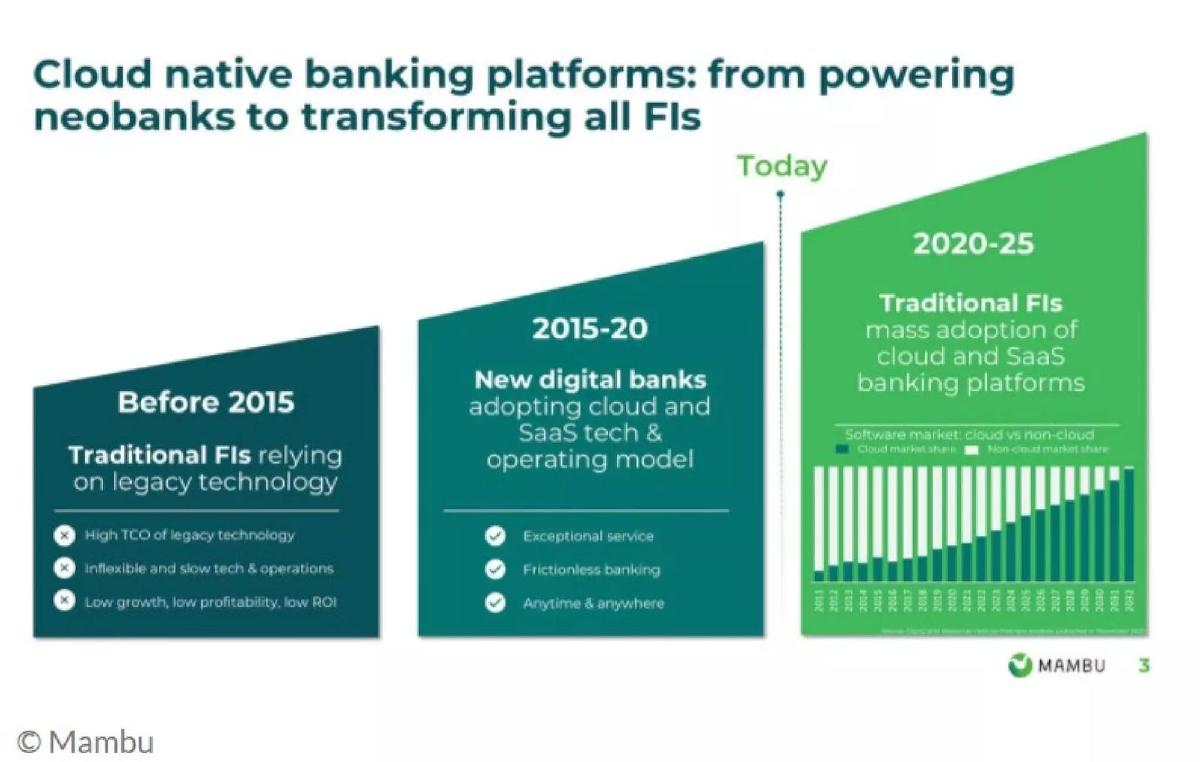
- The deck frames the market opportunity as a massive shift of traditional financial institutions to cloud and SaaS platforms between 2020-2025 (Slide 3).
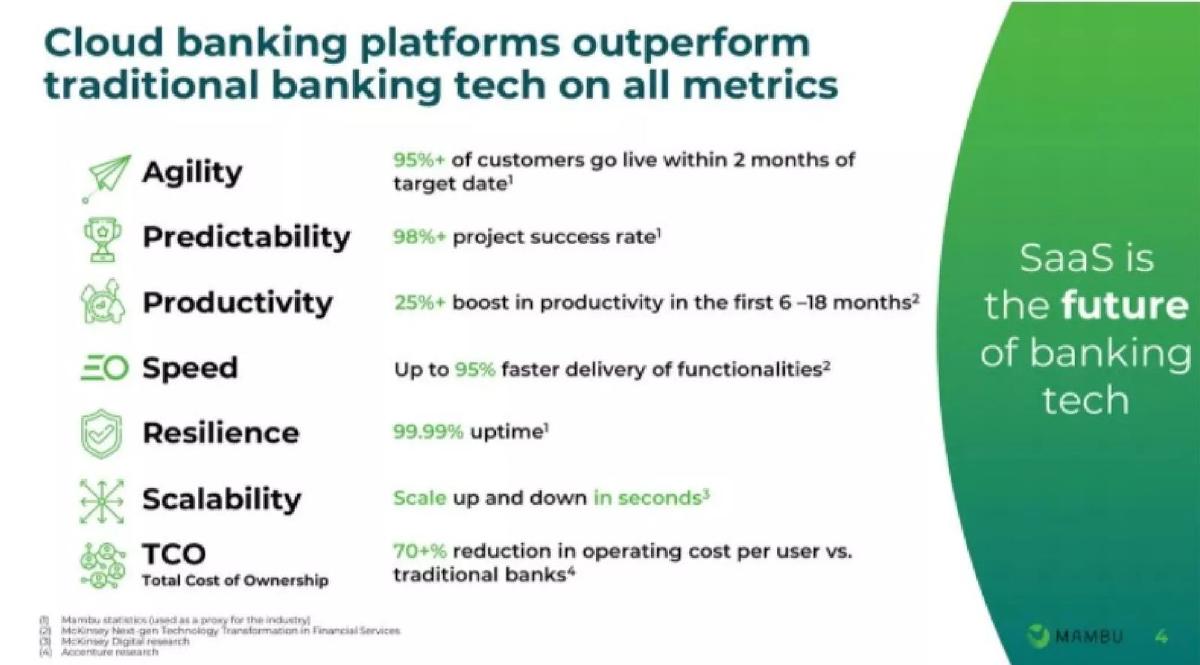
- Mambu claims a 70+% reduction in operating cost per user compared to traditional banks (Slide 4).
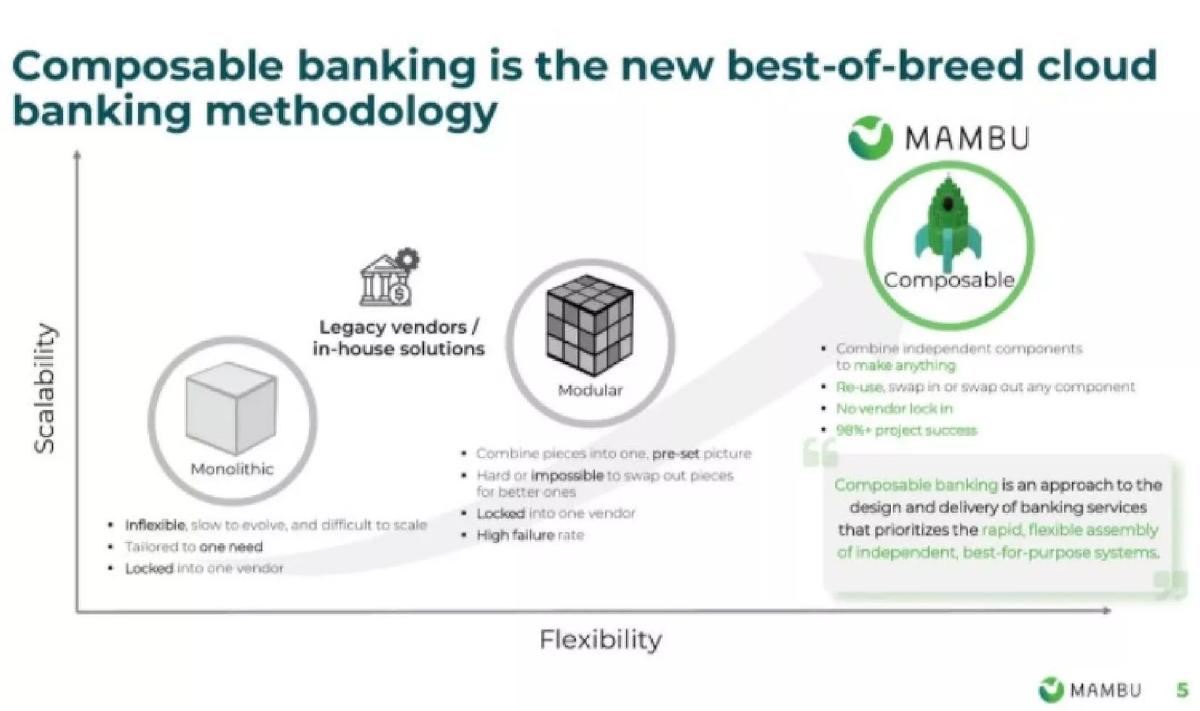
- The core value proposition is 'Composable Banking,' which prioritizes the rapid assembly of independent, best-for-purpose systems (Slide 5).
- Mambu highlights a high project success rate of 98%+ and the ability to go live within 2 months of a target date (Slide 4).
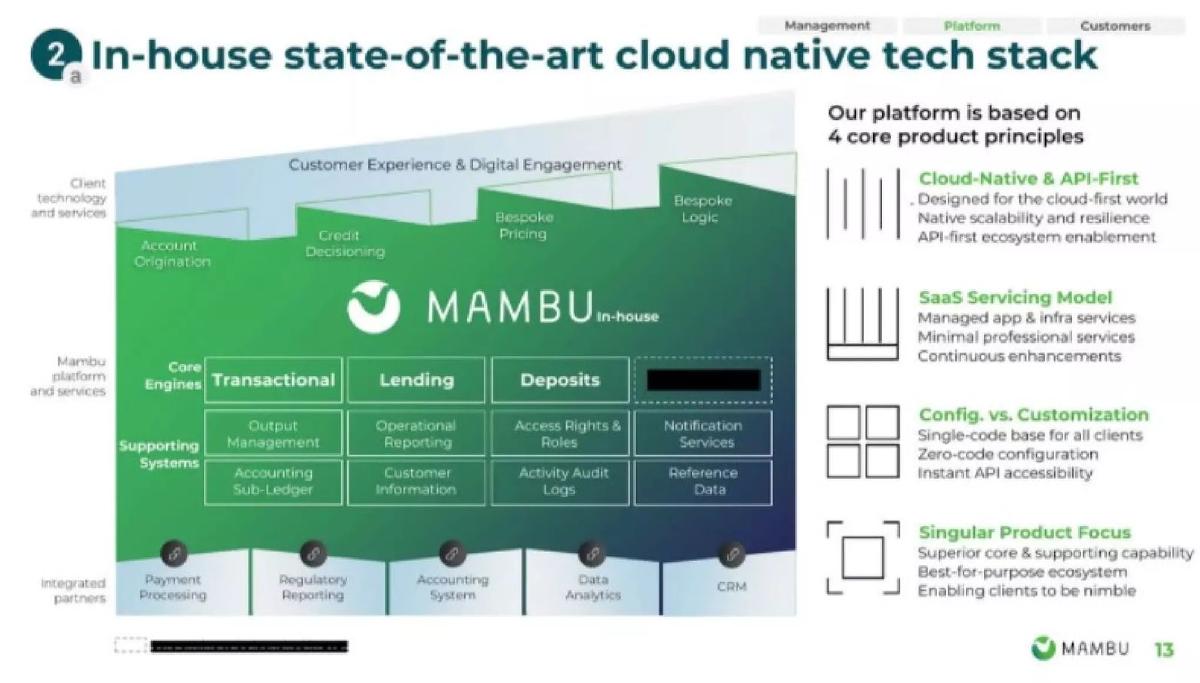
- The platform is built on a single-code base for all clients, emphasizing configuration over customization (Slide 13).
- As of October 2020, the company had 460+ employees (Mambuvians) across 11 global offices (Slide 16).
- The deck showcases a massive ecosystem of partners, including Big 4 firms like Deloitte and PwC, and tech partners like AWS and Salesforce (Slide 15).
- Future growth plans involve scaling from 6 to 50 local Country General Managers by 2022 (Slide 22).
Introduction: The Infrastructure Behind the FinTech Revolution
Mambu occupies a critical space in the financial services ecosystem. As a SaaS banking engine, it provides the 'plumbing' that allows both digital-native neobanks and legacy traditional banks to launch lending and deposit products. This 10-slide deck is a focused, high-level overview of their market position, architectural philosophy, and global scale. It is notably light on financial specifics—there are no revenue charts or burn rates—suggesting this deck was used for a later-stage round where the brand and the 'composable' category leadership were the primary selling points.
Slide 1: Title Slide
The deck opens with a clean, minimalist title slide. The tagline, "The world's leading cloud banking platform," immediately establishes a position of market dominance. The branding is consistent, using a green gradient that carries through the entire presentation, signaling stability and growth.
Slide 3: The Market Evolution
Slide 3 provides the macro-economic context for Mambu's existence. It breaks the market into three distinct eras: Before 2015 (Traditional FIs relying on legacy tech), 2015-20 (New digital banks adopting cloud/SaaS), and 2020-25 (Mass adoption by traditional FIs). The slide uses a bar chart to show the projected growth of cloud market share versus non-cloud market share, indicating a clear tipping point where cloud becomes the standard. This frames Mambu not just as a tool for startups, but as the inevitable solution for the entire banking industry.
Slide 4: Performance Metrics
This slide is the 'proof' slide. It lists seven key metrics where cloud banking platforms outperform traditional tech. Notable figures include:
Agility: 95%+ of customers go live within 2 months of target date. · Predictability: 98%+ project success rate. · Speed: Up to 95% faster delivery of functionalities. · TCO: 70+% reduction in operating cost per user vs. traditional banks.
By citing sources like McKinsey and Accenture at the bottom, Mambu adds institutional credibility to these aggressive claims.
Slide 5: The Composable Banking Methodology
Slide 5 is perhaps the most important strategic slide in the deck. It introduces the concept of "Composable Banking" as the evolution beyond 'Monolithic' and 'Modular' systems. It uses a graph with Flexibility on the X-axis and Scalability on the Y-axis. Mambu positions itself at the top right, defining composable banking as the "rapid, flexible assembly of independent, best-for-purpose systems." This is a classic category-creation move, defining the 'new way' of doing things in a way that only Mambu can satisfy.
Slide 13: The Tech Stack Principles
Slide 13 (numbered as such in the deck, indicating this is a selection from a larger master deck) dives into the product principles. It highlights four pillars:
Cloud-Native & API-First: Designed for a cloud-first world. · SaaS Servicing Model: Managed infrastructure with minimal professional services. · Config. vs. Customization: A single-code base for all clients using zero-code configuration. · Singular Product Focus: A commitment to being a superior core engine rather than a jack-of-all-trades.
The visual diagram shows how Mambu sits between 'Client technology' and 'Integrated partners,' acting as the central transactional engine.
Slide 14: Competitive Advantages
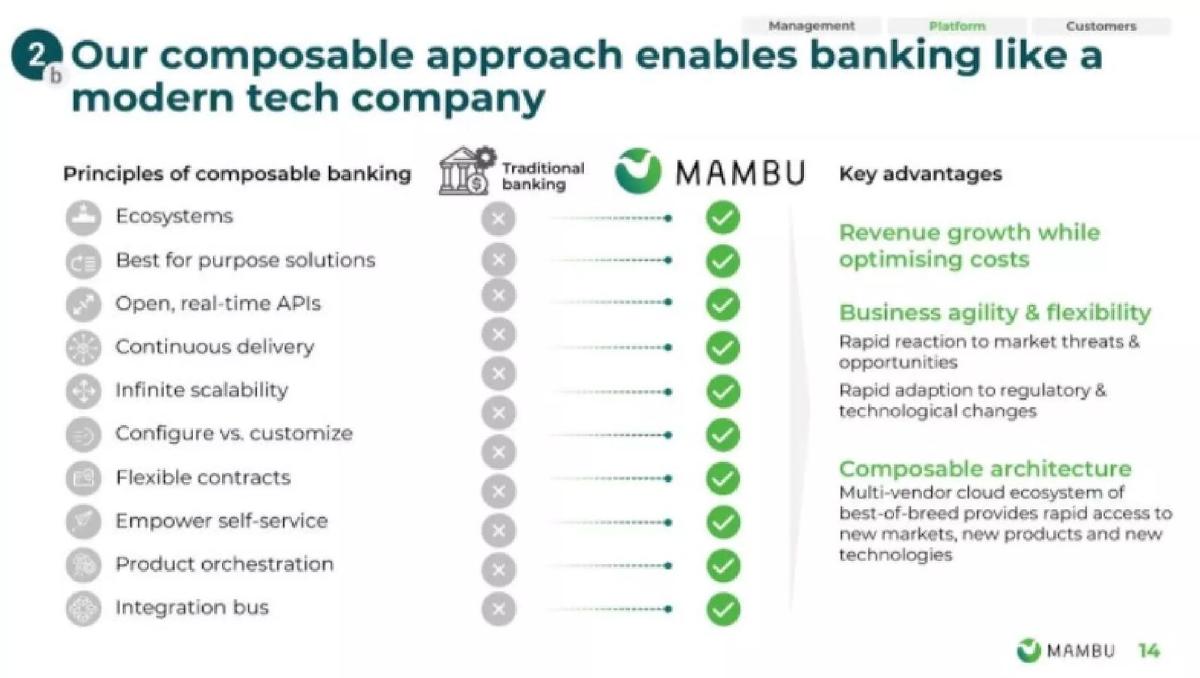
This slide uses a checklist format to compare 'Traditional banking' against Mambu across ten principles, such as 'Infinite scalability' and 'Open, real-time APIs.' Unsurprisingly, Mambu receives green checkmarks across the board while traditional banking receives grey 'X' marks. The key takeaway here is "Banking like a modern tech company," appealing to the desire of traditional banks to shed their image as slow-moving dinosaurs.
Slide 15: The Ecosystem
Slide 15 illustrates the 'Composable' philosophy in action. It shows Mambu at the center of a massive web of partners. This includes 'Business Partners' like the Big 4 (Deloitte, PwC, etc.) and 'Technology Partners' ranging from KYC providers (Onfido) to payment processors (Marqeta, TransferWise) and accounting software (Oracle NetSuite). This slide proves that Mambu isn't just a product; it is a platform that facilitates an entire ecosystem.
Slide 16: Global Operations
This slide focuses on the company's internal scale. As of October 2020, Mambu reported:
11 Offices globally. · 52 Countries with localization accomplished. · 460+ Mambuvians (employees). · ISO27001 Certification achieved in major offices.
The map shows a heavy concentration in Europe (Berlin, Amsterdam, London, Vilnius, Iasi) but with significant outposts in New York, Miami, Singapore, and Sydney. This demonstrates that Mambu is a truly global enterprise capable of supporting international clients.
Slide 17: Social Proof and Testimonials
Slide 17 is a 'wall of love' featuring quotes from C-level executives at major financial institutions. The inclusion of N26, ABN AMRO, TransferWise, OakNorth, Santander, and Marqeta is a powerful validation. When the CTO of N26 says Mambu provides an "unrivalled, technology-driven mobile banking experience," it carries more weight than any marketing copy Mambu could write themselves.
Slide 22: Future Growth and Penetration
The final slide in this selection outlines the roadmap for market penetration. It shows the growth from 6 Country GMs in 2020 to a planned 50 by 2022 . It also notes that the platform is already proven in 50+ countries with 169 customers. The plan is to strengthen local features and deploy regional sales teams to capture more of the market share identified in Slide 3.
What Works in This Deck
1. Strong Category Framing: The transition from 'Monolithic' to 'Composable' is a brilliant narrative arc. It makes legacy systems look obsolete and positions Mambu as the only logical choice for the future.
2. Exceptional Social Proof: The logos on Slides 15 and 17 are top-tier. For a B2B infrastructure company, showing that you are trusted by the biggest names in the industry is the most effective way to de-risk the investment for a VC.
3. Clear Value Proposition: The deck doesn't get bogged down in technical jargon without explaining the business benefit. Slide 4 explicitly links technical features (like 99.99% uptime) to business outcomes (like 70% TCO reduction).
4. Global Scale: The operational map on Slide 16 and the customer count on Slide 22 show that this is not a regional player. They have already solved the hard problem of internationalization and regulatory localization.
What Is Missing from This Deck
1. Financial Metrics: There is no mention of Annual Recurring Revenue (ARR), Net Revenue Retention (NRR), or CAC/LTV ratios. While this information is likely in a separate data room, its absence in the main deck is notable.
2. The 'Ask': The deck does not state how much money is being raised or what the specific use of funds will be. It functions more as a company overview than a specific fundraising pitch.
3. Team Slide: There is no slide introducing the founders or the leadership team. While the '460+ Mambuvians' metric shows scale, investors usually want to see the pedigree of the executive team in a deck of this stage.
4. Competitive Landscape: While it compares itself to 'Traditional Banking,' it does not mention other modern cloud core banking competitors (like Thought Machine or Temenos). It assumes a vacuum where Mambu is the only modern option.
What a Founder Should Copy
1. The 'Principles' Approach: Slide 13's use of '4 core product principles' is a great way to communicate company culture and technical philosophy simultaneously. It tells investors not just what you built, but how you think about building.
2. Visualizing the Ecosystem: If your product integrates with others, use a slide like Slide 15. It shows that your product is sticky and that you have 'moats' built through partnerships with other industry leaders.
3. Outcome-Oriented Metrics: Don't just say your software is fast. Use Slide 4 as a template to show exactly how much faster (95%) and how much cheaper (70%) it makes the customer's life.
4. Strategic Roadmap: Slide 22's simple transition from '6 GMs' to '50 GMs' is a very clear way to show how you intend to scale operations without needing a complex spreadsheet.
Final Thoughts
Mambu's deck is a sophisticated piece of collateral for a company that has already achieved significant product-market fit. It moves away from the 'problem/solution' format of early-stage decks and instead focuses on 'market transformation' and 'architectural superiority.' It is a deck designed to convince late-stage investors that Mambu is the inevitable winner in the race to re-platform the world's financial institutions. By focusing on the 'Composable' narrative, they have successfully moved the conversation away from price and toward agility and future-proofing.
Frequently asked questions
- What is 'Composable Banking' as defined in this deck?
- According to Slide 5, composable banking is an approach to designing and delivering banking services that prioritizes the rapid, flexible assembly of independent, best-for-purpose systems. It moves away from 'Monolithic' (inflexible) and 'Modular' (hard to swap pieces) designs toward a model where components can be re-used, swapped in, or swapped out with no vendor lock-in.
- What specific metrics does Mambu use to prove its superiority over legacy tech?
- Slide 4 lists several key performance indicators: 95%+ of customers go live within 2 months of target dates, a 98%+ project success rate, 25%+ boost in productivity, up to 95% faster delivery of functionalities, 99.99% uptime, and a 70+% reduction in total cost of ownership (TCO) per user.
- How does Mambu handle the 'customization vs. configuration' debate in enterprise software?
- Slide 13 explicitly states that Mambu uses a 'Single-code base for all clients' and 'Zero-code configuration.' This approach allows for instant API accessibility and continuous enhancements without the technical debt associated with bespoke code for individual clients, which is a common pitfall in traditional banking software.
- What is Mambu's global footprint and workforce size?
- Slide 16 notes that as of October 2020, Mambu had over 460 employees (referred to as 'Mambuvians') across 11 offices. Their presence spans major hubs including London, Berlin, Amsterdam, Singapore, and New York. By September 2020, they served 169 customers across 52 countries (Slide 22).
- Who are Mambu's key customers and partners?
- Slide 17 features testimonials from high-profile fintechs and banks including N26, ABN AMRO (new10), TransferWise (now Wise), OakNorth, Santander (asto), and Marqeta. Slide 15 also lists business partners like the Big 4 (PwC, KPMG, Deloitte, EY) and technology partners like Microsoft, Oracle, and Salesforce.