Major League Football (MLFB) utilized this January 2015 presentation to pitch a spring professional football league, aiming for a Q2 2016 launch. As a publicly traded entity on the OTCQB, the company emphasized its 'single-entity' structure to ensure parity and lower operating costs compared to traditional franchise models. The deck leans heavily on the pedigree of its management, including former Chicago Bears GM Jerry Vainisi and Pro Bowler Wes Chandler. While the presentation successfully identifies a market gap—the 42% of Americans who name football as their favorite sport—it lacks granul…
Key takeaways
- The company was already publicly traded on the OTCQB under the ticker MLFB at the time of the presentation (Slide 4).
- MLFB reported a market capitalization of approximately $27 million as of January 2, 2015 (Slide 4).
- The management team features significant NFL experience, including a former Super Bowl-winning General Manager and a four-time Pro Bowl player (Slide 7).
- The league intended to use a 'single-entity' structure to maximize buying power and ensure franchise parity (Slide 19).
- Market demand is supported by the fact that 42% of Americans voted football as their favorite sport, representing a $10 billion pro football revenue market (Slide 13).
- MLFB planned to differentiate its product with rule changes, such as 4-point field goals for kicks over 50 yards and a shorter play clock (Slide 25).
- The competitive analysis positions MLFB as the only league with a 'non-adversarial approach' and 'non-competing schedule' relative to the NFL (Slide 16).
- The roadmap targeted a formal league launch for Q2 2016, following player procurement in late 2015 (Slide 28).
Introduction and Public Market Status
Slide 1: Title Slide
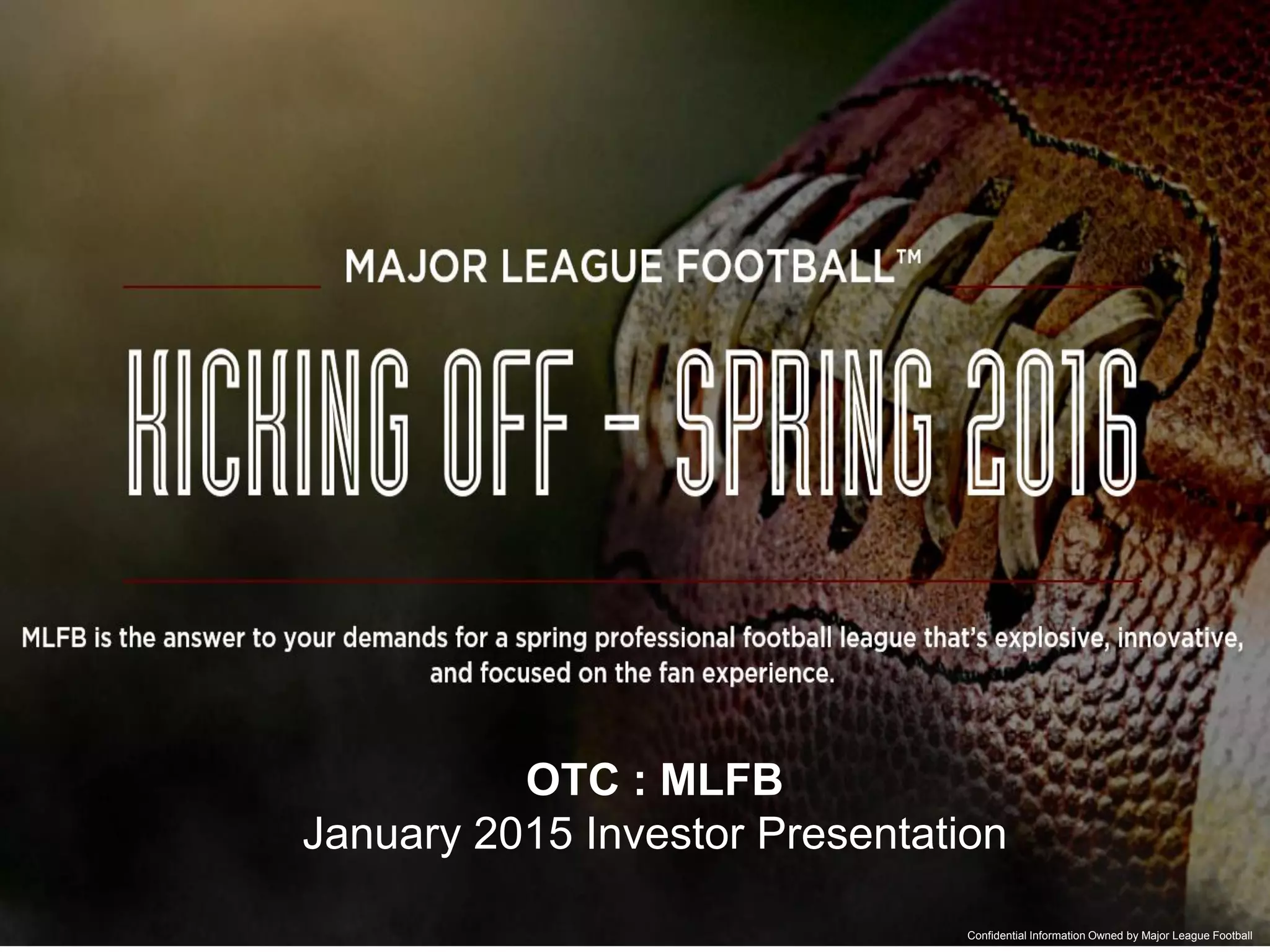
The presentation opens with a high-contrast image of a football, establishing the brand: Major League Football (MLFB). The central hook is "Kicking Off - Spring 2016." The slide positions the league as the answer to fan demands for a spring professional league that is "explosive, innovative, and focused on the fan experience." Notably, it includes the ticker "OTC : MLFB," signaling that this is a presentation for a publicly traded company rather than a private startup. The date is cited as January 2015.
Slide 4: Public Market Snapshot
This slide provides the hard data regarding the company's standing on the OTCQB. It lists the company launch year as 2010. As of January 2, 2015, the company had 38,700,009 total shares outstanding, with 2,000,000 warrants and 4,350,000 options. The share price is stated at $0.70, giving the company a market capitalization of approximately $27 million. Legal counsel is identified as David M. Bovi, PA, and the auditor is Salberg & Company. This slide is critical for transparency, showing that the entity is SEC-reporting and current.
The Leadership Team
Slide 7: Management Team
MLFB leans heavily on the professional pedigree of its leadership. Jerry Vainisi, the Interim CEO, is highlighted for his tenure as General Manager of the Chicago Bears, specifically leading them to a championship in Super Bowl XX. His experience with the World League of American Football (which became NFL Europe) is also noted. Wes Chandler, the President, is introduced as a four-time Pro Bowl performer with 30 years of football experience, including coaching stints in the NFL and NFL Europe. Rick Smith, the COO, provides the non-sports business balance, cited as the founder and CEO of Mainframe Communications with experience serving Fortune 2000 accounts and various branches of the U.S. military. The team slide aims to prove that the league is run by "football experts" rather than just financiers.
Market Demand and Digital Strategy
Slide 10: Digital Media and Social Network Lead Content Delivery
This slide utilizes Pew Research Center data from 2008-2013 to show the growth of online video consumption and social networking across all age groups. It specifically highlights that 80% of Millennials and 66% of Gen X users watch video online. The core claim at the bottom of the slide is that MLFB will deliver its content digitally through "third parties and proprietary social networks." However, the deck does not define what these proprietary networks are or how they would compete with established platforms.
Slide 13: Americans Love Football
To justify the existence of a new league, Slide 13 presents market size statistics. It claims 42% of Americans voted football as their favorite sport and cites ~32 million NFL fans. It notes that the 2011 Super Bowl had 163 million viewers and that pro football generates $10 billion in revenue. The most relevant stat for a new league is the "95% consistent capacity pro football attendance," suggesting that the market for live games is nearly saturated, leaving room for a spring alternative.
Competitive Positioning and Structure
Slide 16: MLFB vs. Past and Current Leagues
This is a standard competitive matrix comparing MLFB to the USFL, XFL, and FXFL. MLFB claims to be the only one that hits every mark, including being founded by experts, targeting unrepresented markets, and having a non-adversarial approach to the NFL. It emphasizes a "single entity structure" and "strong player relations." By checking the "non-competing schedule" and "non-competing locations" boxes, MLFB positions itself as a partner to the football ecosystem rather than a rival to the NFL.
Slide 19: Benefits of MLFB Structure
The deck advocates for a single-entity model. The stated benefits include greater parity among franchises, economies of scale to maximize buying power, and lower operating costs. It also mentions "better risk allocation." The exit strategy for this structure is clearly stated: "Team's will be sold at opportune valuations, to the highest bidder." This implies the league intended to incubate the teams before transitioning to a traditional franchise ownership model.
Endorsements and Product Differentiation
Slide 22: Hall of Famers in Support of MLFB
To build credibility, the deck includes testimonials from NFL legends. Charlie Joiner, Bruce Smith, Richard Dent, and Dan Fouts all provide quotes supporting the need for a spring league. Bruce Smith specifically praises the management team's experience, calling the plan "fail-proof." These endorsements serve as social proof to mitigate the perceived risk of a new sports league, which historically has a high failure rate.
Slide 25: MLFB. The Fastest Game on Turf™
This slide details how the actual game will differ from the NFL. The goal is a faster, more athletic game with more "big game plays." Specific rule changes include a shorter play clock to increase the number of plays per game, a 4-point field goal for kicks of 50+ yards, and a rule change where the ground can create a fumble. These are designed to make the broadcast more engaging for a digital-first audience.
Roadmap and Execution
Slide 28: Progress Markers
The final slide in this selection is a timeline spanning 2014 to 2016. It shows that by Q4 2014, the company had secured its management team, a ticketing company, and an investment bank. For 2015, the goals included establishing cities, securing sponsorships, and starting player procurement in Q3. The timeline culminates in Q1 2016 team workouts and a Q2 2016 launch. This slide provides a clear checklist for investors to hold the company accountable for its execution milestones.
What Works and What is Missing
What Works: The deck does an excellent job of establishing the "Why Now?" by pointing to the massive revenue in pro football and the lack of spring content. The management team is the deck's strongest asset; having a Super Bowl-winning GM and Hall of Fame players involved provides immediate legitimacy that most startup leagues lack. The choice of a single-entity structure is also a logical business argument for controlling costs in the early stages of a high-burn industry.
What is Missing: The most significant omission is a detailed financial breakdown. While the public market cap is mentioned, there are no projections for stadium leases, player salaries, or broadcast rights revenue. Furthermore, while the deck mentions "unrepresented US markets," it does not list the specific cities targeted for the 2016 launch. The mention of "proprietary social networks" is also vague and potentially a red flag, as building a social network is a massive undertaking separate from running a football league.
Founder Takeaways
Leverage Industry Pedigree: If you are entering a high-barrier-to-entry market like professional sports, your team slide is your most important slide. MLFB correctly put their NFL credentials front and center to overcome the skepticism that follows new league launches. Founders should highlight specific, high-level wins (like a Super Bowl victory) rather than just general experience.
Address the Incumbent Directly: MLFB's competitive matrix (Slide 16) is a good example of how to position against a giant. Instead of claiming they will beat the NFL, they argue they are "non-adversarial." This makes the investment feel like a market expansion play rather than a high-risk war against a monopoly. Founders in crowded markets should look for these "non-competing" angles to lower the perceived risk for investors.
Structure as a Strategy: The inclusion of Slide 19 (Benefits of MLFB Structure) shows that the founders thought about the business architecture, not just the game. By explaining why a single-entity model is superior for a startup phase, they demonstrate operational maturity. Founders should be prepared to defend their corporate structure if it deviates from the industry norm.
Frequently asked questions
- What is the 'single-entity' structure mentioned in the deck?
- As described on Slide 19, the single-entity structure means the league owns all the teams rather than selling individual franchises to independent owners initially. MLFB argues this creates greater parity, lowers operating costs through economies of scale, and allows for better risk allocation. The plan was to eventually sell teams to the highest bidder once valuations became 'opportune.'
- How does MLFB plan to compete with the NFL?
- According to Slide 16, MLFB does not intend to compete directly. It proposes a 'non-adversarial approach' and a 'non-competing schedule,' playing in the spring after the NFL season ends. It also targets 'emerging and unrepresented US markets' where the NFL and MLB do not currently have a presence, avoiding direct geographic competition.
- Who are the key leaders of Major League Football?
- Slide 7 lists Jerry Vainisi as Interim CEO, who was the GM of the 1985 Super Bowl champion Chicago Bears. Wes Chandler, a former NFL Pro Bowler and San Diego Chargers Hall of Famer, serves as President. Rick Smith, a former CEO of Mainframe Communications, is listed as the COO, bringing corporate operational experience to the sports venture.
- What specific rule changes did MLFB propose to differentiate the game?
- Slide 25 outlines several 'differentiators' designed to create a faster game. These include a shorter play clock to increase the number of plays per game, awarding four points for field goals of 50 yards or more, and a rule stating that 'the ground can create a fumble' to increase big-game plays and turnovers.
- What was the company's financial status at the time of this deck?
- Slide 4 provides a 'Public Market Snapshot' as of January 2015. The company had 38,700,009 shares outstanding with a share price of $0.70, resulting in a market cap of approximately $27 million. They were reporting as 'Current' on the OTCQB and employed Salberg & Company as their auditor.