Majoran Distillery’s proposal is a focused sponsorship deck rather than a traditional equity-based venture pitch. Positioned as Adelaide’s first tech-focused co-working space, the company uses its first two months of traction—15 members and a small projected profit of $1,910—to justify an expansion. The deck seeks between $30,000 and $60,000 to move into a 300m² space. By utilizing a 'Platinum, Gold, Silver' sponsorship tier system, the founders aim to fund capital expenditures (fit-outs) through brand partnerships rather than dilutive capital. While it lacks deep unit economics or a long-ter…
Key takeaways
- The company achieved 15 members and 2 feature articles within its first 2 months of operation (Slide 1).
- The fundraising target is between $30,000 and $60,000 to facilitate a move to a space 2-3 times larger, up to 300m² (Slide 6).
- Majoran Distillery operates as a not-for-profit entity aimed at growing the tech entrepreneurship ecosystem in Australia (Slide 7).
- Early members include startups like Acumen Ventures, GimmeQuotes, and Theme Matcher (Slide 5).
- The business model relies on tiered sponsorships (Platinum, Gold, Silver) offering benefits like wall signage and newsletter promotion (Slide 8).
- The team includes a President with 10 years of IT experience, a Chartered Accountant as Treasurer, and a Solicitor as Secretary (Slide 9).
- The expansion plan targets a capacity of 30 desks and up to 80 permanent and casual members (Slide 8).
- The deck cites Fishburners in Sydney as a successful benchmark for their intended non-profit co-working model (Slide 7).
Executive Summary: The Local Ecosystem Play
Majoran Distillery’s proposal is a localized, mission-driven pitch for Adelaide’s first tech-focused co-working space. Unlike high-growth software decks, this presentation focuses on community building, physical infrastructure, and corporate social responsibility (CSR) through sponsorship. The deck is brief, totaling 10 slides, and relies heavily on early proof-of-concept traction to justify a modest capital injection for expansion.
Slide 1: Title and Initial Traction
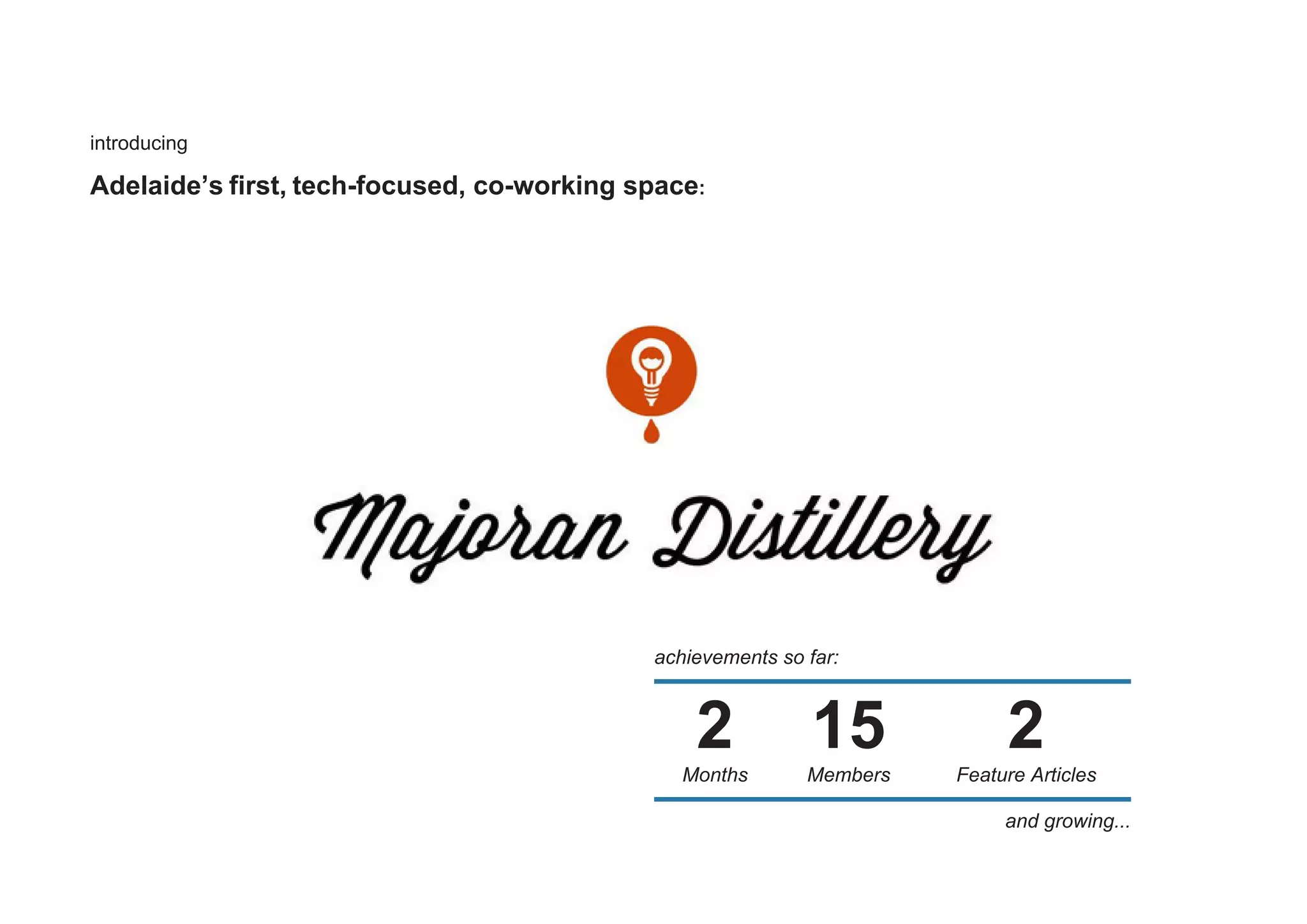
The cover slide introduces Majoran Distillery as "Adelaide’s first, tech-focused, co-working space." It immediately presents three key metrics under "achievements so far": 2 Months of operation, 15 Members, and 2 Feature Articles. This is an effective way to signal that the concept has already moved past the ideation phase and has validated demand in the local market.
Slide 2: The Mission
The mission slide outlines four core objectives: promoting big thinking in Adelaide, acting as a birthplace for "digital giants," growing the startup ecosystem, and connecting local startups to the global stage. The language is aspirational and focuses on the "self-sufficient" nature of the space, which is a critical point for potential sponsors who want to ensure their contribution leads to a sustainable entity rather than a perpetual charity case.
Slide 3: The Sponsorship Overview
This slide functions as the 'Ask' but framed as a partnership. It lists the availability of 1 Platinum Sponsorship, 1 Gold Sponsorship, and 3 Silver Sponsorships. The right side of the slide explains the value proposition for the sponsor: brand association with the local tech brand, community, and forum. It uses a historical metaphor, comparing the space to the "Forum to the Roman Empire," positioning the facility as the physical hub for all things tech in Adelaide.
Slide 4: Current Status and Branding
Slide 4 provides qualitative traction. It notes that the space currently houses 11 startups, including a venture capital fund raising $15 million and a team from the Startmate accelerator. It also highlights social proof: a launch party attended by 80 entrepreneurs, 178 Facebook likes, and 97 Twitter followers. Interestingly, the slide addresses the name "Distillery," explaining that it implies a sense of time and maturation, much like Scotch or tech startups. A clipping from The Advertiser titled "A shared vision for local IT start-ups" provides third-party media validation.
Slide 5: Current Members
This is a logo wall slide. It features 11 logos, including Acumen Ventures , tingtong , GimmeQuotes , AppMajik , future earth , inveress , Web Flame Solutions , Appsogle , THEME MATCHER! , furio.co , and Toolbox Interactive . For a co-working space, the quality of the tenants is the product, and this slide serves to show the diversity of the early community.
Slide 6: The Future and Financial Targets
This slide contains the most dense financial information. Key figures include:
Launch date: August 2012. · Membership fees: Between $200 and $300 per month. · Original forecast: $1,910 profit based on 16 members by June 2013. · Fundraising target: $30,000 to $60,000. · Use of funds: Fit-out and lease for a 300m² space (2-3x larger). · Growth projection: 2 new memberships per quarter. · Breakeven timeline: 18 months (April 2014) to reach sufficient cash reserves.
The slide mentions that a 3-year forecast (P&L, Cash Flow, Balance Sheet) is available for sponsors who wish to take the presentation further.
Slide 7: The Benchmark (Fishburners)
To provide context for their model, Majoran Distillery points to Fishburners in Ultimo, Sydney. They describe it as the largest tech co-working space in Australia and a successful example of a not-for-profit providing space for entrepreneurs. They specifically mention Fishburners' sponsorship with Optus as a precedent for the model they are pursuing. This is a smart move; it proves the business model works in other Australian cities.
Slide 8: Sponsorship Packages
This slide details the deliverables for each sponsorship tier. The expansion phase targets 30 desks and 80 total members. Platinum Sponsors receive wall signage, a dedicated banner at all events, website and Facebook links, mentions in speeches, and one drop-in desk per week. Gold and Silver tiers offer reduced versions of these benefits. This level of detail is necessary for a proposal-style deck to close a deal.
Slide 9: The Team
The team is presented as a group of "young entrepreneurs" with backgrounds in IT, accounting, and law. Chhai Thach (President) is highlighted for his 10 years of experience in IT and telecom. Michael L. Reid (Treasurer) is a Chartered Accountant, and William Chau (Secretary) is a solicitor. The slide also lists a Board of Advisors featuring names like Shane Cheek (former Playford Capital) and Ken Saman (YourAmigo), adding significant professional weight to the project.
Slide 10: Contact Details
The final slide provides direct contact information for Chhai Thach, including a phone number, email, and the physical address at Level 2, 186 Pulteney Street, Adelaide. It also links to their social media profiles.
What Majoran Distillery Does Well
The deck excels at local validation . By including a newspaper clipping from a major local publication and listing specific, recognizable local advisors, they build immediate trust within the Adelaide business community. The use of a "comparable" (Fishburners) is also a strong tactical choice, as it helps potential sponsors visualize the end goal and the social impact of their investment. Furthermore, the transparency regarding their current capacity and the specific need for a larger space makes the 'Ask' feel logical and urgent rather than speculative.
What is Missing from the Deck
While the deck is strong as a sponsorship proposal, it lacks several elements that a traditional investor would look for:
Unit Economics: While they mention $200-$300 per desk, there is no breakdown of the cost per square meter or the margin per desk once the new lease is signed. · Market Size: There is no data on the total number of tech startups in Adelaide or the projected growth of the local tech sector to justify the jump from 15 to 80 members. · Competitive Landscape: The deck claims to be the "first," but it doesn't address potential competitors or why a startup would choose Majoran over a traditional executive suite or working from home. · Long-term Vision: The deck focuses entirely on the immediate move to a 300m² space. It does not address whether this model is intended to scale to multiple locations or if it will remain a single-site community project.
Founder's Guide: What to Copy
Tiered Sponsorship Structure: If you are building a community-centric or non-profit business, Slide 8 is a perfect template. It clearly defines what the partner gives and exactly what they get in return, which simplifies the decision-making process for corporate CSR departments.
Early Traction Metrics: Slide 1 is a masterclass in "doing a lot with a little." With only two months of data, the founders managed to present three distinct metrics that suggest momentum. Founders should always lead with whatever traction they have, even if the timeframe is short.
Professional Board of Advisors: For a young team, having a slide like Slide 9 is essential. By listing an accountant, a lawyer, and seasoned tech advisors, they mitigate the perceived risk of "young entrepreneurs" managing a significant capital fit-out and a commercial lease.
Direct Call to Action: The deck doesn't hide the ball. Slide 3 and Slide 6 clearly state the dollar amounts and the specific sponsorship slots available. This directness is often missing in early-stage decks where founders are afraid to ask for a specific number.
Frequently asked questions
- Is Majoran Distillery seeking equity investment?
- No. According to Slide 3 and Slide 8, the deck is structured as a 'Sponsorship Proposal.' It offers brand association, signage, and marketing opportunities in exchange for funding, rather than shares in the company. Slide 7 further clarifies that they are established as a not-for-profit to grow the tech entrepreneurship ecosystem.
- What is the current financial status of the space?
- Slide 6 states that the space is 'currently operating at capacity' after launching in August 2012. They forecast a small profit of $1,910 based on 16 full-time members by June 2013, and they claim to have almost reached this target within just two months of operations.
- What will the requested $30,000 to $60,000 be used for?
- Per Slide 6, the funds are intended to 'fit-out and lease premises 2-3 times larger than the current space.' The goal is to move into a facility up to 300m² to accommodate higher demand and support a quality calendar of events for members and the public.
- Who are the key people behind the project?
- The leadership team consists of Chhai Thach (President), an IT and telecom veteran; Michael L. Reid (Treasurer), a Chartered Accountant; and William Chau (Secretary), a solicitor and barrister. They are supported by a Board of Advisors including representatives from Enterprise Adelaide and former fund managers (Slide 9).
- How does the company plan to achieve self-sufficiency?
- Slide 6 notes that with the new investment, they estimate it would take approximately 18 months (by April 2014) before cash reserves are sufficient to support the larger investment. Self-sufficiency is driven by membership fees ranging from $200 to $300 per month and the tiered sponsorship model.