Mandaê’s 2014 pitch deck is a masterclass in addressing a specific, high-friction regional problem with a scalable, asset-light solution. Operating in Brazil, where the national postal service (Correios) dominated, Mandaê positioned itself as the 'UPS without the trucks.' The deck highlights a clear three-step user journey—photo, pickup, and professional packaging—that eliminates the primary pain points for small e-commerce sellers and individuals. With a modest initial ask of $200,000 at a $1 million post-money valuation, the founders leveraged their background in investment banking and e-co…
Key takeaways
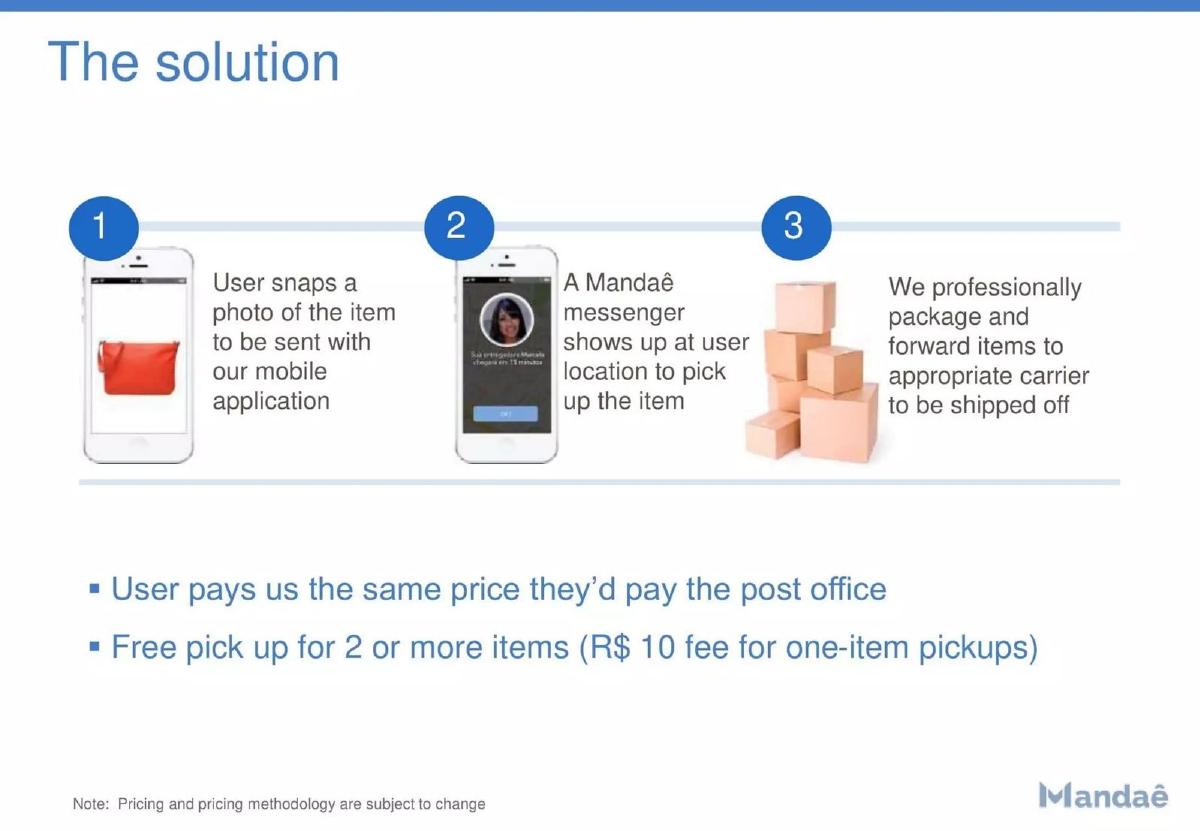
- The solution is distilled into a simple three-step process: snap a photo, messenger pickup, and professional packaging (Slide 3).
- Initial validation was achieved in just 28 days with 4 customers, generating R$ 2,644 in revenue and a 41% contribution margin (Slide 4).
- The addressable market is segmented into three distinct tiers totaling R$ 9.1 billion, with 'Individuals' representing the largest volume at R$ 4.6 billion (Slide 5).
- Mandaê differentiates itself from the 'motoboy' (local courier) market, which is estimated at R$ 2.2 billion in São Paulo state alone (Slide 10).
- The financial model projects aggressive growth, targeting R$ 698 million in gross revenue by Year 5 (Slide 12).
- The fundraising ask was $200,000 for a $1 million post-money valuation, with 39% of funds allocated to Business Development (Slide 8).
- The team includes an advisor with significant industry weight: Hans Hickler, former CEO of DHL Express USA (Slide 2).
- Unit economics are detailed by segment, with individuals having a projected CPA of R$ 2 to R$ 5 and an annual attrition rate of 33% (Slide 14).
The Vision: Shipping Made Simple
The Mandaê pitch deck from February 2014 (Slide 1) opens with a clean, minimalist aesthetic. The tagline, "Shipping made simple," sits beneath a logo featuring stylized boxes. This immediately establishes the brand's focus on physical goods and logistical efficiency. The presence of two co-founders, Karim Hardane and Marcelo Fujimoto, suggests a balanced leadership structure from the outset.
The Team and Advisory Board
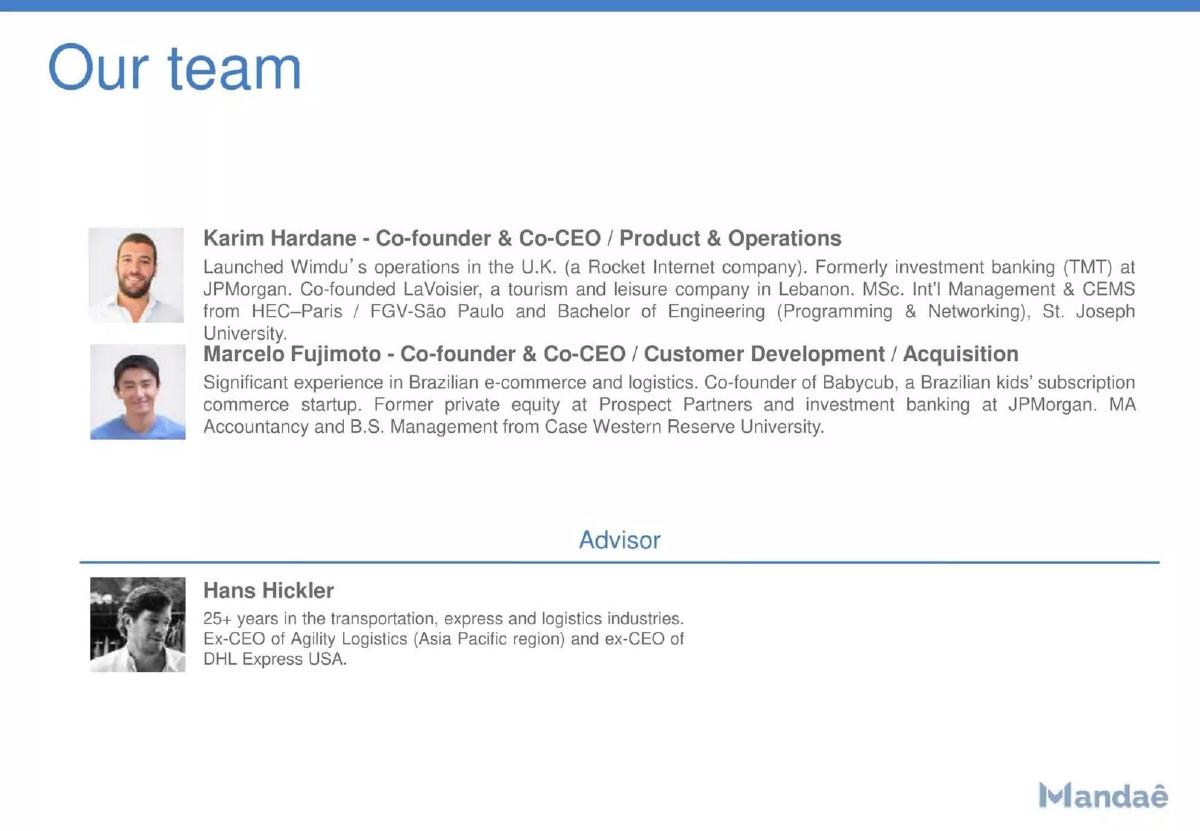
On Slide 2, the deck introduces the leadership. Karim Hardane (Co-CEO) brings experience from Rocket Internet (Wimdu) and JPMorgan, while Marcelo Fujimoto (Co-CEO) has a background in Brazilian e-commerce and private equity. This combination of operational 'blitzscaling' experience and financial rigor is a strong signal to investors. Perhaps most impressive is the inclusion of Hans Hickler as an advisor. As the former CEO of DHL Express USA, Hickler provides the startup with immediate industry credibility and a deep network in the global logistics space.
The Solution: A Three-Step Process
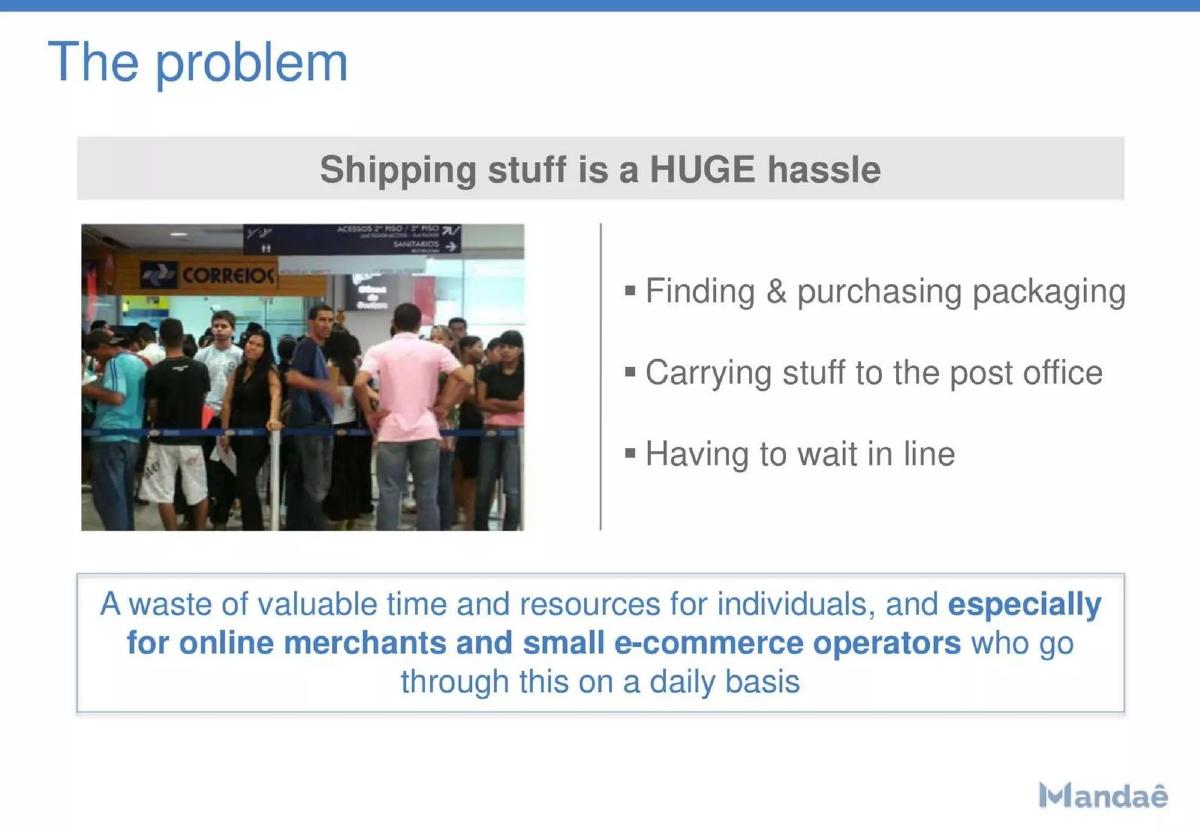
Slide 3 defines the product with extreme clarity. The solution is broken down into three steps: 1) User snaps a photo, 2) A Mandaê messenger picks up the item, and 3) Mandaê packages and forwards the item to a carrier. The pricing strategy is equally straightforward: users pay the same price as the post office, with free pickup for two or more items (and a R$ 10 fee for single items). This slide effectively addresses the 'why now' by highlighting the removal of the physical burden of shipping.
Validation and Unit Economics
Slide 4, titled "Why you should believe in our model," is a data-heavy validation slide. It shows a 28-day test with 4 customers that generated R$ 2,644 in revenue and a gross profit of R$ 1,075 . The deck isn't afraid to show the 'pro forma' nature of these costs, noting that shipping costs were stated as if e-Sedex rates had been applied. A 41% contribution margin in a pilot phase is a compelling proof of concept for a seed-stage company.
Market Opportunity and Segmentation
Slide 5 breaks down the Brazilian transport industry. Out of a total R$ 29 billion market, Mandaê identifies a segmented addressable market of R$ 9.1 billion . This is further categorized into:
Small e-commerce: R$ 3.4 billion (29,000 stores). · Online sellers: R$ 1.1 billion (3 million+ sellers). · Individuals: R$ 4.6 billion (54 million households).
This level of granularity shows that the founders have a deep understanding of where the volume resides and which segments are most underserved by the incumbent postal service.
Distribution and Growth Strategy
Slide 6 outlines the distribution channels for each segment. It suggests a CAC as low as R$ 2 (CPI) for mobile ad platforms. The strategy includes a mix of PPC, inbound marketing, and a viral loop where every box sent contains Mandaê branding and a flyer. For the small e-commerce segment, the company plans to use personalized sales calls and API partnerships with marketplaces, showing a sophisticated multi-channel approach.
Future Expansion: Beyond the First Mile
Slide 7 looks at the long-term roadmap. Mandaê identifies two major expansion opportunities: 1) A "pick up and sell" service for unwanted items (similar to eBay Valet), taking a ~30% commission, and 2) Same-day delivery for large e-commerce players. By framing these as services built "on top of our platform," the deck suggests that the initial shipping service is just the entry point into a much larger logistical ecosystem.
The Ask: Seed Funding for Scale
Slide 8 presents the fundraising round: USD $200,000 at a $1 million post-money valuation . The use of funds is clearly allocated: 39% for Business Development, 35% for Technology, 13% for Marketing, and 12% for Setup. The slide also sets clear 6-month milestones, including reaching 3,000 users and R$ 100,000+ in monthly revenue. This is a modest ask by modern standards, but it reflects the capital efficiency of the asset-light model in 2014.
Appendix: Market Nuance and Financial Projections
The appendix (Slides 9-14) provides deeper context. Slide 10 is particularly important as it differentiates Mandaê from the crowded "motoboy" (local courier) market. While companies like Loggi and Vaimoto were receiving funding for local delivery, Mandaê clarifies that its market is larger and focused on long-distance parcel logistics, though it could enter the motoboy market later. Slide 11 uses historical growth proxies from Mercado Livre and Correios to justify the tailwinds in the sector.
Detailed Financial Modeling
Slide 12 shows a 5-year revenue projection, climbing from R$ 3 million in Year 1 to R$ 698 million in Year 5 . Slide 13 provides a month-by-month forecast for the first year, showing the company reaching EBITDA positivity by Month 11. Finally, Slide 14 lists the key modeling assumptions, such as a 33% annual attrition rate for individuals and a 50% rate for e-commerce, demonstrating that the founders have considered the churn realities of their different customer segments.
What Works in This Deck
1. Extreme Clarity of Process: The three-step visual on Slide 3 makes the business model instantly understandable. Logistics can be complex, but Mandaê makes it feel like a simple software utility.
2. Credible Advisory Board: Having Hans Hickler on the team slide (Slide 2) is a massive de-risking factor. It signals to investors that the company has access to world-class logistics expertise.
3. Granular Market Segmentation: By breaking the market into three distinct buckets (Slide 5), Mandaê shows it understands that a 'one size fits all' marketing strategy won't work. This allows for more precise CAC and LTV calculations.
4. Honest Pilot Data: Slide 4 doesn't try to hide the small scale of the initial test. By showing exactly what 4 customers did over 28 days, the founders build trust through transparency.
What Is Missing
1. Competitive Landscape: While Slide 10 mentions motoboy apps, there is no direct comparison with traditional logistics incumbents or other emerging tech-enabled freight forwarders. A classic 2x2 matrix or a feature comparison table is absent.
2. Technology Deep Dive: The deck mentions "Technology" as a major use of funds, but it doesn't explain what the proprietary 'moat' is. Is it a routing algorithm? A warehouse management system? The 'how' of the tech remains a black box.
3. Risk Factors: Operating in Brazil involves significant regulatory, tax, and security challenges (e.g., cargo theft). The deck does not address how Mandaê plans to mitigate these regional-specific risks.
What a Founder Should Copy
1. The 'Pro Forma' Validation: If you are pre-scale, copy Slide 4. Show the unit economics of a small sample size to prove the business can be profitable if the overhead is covered.
2. Segmented CAC/LTV Assumptions: Slide 14 is a great example of how to present assumptions. Instead of one blended number, break down your expectations by customer type. It shows you've thought about the different behaviors of your users.
3. The 'Asset-Light' Narrative: Mandaê successfully frames being 'truck-less' as a feature, not a bug. If your startup sits as a software layer over physical infrastructure, emphasize how this allows for faster, more capital-efficient scaling.
Frequently asked questions
- What is Mandaê's core value proposition?
- Mandaê simplifies the shipping process for SMBs and individuals in Brazil by handling the 'first mile.' Users take a photo of an item via an app, a messenger picks it up, and Mandaê packages and ships it via private carriers or the postal service. This saves users the time and effort of visiting a post office while offering competitive pricing.
- How does Mandaê's business model remain asset-light?
- The company describes itself as 'UPS without the trucks.' Instead of owning a massive fleet, Mandaê organizes the supply chain by partnering with existing players for pickups, cross-docking, and last-mile transport. This allows them to scale quickly without the heavy capital expenditure associated with traditional logistics companies.
- Who are the primary target customers for Mandaê?
- The deck identifies three segments: Small e-commerce (29,000 stores), Online sellers (3 million+ sellers on platforms like Mercado Livre), and Individuals (54 million households). Each segment has different shipping frequencies and average costs, allowing Mandaê to tailor its acquisition strategy and pricing.
- What were the key financial milestones Mandaê aimed for post-funding?
- With the $200,000 seed round, Mandaê aimed to reach 3,000 users, 1,800 pickups, and over R$ 100,000 in monthly revenue by month six. The plan focused on immediate launch in São Paulo, specifically targeting the Vila Mariana and Pinheiros neighborhoods with existing beta testers.
- How does Mandaê plan to expand beyond basic shipping?
- The deck outlines 'potential services' including a consignment model where Mandaê picks up unwanted items and sells them on marketplaces for a ~30% commission. They also identified same-day delivery for large e-commerce players as a future growth lever once their logistical 'web' covered enough geography.