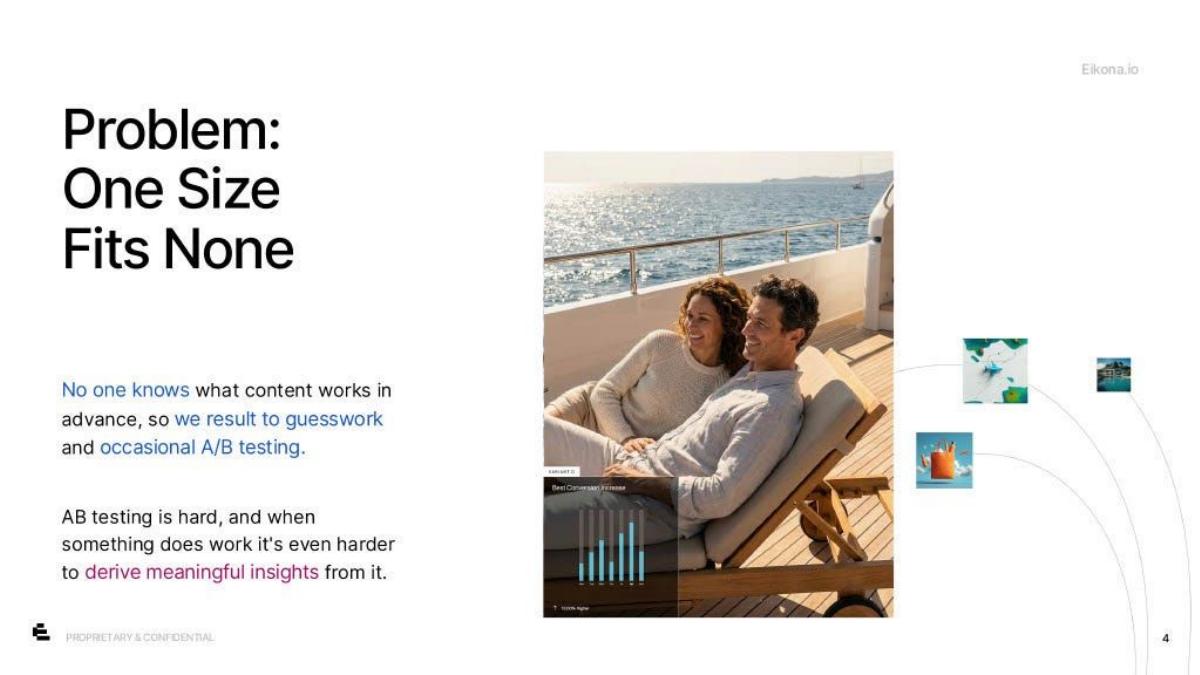
Eikona, a Middle Eastern AI startup, secured $5M in Seed funding in 2024 to tackle the limitations of generic marketing through generative AI. The 12-slide deck positions the company as a technical successor to manual A/B testing, utilizing Reinforcement Learning from Human Feedback (RLHF) to optimize lifecycle marketing. By moving away from manual prompting—which they claim is biased and non-scalable—Eikona offers a 'steering layer' for base models. The deck is notable for its technical positioning, citing industry luminaries like Sam Altman and Andrej Karpathy to validate their architectura…
Key takeaways
- The deck leads with a strong thesis statement on Slide 1: 'End Generic Marketing,' immediately identifying the pain point.
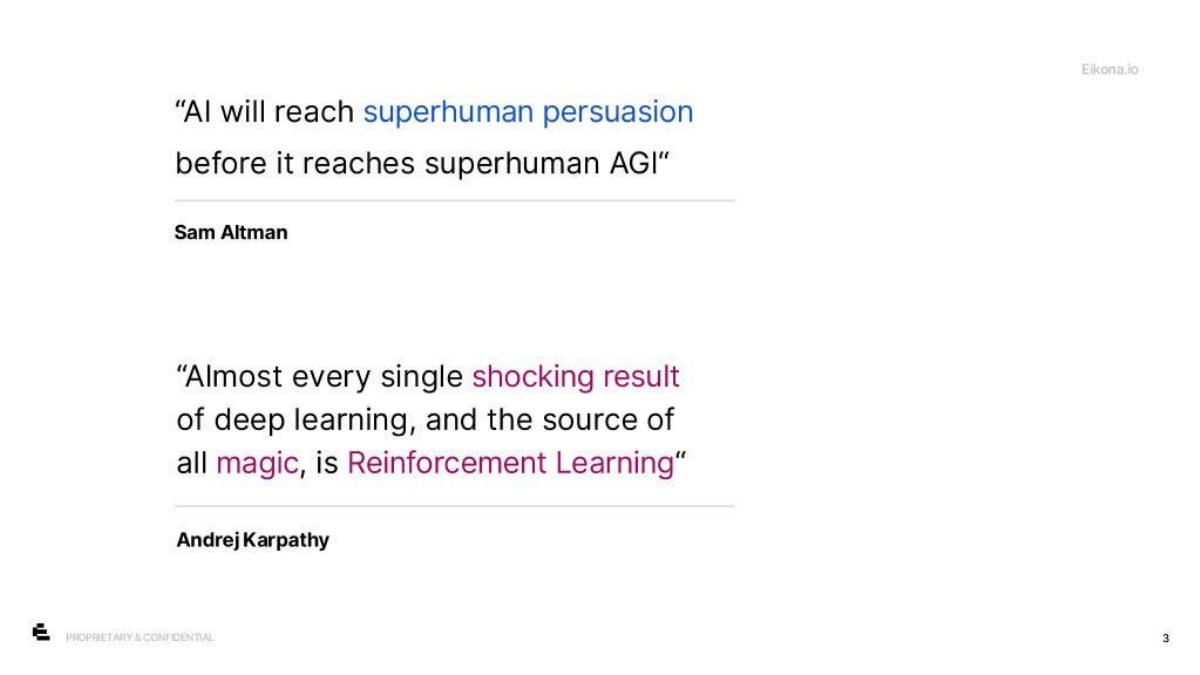
- Eikona uses high-profile industry quotes on Slide 3 from Sam Altman and Andrej Karpathy to frame RLHF as the 'source of all magic' in deep learning.
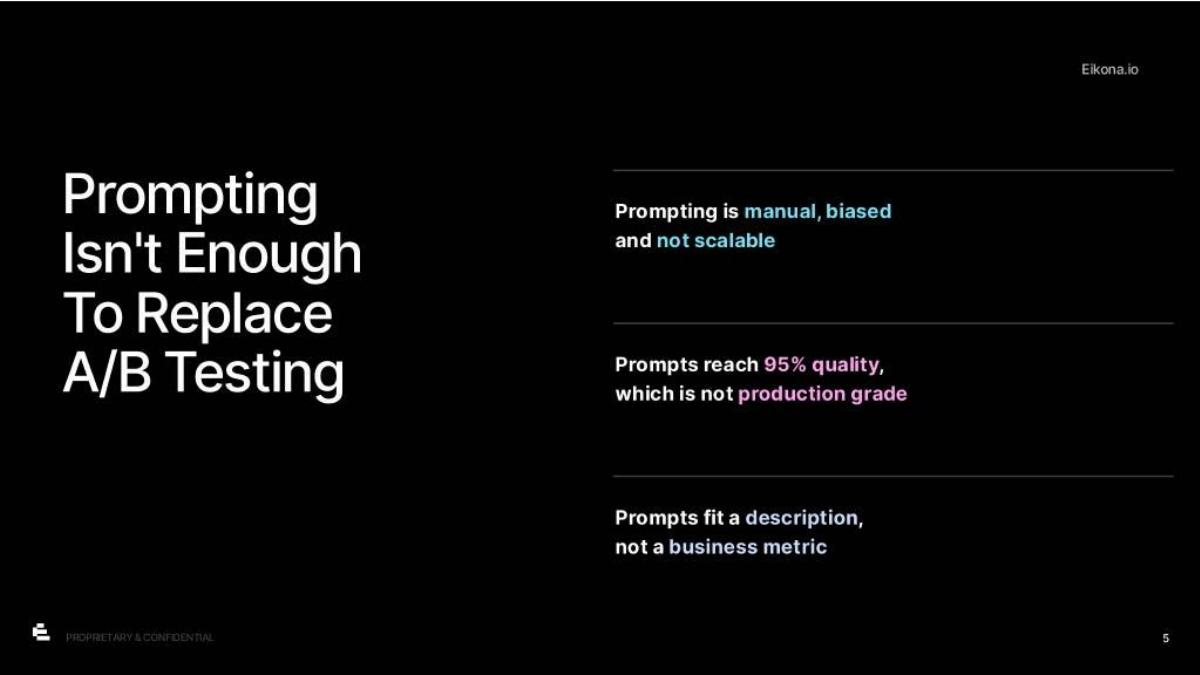
- Slide 5 identifies three critical failures of manual prompting: it is not scalable, it only reaches 95% quality, and it fits descriptions rather than business metrics.
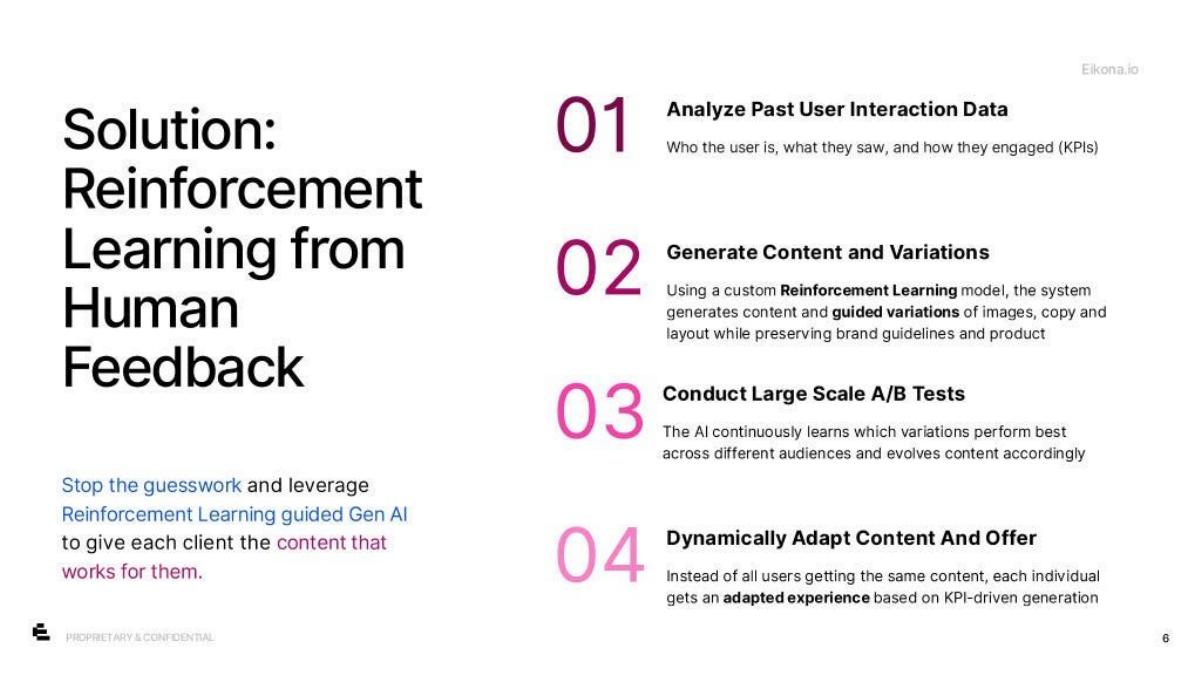
- The technical solution on Slide 7 introduces a 'model agnostic steering layer' that uses RLHF to guide generative models for complete automation.
- Market sizing on Slide 9 uses a bottom-up approach, identifying a total addressable market across three sectors (B2C Services, Gaming, Retail) exceeding $24.7B.
- A case study on Slide 11 shows a 3-stage optimization process (Exploration, Denoising, Exploitation) resulting in a 9.24% unique click rate uplift.
- The deck highlights specific performance gains on Slide 11, including a 36.78% booking uplift for segments discovered via location data.
- Eikona targets high-value clients, with market buckets on Slide 9 ranging from $25M to over $1B in revenue.
Eikona Pitch Deck Analysis
Eikona is a Middle Eastern AI startup that raised $5M in a Seed round in 2024, as reported by Business Insider. The company focuses on generative AI for lifecycle marketing, specifically aiming to replace manual A/B testing and prompting with a more sophisticated Reinforcement Learning from Human Feedback (RLHF) approach. The 12-slide deck is a masterclass in technical positioning, moving the conversation away from generic AI 'magic' toward a specific, scalable engineering solution for marketers.
Slide 1: Title and Vision
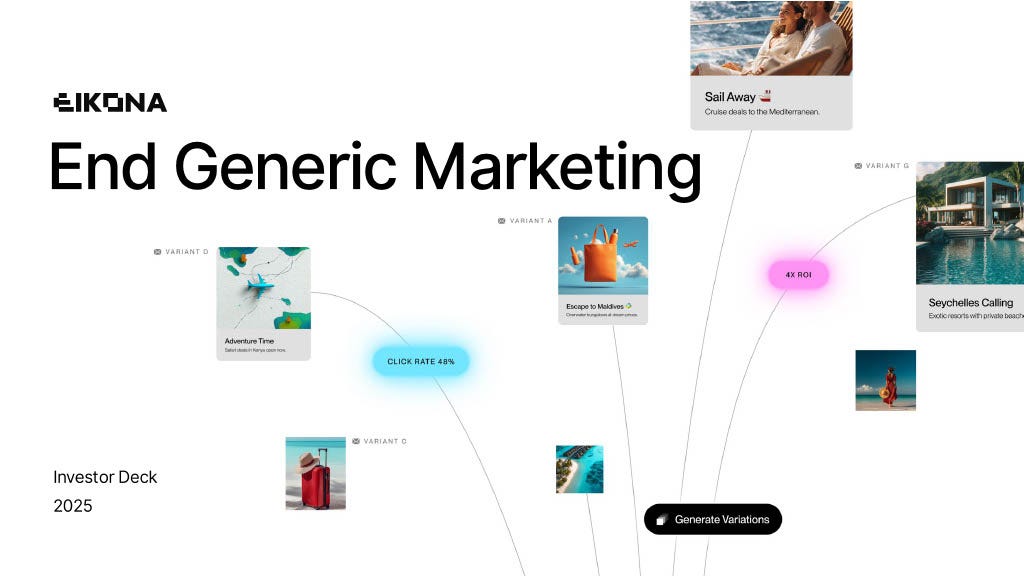
The deck opens with a bold declaration: "End Generic Marketing." Slide 1 sets the visual tone with a minimalist aesthetic, featuring floating marketing creative variants (e.g., "Adventure Time" and "Seychelles Calling") connected by nodes. Two key metrics are highlighted in neon bubbles: "CLICK RATE 48%" and "4X ROI." The slide clearly identifies the document as an "Investor Deck 2025," signaling a forward-looking strategy despite the 2024 funding date reported by publishers.
Slide 2-4: The Philosophical Foundation
Slides 2 through 4 serve to establish the company's brand and intellectual pedigree. While Slide 2 is a simple logo treatment, Slide 3 is a strategic 'appeal to authority.' It features two quotes: Sam Altman stating, "AI will reach superhuman persuasion before it reaches superhuman AGI," and Andrej Karpathy noting, "Almost every single shocking result of deep learning... is Reinforcement Learning." By using these quotes, Eikona justifies its technical focus on RLHF before even explaining its product. It frames the company not just as a marketing tool, but as a practitioner of the 'source of all magic' in AI.
Slide 5: The Problem with Prompting
Slide 5 is the 'anti-thesis' slide. It argues that "Prompting Isn't Enough To Replace A/B Testing." The slide lists three specific pain points:
Prompting is manual, biased and not scalable: It relies on human input which cannot keep up with millions of users. · Prompts reach 95% quality, which is not production grade: This suggests a 'last mile' problem where generic AI outputs aren't polished enough for major brands. · Prompts fit a description, not a business metric: This is the most critical insight—AI usually generates what you ask for (a description), not what makes money (a metric).
Slide 6-7: The RLHF Solution
Slide 7 introduces the core product offering: "Adapting content with RLHF instead of prompts." The slide explains that RLHF uses human feedback to guide generative models, which is the industry standard for fine-tuning Large Language Models (LLMs). Eikona’s specific innovation is a "base model agnostic steering layer." This is a crucial technical detail; it implies that Eikona doesn't need to build its own LLM but instead builds the 'steering wheel' that makes existing models (like GPT-4 or Claude) perform better for marketing. The visual shows a mobile interface with various button options like "Redeem offer now" and "Remind me later," illustrating how the AI optimizes the user journey.
Slide 8-9: Market Opportunity
Slide 9 provides a "Market Bottom-Up" analysis, which is generally preferred by investors over vague top-down 'TAM' slides. The market is broken into three categories:
Online B2C Services ($10.6B): Covering Banking, Telecom, Healthcare, and Hospitality. · Gaming ($5.9B): Specifically the online gaming email market. · Online Retail ($8.2B): Including Apparel, Beauty, and Automotive.
The slide notes that market size is computed as "#clients-in-bucket times bucket ACV." The buckets range from "$25M - $50M" to "$1B+," showing that Eikona is targeting mid-market to enterprise-level clients.
Slide 10-11: Proof of Concept
Slide 11 presents a "Customer Case Study" involving a "leading OTA" (Online Travel Agency) that sends emails to "tens of millions of users in over 40 languages." This demonstrates the scale at which Eikona operates. The slide details a 3-stage optimization process: Exploration, Denoising, and Exploitation. The results are impressive:
+9.24% uplift in unique click rate. · +22.95% uplift in booking count.
A bar chart shows that the highest uplift ( 36.78% ) came from the "Location" segment, proving the AI's ability to discover high-value customer cohorts that manual testing might miss.
Slide 12: Closing
The final slide is a simple sign-off with the Eikona logo. In the provided set, there is no contact information or 'next steps' slide, though these are often included in full versions of the deck.
What Makes This Deck Effective?
Eikona’s deck succeeds because it avoids the 'AI for everything' trap. Instead, it identifies a very specific technical bottleneck—the inefficiency of manual prompting—and offers a specific technical solution—an RLHF steering layer. By citing Karpathy and Altman, they align themselves with the current state-of-the-art in AI research, which gives their Seed-stage claims more weight. The use of a bottom-up market analysis on Slide 9 also shows a level of commercial maturity often lacking in early-stage AI decks; they know exactly who their customers are and how much they are worth.
What Is Missing?
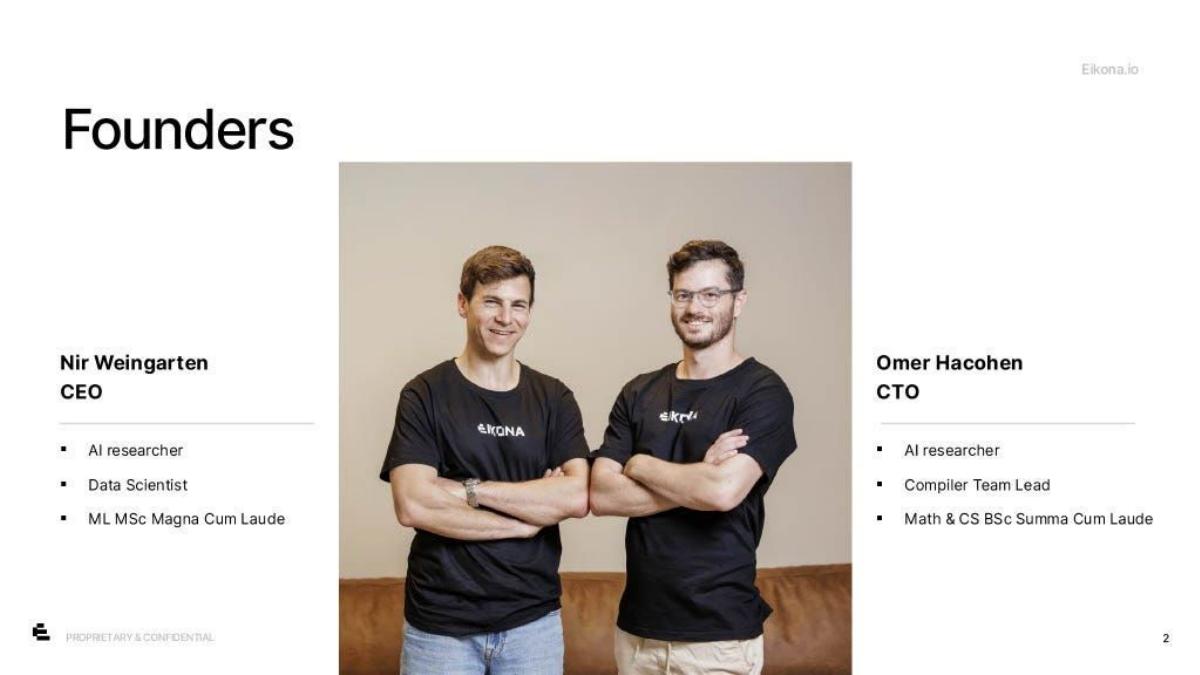
The most glaring omission in the provided slides is the Team Slide. For a $5M Seed round, the pedigree of the founders is usually the most important factor. Investors want to know if the team has the technical capability to actually build a 'model agnostic steering layer.' Additionally, there is no Competition Slide. The marketing automation space is crowded with incumbents (like Braze or Salesforce) and new AI entrants (like Copy.ai or Jasper). Eikona argues against 'prompting' as a category, but they don't explain why their specific RLHF implementation is better than a competitor's similar approach. Finally, the Financial Ask is missing; while we know from external reports they raised $5M, the deck itself should ideally outline what that capital will achieve over the next 18-24 months.
Founder's Playbook: Lessons to Copy
1. Use the 'Anti-Thesis' Strategy: Don't just say what you do; say why the current popular way of doing things is broken. Eikona’s attack on 'prompting' (Slide 5) is a brilliant way to differentiate themselves from the thousands of 'GPT-wrappers' currently in the market.
2. Show the Process, Not Just the Result: Slide 11 doesn't just show a 22% uplift; it explains the Exploration -> Denoising -> Exploitation framework. This gives investors confidence that the results are repeatable and based on a rigorous methodology rather than a one-off fluke.
3. Bottom-Up Market Sizing: If you are selling to enterprises, avoid the 'The global marketing market is $500B' slide. Copy Eikona’s Slide 9 approach: identify your customer buckets by revenue, estimate how many there are, and multiply by your expected contract value. It shows you understand your sales motion.
4. Leverage Industry Consensus: If you are building in a complex technical field, use quotes from recognized experts to validate your architectural choices. It saves you from having to explain the basic merits of a technology like RLHF from scratch.
Frequently asked questions
- What is Eikona's core technical differentiator?
- Eikona differentiates itself by moving away from manual prompting, which they describe as 'manual, biased and not scalable' on Slide 5. Instead, they utilize Reinforcement Learning from Human Feedback (RLHF) to create a 'base model agnostic steering layer.' This allows for automated optimization of marketing content based on actual business metrics rather than just descriptive prompts.
- How does Eikona calculate its market size?
- On Slide 9, Eikona presents a 'Market Bottom-Up' analysis. They compute market size by multiplying the number of clients in specific revenue buckets (ranging from $25M to $1B+) by the bucket's Annual Contract Value (ACV). This results in three primary targets: Online B2C Services ($10.6B), Gaming ($5.9B), and Online Retail ($8.2B).
- What results did Eikona achieve for its customers?
- According to the case study on Slide 11, Eikona worked with a leading Online Travel Agency (OTA) to optimize weekly promotional emails. The results included a 9.24% uplift in unique click rates and a 22.95% uplift in booking counts. They also identified specific high-performing segments, such as a 32.12% uplift for users in the 'Location + Loyalty plan' bucket.
- What are the three stages of Eikona's optimization process?
- As detailed on Slide 11, Eikona follows a 3-stage process: 1. Exploration (creating broad variations across copy and creative), 2. Denoising (isolating signal from noise via controlled tests), and 3. Exploitation (deploying optimized creatives per specific customer segment).
- What is missing from the Eikona pitch deck?
- Based on the provided slides, the deck lacks a dedicated Team slide, a Roadmap slide, and a specific 'Ask' slide detailing how the $5M Seed round will be allocated. It also omits a direct competitor comparison, focusing instead on the technical shortcomings of current 'prompting' methods rather than specific rival companies.