Elektra presents a vision for 'Ada,' a line of haptic wearables including cuffs, sleeves, and vests designed to provide physical sensations via electrical stimulation. The deck identifies a lack of haptic integration in current media, noting that less than 1% of movie ticket sales are for 4D experiences and 4D hall installations cost $2M. Elektra proposes a consumer-grade alternative with hardware build costs ranging from $40 to $160. While the deck provides a rare look at internal equity splits (33% for the CEO, 29% for the CSO and CTO, and 9% for the COO) and early activity metrics like 250…
Key takeaways
- The company positions its 'Ada' product line as the 'iPhone of haptics,' utilizing electrical stimulation for physical immersion (Slide 4).
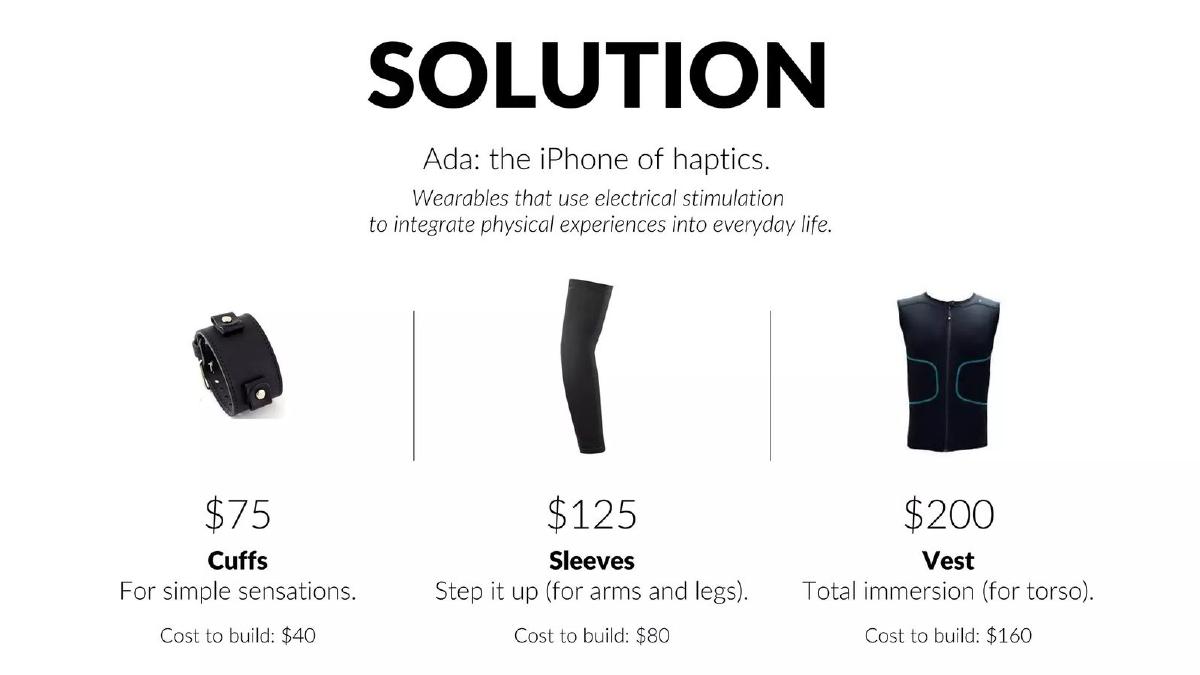
- Hardware unit economics are explicitly stated, showing build costs of $40, $80, and $160 for products retailing at $75, $125, and $200 respectively (Slide 4).
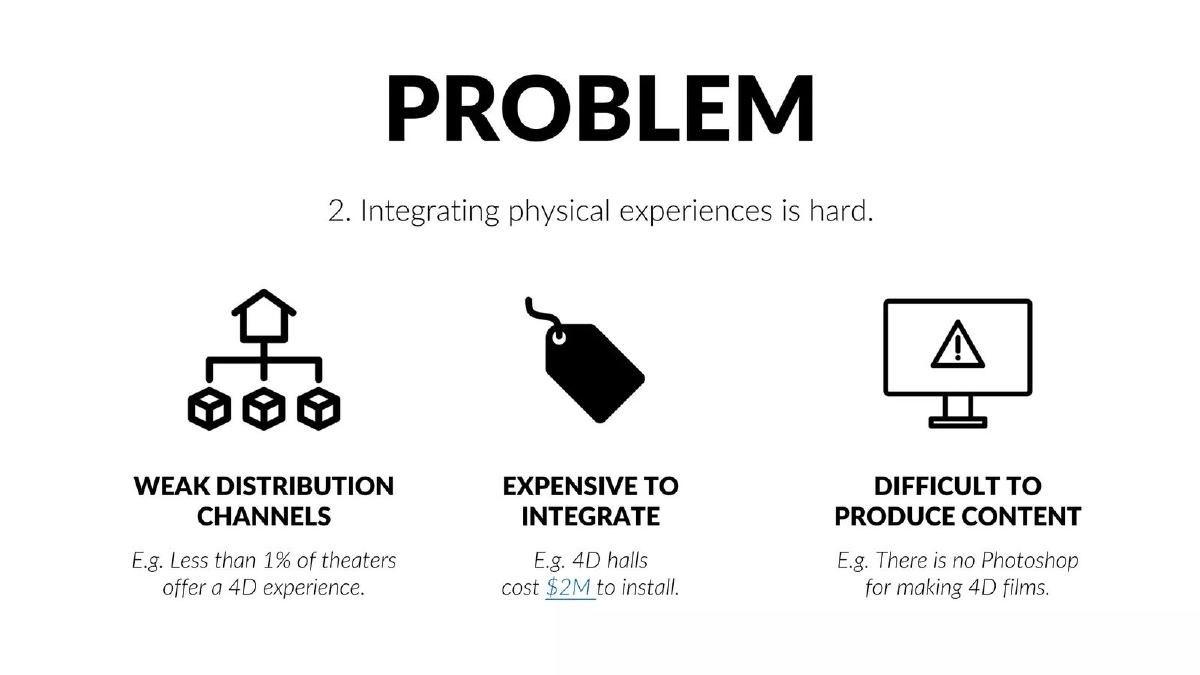
- The deck highlights a significant barrier to entry for competitors, noting that 4D cinema halls cost $2M to install (Slide 3).
- Market size is projected at $19.5B by 2020, based on a 16.2% CAGR from 2016 (Slide 7).
- Traction is measured by activity rather than revenue, citing 10,000 miles driven and 250 meetings held within the first 100 days of 2017 (Slide 9).
- The team slide includes a highly unusual level of transparency by listing the exact equity percentage for each of the four founders (Slide 10).
- The deck identifies a content creation gap, stating there is currently 'no Photoshop for making 4D films' (Slide 3).
- The competitive landscape is mapped on axes of 'Affordable & Light' vs. 'Expensive & Heavy' and '1 application' vs. '20+ applications' (Slide 8).
Executive Summary
Elektra Public presents a 10-slide pitch deck for a haptic wearable company. The deck focuses heavily on the hardware specifications and the perceived gap in the 'physical experience' market. While it provides excellent transparency regarding team equity and unit costs, it follows a somewhat dated market projection (ending in 2020) and lacks a clear financial ask or revenue roadmap.
Slide 1: Title Slide
The deck opens with the tagline MAKE IT PHYSICAL over an image of a person leaping across a grassy hill. The branding is minimal, featuring a flame-like logo with a lightning bolt. Contact information for Arsh Haque, CEO, is provided, including a phone number and email address. This slide establishes the brand's focus on movement and physical sensation.
Slide 2: Problem - The Haptic Gap
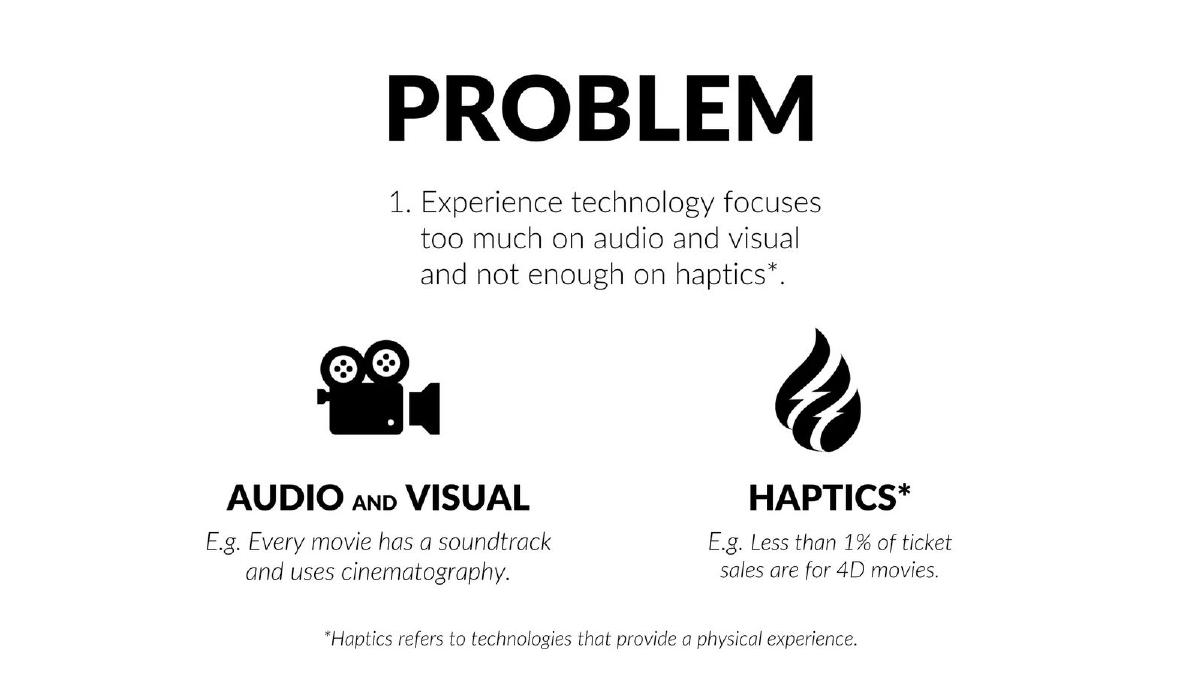
The first problem slide argues that current 'experience technology' is over-indexed on audio and visual elements. It provides a specific data point: Less than 1% of ticket sales are for 4D movies . It defines haptics in a footnote as 'technologies that provide a physical experience.' This slide successfully identifies a niche that has not yet reached mass-market penetration.
Slide 3: Problem - Integration Barriers
The second problem slide focuses on the 'why' behind the lack of haptics. It cites three main barriers: Weak Distribution Channels (less than 1% of theaters), High Costs ($2M for 4D hall installation), and Content Production (stating 'There is no Photoshop for making 4D films'). This is a strong slide because it identifies the infrastructure and software hurdles that a new entrant must overcome.
Slide 4: Solution - The Ada Lineup
Elektra introduces 'Ada,' described as 'the iPhone of haptics.' The slide shows three products with their respective retail prices and build costs:
Cuffs: $75 (Cost to build: $40) for simple sensations. · Sleeves: $125 (Cost to build: $80) for arms and legs. · Vest: $200 (Cost to build: $160) for total torso immersion.
The use of 'electrical stimulation' is mentioned as the core mechanism. Providing build costs this early in a deck is rare and signals a high level of transparency regarding unit economics.
Slide 5: Solution - How It Works
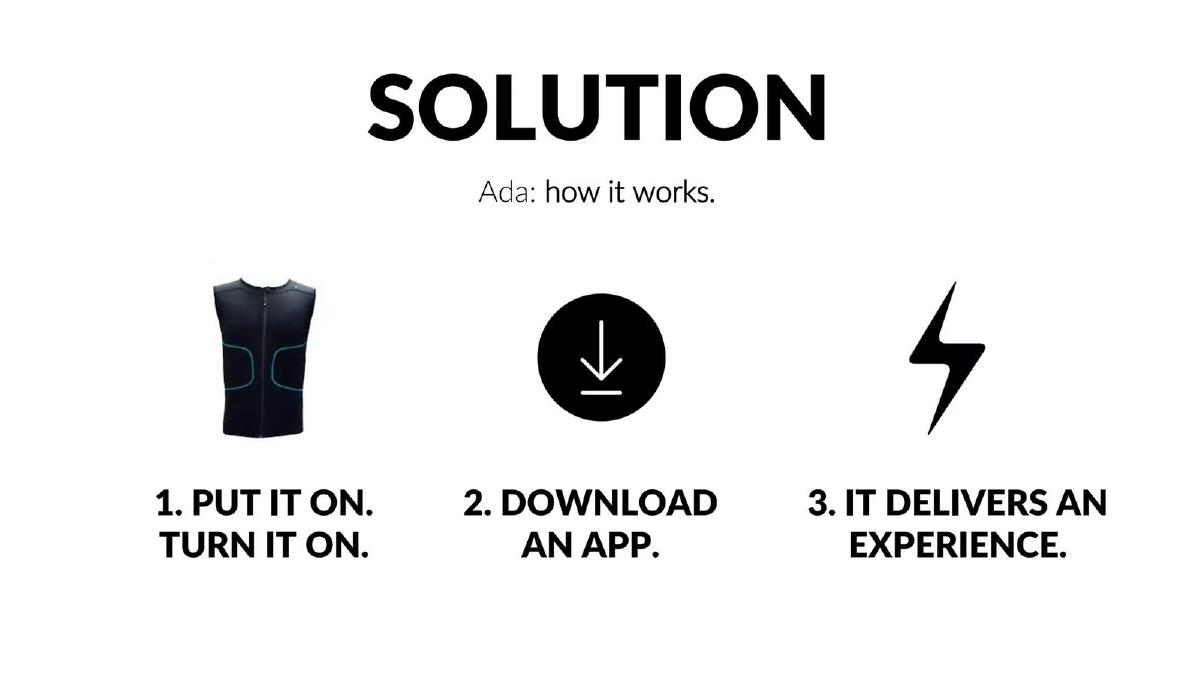
This is a simplified process slide. It breaks the user journey into three steps: 1. Put it on/Turn it on, 2. Download an app, 3. It delivers an experience. While simple, it implies a platform play where the hardware is powered by a software ecosystem, though the deck does not elaborate on how developers will create these 'experiences.'
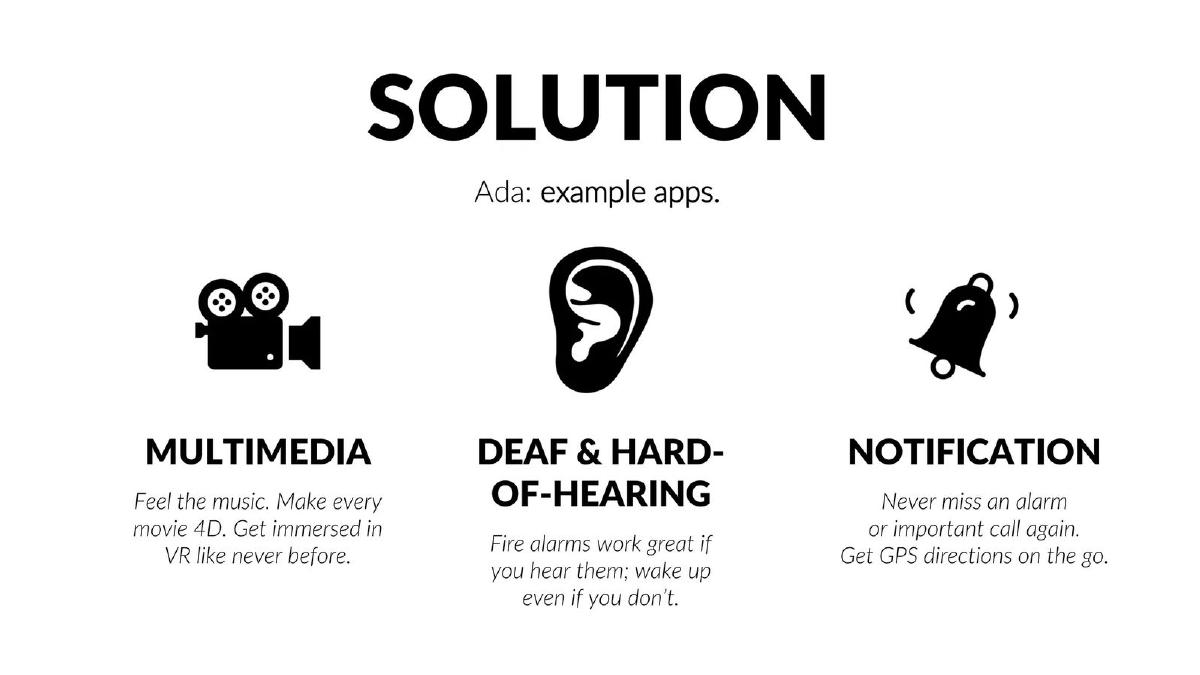
Slide 6: Solution - Example Apps
The deck suggests three use cases: Multimedia (movies/VR), Deaf & Hard-of-Hearing (safety alerts), and Notifications (GPS/calls). The inclusion of the 'Deaf & Hard-of-Hearing' segment is a smart strategic move, as it identifies a high-utility, non-entertainment market that could provide a more stable revenue base than gaming alone.
Slide 7: Market Size
The market slide quotes a $19.5B valuation expected in 2020 , with a 16.2% CAGR between 2016 and 2020. It lists applications in medicine, military, advertising, and sports. While the numbers are large, the slide lacks a bottom-up calculation (SAM/SOM) showing how many units Elektra actually expects to sell in their target segments.
Slide 8: Competitors
The competitive matrix uses two axes: 'Affordable & Light vs. Expensive & Heavy' and '1 application vs. 20+ applications.' Elektra places itself in the top-right quadrant. Competitors shown include Soundbrenner, X Rocker, Aurasens, Kor-FX, and Subpac . The claim of '20+ applications' is bold but not backed by a list of current integrations or partnerships.
Slide 9: Traction
The traction slide covers a 100-day period in early 2017. It lists:
January 20: Founders land in the US. · 100 Days: 10,000 miles driven, 1,000 hours worked, 250 meetings held, 1 prototype built. · April 20: Selected as a finalist for Coca Cola’s program for commercialization (ranked #22 / 200).
This is 'hustle traction.' While it shows founder dedication, it lacks the 'hard' traction metrics investors usually look for, such as pre-orders, letters of intent (LOIs), or pilot results.
Slide 10: The Team and Equity
The final slide introduces the four-person team and, most notably, their equity splits:
Arsh Haque (CEO): 33% - Background in political studies and digital language solutions. · Nazmul Haque (COO): 9% - 27 years at Dow Corning, manufacturing expert. · Ben Douglas (CSO): 29% - CS/EE background, GE experience. · Sophia Searcy (CTO): 29% - PhD in Experimental Psychology, MS in CS/EE.
Listing equity on a pitch deck is extremely unconventional. While it shows a balanced distribution between the technical founders, it is usually information reserved for a cap table in the due diligence phase.
What Works Well
Transparency: The inclusion of build costs and equity splits is refreshing. It allows an analyst to immediately see the margin profile and the internal power structure of the founding team. Problem Definition: The deck does a great job of explaining why haptics haven't gone mainstream yet, specifically citing the $2M cost of theater upgrades as a barrier that their wearable bypasses.
What Is Missing
The Ask: There is no slide indicating how much money the company is raising or what they will do with the funds. Revenue Model: Beyond the one-time sale of hardware, the deck mentions 'apps' but doesn't explain if there is a subscription model, a marketplace fee, or a licensing play. Go-To-Market: There is no plan for how they will reach the 'Deaf & Hard-of-Hearing' market or the 'Multimedia' market. Will they sell D2C, through retailers, or via B2B partnerships?
Founder Takeaway
Founders should take note of how Elektra uses comparative costs to justify their existence. By pointing out that a 4D theater costs $2M, their $200 vest suddenly looks like a bargain for a similar experience. However, founders should avoid 'activity metrics' (miles driven, hours worked) in their traction slides. Investors care about outcomes (customers, revenue, IP), not the amount of time spent in a car. Finally, while the equity transparency is interesting, it is generally better to leave that for the data room to avoid unnecessary friction during the initial pitch.
Frequently asked questions
- What is the core technology behind Elektra's wearables?
- According to slide 4, Elektra's 'Ada' line uses electrical stimulation to integrate physical experiences into everyday life. Unlike traditional mechanical vibration haptics, this approach uses electrical pulses to trigger sensations, allowing for a thinner form factor in their cuffs, sleeves, and vests.
- How does Elektra plan to differentiate itself from existing haptic companies?
- Slide 8 positions Elektra in the top-right quadrant of a competitive matrix, claiming to be more 'affordable & light' than competitors like Subpac or Woojer (represented by logos), while supporting over 20 applications compared to the single-use focus of others.
- What specific use cases does the deck propose for haptic vests?
- Slide 6 outlines three primary categories: Multimedia (4D movies and VR immersion), Deaf & Hard-of-Hearing (physical fire alarms and wake-up alerts), and Notifications (GPS directions and phone call alerts via physical touch).
- What are the manufacturing margins for the Elektra product line?
- Based on the figures on slide 4, the margins vary by product. The Cuffs have a 46.6% margin ($75 price / $40 cost), the Sleeves have a 36% margin ($125 price / $80 cost), and the Vest has a 20% margin ($200 price / $160 cost).
- What is the most notable omission in this pitch deck?
- The deck lacks a 'The Ask' slide. There is no mention of how much capital the company is seeking, the valuation, or the specific milestones they intend to reach with new funding. It also lacks a detailed business model explaining how they will monetize the 'apps' mentioned on slide 5.