Skilljar’s Series B deck is a concise, 12-slide presentation that prioritizes business outcomes over technical specifications. Raising $53.2 million in 2020, the company positioned itself as the leader in the 'External LMS' category. The deck successfully navigates the transition from a startup selling a tool to a scale-up selling a measurable ROI engine. It highlights three macro trends—digital transformation, the rise of customer experience, and the continuous learning economy—to frame its necessity. While the public version of the deck redacts specific financial figures, the structure rema…
Key takeaways
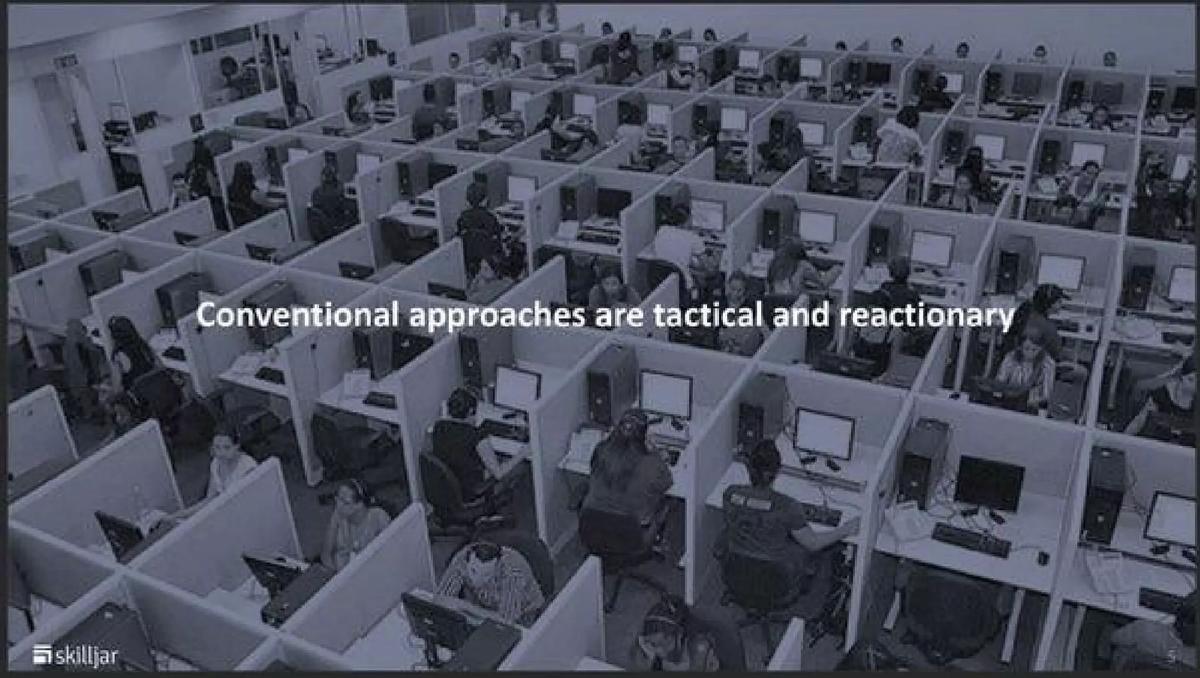
- The deck frames the problem not as a lack of software, but as 'tactical and reactionary' conventional approaches (Slide 5).
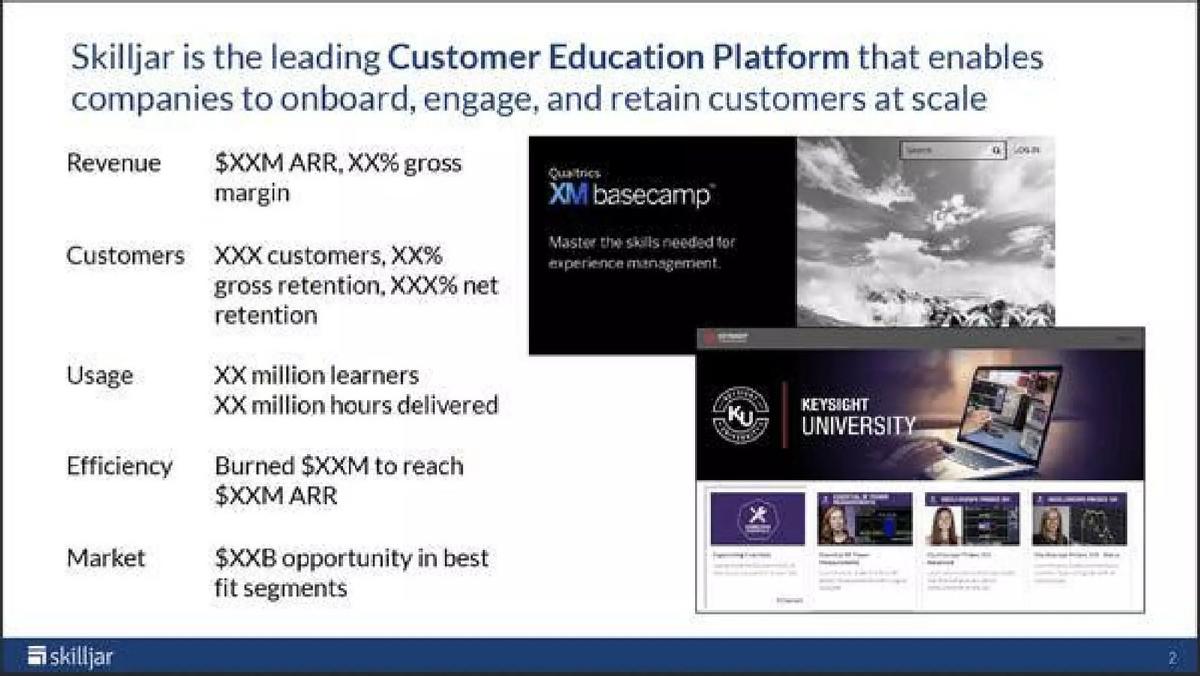
- It identifies a $XXB market opportunity specifically within 'best fit segments' rather than a generic TAM (Slide 2).
- Skilljar differentiates itself from internal HR learning systems by highlighting its Discovery & Commerce and Integrations layers (Slide 7).
- The presentation claims that trained customers show a 420%+ higher net retention compared to untrained ones (Slide 12).
- Product adoption is shown to increase by 30%+ within the first 30 days of training (Slide 12).
- The deck reports a 30%+ reduction in 'how-to' support tickets, directly linking education to cost savings (Slide 12).
- Usage metrics are massive, citing 2.7 million students educated and 10 million hours of education delivered (Slide 13).
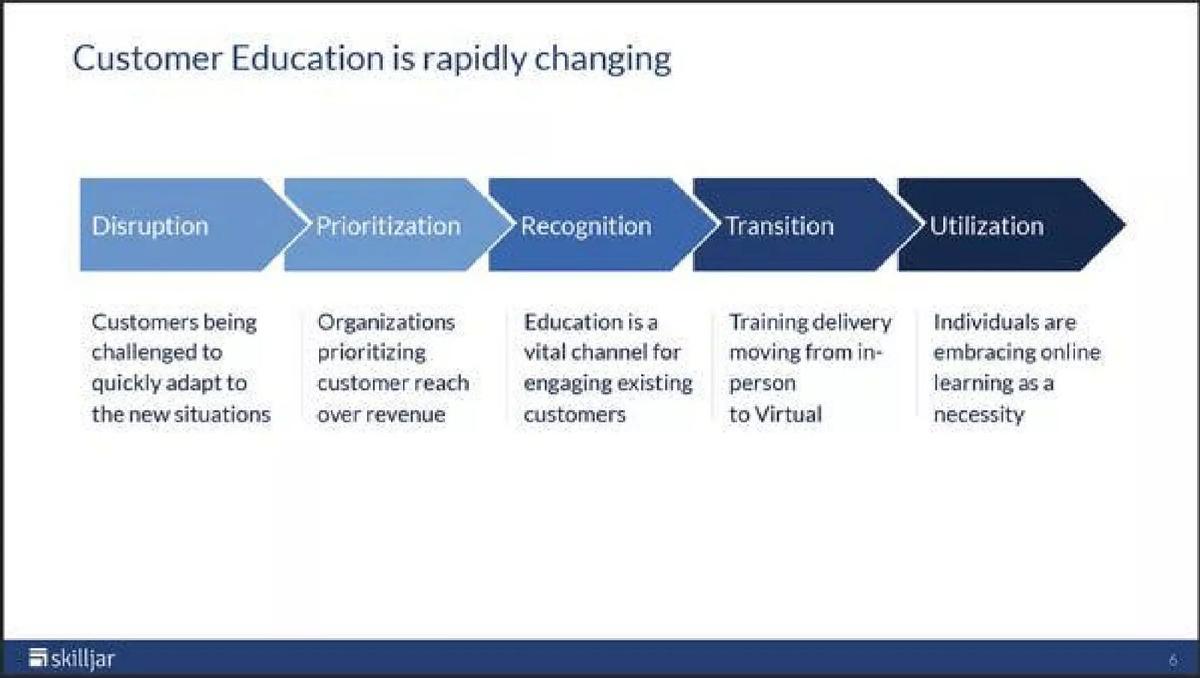
- The narrative leverages the COVID-era shift, noting that individuals are embracing online learning as a 'necessity' (Slide 6).
The Strategic Pivot to External Education
Skilljar’s Series B deck, dated August 2020, arrived at a pivotal moment for the ed-tech and SaaS industries. While many LMS (Learning Management System) platforms focused on internal employee compliance or corporate training, Skilljar doubled down on the external audience: customers and partners. This teardown examines how they used a 12-slide narrative to secure $53.2 million by proving that education is not a cost center, but a revenue driver.
Slides 1-3: The Foundation and The Faces
The deck opens with a clean title slide (Slide 1) stating the mission: Driving Customer Outcomes Through Learning . This sets the tone immediately; the focus is on the outcome , not the learning itself. Slide 2 acts as an executive summary, providing placeholders for Revenue, Customers, Usage, Efficiency, and Market. Even with the figures redacted in this version, the categories reveal what Skilljar prioritized: Gross Retention, Net Retention, and the ratio of Burn to ARR . They also highlight a $XXB opportunity in 'best fit segments,' suggesting they aren't trying to boil the ocean, but rather dominate a specific niche. Slide 3 is a simple, humanizing photo of the founders with a headline about learning being 'accessible and actionable.' It is notable that they chose a lifestyle shot over a list of resumes, likely because their Series A success already established their credibility.
Slides 4-6: Market Trends and The 'Why Now'
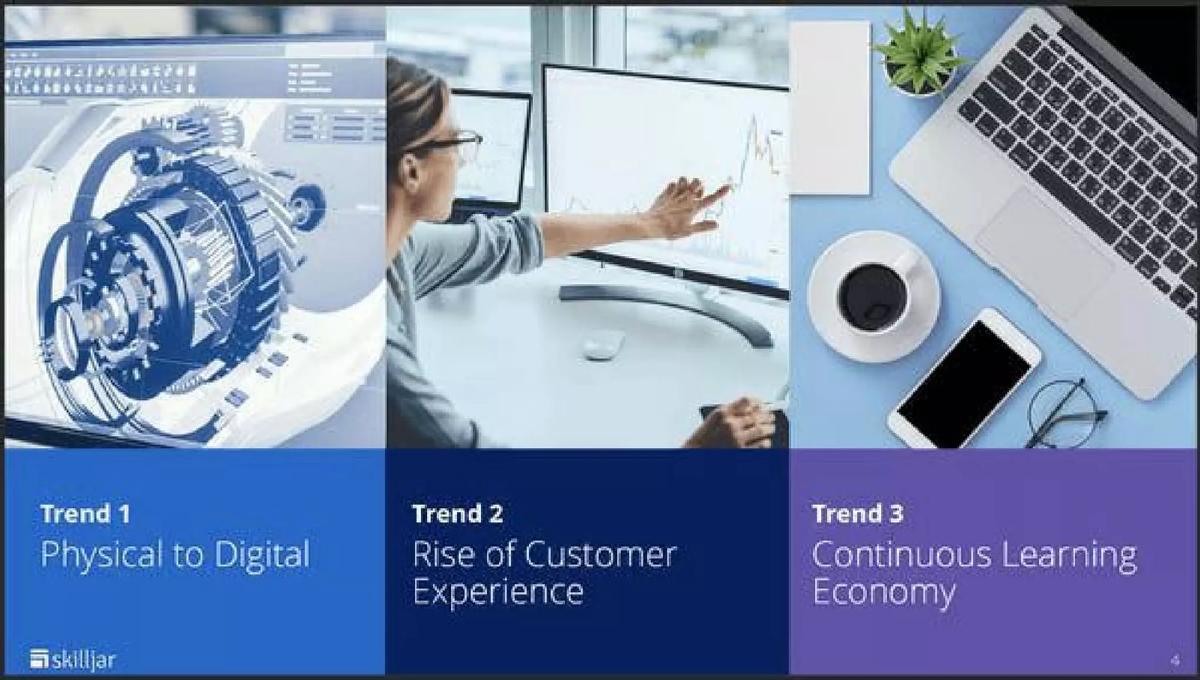
Slide 4 identifies three macro trends: Physical to Digital, Rise of Customer Experience, and the Continuous Learning Economy . By framing their product within these shifts, they make their growth seem inevitable. Slide 5 uses a powerful visual of a crowded, dated call center to argue that conventional approaches are tactical and reactionary . This creates a 'villain' in the narrative—the old way of doing things. Slide 6 then maps the evolution of the market through five stages: Disruption, Prioritization, Recognition, Transition, and Utilization. The final stage notes that individuals are embracing online learning as a necessity , providing the 'Why Now' catalyst needed for a Series B round.
Slides 7-10: Product Differentiation and The User Experience
Slide 7 is the most important technical slide in the deck. It defines the Skilljar Customer Education Platform as being 'purpose-built for external audiences.' It explicitly marks Discovery & Commerce and Integrations as the features that differentiate them from 'HR Learning Systems.' This is a classic category-design move. Slides 8, 9, and 10 provide visual proof of the platform in action. Slide 8 showcases Discovery & Commerce with localized Japanese content and a Zendesk training portal, emphasizing monetization and bundles. Slide 9 focuses on the Learning Experience , showing multimedia support and social certifications. Slide 10 details the Admin Experience , highlighting a dashboard that tracks 30.2K active students and 102K total session hours. These slides move the investor from the abstract 'market' to the concrete 'product.'
Slides 11-12: The ROI and Business Outcomes
Slide 12 is the 'money slide.' It breaks down the impact into three pillars: Adoption, Revenue, and Scalability . The metrics cited are specific and aggressive: a 30%+ increase in product adoption , a 420%+ higher net retention for trained accounts, and a 30%+ reduction in support tickets . The slide concludes with a quote stating that trained customers yield 153% higher ARR . For a Series B investor, this slide represents the entire investment thesis: if you spend $1 on Skilljar, you get a massive multiplier on your customer lifetime value. Slide 11 (omitted in some versions but implied by the flow) leads directly into this impact analysis.
Slide 13: Scale and Momentum
The final slide (Slide 13) is a 'wall of numbers' designed to show massive scale. It lists 2.7 million students educated, 10 million hours of education, and 100 million lessons conducted . It also mentions 63 thousand unique courses published . This slide serves to prove that Skilljar is no longer a startup testing a hypothesis, but a market leader with significant data and infrastructure. It leaves the investor with the impression that the 'impact is only just beginning.'
What Works in This Deck
Outcome-First Messaging: Skilljar avoids the common trap of listing features. Instead, every slide points toward a business result, such as retention, revenue, or support ticket reduction. This speaks the language of the C-suite and the VC.
Category Definition: By explicitly contrasting themselves with HR-focused LMS platforms on Slide 7, they avoid being commoditized. They successfully argue that external education is a different beast entirely, requiring different tools.
Social Proof via UI: Rather than just listing logos, they show the product branded for companies like Zendesk and LinkedIn. This demonstrates that their platform is robust enough for the world's most sophisticated tech companies.
What Is Missing
Detailed Team Slide: While the founders are pictured on Slide 3, the deck lacks a traditional 'Team' slide showing the depth of the leadership team (VP of Sales, CTO, etc.). At Series B, investors usually want to see the 'bench' that will help the founders scale.
Competitive Landscape: The deck assumes Skilljar is the leader but doesn't provide a competitive matrix. While Slide 7 differentiates them from HR systems, it doesn't address other external-facing competitors directly.
The 'Ask': There is no slide detailing how much capital is being raised or how it will be deployed. While this is often removed from public versions, a complete pitch deck should ideally outline the roadmap for the next 18-24 months.
What a Founder Should Copy
The 'Villain' Slide: Use a slide like Slide 5 to show the 'before' state of your industry. Visualizing the inefficiency you are solving is much more effective than just writing about it.
The Integration Argument: If your software needs to live within an ecosystem, make that a core part of your differentiation. Skilljar’s focus on the 'Integrations Experience' as a key differentiator is a smart way to show 'stickiness.'
The Multiplier Metric: Find the one metric that proves your product makes your customers more money. For Skilljar, it was the '153% higher ARR' for trained users. Every deck needs a single, undeniable stat that makes the investment feel like a mathematical certainty.
Final Verdict: Skilljar’s deck is a masterclass in B2B SaaS storytelling. It moves seamlessly from macro trends to product proof to undeniable ROI, making it clear why they were able to secure a $53.2 million Series B.
Frequently asked questions
- Why does the deck redact its revenue and growth figures?
- It is common for successful decks shared publicly to redact sensitive financial data like ARR and burn rate. However, the placeholders on Slide 2 (e.g., '$XXM ARR') show exactly where these metrics should live. For a Series B, investors expect to see high gross margins and a clear ratio of capital burned to ARR generated, which Skilljar clearly presented in the original version.
- How does Skilljar differentiate itself from competitors like Docebo or Cornerstone?
- Skilljar uses Slide 7 to draw a hard line between 'External LMS' and 'HR Learning Systems.' They argue that external education requires discovery, commerce, and deep integrations with CRMs and marketing stacks—features that internal employee training tools often lack. By defining a new category, they avoid being compared to legacy HR software.
- What is the significance of the '153% higher ARR' quote on Slide 12?
- This is the 'smoking gun' of the deck. By stating that trained customers generate 153% more revenue than untrained ones, Skilljar moves from being a 'nice-to-have' training tool to a 'must-have' revenue expansion engine. This metric justifies a higher valuation because the software pays for itself through customer expansion.
- Why is the deck so short at only 12 slides?
- At the Series B stage, the 'story' is often already known by the lead investors. The deck serves as a high-level summary of the business case. Skilljar focuses on the macro trends and the micro outcomes, leaving the deep-dive due diligence for the data room. Brevity at this stage signals confidence and clarity of vision.
- How does the deck handle the 'Why Now' question?
- Slide 6 uses a linear progression from 'Disruption' to 'Utilization.' It argues that the market has moved past just recognizing the need for digital training and is now in a phase where individuals see online learning as a necessity. This creates urgency for companies to implement a professional solution immediately.