Skeyecode’s 10-slide deck from 2014 is a classic example of a 'product-first' technical pitch. The company addresses the $400 billion annual cost of cyber attacks by proposing a frictionless software alternative to clunky hardware security tokens. The deck leans heavily on intellectual property, citing 8 patents, and a team with backgrounds at Oracle, Orange, and PayPal. However, the presentation is structurally incomplete for a professional fundraise. It lacks a business model, a competitive landscape analysis, and a specific 'Ask' regarding capital. While it successfully visualizes a comple…
Key takeaways
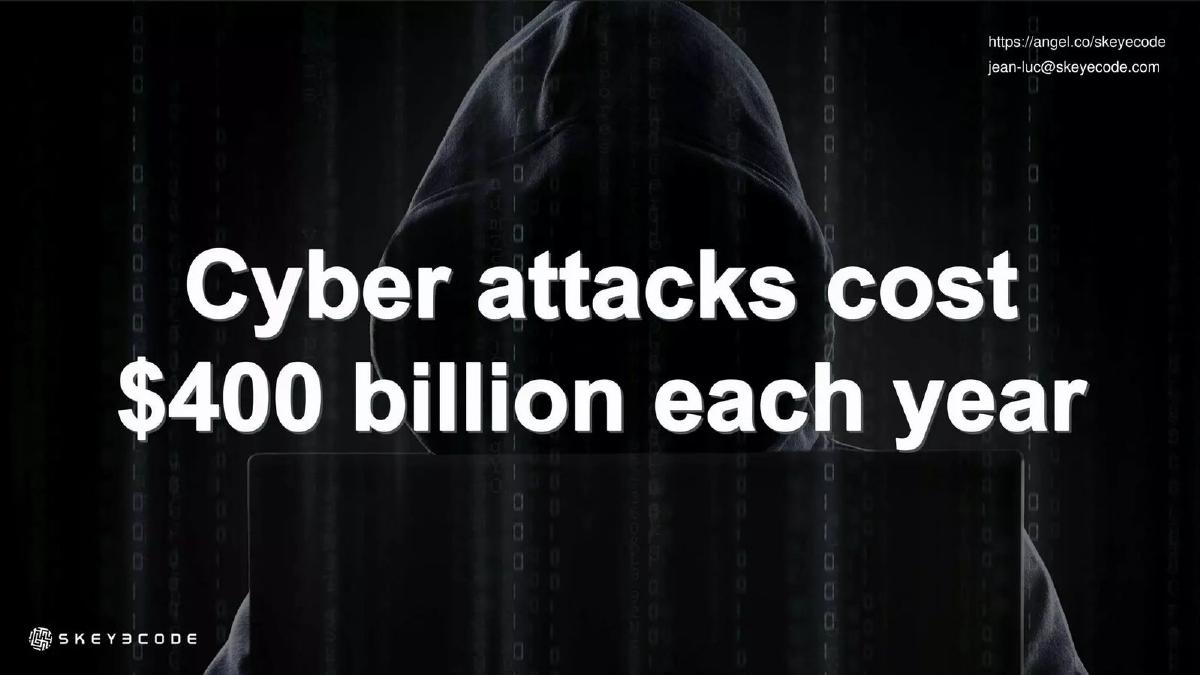
- The deck identifies a massive macro problem, stating that cyber attacks cost $400 billion each year on slide 2.
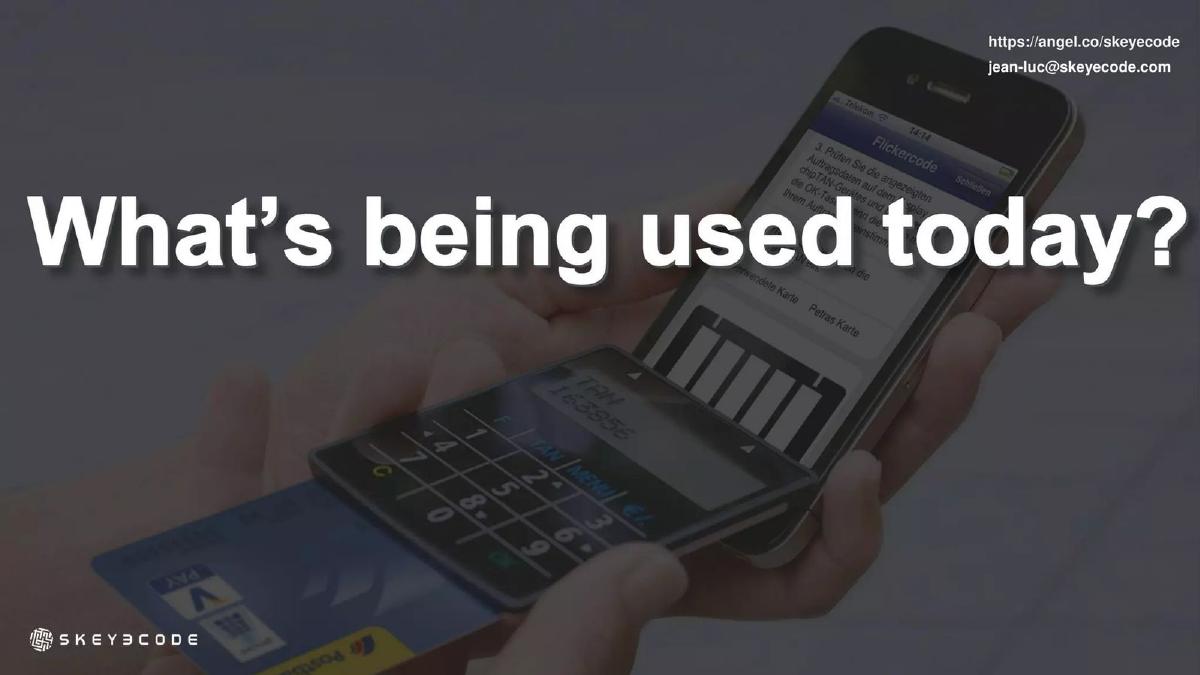
- Skeyecode positions its solution as a frictionless software alternative to existing hardware-heavy methods shown on slide 3.
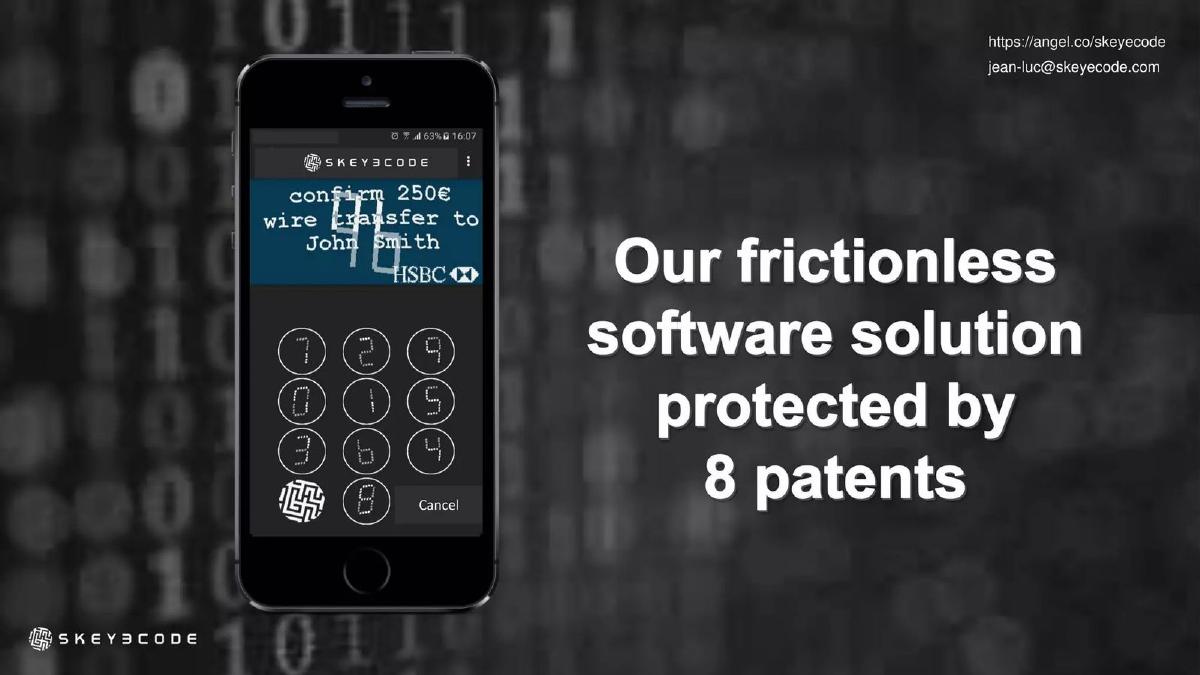
- Intellectual property is a core value driver, with slide 4 explicitly stating the solution is protected by 8 patents.
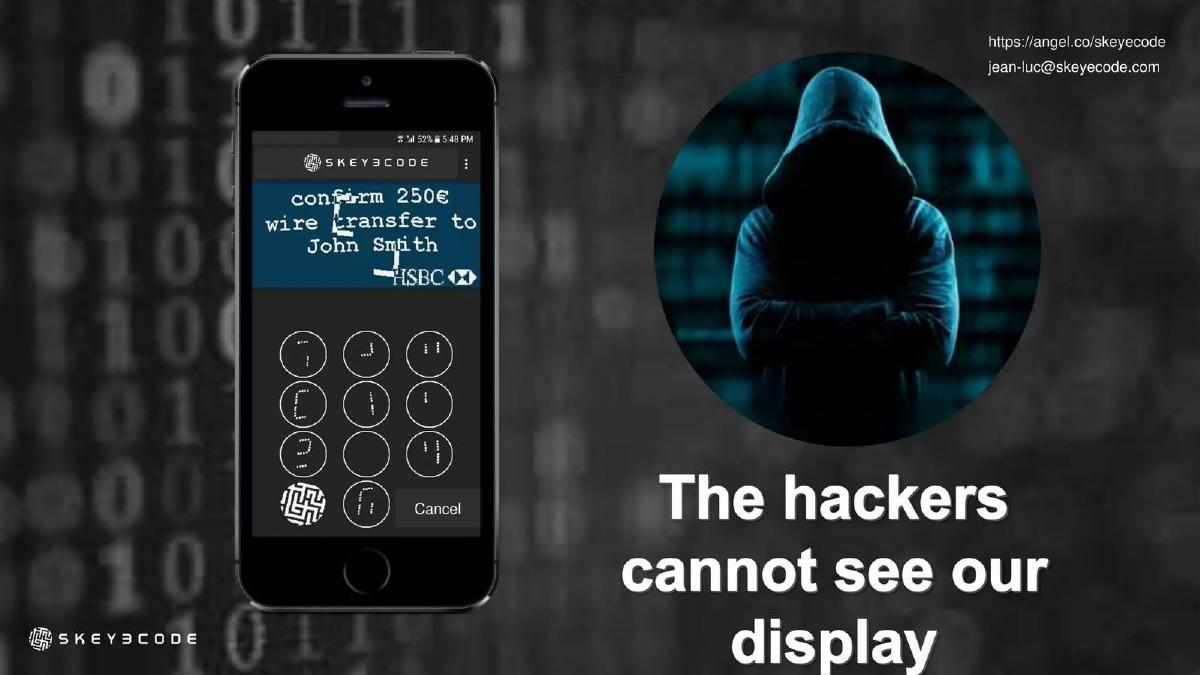
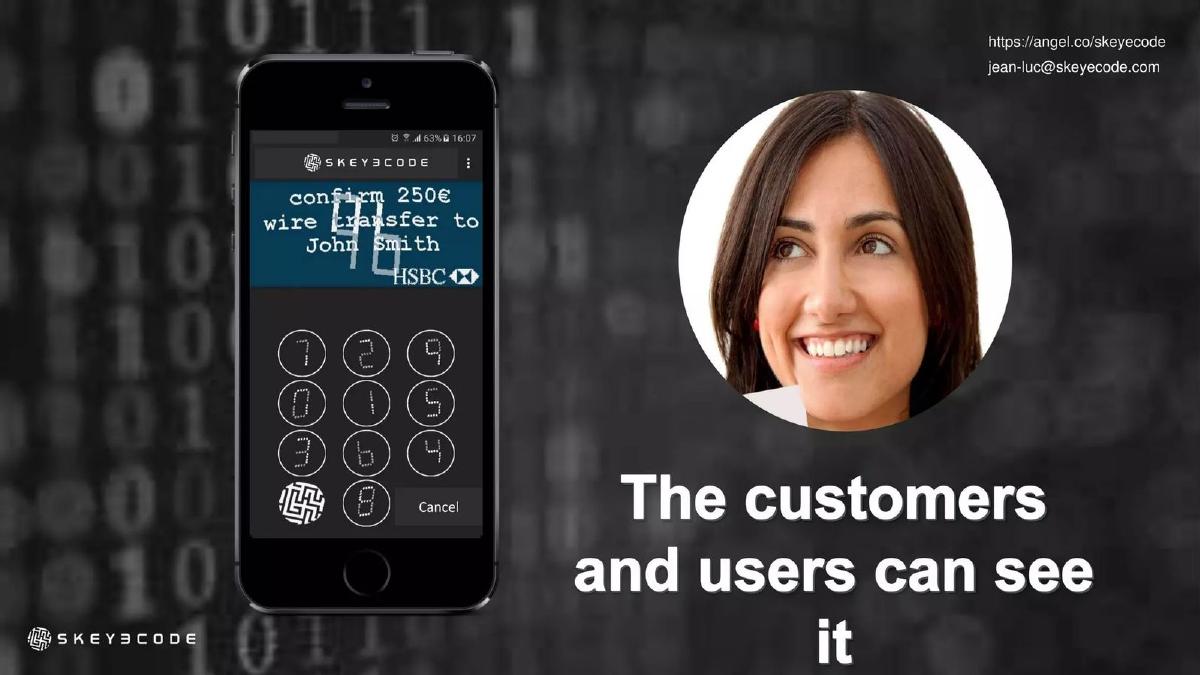
- The product uses a visual decryption method where 'human eyes replace the hardware device' to prevent hackers from seeing the display, as shown on slides 5, 6, and 7.
- Market validation is presented as 'international demand' from providers in Africa, Asia, Europe, and 65% of US Banks on slide 8, though no specific partners are named.
- The team slide (slide 9) features significant corporate pedigree including Oracle, Orange, LVMH, and Qualcomm.
- There is no mention of a business model, pricing strategy, or revenue projections anywhere in the 10 slides.
- The deck concludes on slide 10 without a specific financial ask or a breakdown of how funds will be used.
The Technical Vision: A Skeyecode Teardown
Skeyecode’s 2014 pitch deck is a 10-slide presentation that prioritizes technical differentiation and intellectual property over business metrics. In the cybersecurity space, particularly during the mid-2010s, the transition from hardware-based security (like RSA tokens or physical TAN generators) to software-based solutions was a major theme. Skeyecode leans heavily into this narrative, positioning itself as a patent-protected disruptor. However, the deck leaves significant gaps regarding how the company actually operates as a business.
Slide 1: Title and Positioning
The cover slide introduces the logo and the core value proposition: "TWO FACTOR AUTHENTICATION MADE SIMPLE AND SECURE." The contact information for Jean-Luc Leleu and an Angel.co link are provided in the top right corner. The background image of a city skyline suggests a global, corporate ambition, but does little to explain the product. The branding is clean, using a monospaced font that evokes a 'coding' or 'security' aesthetic.
Slides 2-3: The Problem and Current State
Slide 2 uses a classic 'scare tactic' to establish market size, stating "Cyber attacks cost $400 billion each year." The imagery of a hooded hacker is a cliché in the industry but effectively communicates the threat level. Slide 3 asks, "What’s being used today?" and shows a photo of a user juggling a smartphone, a credit card, and a physical hardware token. This slide successfully identifies the 'friction' in the current market—security is currently a burden for the end-user. By showing the physical clutter of existing solutions, Skeyecode sets the stage for a software-only alternative.
Slide 4: The Solution and IP
Slide 4 introduces the product interface on a smartphone. The headline claims a "frictionless software solution protected by 8 patents." This is the strongest slide in the deck for a technical investor. Mentioning eight patents provides a 'moat' that suggests the technology is not easily replicated by larger incumbents. The visual shows a wire transfer confirmation for "250€ to John Smith" at "HSBC," indicating that the primary target market is the banking and financial services sector.
Slides 5-7: The Technical 'Magic'
This sequence of slides attempts to explain the 'how' without getting bogged down in code. Slide 5 shows the hacker's perspective: "The hackers cannot see our display." Slide 6 shows the user's perspective: "The customers and users can see it." Slide 7 provides a diagram of the "Virtual Secure Element." It illustrates how multiple layers (S0, S1, Sn) of visual noise are combined so that "The human eyes replace the hardware device." This is a compelling visual metaphor for a complex cryptographic process. It explains the unique selling point: the decryption happens in the user's brain/eyes, not on the device's hardware, which theoretically bypasses screen-scraping malware.
Slide 8: Market Validation
Slide 8, titled "International demand from top players," uses three circles to represent different regions. It claims interest from a "Large Payment Provider" in Africa and Asia, an "IT Service Provider for 150+ Banks" in Europe, and "Bank consortiums 65% US Banks" in the United States. While these figures sound impressive, the lack of specific names or 'letter of intent' (LOI) details makes this slide feel more like a target list than a traction report. For a 2014 deck, claiming 65% of US Banks are part of a consortium showing interest is a bold claim that requires more substantiation than a simple circle on a slide.
Slide 9: The Team
The team slide is high-quality. It features four core members and two advisors, all with logos of prestigious former employers. Jean-Luc Leleu (Strategy & Product) brings Oracle and Sun Microsystems experience. Bernard Malachane (Operation) comes from Orange. The advisors are particularly strong: Dr. Markus Jakobsson is linked to Qualcomm and PayPal, while Guillaume Bourcy is linked to Facebook and Google. This level of 'social proof' is often what carries a seed-stage deck when revenue is absent. It tells the investor that even if the business model is unclear, the people involved are industry veterans who understand the ecosystem.
Slide 10: The Conclusion
The deck ends abruptly on slide 10 with the phrase "Now is the time!" and the company logo. This is a missed opportunity. There is no call to action, no summary of the investment opportunity, and no contact information repeated for ease of use. It leaves the presentation feeling unfinished.
What Works in the Skeyecode Deck
Visualizing the Invisible: Cybersecurity is notoriously difficult to 'show.' Slides 5 through 7 do an excellent job of visualizing how their 'ICE zone' technology works using simple overlays and human-centric metaphors. · IP Focus: In a crowded security market, stating "8 patents" early on (Slide 4) gives the company a level of perceived authority and protection that is vital for B2B enterprise plays. · Team Credibility: The pedigree shown on Slide 9 is top-tier. For a technical product, having advisors from PayPal and Google suggests the technology has been vetted by people who understand global scale. · Clear Problem Identification: Slide 3 perfectly captures the user pain point of physical security tokens. It makes the 'why now' argument for a software-only solution very clear.
What is Missing from the Skeyecode Deck
The Business Model: There is absolutely no mention of how Skeyecode makes money. Is it a per-user SaaS fee? A licensing deal for banks? A white-label integration? Without this, it is a product pitch, not a business pitch. · The Ask: The deck never mentions how much money they are looking for or what they plan to do with it. According to the catalogue data, they raised $85,700 , but a founder using this deck today would need to be much more explicit about their capital requirements. · Competitive Landscape: The deck ignores other software-based 2FA solutions (like Google Authenticator or Duo Security, which were well-established by 2014). Investors need to know why Skeyecode’s patented visual method is superior to existing software 2FA. · Traction Metrics: While Slide 8 mentions 'demand,' it doesn't list any revenue, user numbers, or pilot results. Even at an early stage, showing a timeline of development or a specific roadmap would add necessary weight.
What a Founder Should Copy
The 'Hacker vs. User' Comparison: If you have a security product, use the side-by-side comparison seen in Slides 5 and 6. It is the fastest way to communicate a technical advantage to a non-technical investor. · Clean Layouts: The deck uses high-contrast text and minimal clutter. Each slide has one job and does it clearly. · Strategic Use of Logos: On the team slide, the logos are larger than the names. This is a smart move for early-stage founders; the brand equity of Oracle or PayPal is more recognizable than the individual names of the founders. · Macro-to-Micro Flow: The deck follows a logical progression: Big Problem (Slide 2) -> Current Bad Solution (Slide 3) -> Our Better Solution (Slide 4) -> How it Works (Slides 5-7). This is a standard but effective storytelling arc.
Final Analysis
Skeyecode’s deck is a product-centric document that succeeds in explaining a complex technical innovation but fails to present a complete investment case. It relies heavily on the 'wow' factor of its patented visual decryption and the 'who' factor of its experienced team. While this was apparently enough to secure a small amount of funding ($85,700), a modern Series A or even a Seed deck would require significantly more detail on market entry, competition, and financial sustainability. It is a great example of how to pitch a technology , but a poor example of how to pitch a company .
Frequently asked questions
- What is the core technology Skeyecode is pitching?
- Skeyecode is pitching a software-based two-factor authentication (2FA) system. The technology aims to create a 'virtual secure element' that uses visual patterns only decodable by the human eye. This is designed to prevent malware or hackers from intercepting sensitive data on a device's screen, effectively replacing physical security tokens or hardware-based TAN generators with a purely software-driven interface protected by eight patents.
- Does the deck provide any information on how the company makes money?
- No. The deck is entirely focused on the technical problem and the proposed solution. There is no slide dedicated to the business model, unit economics, or pricing tiers. While slide 8 mentions 'international demand' from banks and payment providers, it does not specify if these are paying customers, pilots, or merely a target demographic for a B2B licensing model.
- Who are the key members of the Skeyecode team?
- The team includes Jean-Luc Leleu (Strategy & Product) with an Oracle background, Guillaume Pitel (Technology), Bernard Malachane (Operation) from Orange, and Aude Bourdouxhe (Marketing & Com) from LVMH. They are supported by advisors Dr. Markus Jakobsson (Qualcomm/PayPal) and Guillaume Bourcy (Facebook/Google/BICS), providing the company with significant enterprise and security credibility.
- What is missing from this pitch deck that an investor would typically require?
- This deck is missing several critical components: a Go-To-Market strategy, a competitive analysis, a business model, financial projections, and a clear 'Ask.' It functions more as a technical product overview than a comprehensive investment proposal. An investor would need to know the cost of acquisition, the sales cycle for banks, and the specific amount of capital being raised.
- How does Skeyecode differentiate itself from existing 2FA solutions?
- Skeyecode differentiates itself by removing 'friction.' Slide 3 shows the current state of security involving physical card readers and phones, which is cumbersome. Skeyecode claims to offer a 'frictionless' software-only solution that provides the same security as a hardware device by using the user's eyes as the final decryption layer, making the display invisible to hackers.