Skye Wallet’s 2021 pitch deck presents a focused play on the Nigerian cryptocurrency market, which it identifies as the second-largest Bitcoin market on Paxful. The startup seeks $100,000 to scale a platform that consolidates buying, selling, swapping, and bill payments into a single interface. Within its first 12 weeks, the company reported 2,104 users and over $568,000 in transaction volume. While the deck provides clear early-stage traction and a straightforward 2% fee-based business model, it lacks detailed financial projections, a roadmap beyond two years, and specific biographical backg…
Key takeaways
- The startup reported 2,104 users and 288,750,948.619 Naira in transaction volume within its first 12 weeks of operation (Slide 2).
- The core problem identified is that existing cryptocurrency wallets are not beginner-friendly and lack educational resources for emerging economies (Slide 3).
- Skye Wallet operates on a simple revenue model charging a 2% fee on all buy, sell, and swap trades (Slide 9).
- The market size analysis targets 1 million users within two years, representing a fraction of Nigeria's 4 million active crypto users (Slide 7).
- The company is seeking a $100,000 investment to increase liquidity, boost marketing, and hire technical staff (Slide 11, 12).
- Competitors like Binance and Luno are critiqued for being complex for beginners or supporting too few cryptocurrencies (Slide 10).
- The platform supports multiple chains including ERC20, BEP20, and TRC20, and offers zero fees for deposits and withdrawals (Slide 6).
- The management team consists of four members covering CEO, CTO, Customer Support, and Sales roles, though individual professional histories are omitted (Slide 13).
Skye Wallet Pitch Deck: A Focused Entry into the Nigerian Crypto Space
Skye Wallet’s 2021 pitch deck is a concise 14-slide presentation aimed at securing $100,000 in early-stage funding. The deck is characterized by its focus on the Nigerian market and a 'simplicity-first' product philosophy. By positioning itself against global giants like Binance, Skye Wallet attempts to carve out a niche for the 'beginner' user in an emerging economy.
Slide 1: Title and Contact
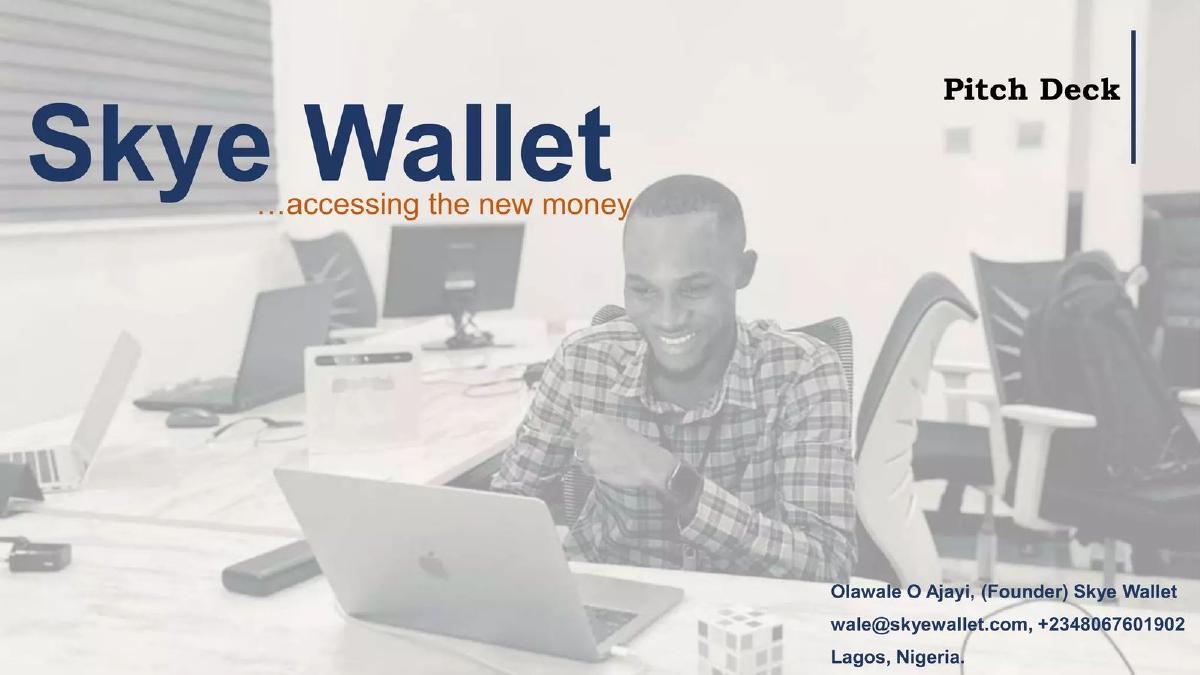
The cover slide introduces Skye Wallet with the tagline "...accessing the new money." It includes direct contact information for Olawale O Ajayi , identified as the Founder, and provides a physical location in Lagos, Nigeria. The imagery features a professional office setting, establishing a sense of place and operational presence.
Slide 2: Current Status & Accomplishments
Unusually, the deck leads with traction. It displays an admin panel screenshot dated Wednesday, 7th July 2021. The metrics are specific: 2,104 users and 288,750,948.619 Naira (approximately $568,407.379 USD ) in transaction volume. The slide notes this was achieved in just 12 weeks and 2 days of operation, providing a strong momentum signal to potential investors.
Slide 3: Problem/Opportunity
The problem is framed around two points: the complexity of existing cryptocurrency wallets which are not "beginner friendly," and the limited education regarding blockchain technology in emerging economies. The slide uses a background image of a frustrated user to emphasize the friction in the current market.
Slide 4-5: Value Proposition
The solution is described as a "super-simple interfaced Web and App based platform" that enables one-click cryptocurrency activities. Slide 5 lists the specific actions users can take: Buy, Sell, Send, Receive, Swap, Hold, Spend (Pay Bills), and Learn . This slide also includes UI screenshots of the web and mobile interfaces, showing a clean design with a prominent balance display and clear action buttons.
Slide 6: Underlying Magic
This slide covers the technical and service-level advantages. It highlights support for multiple chains, specifically BTC, ETH (ERC20), BSC (BEP20), and TRC20 . It also mentions the infrastructure's ability to integrate new tokens quickly, 24/7 live chat support, and a competitive fee structure featuring zero deposit and withdrawal fees .
Slide 7: Market Size
The market analysis is localized to Nigeria. It identifies a Total Available Market (TAM) of 24M+ smartphone and social media users . The Serviceable Available Market (SAM) is cited as 4M+ active cryptocurrency users in Nigeria. Skye Wallet sets a target of 1 million users within two years, which they define as their share of the market.
Slide 8: Market Validation
To justify the opportunity, the deck cites external sources like Statista and Business Insider. Key data points include the global payments revenue hitting $2.9 trillion by 2022 and the fact that Nigeria is the No. 2 bitcoin market on Paxful . It also mentions that major players like PayPal, Square, and Robinhood have entered the crypto space, validating the sector's growth.
Slide 9: Business Model
The revenue model is straightforward. The company generates income through a 2% charge in fees on any traded amount (Buy, Sell & Swap). A secondary arrow points to "Cryptocurrency Investments," suggesting the company may also generate returns from its own holdings or managed assets, though this is not detailed.
Slide 10: Competitive Analysis
Skye Wallet compares itself to Luno, Binance, and Quidax . It acknowledges their strengths (primarily good liquidity) but identifies weaknesses that Skye Wallet intends to exploit. For Binance, the weakness is being "complex for beginners." For Luno and Quidax, the weaknesses cited are "few supported cryptocurrencies" and "high fees/less liquidity," respectively.
Slide 11-12: The Ask and Use of Funds
The startup is seeking $100,000 . The allocation of these funds is split across four areas: increasing liquidity, marketing to boost sales, hiring more technical staff, and servicing infrastructure to boost operations. There is no specific percentage breakdown for these categories, which is a common omission in early-seed decks.
Slide 13: Management Team
The team slide features a photo of four men in Skye Wallet branded apparel. The roles are defined as: Olawale O. Ajayi (Founder/CEO) , Bamidele Ajayi (CTO/Product Design) , Babatunde O. (Customer Support) , and Peter Edoki (Sales) . While the visual shows a unified team, the slide lacks any information regarding their previous experience, education, or professional achievements.
Slide 14: Conclusion
The deck ends with a simple "Thank you" slide on a textured background. It does not repeat contact information or provide a call to action, relying on the information provided on the title slide.
What Skye Wallet Does Well
The deck’s greatest strength is its immediate transparency regarding traction . By placing the admin screenshot on Slide 2, the founders prove that the product is live and generating volume before they even explain the problem. This is highly effective for a $100k raise, as it moves the conversation from "if" they can build it to "how fast" they can scale it.
The market focus is also a plus. Rather than claiming they will take over the global crypto market, they lean into their Nigerian roots, citing specific local statistics from Paxful. This makes the 1-million-user goal feel grounded in a specific, reachable demographic.
What is Missing from the Deck
The most significant omission is team pedigree . Investors at the seed stage are primarily betting on the founders. While we see their faces and titles, we don't know if the CTO has built secure fintech apps before or if the CEO has a background in finance. In the high-stakes world of crypto exchanges, security and regulatory experience are paramount, and this deck does not address them.
Furthermore, the financial roadmap is thin. While the 2% fee is clear, there are no projections on burn rate, expected revenue at the 1-million-user mark, or how long the $100,000 runway will last. The "Cryptocurrency Investments" revenue stream is also left dangerously vague—investors generally want to know if a startup is trading its own balance sheet to stay afloat.
What Other Founders Should Copy
Founders should emulate the clarity of the business model on Slide 9. Many startups overcomplicate their revenue slides with tiered subscriptions and future possibilities. Skye Wallet’s "2% on trades" is easy to understand and easy to model. Additionally, the competitive analysis on Slide 10 is a good example of how to acknowledge a competitor's strength (like Binance's liquidity) while still identifying a clear gap (complexity) that your product fills. It shows a realistic understanding of the market landscape.
Frequently asked questions
- What is Skye Wallet's primary value proposition?
- According to slides 4 and 5, Skye Wallet offers a 'super-simple' interface for both web and mobile apps. It allows users to perform all cryptocurrency activities—buying, selling, sending, receiving, swapping, holding, spending on bills, and learning—in a single click. The focus is on removing the complexity that typically prevents beginners in emerging markets from adopting blockchain technology.
- How much traction did the company have at the time of the pitch?
- Slide 2 shows an admin panel screenshot from July 7, 2021. At that point, the company had been operating for 12 weeks and 2 days. It recorded 2,104 users and a total transaction volume of approximately $568,407.379 USD (288,750,948.619 Naira).
- What is the specific business model?
- Slide 9 outlines two revenue streams. The primary stream is a 2% charge in fees on any traded amount, including buying, selling, and swapping. The second stream is listed as 'Cryptocurrency Investments,' though the deck does not elaborate on whether this refers to company-held assets or a managed investment product for users.
- How does Skye Wallet plan to use the $100,000 investment?
- Slide 12 breaks down the use of funds into four categories: increasing liquidity to facilitate trades, boosting sales through marketing efforts, hiring additional technical staff to improve the product, and boosting operations through infrastructure servicing. The raise is relatively small, suggesting a seed or pre-seed stage focus on immediate operational scaling.
- Who are the main competitors identified in the deck?
- Slide 10 identifies three main competitors: Luno, Binance, and Quidax. Skye Wallet differentiates itself by claiming these platforms are either too complex for beginners (Binance), support too few cryptocurrencies (Luno), or suffer from high fees and low liquidity (Quidax).