Skymind’s Series A deck is a highly technical, infrastructure-focused presentation that successfully positioned the company as the primary gatekeeper for enterprise deep learning. By leveraging the popularity of the Java Virtual Machine (JVM) and the existing Hadoop/Spark ecosystem, Skymind demonstrated a clear path to production for Fortune 500 companies. The deck avoids traditional 'problem/solution' tropes in favor of a 'capability/ecosystem' narrative, highlighting their open-source libraries like Deeplearning4j. While it lacks explicit financial projections and a specific 'Ask' slide, th…
Key takeaways
- The deck positions Skymind as the first dedicated AI ecosystem builder, rather than just a software vendor (Catalogue Facts).
- Skymind leverages the 'Write Once, Run Everywhere' Java philosophy to appeal to enterprise IT departments already using Hadoop and Spark (Slide 10).
- The team slide highlights significant technical pedigree, including creators of major open-source libraries and former employees of Cloudera and NVIDIA (Slide 7).
- Strategic validation is achieved through certifications and integrations with Cloudera, Hortonworks, Intel, NVIDIA, and IBM (Slide 11).
- The 'Deep Learning Ecosystem' slide visualizes a complex technical pipeline from data ingestion to model evaluation (Slide 13).
- Skymind uses a specific case study with Orange SV to prove real-world ROI in fraud detection (Slide 19).
- The deck emphasizes an open-source strategy, stating that all products are 100% open-source and community-maintained (Slide 8).
- A published O'Reilly book by the founders serves as a powerful 'authority hack' for technical credibility (Slide 18).
The Infrastructure Play: How Skymind Defined the Enterprise AI Stack
Skymind’s Series A pitch deck is a departure from the typical 'Problem-Solution' format found in most Silicon Valley decks. Instead, it reads like a technical manifesto for the future of enterprise data. Founded in 2016, Skymind identified a specific gap: while AI research was exploding in Python, the enterprise world ran on Java and the JVM. This deck is the story of how they bridged that gap.
Slides 1-5: The Macro Vision and Technical Foundation
Slide 1 is a standard title slide, but the subtitle 'Deep Learning for Enterprise' immediately sets the target audience. There is no ambiguity about who this product is for.
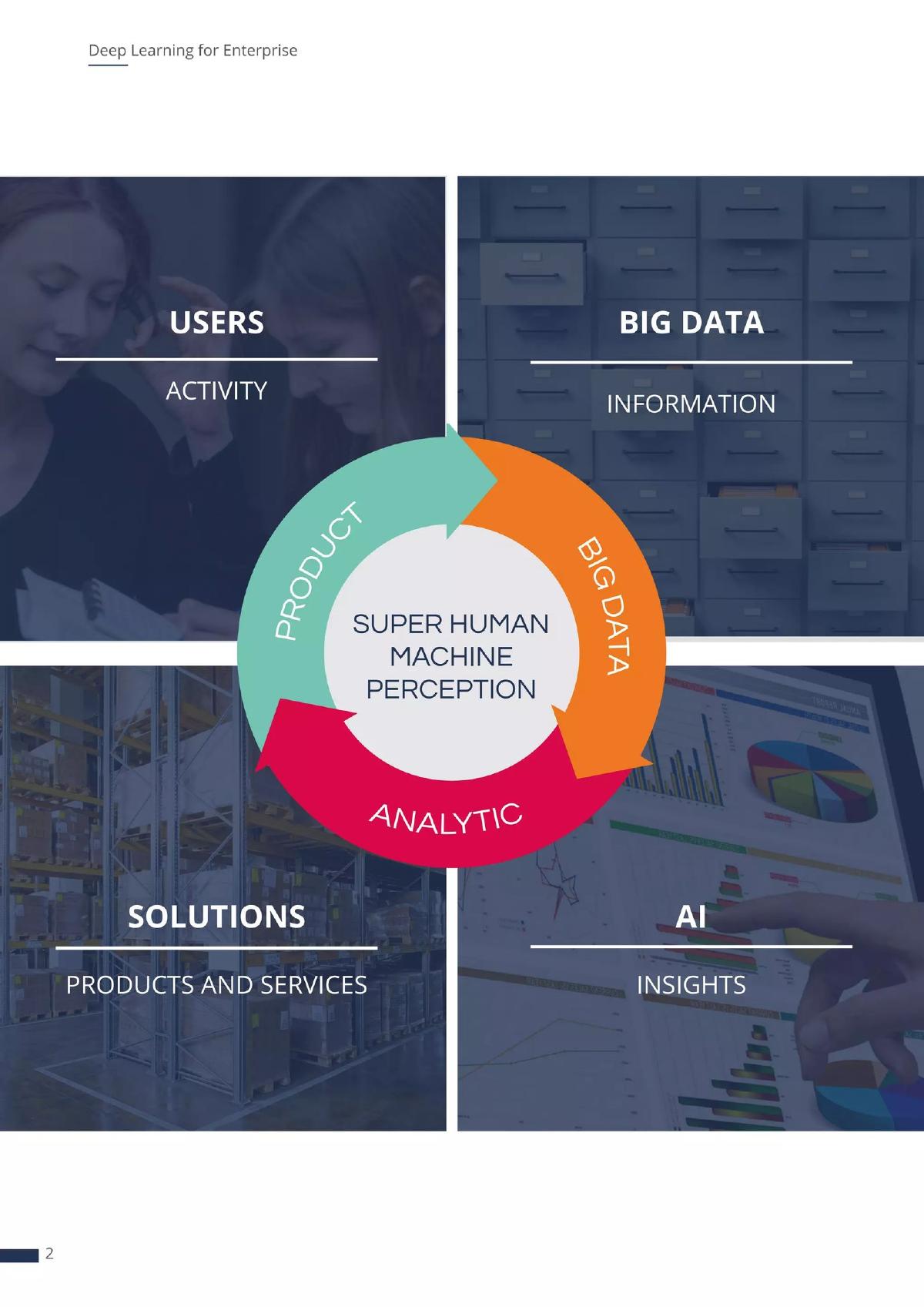
Slide 2 uses a circular flow diagram to connect Users, Big Data, AI Insights, and Solutions. The center of this wheel is 'Super Human Machine Perception.' This slide attempts to show the feedback loop of a data-driven organization, though it is somewhat abstract.
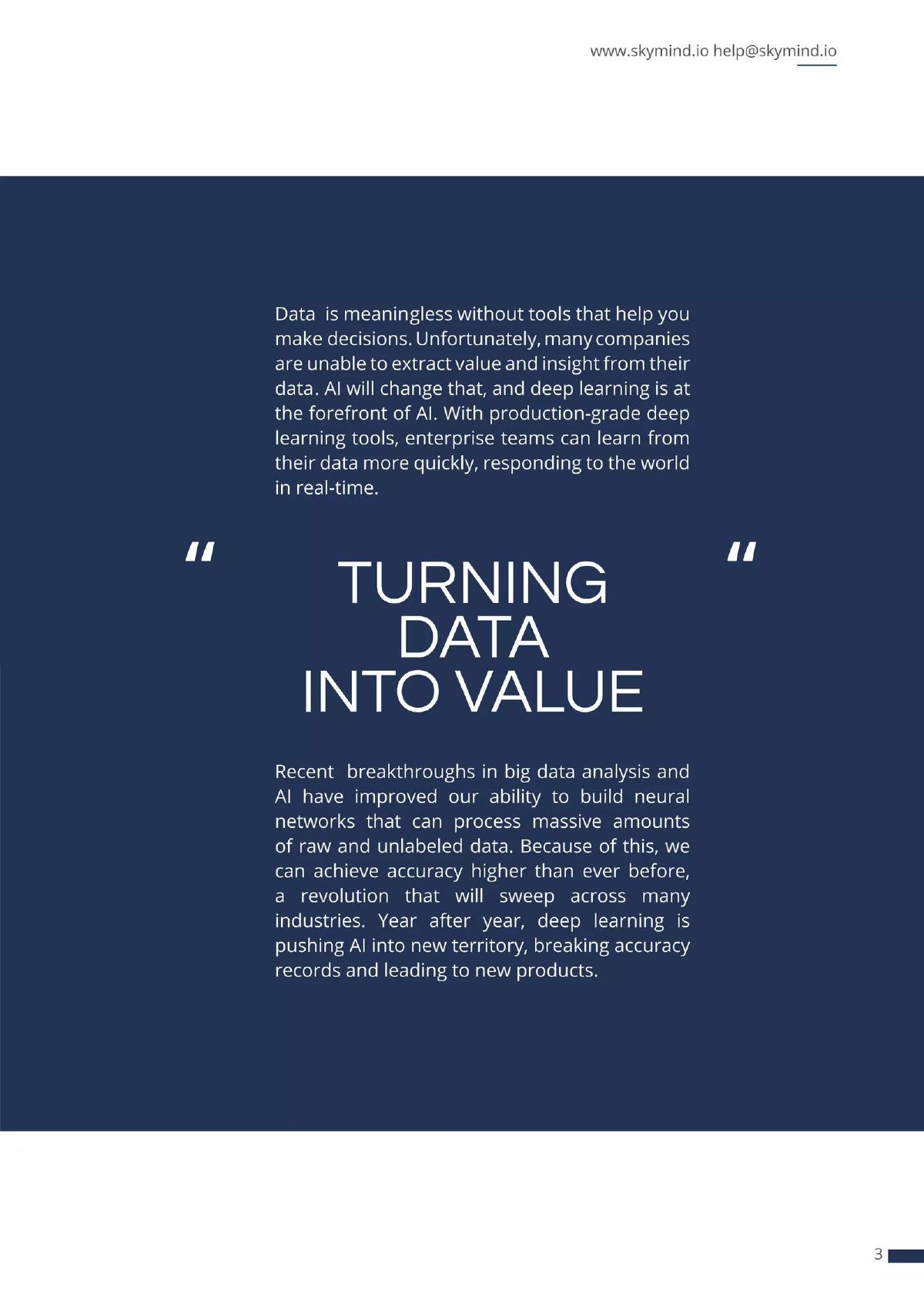
Slide 3 serves as the 'Mission' slide. It uses a bold quote—'Turning Data Into Value'—and explicitly mentions that 'production-grade deep learning tools' are the missing link for enterprise teams. This is the first hint at their value proposition: moving AI from the lab to production.
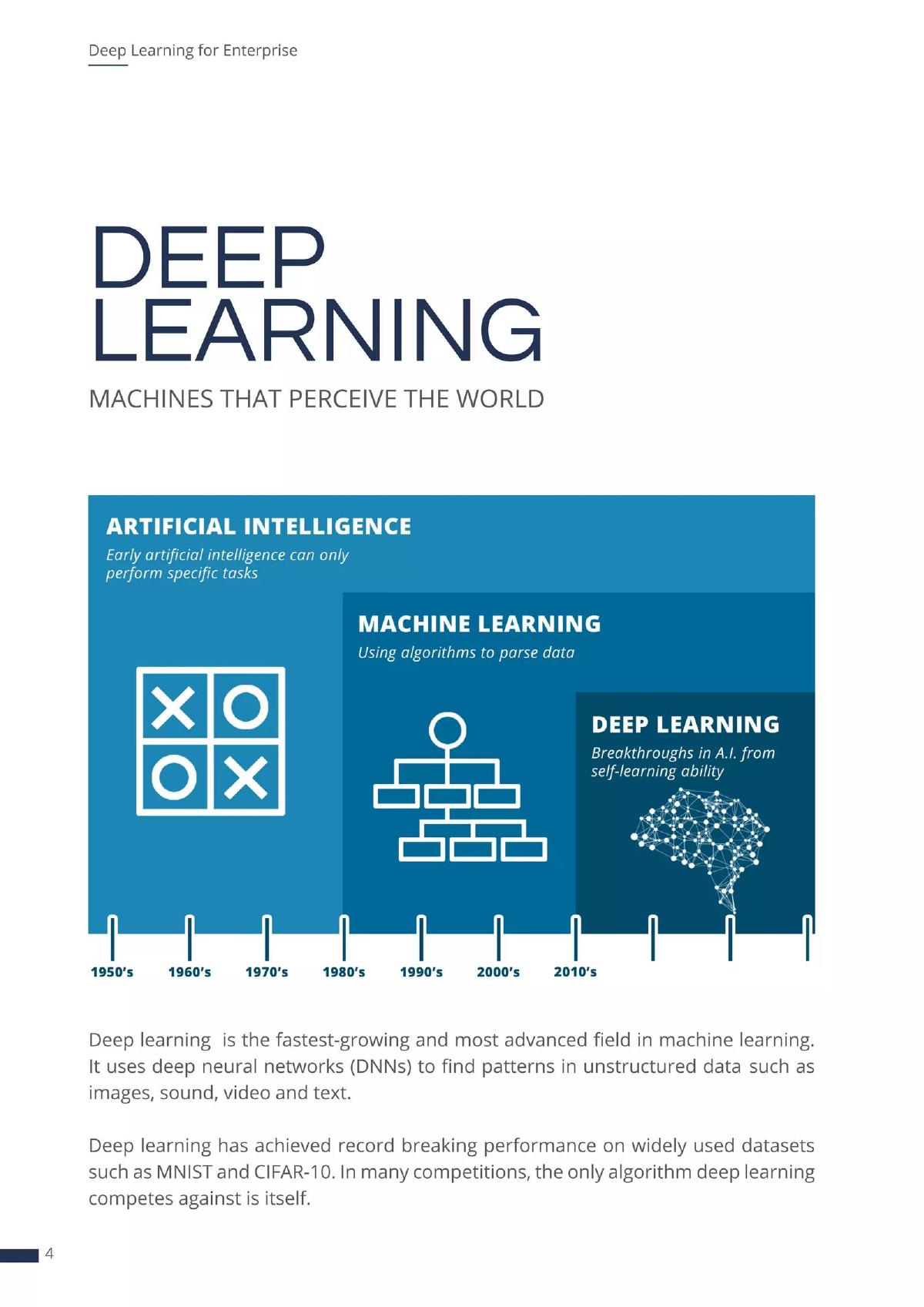
Slide 4 provides a brief history of AI, Machine Learning, and Deep Learning. While often considered 'filler' in modern decks, in 2019, this education was necessary to distinguish Skymind’s focus on neural networks from simpler algorithmic approaches. It cites record-breaking performance on datasets like MNIST and CIFAR-10 to anchor its claims in scientific reality.
Slide 5 is a collage of use cases, ranging from credit card fraud and agriculture to military drones and medical imaging. It’s a 'market breadth' slide designed to show that their infrastructure is industry-agnostic.
Slides 6-11: The Team and the Ecosystem
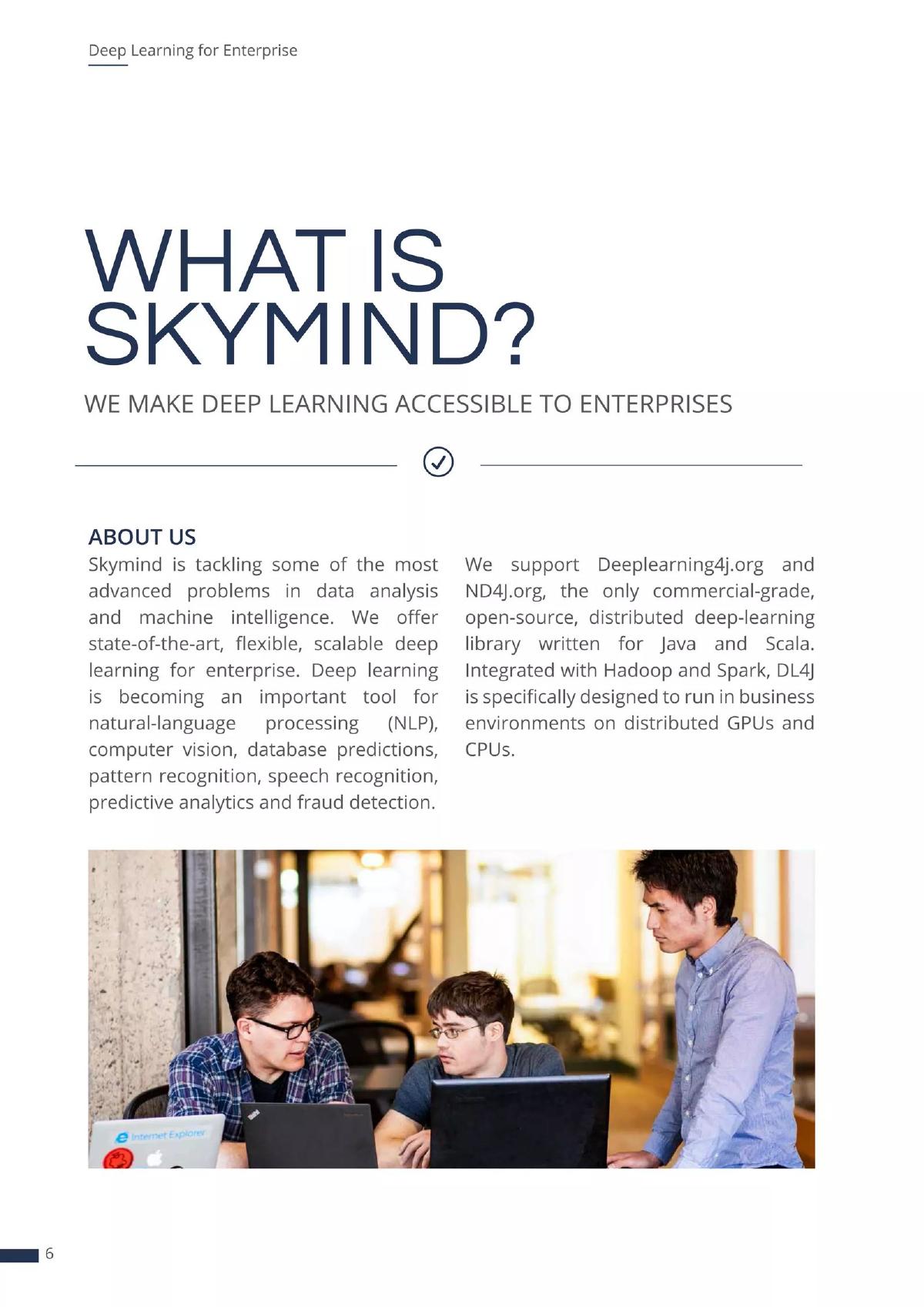
Slide 6 formally introduces the company. It highlights that Skymind supports Deeplearning4j.org and ND4J.org , which it describes as the 'only commercial-grade, open-source, distributed deep-learning library written for Java and Scala.' This is their primary differentiator.
Slide 7 is a dense 'Key Personnel' slide. It is one of the strongest slides in the deck. It features 12 individuals, including Chris Nicholson (CEO) and Adam Gibson (CTO) . The bios are impressive: Gibson is the creator of Deeplearning4j; Josh Patterson was employee #34 at Cloudera; others come from NVIDIA, Samsung SDS, and Monash University. The sheer number of 'Deep Learning Engineers' listed signals to investors that this is a talent-heavy organization.
Slide 8 leans into the open-source strategy. It lists four key projects: Deeplearning4j (modeling), ND4J (scientific computing for JVM), DataVec (ETL), and Arbiter (model evaluation). By stating these are '100% open-source,' they address the enterprise fear of vendor lock-in.
Slide 9 reinforces the 'First Commercial-Grade' claim and highlights integration with Hadoop and Apache Spark. It uses icons to show the types of data they handle: Sound, Text, Time Series, Image, and Video.
Slide 10 is the 'Why Java?' slide. It’s a defensive but necessary slide that argues Java’s 'Write Once, Run Everywhere' philosophy is superior for enterprise speed and security. It correctly identifies that most large enterprises already have their data in Hadoop (Java-based) or Spark (Scala/JVM-based).
Slide 11 is pure validation. It features the logos of Cloudera, Hortonworks, Intel, NVIDIA, and IBM . These aren't just customers; they are 'certifications' and 'seamless integrations.' For a Series A company, this level of partnership is a massive de-risking signal.
Slides 12-15: Product Architecture and Compatibility
Slide 12 lists 'Advantages' like 24/7 support, scalability, and high accuracy. While the graphics are generic, the claim of being 'Compatible with all major systems' is the recurring theme.
Slide 13 is a 'Deep Learning Ecosystem' visualization. It shows a factory-like pipeline where data flows from Hadoop through DataVec and ND4J into DL4J for modeling, and finally through Arbiter for evaluation. It makes a complex technical process look like a manageable industrial workflow.
Slide 14 introduces SKIL (Skymind Intelligence Layer) . This is the 'money' slide. It explains that while the libraries are open-source, SKIL is the 'proprietary enterprise distribution' that includes the necessary components to deploy to production. The reference architecture diagram shows how SKIL sits between the data sources (Kafka, HDFS) and the web applications.
Slide 15 is a 'Compatibility Map.' It is a brilliant way to show market dominance without a competitor slide. By showing how SKIL and DL4J sit atop every major operating system (RHEL, Ubuntu), storage layer (HDP, CDH), and chip (NVIDIA, Intel, Power8), they position themselves as the universal glue of the AI world.
Slides 16-20: Business Model, Authority, and Case Study
Slide 16 outlines their service offerings: Proof of Concept, Consultation, Corporate Training, Enterprise Support, Certification, and Workshops. This shows a clear path to non-software revenue while the product matures.
Slide 17 details 'Skymind University.' By offering a certification program, they are effectively building a 'Skymind-certified' workforce, which is a classic ecosystem-building tactic used by companies like Cisco or Salesforce.
Slide 18 is a unique 'Authority' slide. It features the O'Reilly book 'Deep Learning: A Practitioner’s Approach' authored by founders Adam Gibson and Josh Patterson. In the world of developer tools, having the 'Bible' of the industry written by your founders is the ultimate credibility marker.
Slide 19 is a case study with Orange SV . It provides a specific problem (SIMBox fraud) and a specific outcome (enabling analysts to prioritize high-probability cases). It includes a quote from the CEO of Orange Silicon Valley, which adds significant weight to the claim of enterprise readiness.
Slide 20 is a contact slide with a QR code and their San Francisco address. Notably, there is no 'Ask' slide in this version of the deck—no mention of the $11.5M they were seeking or how they intended to spend it.
What Works in the Skymind Deck
Technical Credibility: Between the O'Reilly book, the open-source library ownership, and the talent-heavy team slide, the deck screams technical excellence. · Ecosystem Positioning: Instead of fighting the giants, Skymind positions itself as the partner that makes Intel, NVIDIA, and Cloudera hardware/software actually work for AI. · The 'Java' Differentiator: By leaning into a 'boring' but ubiquitous language like Java, they carved out a niche that Python-centric startups couldn't easily touch. · Visualizing the Pipeline: Slide 13 and 14 do a great job of turning abstract software concepts into a visual 'assembly line' that an executive can understand.
What is Missing from the Skymind Deck
The Financials: There are zero revenue figures, growth charts, or projections. While this is common in deep-tech infrastructure decks, it leaves the 'business' side of the business to the imagination. · The Ask: The deck ends without telling the investor how much money is needed or what the milestones for the next 18 months are. · Competitor Analysis: While they show compatibility, they don't address other enterprise AI platforms or cloud-native solutions from AWS or Google. · Unit Economics: There is no mention of the cost of sale, implementation times, or typical contract values for the SKIL layer.
Founder's Playbook: What to Copy
The Authority Hack: If your founders have written books, patents, or major open-source libraries, give them their own slide. It is the fastest way to build trust with technical investors. · The Integration Map: If you are building infrastructure, don't just list competitors. List everyone you work with . Showing a 'stack' where you are the central connector is a powerful narrative. · Case Study Depth: The Orange SV slide is excellent because it names a real person and a real problem. Avoid anonymous case studies whenever possible. · Strategic Education: If your technology relies on a specific choice (like Java over Python), dedicate a slide to explaining why that choice is a competitive advantage for your customers , not just your developers.
Frequently asked questions
- Why does the deck focus so heavily on Java?
- Slide 10 explicitly addresses this, noting that while the AI community often focuses on Python, Java is the standard for enterprise deployment due to speed and security. By integrating with the JVM, Skymind ensures compatibility with existing big data systems like Hadoop and Spark, which are the backbone of most large-scale corporate data infrastructures.
- What is the 'SKIL' mentioned in the deck?
- SKIL stands for the Skymind Intelligence Layer. As described on Slide 14, it is the company's proprietary enterprise distribution. It bundles open-source components with proprietary vendor integrations and connectors, providing the 'production-grade' wrapper that enterprises need to deploy deep learning models reliably.
- How does Skymind handle the 'Open Source vs. Proprietary' conflict?
- Skymind uses a 'core-plus' model. Slide 8 highlights that their core libraries (DL4J, ND4J) are 100% open-source to drive adoption and community trust. However, Slide 14 and 16 introduce the proprietary SKIL layer and professional services (consultation, training, certification) as the primary commercial engines.
- Is there a competitor analysis in this deck?
- No. The deck completely omits a traditional competitor matrix. Instead, it uses Slide 15 to show a massive 'Compatible Technology' and 'Vendor Integration' map. By positioning themselves as compatible with almost every major data player (Red Hat, Kafka, Intel), they frame themselves as a necessary layer rather than a replacement for existing tools.
- What is the purpose of the 'Skymind University' slide?
- Slide 17 outlines Skymind University and their certification program. This is a strategic move to create a 'moat' by training a workforce of engineers who are specifically skilled in Skymind’s tools. It also serves as a lead generation tool for their enterprise services and software licenses.