Sizzle AI’s pitch deck is a masterclass in identifying a massive market inefficiency—the 'engagement gap' in EdTech—and proposing a solution that mimics the most successful consumer apps of the current era. By contrasting the 3.13% completion rate of traditional MOOCs against the 25.7 hours per month spent on TikTok, the deck establishes a clear psychological and technical opportunity. The product vision shifts from static courses to a personalized, AI-curated feed that learns from student interactions. While the deck is light on current traction and specific team details, it successfully sel…
Key takeaways
- The deck identifies a critical industry failure: a 3.13% course completion rate for traditional MOOCs (Slide 2).
- It uses a powerful visual comparison between declining MOOC retention and the skyrocketing engagement of TikTok, which reached 25.7 hours per month per user (Slide 2).
- The product workflow begins with a simple search bar asking 'What do you want to learn today?' to generate personalized study plans (Slide 3-4).
- Social proof and motivation are baked into the UI, showing users sharing progress percentages with peers like 'Stacy' or 'Nat' (Slide 5).
- The technology is positioned as a bridge that makes existing content from Khan Academy, YouTube, and Wikipedia interactive and 'bite-sized' (Slide 6).
- Sizzle proposes an algorithmic approach to education, claiming to 'promote' high-quality content and 'demote' low-quality content based on student interactions (Slide 7).
- The business model is speculative, listing five potential revenue streams including premium content fees, tutoring, and ads (Slide 8).
- The deck sets an ambitious target of 10M+ DAU as a primary metric for success (Slide 8).
The Vision: EdTech Meets the Attention Economy
Sizzle AI’s pitch deck is a fascinating look at how to frame a 'wrapper' startup as a revolutionary platform. By 2023, the market was flooded with AI tutoring tools, but Sizzle differentiated itself by focusing on the delivery mechanism rather than just the LLM capabilities. The deck argues that the problem with education isn't a lack of content—it's a lack of engagement. By comparing the 'boring' world of MOOCs to the 'addictive' nature of TikTok, they created a compelling narrative for investors looking for the next big consumer play.
Slide 1-2: The Engagement Gap
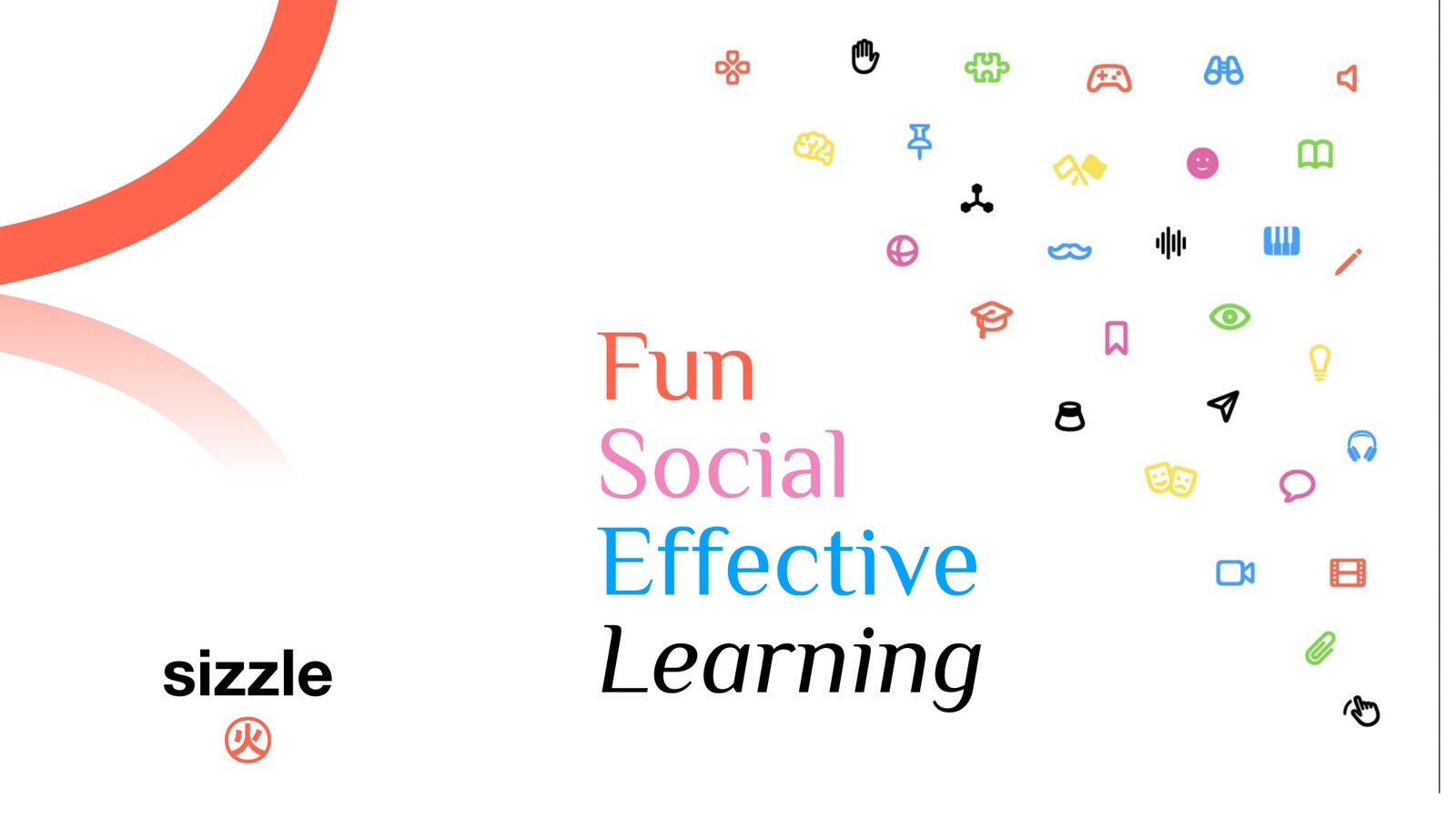
The deck opens with a bold brand promise: 'Fun, Social, Effective Learning.' Slide 2 is the most critical slide in the entire presentation. It presents a stark contrast between two datasets. On the left, it shows the decline of MOOC (Massive Open Online Course) retention, citing a specific 3.13% course completion rate . On the right, it shows a graph of TikTok engagement 'keeping going up,' reaching 25.7 hours per month per user by 2021, dwarfing Facebook (16h) and Instagram (7.9h).
This is a classic 'Why Now?' and 'Problem' slide combined. It tells the investor that the current education system is failing to capture the attention of the modern student, and there is a massive opportunity to apply the engagement tactics of social media to educational content.
Slide 3-5: Product UX and Personalization
Slides 3 and 4 introduce the interface. It starts with a simple, Google-like search bar asking, 'What do you want to learn today?' This emphasizes ease of entry. Slide 4 shows the transition from a 'free-form learning goal' (e.g., 'Refresh my high school Organic Chemistry') to a 'personalized study plan' represented by a series of icons. This demonstrates the AI's ability to structure unstructured requests.
Slide 5 dives into the social and tracking elements. It shows a dashboard where users can see their progress (e.g., Algebra Mid-Terms at 75% ) and, crucially, who they are sharing that progress with. The inclusion of 'Stacy' and 'Nat' with heart and smiley emojis suggests a peer-to-peer accountability model. The slide explicitly states that success comes from a 'personalized feed that learns from all their interactions,' positioning the product as an algorithmic tutor.
Slide 6-7: The AI Engine and Content Strategy
Slide 6 clarifies Sizzle's role in the ecosystem. They aren't replacing Khan Academy or Wikipedia; they are augmenting them. The slide shows logos for Khan Academy, TED, YouTube, and arXiv.org, stating that AI makes this content 'accessible, interactive, and bite-sized.' This is a smart strategic move—it tells investors that Sizzle doesn't have the high overhead of content creation. Instead, they are the 'intelligent layer' that makes existing content consumable 'anywhere, anytime.'
Slide 7 explains the 'Learning to teach' feedback loop. It uses a flow chart to show how the system 'Promotes' high-quality content and 'Demotes' low-quality or misleading content based on student interactions. This suggests a self-correcting marketplace of ideas, similar to how TikTok’s algorithm surfaces the best videos. By framing it this way, Sizzle positions itself as a quality-control filter for the internet's vast educational resources.
Slide 8: Business Metrics and The Path to Revenue
The final slide in this set addresses the business side. It sets a high bar for success, targeting 10M+ DAU (Daily Active Users) . It reiterates the failure of MOOCs, noting they have been 'growing businesses despite not having product market fit!' This is a clever jab at the competition, implying that if a 'broken' model can grow, a 'fixed' model (Sizzle) will explode.
The monetization section is a list of possibilities: premium content fees, tutoring fees, corporate offerings, certifications, and ads. While investors usually prefer a more focused revenue plan, at the seed stage, showing multiple paths to a billion-dollar outcome is often acceptable if the user growth story is strong enough.
What Works in This Deck
The TikTok Comparison: Using TikTok as a benchmark for engagement is a powerful way to illustrate the 'Engagement Gap.' It makes the problem feel urgent and the solution feel modern. · Visual Simplicity: The deck is not cluttered. It uses clean UI mockups and simple charts to convey complex ideas about algorithmic curation. · Leveraging Existing Content: By showing they can ingest content from YouTube and Wikipedia, they solve the 'cold start' problem of having no content on day one. · Social Integration: The focus on 'Shared With' (Slide 5) addresses the lonely nature of online learning, which is a primary reason for high drop-out rates.
What is Missing
The Team: As reported by Business Insider, Sizzle raised $7.5M. A round of that size is almost always driven by the founders' previous successes (the founder, Jerome Pesenti, was the former VP of AI at Meta). The absence of a team slide in this set is a major omission for any founder looking to copy this deck. · Unit Economics: There is no mention of the cost to acquire a user (CAC) or the projected lifetime value (LTV). While Slide 8 lists monetization ideas, it lacks data on how these would scale. · Technical Moat: While the deck mentions 'AI,' it doesn't explain if they are building their own models or just using OpenAI's API. In a crowded AI market, a lack of technical depth can be a red flag. · The Ask: The deck ends without a specific request for capital or a breakdown of how the $7.5M will be spent (e.g., hiring, marketing, R&D).
Founder's Playbook: Lessons from Sizzle AI
Founders should take note of how Sizzle frames their competition. They don't just say 'MOOCs are bad'; they provide a specific metric ( 3.13% completion ) to prove it. This makes their argument objective rather than subjective. Furthermore, the deck does an excellent job of 'selling the future.' It doesn't get bogged down in the current limitations of AI; instead, it focuses on the user experience of a 'personalized feed' that makes learning as addictive as social media.
If you are building a 'wrapper' startup, follow Sizzle's lead on Slide 6. Don't hide the fact that you use external content; frame it as a strength. You are the curator, the translator, and the interactive layer that makes the world's data useful. That is a much more scalable business than trying to write your own textbooks.
Frequently asked questions
- What is the core problem Sizzle AI aims to solve?
- Sizzle AI targets the lack of engagement in online education. As shown on Slide 2, traditional Massive Open Online Courses (MOOCs) suffer from a dismal 3.13% completion rate. The company argues that while educational content exists in abundance, the delivery mechanism is outdated compared to modern social media platforms like TikTok, leading to high abandonment rates among students.
- How does the product actually work according to the deck?
- The product functions as an AI-driven interface for learning. Users enter a 'free-form learning goal' (Slide 4) which the AI converts into a personalized study plan. The experience is delivered through a 'personalized feed' (Slide 5) that tracks time spent and progress, allowing students to share their milestones with friends for social motivation and support.
- What is Sizzle AI's strategy for content creation?
- Interestingly, Sizzle does not appear to be a content production house. Slide 6 suggests they leverage 'existing educational and non-educational content' from sources like Khan Academy, TED, YouTube, and Wikipedia. Their AI layer makes this content 'accessible, interactive, and bite-sized,' effectively acting as an intelligent wrapper and curator for the world's existing knowledge base.
- How does the company plan to make money?
- Slide 8 outlines a multi-pronged monetization strategy rather than a single fixed model. Potential revenue streams include service fees for premium content or tutoring, corporate offerings for employee training, certifications, and traditional advertising. This suggests the seed round was focused on user growth and engagement (targeting 10M+ DAU) before finalizing a specific revenue engine.
- Is there a team slide in the Sizzle AI deck?
- The provided slide set does not include a team slide. While the publisher reports a $7.5M raise, the deck focuses almost entirely on the problem, the product vision, and the market opportunity. In a seed round of this size, the founder's pedigree usually plays a massive role, but it is not explicitly detailed in these specific slides.