SingleStore’s Series F deck is a highly polished, technical narrative that centers on the friction of modern data architectures. By highlighting the 'Complexity of Current Approaches' (Slide 25), the company positions itself as the antidote to a fragmented ecosystem of specialized databases like Redis, MongoDB, and Snowflake. The deck is light on traditional team bios but heavy on product vision and growth metrics, specifically highlighting a 151% annual growth rate in Managed Services (Slide 9). It effectively uses a Venn diagram (Slide 34) to claim the middle ground between OLTP and OLAP wo…
Key takeaways
- The deck identifies 'sluggish event-to-insight response' and 'rising costs' as the primary drivers for market change on Slide 6.
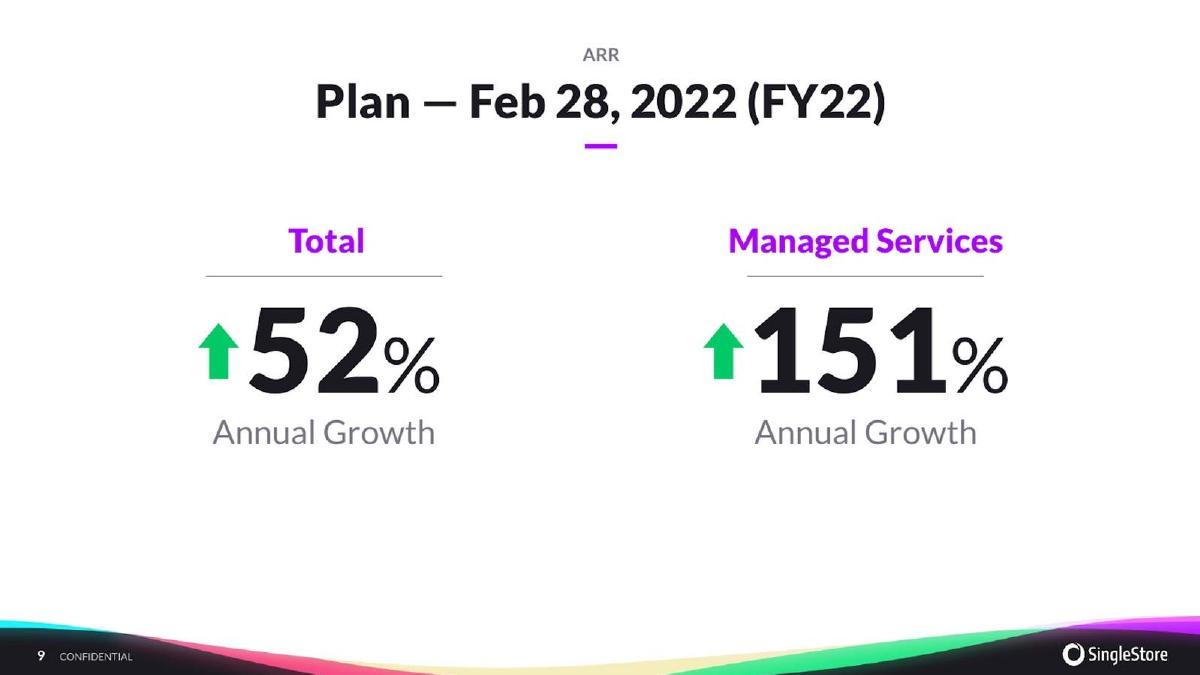
- SingleStore reports a 52% total annual growth rate, with a significant 151% surge in their Managed Services segment on Slide 9.
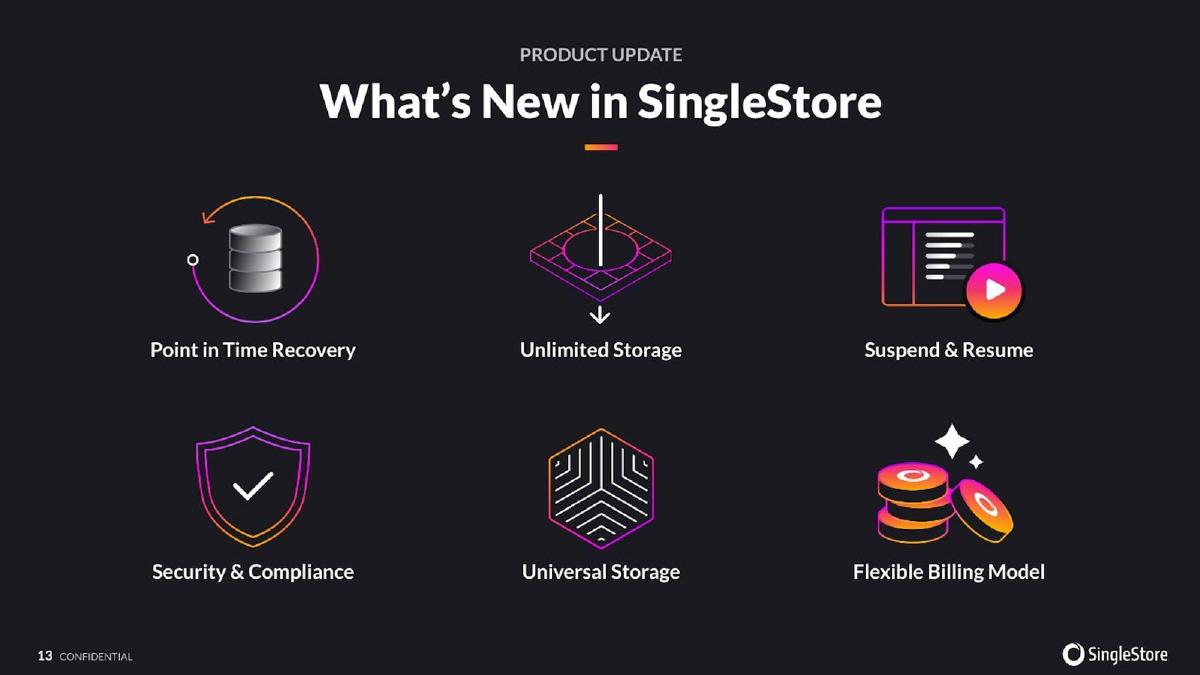
- Product updates focus on enterprise-grade features including Point in Time Recovery and a Flexible Billing Model on Slide 13.
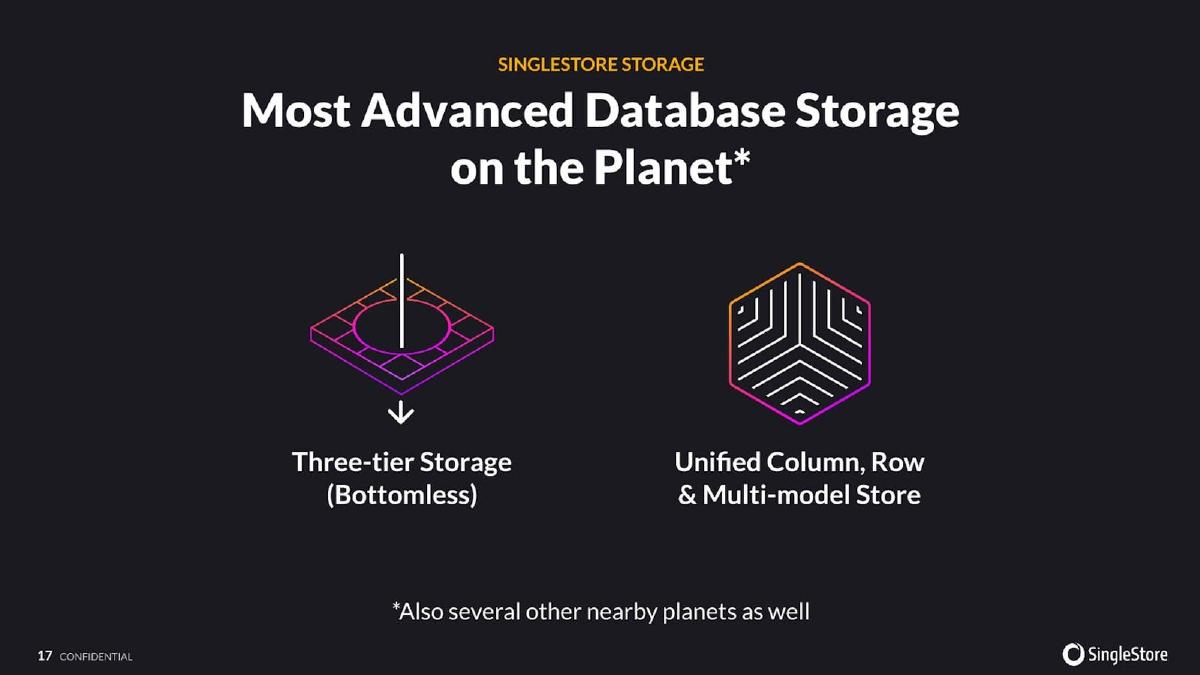
- The company claims to offer the 'Most Advanced Database Storage on the Planet' through three-tier bottomless storage on Slide 17.
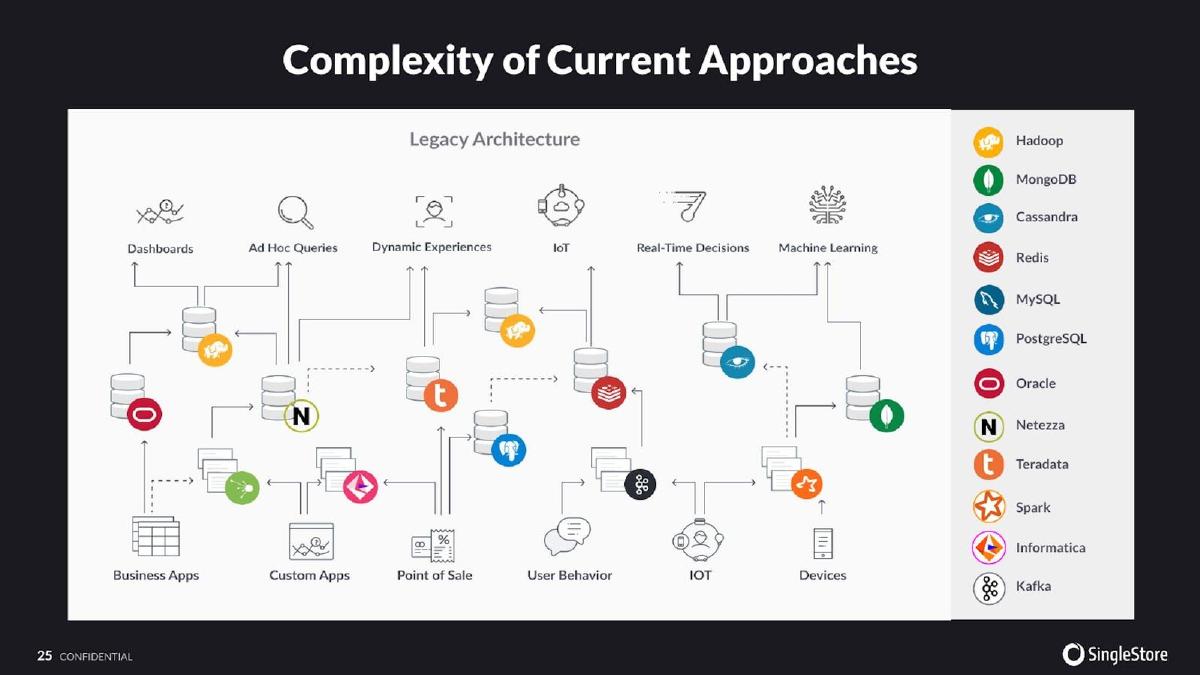
- A complex architectural map on Slide 25 visualizes the mess of legacy systems involving 12+ different logos like Hadoop, Kafka, and Oracle.
- The three-step product vision moves from SaaS to Edge to Global Namespace, as outlined on Slide 29.
- Slide 34 positions SingleStore as the unique intersection of OLTP (transactional) and OLAP (analytical) workloads.
- The deck omits a traditional 'Team' slide with executive bios, focusing instead on the product's technical capabilities and market positioning.
The SingleStore Series F Teardown
SingleStore, formerly known as MemSQL, utilized this 35-slide investor briefing in August 2021 to secure $80 million in Series F funding. At this stage of a company's lifecycle, the pitch is less about proving the technology works and more about proving the technology can dominate a massive, established market. The deck is a masterclass in positioning a 'unified' solution against a fragmented status quo.
Slides 1-5: Branding and Confidentiality
The deck opens with a minimalist aesthetic. Slides 1 through 5 are largely placeholder or branding slides, establishing the 'SingleStore' identity with its purple and teal color palette. The cover slide (Slide 1) clearly marks the document as an 'Investor Briefing' from August 2021. This period was characterized by a massive surge in cloud spending, and SingleStore’s branding reflects a modern, cloud-native enterprise software company. The repetition of the logo slides suggests a transition or a setup for a live presentation where the speaker might be introduced before the content begins.
Slide 6: The Problem Statement
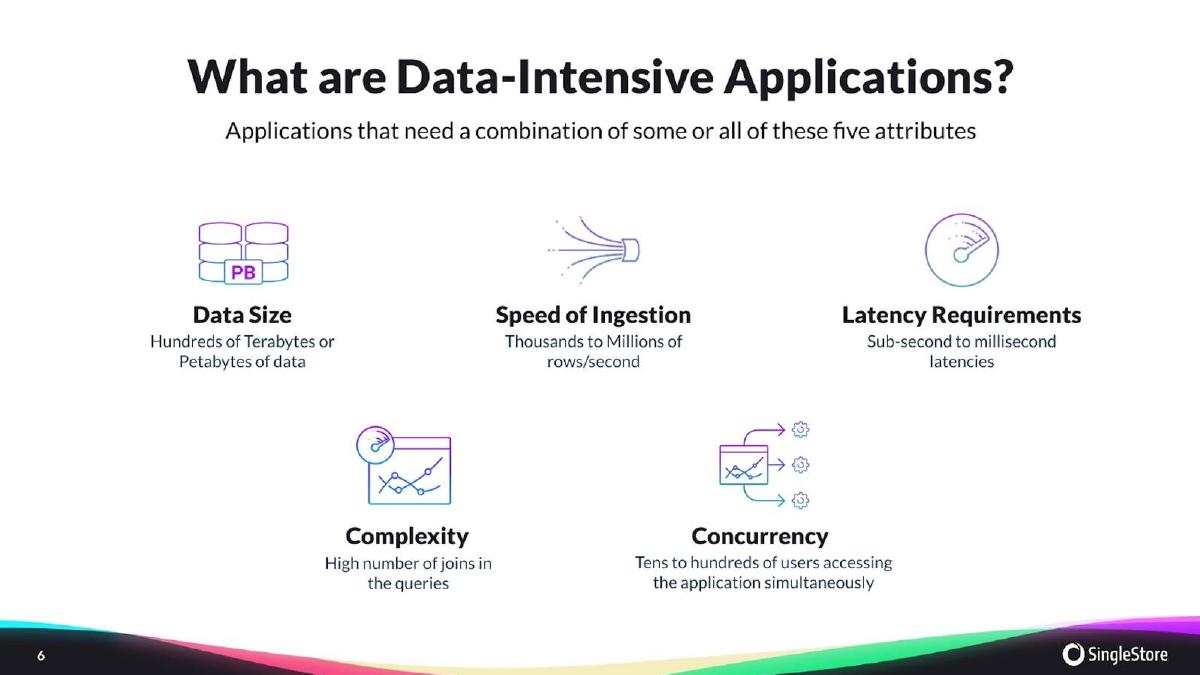
Slide 6, titled 'Businesses are becoming data-intensive,' serves as the primary hook. It splits the narrative into two halves: the macro trend and the resulting pain. On the left, it notes that data volume and complexity are rising, and that AI/ML models are driving the need for real-time analytics. On the right, it lists the symptoms of failure: 'Sluggish event-to-insight response,' 'Rising costs and complexity,' and 'concurrency challenges.' This is a classic 'Why Now?' slide. It doesn't just say data is growing; it says the nature of data usage has changed, making old tools obsolete.
Slide 9: Growth Metrics and Managed Services
By Slide 9, SingleStore moves directly into the 'Plan' for FY22 (ending February 28, 2022). This is a high-conviction move, placing growth metrics early in the deck. The slide highlights two massive numbers: 52% Total Annual Growth and 151% Managed Services Annual Growth . For a Series F investor, the 151% growth in managed services is the most important metric here. It proves that SingleStore is successfully migrating its business model to the cloud (SaaS), which typically commands higher valuation multiples than traditional on-premise software licenses.
Slide 13: Product Updates and Enterprise Readiness
Slide 13, 'What’s New in SingleStore,' lists six key features: Point in Time Recovery, Unlimited Storage, Suspend & Resume, Security & Compliance, Universal Storage, and a Flexible Billing Model. This slide is designed to check the boxes for institutional investors who worry about 'enterprise readiness.' Features like Point in Time Recovery and Security & Compliance are not 'flashy,' but they are mandatory for the Fortune 500 customers SingleStore is targeting. The 'Flexible Billing Model' also signals a shift toward consumption-based pricing, a popular trend in the snowflake-era data market.
Slide 17: Technical Differentiation
Slide 17 makes a bold claim: 'Most Advanced Database Storage on the Planet.' The asterisk humorously adds, 'Also several other nearby planets as well.' Beneath the bravado, the slide points to two core technical pillars: Three-tier Storage (Bottomless) and Unified Column, Row & Multi-model Store . This is the 'secret sauce.' Most databases are good at either rows (transactions) or columns (analytics). SingleStore claims to do both, which is the foundation of their consolidation pitch.
Slide 21: The Four Pillars
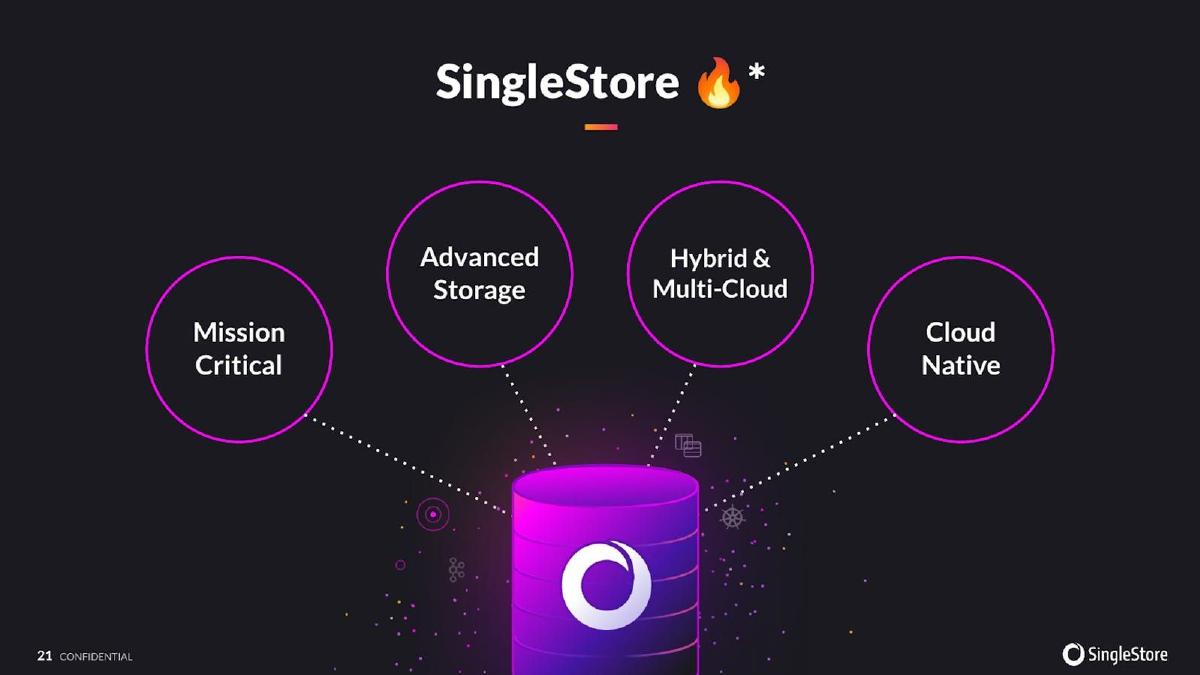
Slide 21 summarizes the product's identity into four circles: Mission Critical, Advanced Storage, Hybrid & Multi-Cloud, and Cloud Native. This slide acts as a bridge between the technical features and the market strategy. It reassures investors that the product can run anywhere (Hybrid/Multi-Cloud) and handle the most important workloads (Mission Critical).
Slide 25: The Complexity Map
Slide 25 is arguably the most impactful visual in the deck. Titled 'Complexity of Current Approaches,' it shows a 'Legacy Architecture' that is a chaotic web of icons. It includes logos for Hadoop, MongoDB, Cassandra, Redis, MySQL, PostgreSQL, Oracle, Netezza, Teradata, Spark, Informatica, and Kafka . By showing these logos connected by a mess of arrows, SingleStore visualizes the 'Data Tax' companies pay to keep these disparate systems synced. The implicit promise is that SingleStore can replace or simplify this entire diagram.
Slide 29: The Product Vision
Slide 29, 'Path to a Single Store,' outlines the roadmap. It is divided into three phases: 1. Start with SaaS (Embedded Edition, Central Control Plane), 2. Take it to the Edge (Edge Edition, Secure Policy Engine), and 3. Going Global (Global Namespace, Seamless Synchronization). This shows that the company isn't just thinking about the current database market, but also the future of edge computing and global data distribution.
Slide 34: The Market Opportunity
The deck concludes its narrative on Slide 34 with 'The SingleStore Opportunity.' It uses a large Venn diagram to show the intersection of OLTP Workloads (Transactional) and OLAP Workloads (Analytical). In the OLTP circle, it places competitors like MySQL, MariaDB, and Amazon Aurora. In the OLAP circle, it places Snowflake, Google BigQuery, and Amazon Redshift. SingleStore places itself directly in the center, labeled 'Data-Intensive Workloads.' This is a brilliant bit of positioning; it frames the competition as 'specialized' (and therefore limited) while framing SingleStore as the 'universal' solution.
What SingleStore Does Well
The deck excels at visualizing the pain of fragmentation . Slide 25 is a masterpiece of 'fear, uncertainty, and doubt' (FUD). By showing how many different tools a modern enterprise currently uses, SingleStore makes their 'unified' solution feel like a necessity rather than a luxury. They also do a great job of highlighting Managed Services growth . In the 2021 market, investors were obsessed with cloud transitions, and the 151% growth figure on Slide 9 directly addresses that appetite.
Furthermore, the deck balances technical depth with high-level business value . It mentions 'Point in Time Recovery' for the CTOs, but also 'Rising costs and complexity' for the CFOs. The use of humor on Slide 17 ('nearby planets') also helps to humanize a very dense, technical product.
What is Missing from the Deck
The most notable omission is a Team Slide . While this is a Series F deck and the leadership is likely well-known to the investors in the room, a teardown of the provided slides shows no bios or headshots of the executive team. At this stage, investors are betting on the ability of the leadership to execute a global go-to-market strategy, so the absence of this information is surprising.
There is also a lack of detailed Unit Economics . While ARR growth is shown, there is no mention of Net Revenue Retention (NRR), Customer Acquisition Cost (CAC), or LTV/CAC ratios. For an $80M round, these metrics are usually scrutinized heavily. Finally, there is no explicit 'Ask' slide in the provided set, which would typically detail how the $80M would be allocated across R&D, sales, and marketing.
What Founders Should Copy
The 'Complexity' Visual: If you are building a tool that consolidates other tools, create a slide like Slide 25. Show the 'mess' your customers are currently dealing with. It makes your solution feel like a relief. · Segmented Growth: Don't just show one growth number. If one part of your business (like SaaS) is growing faster than the rest, break it out like SingleStore did on Slide 9. It tells a much more compelling story about where the company is going. · The Venn Diagram Positioning: Slide 34 is a perfect example of how to claim a new category. By placing yourself at the intersection of two established markets, you can claim the total addressable market (TAM) of both. · Roadmap Phases: Use a three-step vision like Slide 29. It shows that you have a plan for today (SaaS), tomorrow (Edge), and the future (Global), giving investors confidence in your long-term defensibility. · Consistent Branding: The deck uses a very tight color palette and iconography style. This professional polish reflects the 'enterprise-grade' nature of the product.
Frequently asked questions
- What is the primary value proposition SingleStore presents?
- SingleStore pitches the consolidation of data workloads. They argue that modern applications are struggling with 'data-intensive' requirements that legacy systems can't handle. By combining transactional (OLTP) and analytical (OLAP) capabilities into a single engine, they claim to reduce the complexity and cost associated with managing multiple specialized databases like MongoDB, Redis, and Snowflake.
- How does SingleStore demonstrate its growth to investors?
- On Slide 9, the deck highlights two key growth figures for the fiscal year ending February 28, 2022. They show a 52% increase in total Annual Recurring Revenue (ARR) and a much more aggressive 151% growth in their Managed Services (cloud) business. This indicates a successful transition from on-premise software to a cloud-first SaaS model.
- Which competitors does SingleStore explicitly name?
- Slide 25 and Slide 34 name a wide array of competitors across different niches. These include legacy players like Oracle, IBM DB2, and Teradata; NoSQL options like MongoDB and Cassandra; caching layers like Redis; and modern cloud data warehouses like Snowflake, Amazon Redshift, and Google BigQuery. They position themselves as the unified alternative to this fragmented list.
- What technical features are emphasized in the Series F deck?
- The deck highlights 'Three-tier Storage (Bottomless)' and 'Unified Column, Row & Multi-model Store' on Slide 17. They also emphasize new enterprise features on Slide 13, such as Point in Time Recovery, Unlimited Storage, and Suspend & Resume capabilities, which are critical for cloud-native scalability and data safety.
- Is there a specific 'Ask' slide in this deck?
- No, the provided slides do not include a specific 'Ask' slide detailing the exact dollar amount sought or the planned use of funds. While publisher reports indicate an $80M raise, the deck itself focuses on the strategic vision, product roadmap, and existing growth momentum rather than the mechanics of the round.