SIMBA Chain’s 2022 Series A deck is a masterclass in positioning a complex technology—blockchain—as a simple enterprise utility. By framing themselves as the 'Stripe for blockchain,' they move the conversation away from crypto speculation and toward infrastructure. The deck relies heavily on massive social proof, including logos from the U.S. Air Force, Boeing, and the U.S. Navy, alongside a list of high-profile individual investors from KKR and Coinbase. While the deck is light on specific unit economics and financial projections, it compensates with a clear competitive comparison against Al…
Key takeaways
- The company positions itself as the 'picks and shovels' of the blockchain rush, explicitly comparing its role to Stripe's role in payments (Slide 7).
- Traction is demonstrated through a high-density logo slide featuring the U.S. Air Force, Navy, Boeing, and multiple universities (Slide 8).
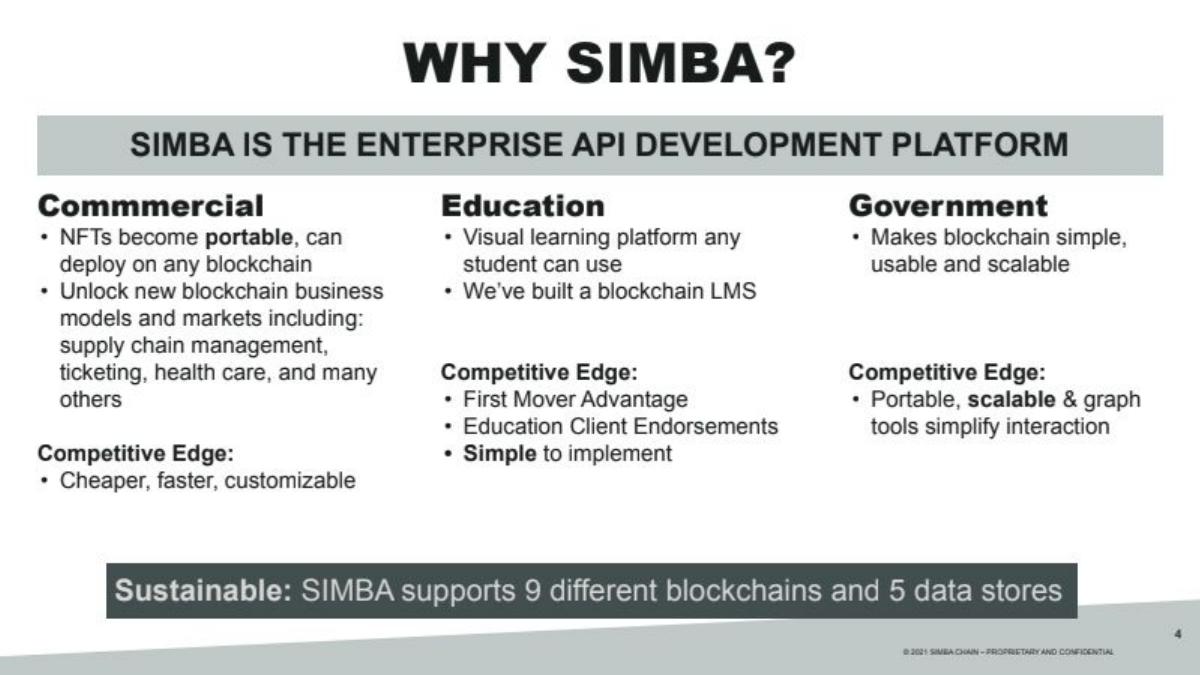
- The platform supports 9 different blockchains and 5 data stores, emphasizing portability as a core value proposition (Slide 4).
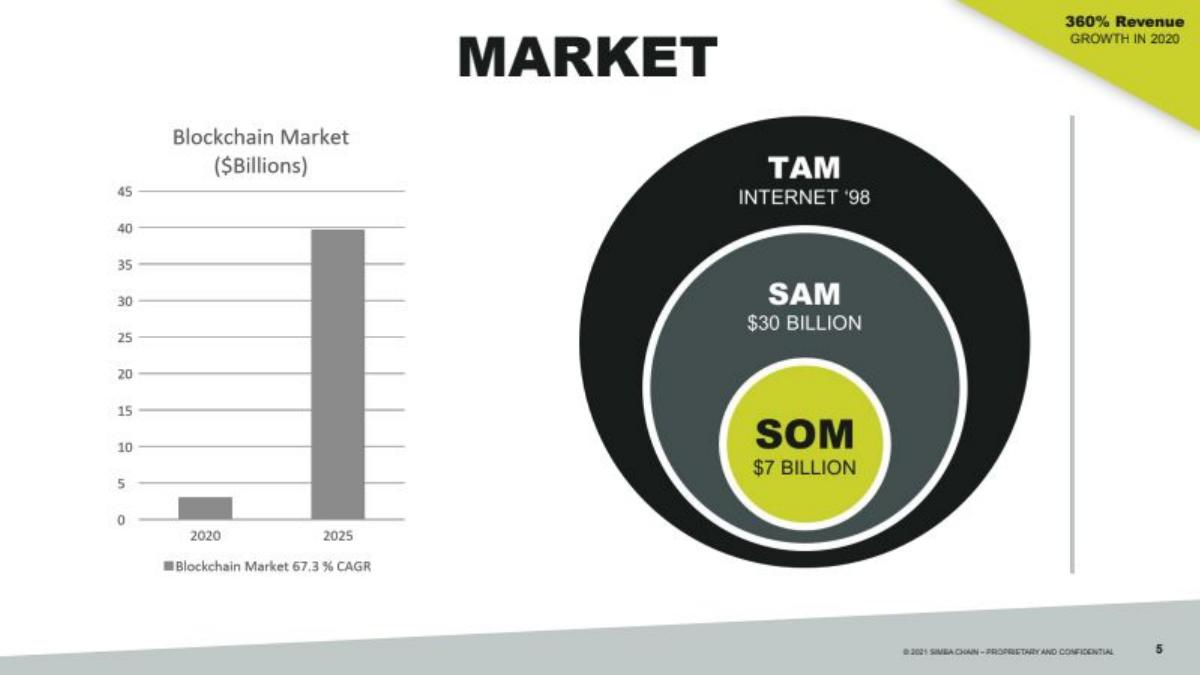
- Market sizing targets a $7 billion Serviceable Obtainable Market (SOM) within a broader $30 billion SAM (Slide 5).
- A direct 'Step-by-Step' comparison against competitor Alchemy highlights a reduction from 16 steps to 4 steps for deploying a contract (Slide 16).
- The deck lists 21 universities already signed to recurring revenue contracts as part of their education vertical (Slide 12).
- The 'World Class Investor Group' slide lists over 20 high-profile individuals, including the founders of KKR and NEA (Slide 20).
- The team slide highlights a CEO involved in 380 startups and 17 exits, providing significant entrepreneurial weight (Slide 10).
The Narrative: From Crypto Hype to Enterprise Utility
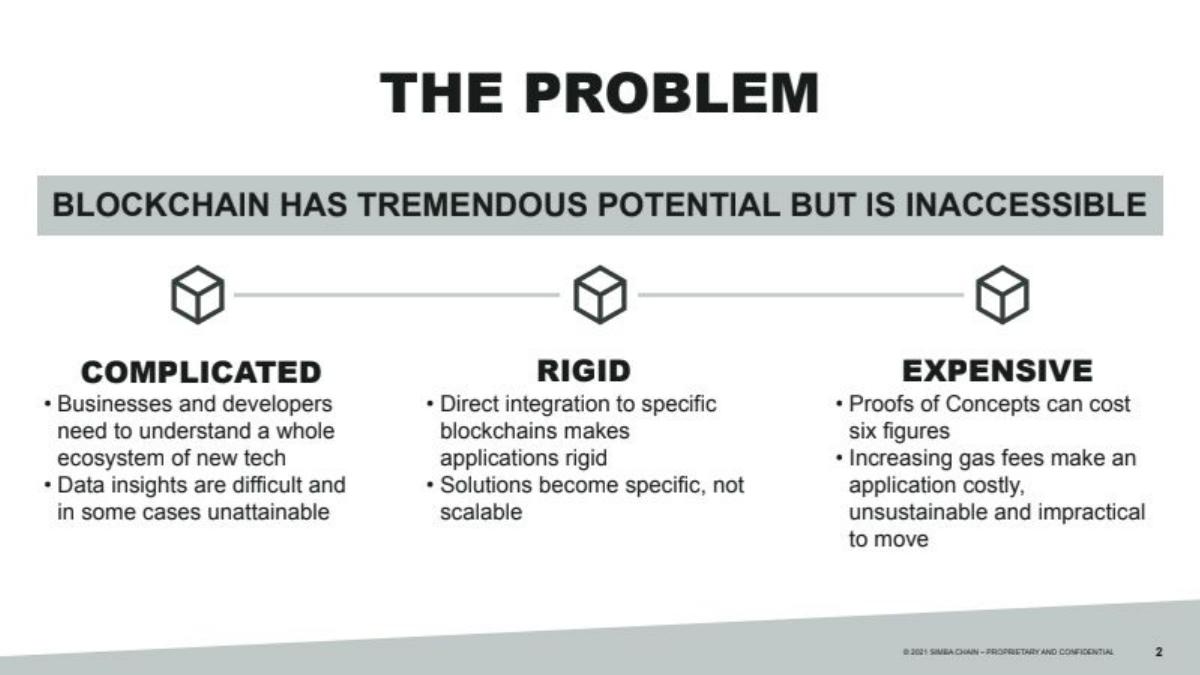
SIMBA Chain’s Series A deck arrived at a pivotal moment in 2022. While the broader cryptocurrency market was volatile, SIMBA positioned itself as the stable infrastructure layer—the 'picks and shovels'—for the enterprise. The deck avoids the typical 'to the moon' rhetoric of Web3 startups, instead focusing on solving the 'Complicated, Rigid, and Expensive' nature of blockchain (Slide 2). By framing the problem as a barrier to enterprise adoption rather than a lack of consumer interest, they immediately align themselves with the needs of large-scale organizations like the Department of Defense and Boeing.
Slides 1-3: The Hook and the Solution
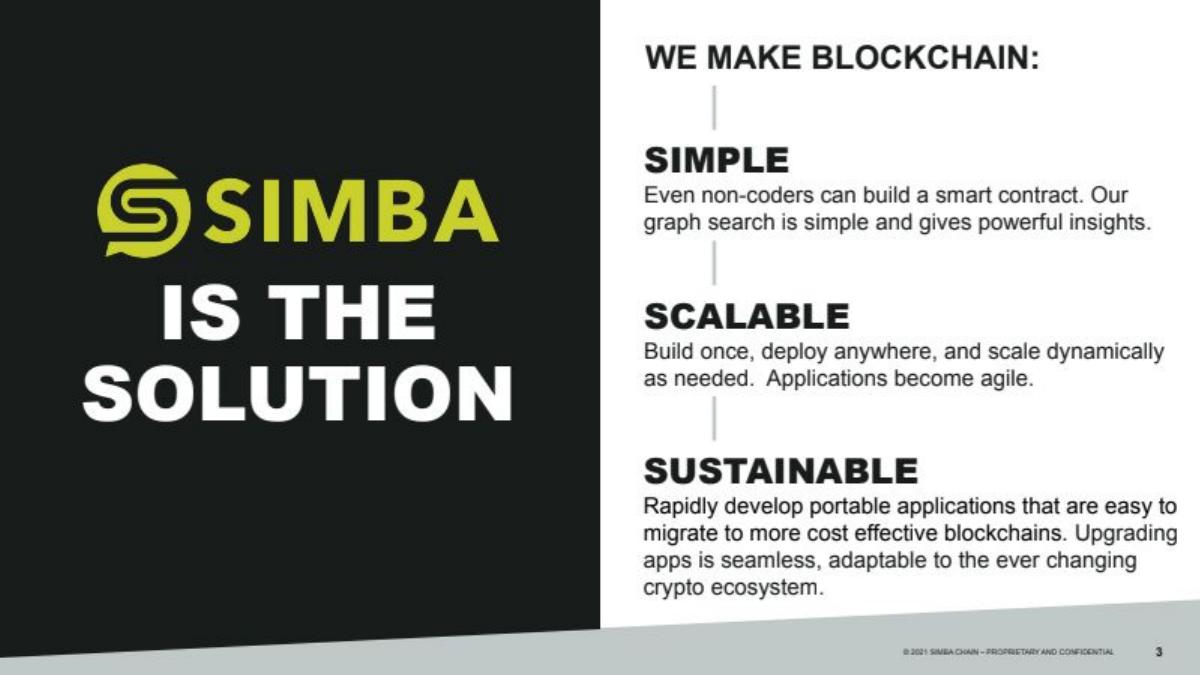
The deck opens with a minimalist title slide (Slide 1) and moves quickly into a standard problem/solution framework. Slide 2 identifies the core friction points: blockchain is too complicated for developers, too rigid due to specific chain integration, and too expensive, noting that Proofs of Concept (PoCs) can cost 'six figures.' Slide 3 presents SIMBA as the antidote, using three pillars: Simple (non-coders can build smart contracts), Scalable (build once, deploy anywhere), and Sustainable (portable applications). This sets the stage for a 'low-code' narrative that has been highly successful in other SaaS verticals.
Slides 4-6: Market Opportunity and Verticals
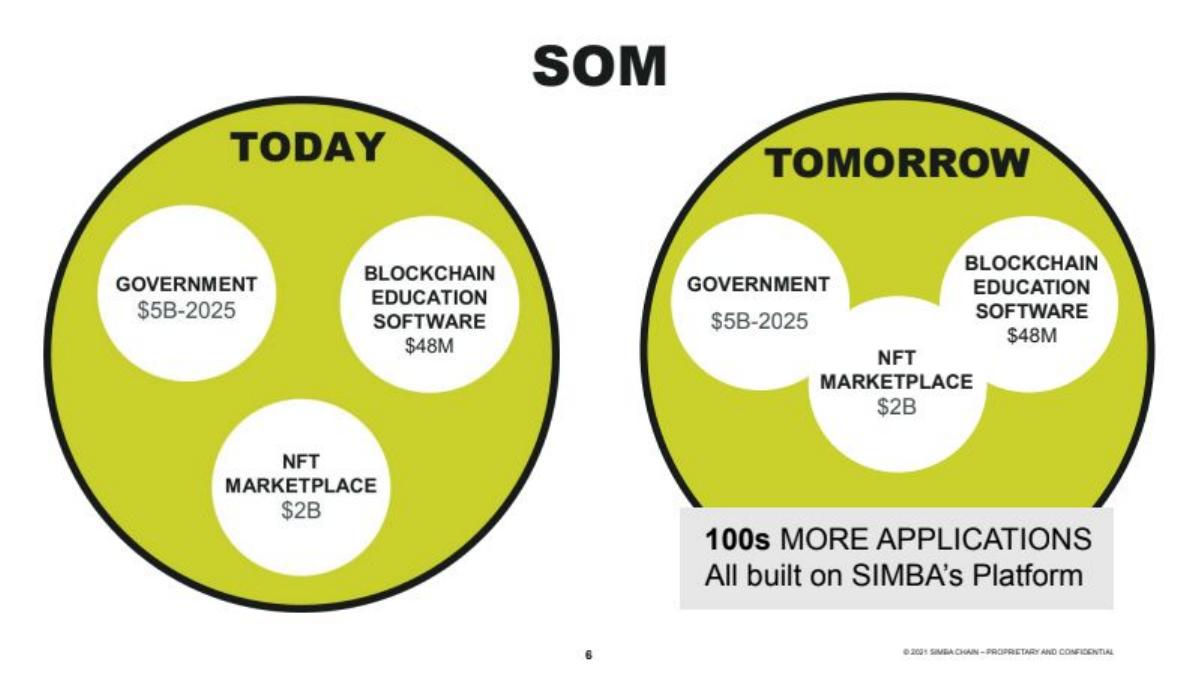
Slide 4 introduces the 'Enterprise API Development Platform' and segments the market into Commercial, Education, and Government. A key technical detail is tucked at the bottom: 'SIMBA supports 9 different blockchains and 5 data stores.' This multi-chain support is a critical selling point for enterprises wary of vendor lock-in. Slide 5 provides the mandatory TAM/SAM/SOM charts, claiming a $7 billion SOM. Interestingly, they compare the current state of blockchain to 'Internet '98' on the TAM circle, a common trope used to justify early-stage investment in infrastructure. Slide 6 breaks down the SOM further, projecting $5B for Government and $2B for NFT Marketplaces by 2025.
Slides 7-9: The Power of Social Proof
This is the strongest section of the deck. Slide 7 explicitly states the vision: 'what Stripe is to payments, Simba will be to blockchain.' This is a high-gravity comparison that VCs love because it implies a toll-booth business model. Slide 8 is a 'wall of logos' that is rare for a Series A startup. It includes the U.S. Air Force, U.S. Navy, Boeing, Caterpillar (ITAMCO), and several major universities. For an investor, this slide validates that the technology isn't just theoretical—it is being used by the most security-conscious organizations in the world. Slide 9 reinforces this with awards, specifically mentioning the '2020 First Air Force Olympics Gold Medal' and the Tibbett’s Award, which they note was previously won by Qualcomm and 23&Me.
Slides 10-11: Team and Governance
Slide 10 introduces the leadership. CEO Bryan Ritchie is described as a 'Serial Entrepreneur, involved in 380 startups and 17 exits.' This is an extraordinary claim that suggests a background in venture studios or university tech transfer (confirmed by the Notre Dame connection). The team includes veterans from Microsoft and Boeing, which balances the 'crypto' expertise with 'enterprise' experience. Slide 11 highlights the Board of Directors (BOD), featuring Michael Lempres (former Chief Legal and Risk Officer at Coinbase) and Steve O’Hara (Valley Capital). The presence of heavyweights from Coinbase and KKR-linked entities adds a layer of regulatory and financial credibility.
Slides 12-15: Product Depth and Competitive Moat
Slide 12 provides specific use cases for their scaling strategy, such as '75% of [car] titles currently require manual investigation' and 'Signed 21 Universities to recurring revenue contracts.' Slide 13 positions them as the 'Web3 Application Interface,' comparing their service to MuleSoft. Slide 14 is a classic competitive matrix. SIMBA gives itself checkmarks across 'Low-Code UI,' 'Deploy on Multiple Chains,' and 'Data Relationships Graph Searching,' while competitors like Alchemy and ConsenSys Codefi are shown with multiple 'X' marks. Slide 15 defines the moat: a two-year head start in building a no-code API interface that is 'extremely innovative/lightweight.'
Slides 16-19: Technical Validation
To prove the 'Simple' claim from Slide 3, Slide 16 shows a side-by-side comparison of deploying a contract. Alchemy takes 16 steps; SIMBA takes 4. Slide 17 follows up with a code comparison for invoking a smart contract method, showing SIMBA’s Javascript-like syntax against Alchemy’s more verbose cURL command. Slide 18 lists the 'Currently Supported Blockchains,' which includes Ethereum, Binance, Stellar, and several Hyperledger variants (Fabric, Burrow, Sawtooth). This variety is crucial for government and enterprise clients who often prefer private or permissioned ledgers over public ones.
Slide 20: The 'World Class' Investor List
The deck concludes its persuasive argument with Slide 20 , a dense list of individual investors. It includes the 'top brass from KKR,' the former CEO of Equinix, and executives from Apple, Amazon, and SpaceX. This is a 'who's who' of tech and finance, serving as a final signal to the Series A lead that the 'smart money' is already in the building.
What Works in This Deck
The Stripe/MuleSoft Analogies: By comparing themselves to well-known enterprise successes, they make a complex technology understandable to generalist investors. · Extreme Social Proof: The combination of military logos, university contracts, and a list of high-profile individual investors creates a 'fear of missing out' (FOMO) and de-risks the technical execution. · Developer Experience Focus: The side-by-side step comparison (16 steps vs. 4 steps) is a visceral way to demonstrate value-add to anyone who has ever managed a dev team. · Vertical Diversification: Showing traction in Government, Education, and Commercial sectors proves the platform is a horizontal utility rather than a niche tool.
What Is Missing
Financial Projections: The deck contains no slide showing historical revenue growth, burn rate, or future financial forecasts. While 'recurring revenue' is mentioned, the actual numbers are absent. · Unit Economics: There is no mention of Customer Acquisition Cost (CAC) or Lifetime Value (LTV), which are standard for a Series A SaaS pitch. · The 'Ask' Slide: The deck ends with a 'Thank You' (Slide 21) but does not explicitly state how much they are raising or how the funds will be allocated (though the catalogue confirms it was a $25M round). · Case Studies: While they show logos, they don't provide a deep dive into a single successful implementation (e.g., 'How the Navy saved X dollars using SIMBA').
What Other Founders Should Copy
The Competitive Comparison: Don't just list features; show the process. The '16 steps vs. 4 steps' slide is much more effective than a simple checkmark grid. · The 'Picks and Shovels' Positioning: If you are in a volatile or hyped industry, position yourself as the infrastructure that wins regardless of which specific player or token succeeds. · Leveraging Board Credibility: If you have high-profile investors or board members, give them their own slide. In enterprise sales and fundraising, who you know is a proxy for the 'trust' you haven't yet earned through decades of history. · Clear Verticalization: Even if your product is horizontal, show that you understand the specific pain points of different sectors (e.g., car titles for commercial, inventory for the Air Force).
Frequently asked questions
- What is SIMBA Chain's core business model?
- Based on the catalogue facts and Slide 4, SIMBA Chain operates as a B2B SaaS enterprise API development platform. They provide a low-code/no-code interface that allows businesses to integrate with various blockchains without needing specialized blockchain programmers. Their revenue comes from recurring contracts across government, education, and commercial sectors.
- How does SIMBA Chain differentiate itself from competitors like Alchemy?
- SIMBA Chain uses Slides 16 and 17 to show a technical comparison. They claim that while Alchemy requires a 16-step process involving manual coding and external tools like Hardhat and Metamask, SIMBA reduces this to 4 steps within their own UI. They also highlight 'Data Relationships Graph Searching' as a feature competitors lack on Slide 14.
- Which industries is SIMBA Chain targeting?
- The deck identifies four primary verticals on Slide 12: NFTs (sports franchises and ticketing), Government (supply chain for the Air Force and Navy), Supply Chain (food tracking for restaurant chains like Toks), and Education (recurring contracts with 21 universities).
- What is the 'moat' described in the deck?
- According to Slide 15, the moat consists of their no-code API interface for enterprise-level products, which they claim took two years for a 'world-class development team' to build. They also cite a 'head start' in the market and the portability of being chain-agnostic as key defensive advantages.
- Who are the key investors mentioned in the pitch?
- The deck lists an extensive group on Slide 20, including George Roberts and Henry Kravis (Founders of KKR), Dick Kramlich (Founder of NEA), and Chris Schaepe (Founder of Lightspeed). The catalogue facts note that Valley Capital Partners led the $25M Series A round.