Silver One Resources Inc. (TSX-V: SVE) utilizes a 43-slide corporate presentation from March 2020 to position itself as a prime beneficiary of a projected silver bull market. The deck focuses on three key pillars: the macro-economic environment for precious metals, the technical potential of the Candelaria Project in Nevada, and the deep industry experience of its leadership. By citing a Gold/Silver ratio of 88.77 as of February 2020, the company argues for a significant silver price correction. Operationally, the deck outlines a clear path from metallurgical testing to production for its hea…
Key takeaways
- The deck emphasizes a Gold/Silver ratio of 88.77 (Feb 2020), suggesting silver is undervalued relative to its all-time high ratio of 99.76 (Slide 11).
- Silver One successfully raised $5.2M CAD in an oversubscribed financing round in January 2020, with Eric Sprott taking a 12.9% stake (Slide 16).
- The Candelaria Project covers 5,422 hectares and includes historical heap leach pads and multiple pit extensions (Slide 21).
- A detailed project timeline for Candelaria shows a progression from heap leach drilling and met testing to production and new target exploration (Slide 26).
- Geochemical data for the Cherokee Mine Area shows high-grade samples, including one at 1162.9 gpt Ag and 22900 ppm Cu (Slide 31).
- Visual evidence of high-grade mineralization is provided via photos of silver fragments weighing up to 417 lbs, though a disclaimer notes these are not necessarily representative (Slide 36).
- The management team brings significant tenure, including CEO Greg Crowe with 30+ years and Director Barry Girling with 39+ years of experience (Slide 41).
- The company aims to convert historic resources to 43-101 compliant status within the 2020 calendar year (Slide 16).
Silver One Resources: A Deep Dive into the March 2020 Corporate Presentation
Silver One Resources Inc. operates in the high-stakes world of mineral exploration, specifically focusing on silver assets in Nevada and Arizona. This 43-slide deck, presented at the PDAC (Prospectors & Developers Association of Canada) convention, serves as a comprehensive overview of the company's value proposition during a period of significant macroeconomic volatility. The presentation is structured to first sell the investor on the silver market itself, then on the specific projects, and finally on the team capable of executing the plan.
Slide 1: Title and Branding
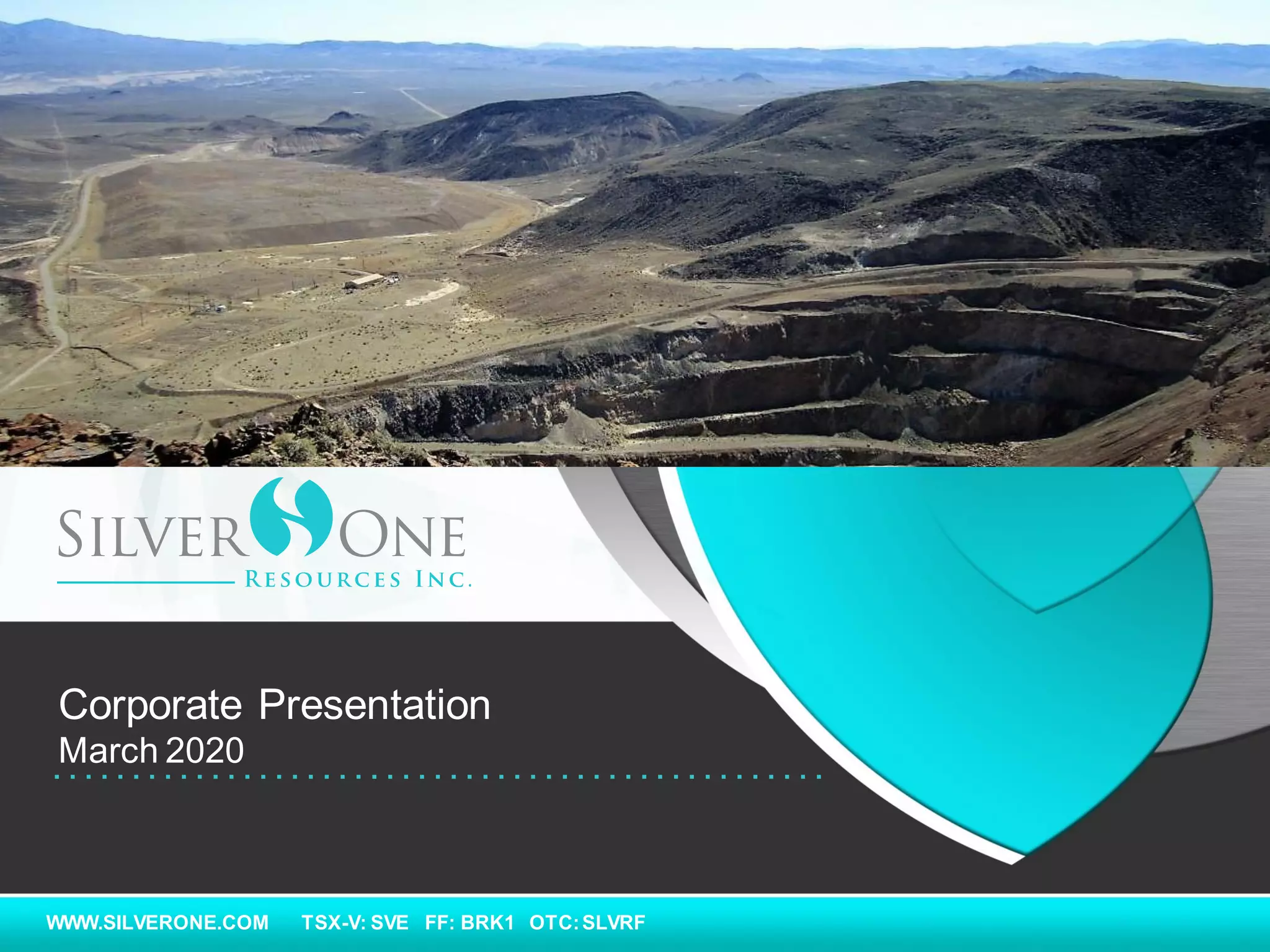
The cover slide establishes the company's identity with a high-resolution aerial photograph of a mining operation, likely the Candelaria site. It clearly lists the date as March 2020 and provides the trading symbols for the TSX Venture Exchange (SVE), the Frankfurt Exchange (BRK1), and the OTC market (SLVRF). This immediately signals to the investor that the company is publicly traded and has international reach.
Slides 6 and 11: The Macro Case for Silver
Mining decks often spend significant time on macroeconomics because the underlying commodity price is the greatest driver of the stock's performance. Slide 6, titled "Key Investor Driven Factors Affecting Silver Price," lists several tailwinds: the US$ Index, Dow Jones/S&P corrections, rising debt, inflation, and political risk. The slide concludes with a bold statement: "In a precious metals bull market, silver outperforms gold."
Slide 11 provides the data to support this. It tracks the Gold/Silver ratio from the year 1800 to 2020. The slide notes that as of February 2020, the ratio stood at 88.77. By comparing this to the all-time high of 99.76 in 1941 and the all-time low of 18.29 in 1968, the company implies that silver is historically undervalued and due for a massive 'return to average' correction.
Slide 16: The Investment Thesis and Recent Wins
This slide summarizes the "Why Invest?" argument. It highlights the potential of re-processing historic leach pads at Candelaria and the ongoing drilling to test high-grade targets. Crucially, it mentions a $5.2M CAD oversubscribed financing round completed in January 2020. The mention of Eric Sprott owning 12.9% is a strategic move to leverage the reputation of a legendary mining investor to build confidence in the retail and institutional audience.
Slide 21: Candelaria Project Overview
The Candelaria Project is the flagship asset. Slide 21 shows a technical map of the 5,422-hectare property. It identifies key areas including the Northern Belle Pit, Mount Diablo Pit, and various leach pads. The bottom of the slide features a process arrow: Drill -> Metallurgy -> PFS-FS -> Production. This simplifies a complex industrial process into a digestible roadmap for investors.
Slide 26: Candelaria Objectives and Timeline
This Gantt-style chart provides a visual timeline for the project's development. It shows overlapping activities for 2020 and beyond, including metallurgical testing, baseline studies, and permitting. The "Explore New Targets" bar (in orange) spans the entire duration, suggesting that while they move toward production on known areas, they are simultaneously hunting for the next big discovery on the same property.
Slide 31: Cherokee Mine Geochemistry
Moving to the Cherokee Mine area, Slide 31 presents a highly technical geochemical and geological map. It is peppered with data points showing grams per tonne (gpt) of Silver (Ag) and Gold (Au), as well as parts per million (ppm) of Copper (Cu). Notable figures include 1162.9 gpt Ag and 22900 ppm Cu. This slide is intended for the technically-minded investor who wants to see proof of high-grade mineralization in the ground.
Slide 36: Visual Proof of Mineralization
Mining is an abstract business until you see the ore. Slide 36 displays three massive silver fragments weighing 80 lbs, 417 lbs, and 116 lbs. While the disclaimer at the bottom notes these are "selected samples" and not necessarily representative, the visual impact of a 417 lb silver-bearing rock is a powerful marketing tool to illustrate the potential scale of the system they are exploring.
Slide 41: Management and Directors
The final slide in this selection covers the human capital. The team is led by Greg Crowe (President and CEO) and Barry Girling (Director), who have 30+ and 39+ years of experience, respectively. The slide emphasizes their previous roles at successful companies like Entrée Gold and Rio Tinto. In junior mining, the 'jockey' is often as important as the 'horse,' and this slide aims to prove that the leadership has the requisite experience to navigate the permitting and development cycles.
What Works in This Deck
Strong Institutional Validation: The explicit mention of Eric Sprott's 12.9% ownership (Slide 16) is the strongest possible signal for a junior miner. It suggests that a professional with deep pockets and a track record has vetted the technical data and found it compelling.
Clear Macro-to-Micro Logic: The deck follows a logical flow. It starts with why silver is a good investment, moves to why Nevada is a good jurisdiction, then focuses on the specific assets, and ends with the team. This helps build a cohesive narrative rather than just presenting a list of facts.
Technical Transparency: The inclusion of detailed geochemical maps (Slide 31) and project timelines (Slide 26) shows a level of transparency that sophisticated investors appreciate. It demonstrates that the company has a plan beyond just "drilling and hoping."
What Is Missing or Could Be Improved
Lack of Unit Economics: While the deck mentions moving toward a Feasibility Study, it lacks preliminary economic assessments (PEA) data such as projected All-In Sustaining Costs (AISC) or Net Present Value (NPV). While this is common for early-stage exploration, even historical cost estimates for the heap leach reprocessing would have added weight to the production argument.
Environmental and Social Governance (ESG): In the modern mining landscape, ESG is a major concern for institutional investors. The deck mentions "Baseline Studies" on the timeline (Slide 26), but there is no dedicated slide discussing water rights, community relations, or environmental mitigation strategies in Nevada.
Competitor Comparison: The deck focuses entirely on Silver One. A slide comparing their resource grade or market capitalization to other silver explorers in the region (like Coeur Mining or First Majestic) would help investors understand the relative value proposition.
Founder's Playbook: What to Copy
Use the 'Big Name' Anchor: If you have a high-profile investor or partner, put their name and ownership percentage front and center. It reduces the perceived risk for everyone else.
Visual Roadmaps: The timeline on Slide 26 is excellent. It shows that management understands the dependencies between drilling, permitting, and construction. Every startup deck, regardless of industry, should have a slide that shows the sequence of milestones required to reach the next value inflection point.
Macro Context: Don't assume your investors are already sold on your industry. By providing the Gold/Silver ratio data (Slide 11), Silver One gives the investor a reason to care about the sector before they even look at the company's specific assets.
The Disclaimer Strategy: Slide 36 is a masterclass in using 'eye candy' (the large silver fragments) while staying compliant with securities laws. If you have a 'hero' product or a 'best-case' case study, use it, but always include the necessary context to ensure you aren't accused of cherry-picking data later.
Frequently asked questions
- What is the primary investment thesis presented by Silver One?
- The thesis is two-fold: a macroeconomic bet on silver prices and a technical bet on Nevada-based assets. Silver One argues that the Gold/Silver ratio is at historical extremes (88.77), indicating silver will outperform gold in a bull market. Simultaneously, they are applying modern metallurgical testing to historic leach pads at Candelaria to unlock value that was previously bypassed.
- Who are the key institutional backers mentioned in the deck?
- The most prominent backer mentioned is Eric Sprott, a well-known precious metals investor. According to Slide 16, he holds a 12.9% stake in the company following an oversubscribed $5.2M CAD financing round completed in January 2020. This serves as a 'seal of approval' for other potential investors evaluating the junior mining space.
- What are the specific operational goals for the Candelaria Project?
- As outlined on Slide 26, the company has a sequential plan: complete heap leach drilling and metallurgical testing, move into a Feasibility Study (FS) for the heaps, obtain reprocessing permits, and eventually move into construction and production. Parallel to this, they are conducting baseline studies and exploring new targets to expand the resource base.
- How does the company address the risk of non-representative samples?
- On Slide 36, which displays massive silver fragments (80 lb, 417 lb, and 116 lb), the company includes a mandatory regulatory disclaimer. It states that the photo is of 'selected samples that are not necessarily representative of the mineralization hosted on the property.' This is a standard but crucial legal protection in mining decks to prevent misleading investors.
- What is the significance of the 43-101 compliance mentioned?
- NI 43-101 is a mineral resource disclosure standard used in Canada. Slide 16 notes the plan to convert 'historic resources' to 43-101 compliant resources in 2020. This is a critical milestone for junior miners, as it moves the project from 'speculative' historical data to a verified, modern standard that institutional investors and banks require for valuation.